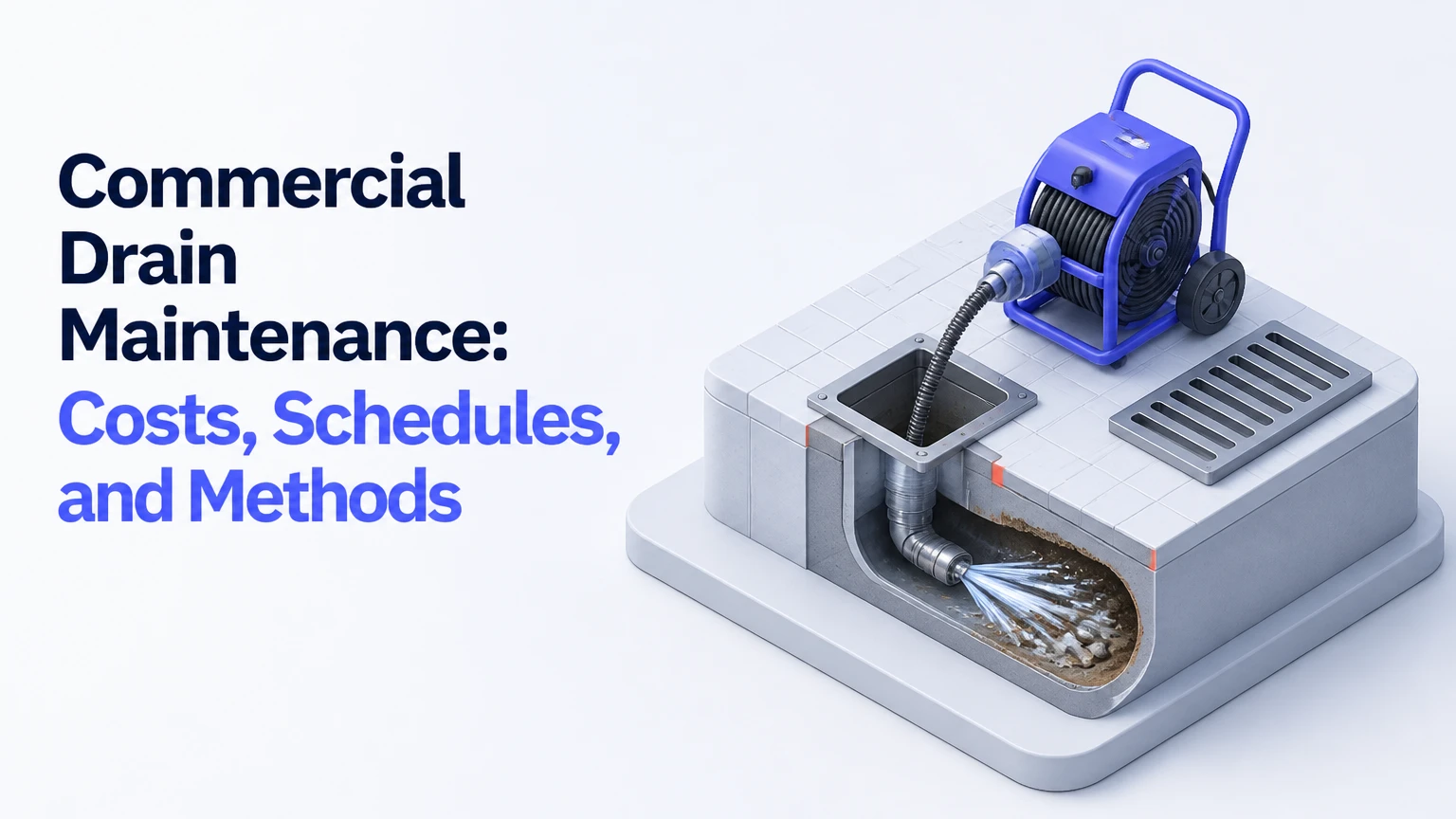
Commercial drain maintenance is a planned program of inspection, cleaning, prevention, and repair for wastewater fixtures, branch lines, stacks, interceptors, and building sewers. The program reduces blockages and downtime by matching CCTV inspection, mechanical cleaning, hydro-jetting, grease control, and documentation to the facility’s waste profile and pipe condition.
Key Facts at a Glance
Commercial drain maintenance covers internal wastewater systems, not automatically the public sewer outside the property boundary.
CCTV inspection identifies pipe condition and blockage location; cleaning removes deposits but does not repair structural defects.
Hydro-jetting removes wall deposits more completely than snaking, but an operator must verify pipe condition and control pressure.
A grease interceptor commonly requires pumping around the 25% accumulated FOG-and-solids level, subject to local rules and manufacturer instructions.
Typical commercial service costs range from $150-$500 for CCTV inspection, $150-$400 for straightforward augering, and $600-$1,500 or more for mainline jetting.
The best schedule is trigger-based: usage, FOG load, pipe history, occupancy, age, and inspection findings matter more than a universal calendar.
What Is Commercial Drain Maintenance?
Commercial drain maintenance is the recurring management of a business’s wastewater pathways, from floor drains and fixtures to the building sewer connection. Unlike a single emergency drain clearing, maintenance combines condition assessment, preventive cleaning, component servicing, operational controls, and records that show what was inspected and completed.
A restaurant may need grease interceptor pumping, kitchen branch-line cleaning, and quarterly mainline assessment. An office tower may prioritize sanitary stacks, tenant fixture misuse, and basement ejector systems. A manufacturing plant may need process-sediment removal, pH controls, sampling, and discharge coordination.
The system has several distinct assets:
| Asset | Typical issue | Appropriate control | Maintenance record |
|---|---|---|---|
| Floor drain and trap | Dry trap, sediment, odor | Trap priming and debris removal | Inspection date and trap condition |
| Kitchen branch line | FOG, food solids, scale | Straining, cleaning, jetting | Line cleaned and nozzle used |
| Vertical stack | Paper, wipes, scale | Camera inspection and augering | Blockage height and footage |
| Building sewer | Roots, bellies, collapse | CCTV, jetting, lining or repair | Video, defect code, recommendation |
| Grease interceptor | FOG and solids accumulation | Pumping and manifest control | Pump date, volume, disposal site |
Commercial maintenance does not include every plumbing asset. Domestic water piping, HVAC condensate, storm drains, sanitary drains, grease devices, and process drains may have different owners, codes, and service requirements.
Why Does a Commercial Drain Need a Maintenance Program?
Commercial wastewater systems fail faster when high flow combines with FOG, solids, scale, heat, chemicals, or non-flushable materials. A planned program catches restricted flow and pipe defects before a backup contaminates occupied space, closes a kitchen, damages inventory, or interrupts production.
The financial logic is straightforward. A scheduled cleaning normally uses predictable labor and access windows, while an emergency may add after-hours labor, water extraction, sanitation, tenant disruption, disposal, and lost revenue. Preventive maintenance cannot prevent a collapsed or undersized line, but it can distinguish a deposit problem from a structural problem before the failure becomes urgent.
The U.S. Environmental Protection Agency’s Water Research Foundation materials on fats, oils, and grease management emphasize source control, maintenance of grease-control devices, and enforcement because FOG can accumulate in private laterals and public sewer systems. Property managers should therefore treat the interceptor, kitchen lines, and building sewer as one connected risk chain.
A useful rule is to schedule by consequence as well as frequency. A hotel with a history of basement backups deserves a tighter inspection interval than a low-occupancy office with clean annual camera footage, even if both have similar pipe sizes.
How Does Commercial Drain Maintenance Work?
A professional maintenance visit follows a documented sequence: review the system, isolate water use, inspect accessible cleanouts, diagnose with a camera when appropriate, clean with the least aggressive suitable method, verify flow, and record the result. The pipe material, defect severity, deposit type, access, and downstream discharge route determine the equipment settings.
Step 1: Review the System and Make It Safe
The contractor identifies cleanouts, isolation points, grease devices, ejector pumps, confined spaces, chemical hazards, and the building’s operating constraints. Staff stop dishwashing, laundry, restroom use, or process discharge in the affected area while technicians work.
Wastewater exposure requires appropriate personal protective equipment, hygiene controls, and contamination procedures. If entry into a manhole, vault, tank, or other permit-required confined space is proposed, OSHA requirements, atmospheric testing, rescue planning, and trained personnel apply. Technicians should not enter a confined space merely because a camera or hose cannot reach.
Step 2: Inspect Before Choosing a Cleaning Method
CCTV inspection shows whether the restriction is grease, scale, roots, foreign material, a belly, offset joints, fractures, or collapse. A camera report should identify the pipe diameter, access point, distance to each defect, flow direction, and recommended next action.
A camera is especially valuable before high-pressure jetting in old, repeatedly failing, or structurally uncertain lines. Pre-cleaning footage may be poor when grease or standing water blocks the lens, so technicians may perform a controlled initial opening before obtaining a useful diagnostic view.
Step 3: Remove the Restriction
Mechanical augering uses a rotating cable and cutting head to open a passage through paper, wipes, soft obstructions, roots, or localized solids. It is often the safer first response when the pipe is fragile or the objective is rapid flow restoration rather than full wall cleaning.
Hydro-jetting uses a pump, hose, and nozzle to direct water against the pipe wall. The technician controls pressure, flow, nozzle angle, hose speed, and recovery because a high pressure number alone does not describe cleaning performance.
Step 4: Flush and Manage Removed Material
Dislodged grease, scale, and solids must move to a recoverable downstream point or be removed by vacuum equipment. A technician who pushes a large grease mass toward a smaller downstream line may relocate the blockage rather than solve it.
Wastewater and solids handling must follow local sewer, environmental, and disposal requirements. Industrial process residues may require characterization before disposal, especially when metals, solvents, acids, caustics, or biological hazards are present.
Step 5: Verify the Result and Document the Baseline
The contractor verifies flow with controlled water use and, when appropriate, performs a post-cleaning camera inspection. The correct acceptance criterion is unobstructed flow and an adequately clean, structurally serviceable line, not a guaranteed return to 100% of its original internal diameter.
A useful report includes before-and-after images, footage measurements, pipe condition, equipment used, flow observations, defects remaining, and recommended interval. That record lets the next visit compare deterioration rather than start from zero.
Which Commercial Drain Cleaning Method Is Best?
Hydro-jetting is usually the best preventive method for accessible lines with grease, sludge, or mineral deposits and a confirmed sound pipe. Mechanical augering is better for a fast opening, a localized hard obstruction, or a line whose condition makes aggressive jetting unsuitable. Biological treatment supports source control but cannot remove a severe existing blockage.
| Method | Best target | Typical operating detail | Main limitation |
|---|---|---|---|
| Mechanical auger | Wipes, paper, localized solids, roots | Cable with cutting head, 45-120 minutes per run | Leaves wall deposits behind |
| Hydro-jetting | FOG, sludge, scale, biofilm | Typical 1,500-4,000+ PSI and 12-25 GPM, operator-selected | Can worsen defects in damaged lines |
| Enzyme or biological dosing | Residual organic film and odor control | Metered product at trap or drain, repeated application | Cannot cut roots or clear collapse |
| Vacuum extraction | Interceptor solids and recovered debris | Tanker or portable vacuum equipment | Requires disposal planning and access |
| CCTV inspection | Defect and blockage diagnosis | Push camera or crawler, footage-based report | Does not clean or repair the pipe |
When Should Technicians Use Mechanical Augering?
Mechanical augering suits a discrete obstruction when the immediate goal is to restore a passage. A cutting head can break through wipes, paper towels, food solids, or root tendrils without applying the sustained wall force associated with jetting.
Augering is not a complete FOG maintenance strategy. The cable may bore a small channel through grease while leaving a thick annulus on the pipe wall, which explains why a line can back up again days or weeks later. Root cutting also leaves the cause of intrusion, such as a joint defect, in place.
When Is Hydro-Jetting Appropriate?
Hydro-jetting is appropriate after technicians establish that the pipe can tolerate the operation and that the downstream system can receive or recover the removed material. A rotating nozzle can clean a larger proportion of the pipe circumference than a cable, making jetting useful for kitchen lines and recurrent grease restrictions.
Pressure is not a universal material rating. Pipe age, wall condition, joints, lining, nozzle orifice, hose diameter, flow, and distance from the access point all affect risk. The often-repeated statement that 4,000 PSI is safe for every cast-iron or PVC line is unreliable; a sound modern pipe and a cracked legacy line require different settings.
Do Enzymes Prevent Commercial Drain Blockages?
Enzymes and non-pathogenic biological products can help reduce fresh organic residue under consistent dosing and adequate contact time. They are preventive aids, not substitutes for interceptor pumping, source control, CCTV diagnosis, or physical cleaning.
Product compatibility matters. A facility should confirm that the treatment does not conflict with local wastewater rules, treatment-plant requirements, disinfectants, hot process waste, or chemical cleaners. Products cannot digest mineral scale, plastic, roots, collapsed pipe, or a dense established grease plug.
How Often Should a Commercial Drain Be Cleaned?
Commercial drain cleaning frequency should follow measured buildup and failure history, with typical intervals ranging from monthly process-line service to annual inspection in low-risk office systems. A contractor should shorten the interval when inspections show rapid accumulation, when a backup has occurred, or when the consequence of failure is high.
| Facility profile | Typical starting schedule | Primary work | Trigger to increase frequency |
|---|---|---|---|
| Restaurant with heavy frying | Monthly interceptor inspection, quarterly line cleaning | FOG control and hydro-jetting | Grease at 20-25% capacity or recurring slow flow |
| Hotel or school | Semiannual stack review, annual mainline camera | Paper control and selective cleaning | Multiple fixtures slow at once |
| Office building | Annual camera or condition review | Targeted branch and mainline service | Two restrictions within 12 months |
| Food processor | Monthly or more frequent process-line review | Sediment, solids, and discharge controls | Flow, pH, or solids trend changes |
| Warehouse | Annual review, event-based cleaning | Floor drains and sanitary branches | Spills, seasonal occupancy, or tenant change |
The 25% grease rule needs careful wording. Many jurisdictions and industry programs use a 25% accumulated FOG-and-solids threshold for grease interceptor pumping, but the enforceable requirement comes from the local sewer authority, plumbing code, permit, or manufacturer. The threshold is not a universal national law.
A better program measures the interval between pumping and the next threshold observation. If a restaurant reaches the limit in six weeks, quarterly pumping is inadequate regardless of what a generic schedule says.
What Does Commercial Drain Maintenance Cost?
Typical commercial drain maintenance costs about $150-$500 for a CCTV inspection, $150-$400 for a straightforward auger run, $600-$1,500 or more for mainline hydro-jetting, and $950-$3,000 or more for an after-hours emergency. Local labor rates, access, line size, disposal, water supply, traffic control, and reporting can move the final price substantially.
| Service | Typical cost | Typical duration | Common price drivers |
|---|---|---|---|
| CCTV inspection | $150-$500 per line | 1-2 hours | Access, footage, written report |
| Mechanical augering | $150-$400 per run | 45 minutes-2 hours | Cable length, cutting head, blockage |
| Mainline hydro-jetting | $600-$1,500+ | 2-5 hours | Diameter, grease load, recovery |
| Interceptor pumping | $300-$1,500+ | 1-3 hours | Tank volume, access, disposal distance |
| Emergency after-hours clearing | $950-$3,000+ | 2-8 hours | Response time, sanitation, equipment |
A low quote may omit vacuum recovery, disposal, camera documentation, access covers, traffic control, or a post-service test. A defensible proposal states whether pricing is per fixture, per line, per hour, per gallon, or per visit and identifies overtime conditions.
Repair costs are separate. Spot excavation, pipe replacement, cured-in-place lining, bypass pumping, and restoration can exceed cleaning costs by several thousand dollars, particularly beneath kitchens, loading docks, finished floors, or public rights of way.
What Should a Commercial Maintenance Contract Include?
A commercial drain maintenance contract should define the assets, service intervals, response times, safety duties, reporting standard, exclusions, and escalation path. The contract becomes useful when a different technician can read the last report and repeat the program without guessing.
Specify these items:
- Asset register: Building drains, grease interceptors, cleanouts, ejector pits, stacks, and building sewer limits.
- Service frequency: Calendar intervals plus trigger-based visits after defined buildup or flow changes.
- Diagnostic standard: When CCTV is required, expected footage, defect coding, and video delivery format.
- Cleaning scope: Pipe diameters, access points, method, water source, recovery, and disposal responsibility.
- Safety plan: PPE, wastewater exposure controls, confined-space boundaries, and tenant isolation.
- Acceptance test: Controlled flow, fixture test, pump operation, odor check, and post-cleaning footage where specified.
- Reporting: Before-and-after photographs, measurements, remaining defects, materials removed, and next-service recommendation.
- Emergency terms: Arrival target, after-hours rates, authority to spend, and temporary sanitation measures.
The contract should not promise “permanent” blockage prevention. Cleaning cannot correct undersized pipe, negative slope, broken joints, infiltration, poor fixture design, or recurring foreign-object disposal.
How Can Facilities Reduce FOG and Foreign Material?
Facilities reduce drain failures by stopping waste at the source, maintaining grease-control devices, and training staff on what belongs in each drain. Screens, strainers, dry wiping, correct interceptor sizing, and documented pumping usually outperform repeated reliance on chemical additives.
Restaurant controls include:
- Scrape pans and plates into solid-waste containers before washing.
- Install and clean sink basket strainers.
- Keep mop water, fryer oil, and food solids out of floor drains.
- Inspect interceptor inlet and outlet conditions during each service.
- Record pumping dates, approximate volume, hauler, and disposal destination.
- Coordinate hot-water and detergent practices with the grease-control plan.
The National Association of Sewer Service Companies, or NASSCO, uses condition assessment concepts such as PACP coding to standardize sewer defect descriptions. A facility that records “roots at 84 feet, joint offset at 91 feet” gains more operational value than one that records “line cleaned.”
Industrial sites need additional controls. Process chemistry, temperature, suspended solids, and pH can affect pipe materials and biological treatment, so the maintenance plan should connect drain work with the facility’s environmental manager and discharge permit.
What Causes Commercial Drain Odors?
Commercial drain odors most often come from dry traps, failed trap primers, grease deposits, stagnant wastewater, or sewer-gas pathway defects. Water poured into a dry trap can restore the seal temporarily, but recurring odor requires inspection of the primer, trap, vent, cleanout, and surrounding floor penetration.
Hydrogen sulfide has a rotten-egg odor at low concentrations, but odor detection is not a reliable safety test because smell can diminish as exposure increases. Workers should not enter pits, tanks, or manholes to investigate odor without appropriate confined-space controls and atmospheric monitoring.
For floor drains, verify that the trap retains water after nearby fixtures discharge. For kitchen drains, inspect grease film and cleanout access. For sewer gas entering occupied areas, check missing cleanout plugs, cracked traps, vent defects, ejector-pit covers, and negative-pressure conditions.
Why Do Commercial Drains Keep Backing Up?
Repeated commercial backups usually indicate an unresolved deposit, structural defect, capacity issue, or operational source rather than bad luck. Multiple slow fixtures point toward a shared branch, stack, or building sewer; one slow fixture more often indicates a local trap or branch restriction.
Use the symptom pattern to triage:
| Symptom | Likely location | First diagnostic action | Escalation |
|---|---|---|---|
| One sink drains slowly | Trap or branch | Remove trap debris and inspect branch | Camera if recurrence continues |
| Several fixtures slow together | Shared branch or stack | Check cleanouts and camera upstream/downstream | Jet or auger after diagnosis |
| Backup during rain | Building sewer, roots, infiltration | CCTV during or after event | Root management or structural repair |
| Grease returns quickly | Kitchen branch or interceptor | Measure FOG and inspect line walls | Source controls plus shorter interval |
| Odor without slow flow | Trap, vent, cleanout, ejector pit | Test trap seal and gas pathways | Plumbing and safety inspection |
A jetter should not be used as the automatic answer to every recurring backup. If the camera shows a belly that holds solids, an offset joint, collapse, severe corrosion, or an undersized connection, repeated cleaning treats the symptom while the defect continues.
When Is Repair Better Than Cleaning?
Repair is better than repeated cleaning when CCTV confirms collapse, severe displacement, a persistent belly, open joints, major corrosion, or a defect that restores blockage soon after service. Cleaning remains appropriate when the pipe is structurally sound and deposits are the primary restriction.
| Finding | Cleaning response | Repair response | Decision signal |
|---|---|---|---|
| Soft grease coating | Hydro-jet and source control | None initially | Buildup rate after cleaning |
| Local root intrusion | Root cutting | Spot repair or lining after assessment | Recurrence and joint condition |
| Cracked pipe | Limited, low-risk opening | Spot repair, lining, or replacement | Leakage, soil loss, collapse risk |
| Severe offset joint | Temporary clearing only | Reconnect or replace section | Camera shows persistent obstruction |
| Belly with sediment | Periodic cleaning | Regrade or replace pipe | Same low point repeatedly fills |
| Full collapse | No durable cleaning option | Excavation or trenchless replacement | No passable internal channel |
Epoxy or cured-in-place lining may address certain defects, but lining requires suitable geometry, preparation, service bypass, and a qualified assessment. A liner does not correct every slope problem, eliminate all capacity constraints, or replace a collapsed section without additional work.
Common Commercial Drain Maintenance Mistakes
The most expensive mistakes are usually specification failures rather than equipment failures. Property owners often authorize a method before anyone confirms the blockage, pipe condition, recovery route, or acceptance test.
Using Caustic or Acid Drain Chemicals
Strong acids and caustics can injure workers, react with other cleaners, damage certain materials, and create hazardous residues. Chemical products also leave grease, wipes, roots, and structural defects in place. Isolate and diagnose the line instead.
Jetting an Unknown or Damaged Line
A 4,000-PSI setting is not a universal safe limit. Camera evidence, nozzle selection, flow, hose movement, and pipe condition determine the operating envelope. Jetting a fragile line can turn a restriction into a leak or collapse.
Treating the Grease Interceptor as the Whole System
An interceptor captures a portion of FOG under designed flow conditions, but it does not guarantee clean downstream piping. Kitchen branches still need straining, scraping, inspection, and periodic cleaning.
Accepting “Open” as “Clean”
An auger may restore a narrow channel while deposits remain on most of the circumference. Ask whether the service goal is emergency flow restoration, preventive wall cleaning, inspection, or structural diagnosis.
Skipping Records
Without footage, measurements, pumping logs, and buildup rates, the next contractor cannot optimize timing. Documentation also supports landlord coordination, insurer questions, environmental compliance, and capital planning.
Expert Rules for Better Scheduling
Track accumulation rate, not only calendar time. The interval between two measured FOG or sediment observations predicts the next service better than a generic quarterly label.
Separate cleaning from condition assessment. A clean pipe can still have a belly, offset, crack, or infiltration path. CCTV and cleaning answer different questions.
Use the least aggressive method that meets the objective. Opening a compromised line may require careful augering, while a sound grease-coated line benefits from controlled jetting. More pressure is not automatically better.
Protect the downstream restriction. Before dislodging a large mass, confirm where the material will go and whether recovery is possible. Moving a blockage to a smaller connection creates a second emergency.
FAQ
Is commercial drain maintenance tax-deductible?
Routine cleaning, inspection, interceptor pumping, and minor repairs are commonly treated as operating expenses, but tax treatment depends on jurisdiction, accounting policy, lease terms, and whether work improves the property. A facility should retain invoices and service reports, then ask its accountant how maintenance differs from a capital improvement.
How long does a commercial drain cleaning visit take?
A straightforward auger service often takes 45 minutes to 2 hours, CCTV inspection commonly takes 1-2 hours, and mainline hydro-jetting usually takes 2-5 hours. Access covers, multiple lines, heavy deposits, recovery, tenant coordination, and disposal can extend the visit substantially.
Can a commercial drain maintenance company work while the building remains open?
Often, yes, if the affected fixtures are isolated and the work area is separated from occupants. Restaurants, schools, healthcare facilities, and production plants may need a shutdown window because wastewater discharge, odors, noise, contamination controls, or equipment access make simultaneous operation unsafe or impractical.
How do I choose a commercial drain contractor?
Choose a contractor that can provide CCTV footage, written measurements, method-specific safety controls, disposal documentation, insurance, and clear emergency rates. Ask for examples involving the same pipe material and facility type, then compare the proposed acceptance test rather than comparing only the hourly price.
Should storm drains be included in the same maintenance plan?
Storm drains should be tracked in the same facility asset register but assessed separately from sanitary drains. Catch basins, roof drains, trench drains, culverts, and detention systems carry different debris, environmental, and discharge risks. Seasonal inspection before major rainfall is a practical starting point.
What should happen after a commercial drain backup?
Stop water use in the affected area, restrict access to contaminated surfaces, notify the responsible manager, and call a qualified contractor. Do not use chemical drain opener or open a contaminated cleanout without controls. After clearing, identify the cause, document damage, sanitize as required, and revise the maintenance interval.
The Bottom Line
Commercial drain maintenance is a risk-managed program, not a single cleaning product or emergency service. Start with an asset list and baseline CCTV where access or history justifies it, control FOG and foreign material at the source, use augering for targeted openings, use hydro-jetting for suitable deposit-covered lines, and reserve biological products for limited preventive support.
Set the schedule from measured buildup, facility consequence, pipe condition, and prior failures. Require reports that identify footage, defects, method, flow verification, and remaining risks. With that structure, commercial drain maintenance reduces avoidable downtime while revealing when cleaning has reached its limit and repair is the more responsible investment.