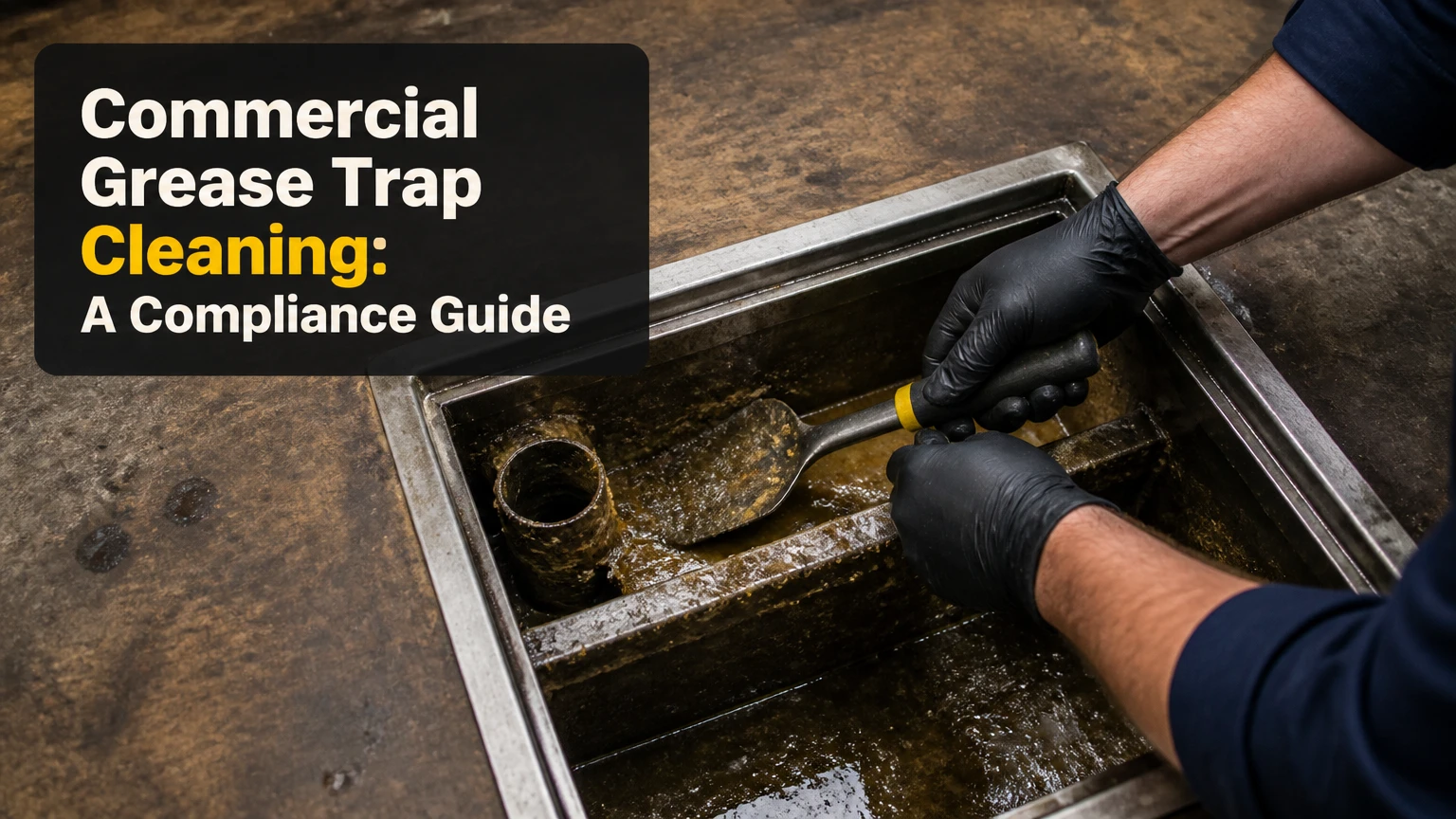
Commercial grease trap cleaning removes accumulated fats, oils, grease, food solids, and wastewater from a commercial grease trap or interceptor. Professional service prevents restricted flow, sewer blockages, odors, equipment damage, and local wastewater violations by measuring buildup, pumping the entire unit, inspecting components, and documenting legal disposal.
Key Facts at a Glance
- The 25% rule is a widely used maintenance trigger, but the controlling requirement is the local sewer authority’s ordinance or permit.
- A complete pumping removes grease, solids, and wastewater, rather than skimming only the floating grease layer.
- Small indoor traps may require service every 1-4 weeks, while outdoor interceptors commonly require service every 30-90 days.
- Typical commercial cleaning costs range from $150-$300 for a small indoor unit and $400-$900 for a large outdoor interceptor.
- Enzyme products, chemical digesters, and boiling water can move grease downstream without removing the pollutant load.
- A valid service record should identify the date, equipment, volume removed, hauler, and disposal destination.
What Does Commercial Grease Trap Cleaning Include?
Commercial grease trap cleaning is the controlled removal and disposal of FOGS and settled solids from a food-service wastewater interceptor. The service normally includes access-lid opening, layer measurement, full pump-out, wall and baffle cleaning, component inspection, refill testing, and a waste manifest.
A grease trap is not the same thing as a grease-coated drain line. Pumping the trap removes material inside the interceptor, but it may not clear a hardened blockage in the pipe between a sink and the trap. Drain-line cleaning, hydro-jetting, and sewer backup response are separate services that may be needed after the interceptor is emptied.
The U.S. Environmental Protection Agency describes fats, oils, and grease as materials that can accumulate in sewer systems and cause sanitary sewer overflows. That distinction matters operationally: a trap is designed to intercept grease before it reaches public infrastructure, not to make grease disappear.
What the service is not
Commercial grease trap cleaning is not routine sink washing, surface degreasing, or pouring hot water through a drain. It is also not the same as replacing a damaged interceptor, repairing a failed baffle, or correcting an undersized design.
A professional technician should state whether the quoted service covers only pumping or also scraping, pressure washing, inlet-line jetting, outlet inspection, deodorizing, and disposal documentation. Those inclusions explain many price differences between apparently similar estimates.
How Does a Grease Interceptor Work?
A grease interceptor separates wastewater by slowing flow long enough for lighter FOGS to float and heavier food particles to settle. Baffles reduce turbulence, the grease layer accumulates at the top, solids form sludge at the bottom, and the outlet draws from the relatively clearer middle zone.
The process depends on time, temperature, flow rate, and tank geometry. A sudden surge from a dishwasher can disturb separation, while detergents can disperse grease into smaller droplets that travel farther before coalescing. An outlet baffle or tee helps prevent surface grease from leaving with the discharge.
The separation sequence
- Wastewater enters from sinks, floor drains, dishwashing equipment, or food-preparation areas.
- The inlet baffle reduces velocity and directs flow into the separation chamber.
- Cooling wastewater allows buoyant grease to rise into a scum layer.
- Dense food particles and grit settle into bottom sludge.
- The outlet draws water from between the accumulated layers.
- Continued loading reduces the effective separation volume and increases escape risk.
The 25% measurement usually combines the floating grease layer and settled solids layer. When those layers occupy roughly one-quarter of the operating depth, the interceptor has less usable separation space and should be pumped, unless a local rule requires a stricter threshold.
Which Grease Trap Types Need Cleaning?
Three commercial FOG control systems commonly require scheduled maintenance: passive hydro-mechanical traps, automatic grease removal devices, and gravity grease interceptors. Their capacities, access requirements, and maintenance tasks differ enough that a frequency suitable for one system can be unsafe or ineffective for another.
| System type | Typical capacity or rate | Typical location | Main cleaning task |
|---|---|---|---|
| Passive hydro-mechanical trap | 20-100 gallons per minute | Under or beside a sink | Full pump-out every 1-4 weeks |
| Automatic grease removal device | 25-50 gallons per minute | Indoor equipment area | Daily solids or grease-bin emptying plus periodic tank cleaning |
| Gravity interceptor | 500-5,000+ gallons | Underground exterior | Full pump-out commonly every 30-90 days |
| Large custom interceptor | 1,500-10,000+ gallons | Exterior service yard | Pumping based on measured accumulation and permit conditions |
Passive hydro-mechanical traps
Small passive traps use internal baffles, flow control, and gravity. They suit lower-volume cafes, bakeries, and small preparation kitchens, but their limited capacity makes them sensitive to frying volume, food solids, and missed service visits.
Indoor units are accessible, but opening them can release strong odors and expose staff to contaminated wastewater. A technician should confirm that the lid gasket, baffles, flow control, and inlet and outlet connections remain intact after cleaning.
Automatic grease removal devices
An automatic grease removal device, or AGRD, mechanically skims floating grease into a container. The device can reduce the amount of free grease retained in the tank, but it does not eliminate the need to remove settled solids or maintain the motor, scraper, wiper, heater, and controls.
Kitchen staff typically empty the collection container on a daily schedule. Water in the grease bin, poor skimming, a missing flow restrictor, or a misaligned wiper can indicate a mechanical or installation problem rather than excessive grease production alone.
Gravity grease interceptors
Outdoor gravity interceptors use larger volume and longer retention time. They handle higher wastewater loads than many under-sink units, but they need accessible lids, safe working clearance, and a route suitable for a vacuum truck.
A large tank is not automatically a low-maintenance tank. Heavy frying, multiple kitchen branches, high solids loading, or an obstructed outlet can shorten the interval substantially.
When Should a Commercial Grease Trap Be Cleaned?
A commercial grease trap should be cleaned before grease and sludge reach the governing limit, commonly the 25% rule, and before slow drainage, odors, or backups develop. Typical planning intervals are 1-4 weeks for small indoor traps and 30-90 days for outdoor gravity interceptors, but measured accumulation and local regulations should set the final schedule.
The 25% rule is common in municipal FOG programs, not a universal law. Cities and wastewater utilities may specify monthly service, quarterly service, a lower accumulation limit, a maintenance log, or a different method for measuring depth. The local sewer-use ordinance, food-service permit, and interceptor manufacturer’s instructions take priority.
| Kitchen profile | Typical system | Starting interval | Adjustment trigger |
|---|---|---|---|
| Coffee shop with light food preparation | 20-50 gallon indoor trap | Every 3-4 weeks | Frying, solids, or odor increases frequency |
| Bakery with moderate wash-down | 50-100 gallon indoor trap | Every 2-4 weeks | Flour, fats, and batter increase sludge |
| Fast-food kitchen with heavy fryer use | AGRD or outdoor interceptor | AGRD daily, tank every 30-60 days | Fryer volume and peak meal surges |
| Full-service restaurant | 1,000-2,000 gallon interceptor | Every 60-90 days | Measured 25% accumulation or backups |
| Hotel, stadium, or institutional kitchen | Multiple or large interceptors | Every 30-60 days | Events, banquet volume, and seasonal peaks |
A practical schedule begins with three or four measured cleanings. Record layer depths, gallons removed, operating days, meal volume, and unusual events. If the unit reaches 25% after 42 days, a 30-day schedule provides a buffer; if it remains below the threshold after 90 days, local rules may still require more frequent service.
How Do Hot Water and Detergents Affect Grease Traps?
Hot water and detergents can emulsify grease, allowing smaller droplets to pass through an interceptor before they cool and separate. Dishwasher discharge commonly reaches approximately 140-180°F, or 60-82°C, so flow control, adequate interceptor sizing, and proper plumbing design matter more than temperature reduction alone.
Boiling water is not a reliable cleaning method. It can liquefy grease inside the kitchen line, move it into a cooler sewer main, and contribute to a downstream blockage after the material hardens again.
Detergent does not remove the grease mass. Surfactants disperse it, and the dispersed material can travel beyond the trap. Staff should follow the detergent manufacturer’s dosage and the wastewater utility’s best-management practices rather than adding excessive soap to force drainage.
An interceptor also cannot compensate for a missing flow restrictor, an incorrect inlet connection, or a dishwasher connected where local plumbing rules prohibit that arrangement. A plumbing professional should review the installation when hot water repeatedly causes carryover.
What Happens During Professional Cleaning?
Professional commercial grease trap cleaning normally takes 30-45 minutes for a small indoor unit and one to two hours for a 1,000-1,500 gallon outdoor interceptor. The technician’s success checkpoint is a fully evacuated, visibly clean, correctly reassembled interceptor with documented waste transfer and unobstructed flow.
Step 1: Prepare the kitchen and work area
The operator coordinates a water-use pause, identifies connected fixtures, places absorbent materials, and secures the work zone. Workers should use gloves, eye protection, protective footwear, and clothing appropriate for contaminated wastewater.
The common mistake is opening the lid while sinks or dishwashers are still running. Active flow can cause spills, disturb measurements, and expose workers to sudden discharge.
Step 2: Measure grease and sludge layers
The technician uses a calibrated measuring device, sometimes called a Sludge Judge, to record the grease and sludge depths. The measurement documents whether the service interval is controlling accumulation before the permitted limit.
The checkpoint is a written measurement associated with the tank, date, and operating location. A vague statement that the trap was “full” does not provide the same maintenance evidence.
Step 3: Pump the entire interceptor
A vacuum hose removes the contents, including floating grease, wastewater, and settled solids. Partial skimming leaves sludge behind and can create a misleading appearance of cleanliness.
The common mistake is accepting a low-cost service that removes only the top layer. Ask whether the quote includes complete evacuation and whether the hauler records the volume removed.
Step 4: Clean walls, baffles, and connections
Technicians scrape adhered grease from the walls, lid, baffles, inlet, and outlet. Hydro-jetting may be appropriate for substantial buildup, but pressure should be controlled to avoid damaging aged fiberglass, seals, or fittings.
The checkpoint is a clear baffle path and an outlet opening without hardened deposits. Jetting the tank cannot repair a cracked wall or replace a missing baffle.
Step 5: Inspect and test flow
The technician checks baffles, gaskets, structural surfaces, access covers, inlet pipes, outlet tees, and signs of corrosion or leakage. Fresh water then confirms that the interceptor refills and drains without immediate restriction.
If water backs up after a clean tank, the obstruction may be in the upstream line, the outlet line, or the municipal connection. Pumping the tank again will not solve that separate defect.
Step 6: Document disposal
The service record should state the date, site, tank or trap identification, estimated or measured volume, hauler, vehicle, and disposal or processing facility. Some jurisdictions require manifests or retained pumping records for inspection.
The U.S. EPA’s waste-management framework and local wastewater ordinances place responsibility on businesses to use lawful handling routes. A company that cannot identify where removed grease went presents a compliance risk even when the interceptor looks clean.
How Much Does Commercial Grease Trap Cleaning Cost?
Typical commercial grease trap cleaning costs $150-$300 for a small indoor unit and $400-$900 for a large outdoor interceptor. Emergency line clearing, after-hours access, hydro-jetting, difficult excavation, long hose runs, and disposal surcharges can raise a visit to $1,000-$2,500.
| Service scope | Typical price | Typical duration | Main price driver |
|---|---|---|---|
| Small indoor trap pump-out | $150-$300 | 30-45 minutes | Access and waste volume |
| Indoor trap with scraping | $200-$450 | 45-75 minutes | Hardened wall buildup |
| 1,000-1,500 gallon interceptor | $400-$900 | 1-2 hours | Truck access and disposal |
| Interceptor plus inlet-line jetting | $700-$1,500 | 2-4 hours | Pipe length and blockage severity |
| Emergency backup response | $1,000-$2,500 | 2-6 hours | After-hours labor and jetting |
| AGRD service and inspection | $200-$600 | 45-90 minutes | Mechanical components and container condition |
These are typical planning ranges, not regulated prices. Disposal fees vary by region, grease concentration, transfer distance, and whether the material qualifies for rendering or another permitted processing route.
A written estimate should identify pumping volume, cleaning method, travel, disposal, tax, emergency premiums, replacement gaskets, and line jetting separately. Separating those items prevents a business from comparing a basic pump-out with a full interceptor restoration as though they were equivalent services.
Which System Fits Each Commercial Kitchen?
Small cafes and bakeries usually benefit from an accessible passive trap when their flow rate and grease load fit the manufacturer’s design. The system is inexpensive to install, but the operator must accept frequent cleaning and the odor exposure that accompanies indoor access.
High-volume fast-food kitchens with limited outdoor space may consider an AGRD. The device can remove floating grease every day, but staff training, bin emptying, electrical maintenance, and periodic solids removal remain necessary.
Full-service restaurants, hotels, schools, and stadium kitchens generally need an outdoor gravity interceptor or a larger engineered system. The higher installation cost buys capacity, not immunity from maintenance, and the access location should allow a vacuum truck to reach the lids without blocking emergency routes.
| Decision factor | Passive indoor trap | AGRD | Outdoor gravity interceptor |
|---|---|---|---|
| Typical purchase cost | $300-$1,500 | $3,000-$8,000 | $5,000-$25,000+ |
| Footprint | 1-4 square feet | 2-8 square feet | 500-5,000+ gallon tank |
| Staff task | Clean area after service | Empty bin daily | Keep lids and access clear |
| Mechanical complexity | Low | Motor, scraper, controls | Low mechanical complexity |
| Best operating profile | Low-volume kitchen | High grease, limited excavation | High volume and multiple fixtures |
| Main limitation | Rapid filling | Parts and electrical failures | Installation and truck access |
Can staff perform routine grease trap maintenance?
Staff can wipe equipment, scrape food waste into bins, check an AGRD collection container, and report odors or slow drainage. Staff should not replace professional full pumping where local rules require a licensed hauler, manifest, or complete waste removal.
A staff member using a bucket to skim the top can leave bottom sludge and contaminated water behind. That practice may reduce visible grease temporarily while allowing the interceptor to remain over capacity.
What Maintenance Mistakes Cause Failures?
The most damaging maintenance mistakes are partial cleaning, unapproved additives, boiling-water flushing, poor food-solid control, and missing service records. Each mistake either transfers grease downstream, hides accumulation, or removes evidence that the business followed its permit conditions.
- Skimming instead of pumping: Top-layer removal leaves sludge and wastewater in the tank. Require complete evacuation.
- Adding enzymes or bacterial products without approval: Many municipalities restrict additives because dispersed grease can reform downstream. Check the local ordinance first.
- Pouring boiling water into drains: Heat transports grease rather than destroying it. Use dry cleanup and approved detergent practices.
- Sending food scraps through sinks: Solids consume interceptor capacity quickly. Scrape plates, strain sinks, and empty strainers into solid-waste containers.
- Ignoring lid gaskets: A damaged seal can release odor and sewer gas even when the tank is not full. Replace the gasket and inspect the cover.
- Losing manifests: Missing records can create an inspection problem independent of the tank’s physical condition. Store invoices and disposal documents for the period required locally.
A counterintuitive field rule is that a cleaner-looking trap can still be a failing trap. Emulsified grease may have already passed into the outlet, while a thin surface layer gives the operator false confidence.
Troubleshooting Commercial Grease Trap Problems
Why does the kitchen smell like rotten eggs?
A rotten-egg odor usually indicates sewer gas, decomposing organic material, a failed lid seal, or a dry nearby floor-drain trap. Run water into seldom-used floor drains, inspect the interceptor gasket, and schedule an inspection if the odor persists after the trap is cleaned.
Odor from the open interceptor during service is expected. Odor around a closed, correctly sealed unit is not.
Why are sinks draining slowly?
Slow sinks can result from an overfilled interceptor, hardened grease in the inlet line, a blocked outlet tee, inadequate venting, or a downstream sewer restriction. A technician should inspect both the trap and connected lines instead of assuming another pump-out will solve the problem.
If multiple unrelated fixtures back up simultaneously, the obstruction may be beyond the interceptor. Stop water use and request emergency plumbing assessment.
Why is an AGRD grease container filling with water?
Water in an AGRD container can indicate a misaligned scraper, damaged wiper, incorrect flow control, blocked skimmer, or a failed internal component. Clean the assembly according to the manufacturer’s instructions, then have the unit tested before relying on daily skimming.
Do not bypass the device or pour its contents into a drain. The collected material remains FOGS waste.
When should a grease interceptor be replaced?
Replacement is appropriate when the tank has structural cracks, persistent leakage, collapsed baffles, inaccessible or unsafe covers, repeated outlet failures, or capacity that cannot meet the kitchen’s flow and grease load. Repeated cleaning alone cannot correct an undersized or damaged interceptor.
An inspection camera, dye test, structural assessment, and flow calculation can distinguish repair from replacement. Installing a larger unit may also require plumbing, excavation, traffic-control, and permit work.
How to Choose a Commercial Grease Trap Service
Choose a provider that can identify the equipment type, perform full evacuation, transport waste legally, and produce records acceptable to the local wastewater authority. The lowest bid is not the best value when it excludes sludge removal or disposal documentation.
Ask these questions before scheduling:
- Is the technician licensed or approved under the local wastewater program?
- Does the price include all liquid, grease, and sludge removal?
- Will the technician measure and record grease and sludge depth?
- Are baffle cleaning, gasket inspection, and flow testing included?
- Is inlet or outlet line jetting separate from the pump-out?
- Which permitted facility receives the removed FOGS?
- What emergency, travel, hose-length, and disposal fees apply?
- How long will the business retain the manifest and invoice?
- Can the provider recommend a frequency from measured accumulation?
- Does the company service passive traps, AGRDs, and outdoor interceptors?
A reliable maintenance contract specifies the interval, service scope, response time, price adjustments, documentation, and procedure for abnormal findings. It should also permit schedule changes when measured buildup exceeds the planned rate.
FAQ
Can a grease trap be cleaned without pumping it?
A complete commercial cleaning normally requires pumping the entire contents. Hand scraping or top-layer skimming may remove visible grease from a small unit, but it leaves wastewater and settled solids that continue reducing capacity and can violate local maintenance requirements.
How long can a restaurant operate after a grease trap backup?
A restaurant should stop using connected fixtures until the backup source is identified and wastewater flow is restored. Continuing operation can discharge contaminated water into the kitchen, worsen a sewer blockage, and increase cleanup and after-hours costs.
Does a larger grease trap need less frequent cleaning?
A larger interceptor often permits longer intervals because it provides more retention volume, but capacity does not eliminate maintenance. Heavy fryer use, high solids, multiple branches, and local pumping rules can require service every 30-60 days even for a large tank.
Are grease trap additives legal?
Grease trap additives are not universally legal. Municipal wastewater authorities may ban or restrict enzymes, bacteria, solvents, and emulsifiers because these products can move grease into public sewer lines; confirm the local ordinance before using any additive.
What records should a restaurant keep after cleaning?
A restaurant should retain the service invoice, pumping date, equipment identification, measured layer depths when available, volume removed, hauler information, disposal facility, and corrective-action notes. The retention period varies by jurisdiction, so the local sewer authority’s rule controls.
Should dishwasher water enter a grease interceptor?
Dishwasher connections depend on local plumbing requirements, interceptor design, flow rate, and manufacturer instructions. Because commercial dishwashers can discharge 140-180°F water and detergents, a qualified designer or plumbing authority should approve the connection rather than relying on a generic rule.
The Bottom Line
Commercial grease trap cleaning is a scheduled FOGS-control service, not a cosmetic drain treatment. Measure accumulation, follow the local ordinance, pump the entire trap, clean the baffles and connections, inspect flow, and retain disposal records.
For planning, small indoor traps often need service every 1-4 weeks, while outdoor gravity interceptors commonly fall within a 30-90 day range. Use those figures only as starting points, then adjust them from measured grease and sludge accumulation, kitchen production, equipment design, and local compliance requirements. Proper commercial grease trap cleaning protects drainage, public sewers, operating continuity, and the business’s inspection record.