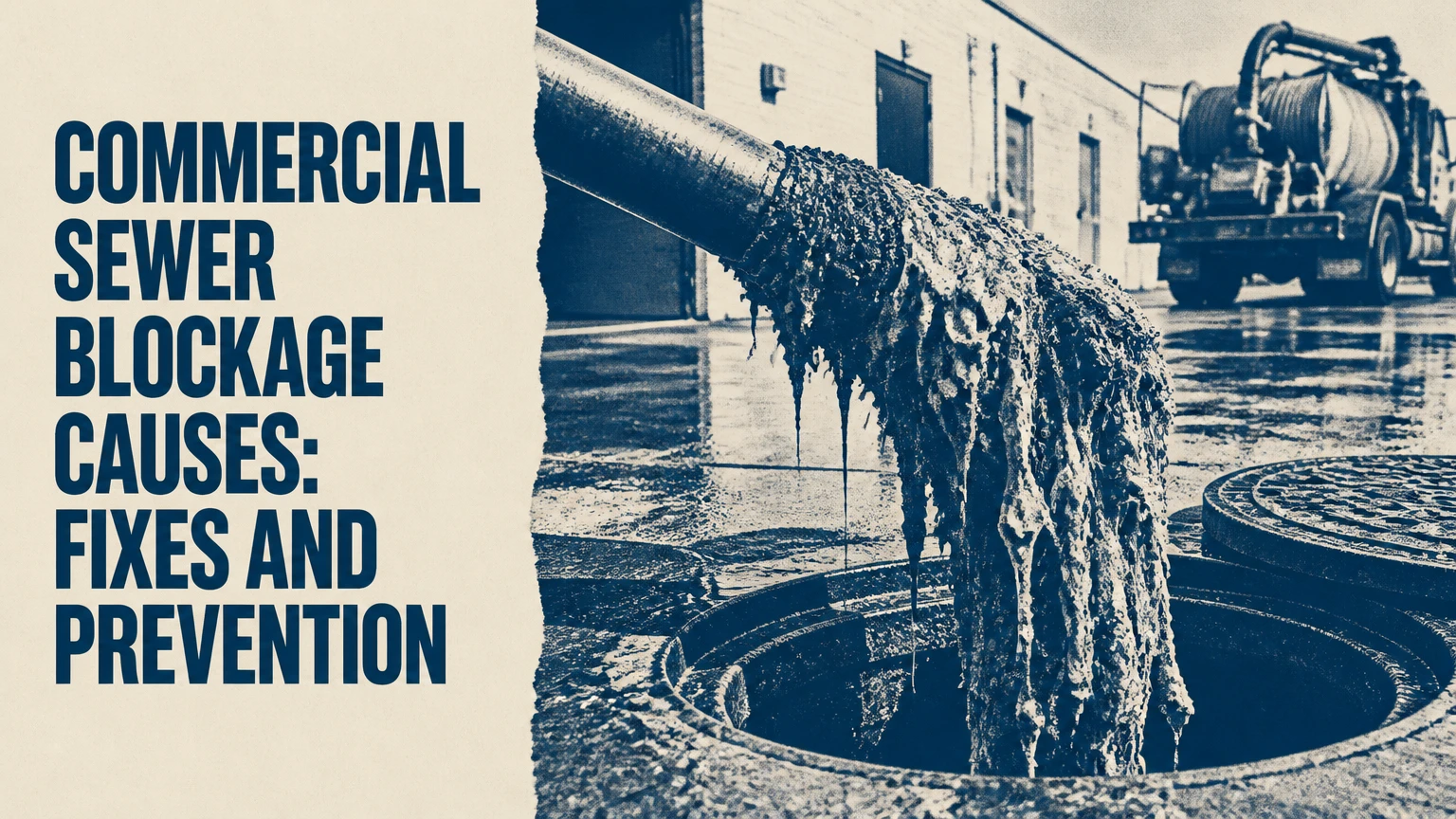
Commercial sewer blockage causes include fats, oils and grease, foreign objects, tree roots, pipe deformation, corrosion, poor slope, and collapsed or disconnected joints. A blockage forms when material narrows or interrupts a wastewater pipe, reducing flow until upstream fixtures drain slowly, gurgle, or discharge sewage through the lowest available opening.
Key Facts at a Glance
- Commercial sewer blockages usually occur in a branch drain, building main, private lateral, or shared sewer connection.
- Restaurants most commonly face grease, food solids, and defective grease-interceptor problems.
- Multiple fixtures backing up together usually indicate a downstream mainline restriction rather than one local fixture clog.
- A sewer camera inspection identifies structural defects that cabling alone cannot diagnose.
- Mechanical cabling can restore flow through a hole, while hydro-jetting removes more residue from pipe walls.
- Typical commercial service costs range from about $250 for basic cabling to more than $3,000 for extensive hydro-jetting.
What Is a Commercial Sewer Blockage?
A commercial sewer blockage is a restriction inside a business’s wastewater drainage system that prevents normal discharge toward the municipal sewer. The restriction may sit in a fixture branch, vertical stack, horizontal building drain, private sewer lateral, or shared connection, so “commercial sewer blockage” describes a condition rather than one exact pipe location.
Commercial systems handle greater fixture counts, longer pipe runs, variable wastewater, and more occupants than typical homes. A restaurant may send grease and food solids into its drainage network, while a hotel may send high volumes of bathroom waste, laundry lint, and non-flushable products through the same downstream line.
Commercial Drain Versus Sewer Lateral
A branch drain serves one fixture or a small fixture group. A building drain collects branch lines inside the property, while a building sewer or private lateral carries wastewater from the structure toward the public sewer main. The exact terminology varies by plumbing code and municipality, but the distinction matters for access, responsibility, and repair approval.
| Pipe location | Typical served area | Common blockage evidence | Usual access point |
|---|---|---|---|
| Fixture branch | One sink, toilet, or floor drain | One fixture drains slowly | Trap, cleanout, or fixture opening |
| Horizontal building drain | Several fixtures on one floor | Multiple nearby fixtures affected | Interior cleanout |
| Vertical stack | Fixtures on several floors | Fixtures aligned above one another | Stack cleanout or access fitting |
| Private sewer lateral | Whole building or tenant group | Building-wide backup | Exterior cleanout or manhole |
| Municipal main | Several properties | Neighbors also report backups | Public manhole or utility access |
A property manager should not assume that a backup belongs to the city simply because it appears outside the building. Ownership boundaries differ by jurisdiction, and the private lateral may extend from the building to the public connection.
How Does a Commercial Sewer Blockage Form?
A commercial sewer blockage develops when an initial restriction reduces the pipe’s open area, slows transport, and gives additional solids a surface where they can settle or adhere. The sequence commonly moves from partial obstruction to intermittent symptoms, then to a full backup when incoming discharge exceeds the restricted pipe’s capacity.
The process is hydraulic, but the initiating event may be behavioral, environmental, or structural:
- A defect or deposit creates a catch point. Grease film, a displaced joint, root hair, scale, or an object interrupts the smooth interior surface.
- Flow loses usable area. The same wastewater volume must pass through a narrower opening, increasing turbulence and wall friction.
- Solids settle or attach. Food particles, paper products, sediment, and mineral scale accumulate around the restriction.
- Air and wastewater move abnormally. Trapped air can produce bubbling or gurgling at nearby fixtures.
- The upstream pipe fills. The lowest floor drain, toilet, shower, or cleanout becomes the likely overflow point.
A 2 feet-per-second self-cleansing figure is a useful design reference, not a universal field cutoff. Actual transport depends on pipe diameter, slope, roughness, discharge volume, solids type, and whether the line receives intermittent or continuous flow. A large commercial pipe can carry low-volume discharge slowly without immediately backing up, while a smaller grease-coated line can fail under much less visible accumulation.
Partial Versus Complete Blockage
A partial blockage allows some wastewater through, so symptoms often appear during peak occupancy or high-volume discharge. A complete blockage stops normal downstream movement and can cause rapid sewage accumulation after one toilet flush, kitchen washdown, or laundry cycle.
| Blockage stage | Typical symptom | Trigger that reveals it | Likely risk |
|---|---|---|---|
| Early restriction | Drainage takes 10-30 seconds longer | Morning opening or first kitchen wash | Accumulation continues unnoticed |
| Moderate restriction | Gurgling and intermittent slow fixtures | Several fixtures discharge together | Sewage reaches low fixtures |
| Severe restriction | Water rises in floor drains | Toilet flush or mop sink use | Contaminated-floor exposure |
| Complete blockage | No downstream drainage | Any significant discharge | Overflow, closure, equipment damage |
What Are the Main Commercial Sewer Blockage Causes?
The main commercial sewer blockage causes are grease and food solids, non-flushable foreign objects, tree roots, pipe sags, corrosion, collapsed joints, sediment, and poor operating practices. The business type changes the probability: kitchens generate FOG, public restrooms generate debris, and older properties face more structural deterioration.
Fats, Oils, Grease, and Fatbergs
FOG is the leading operational cause for many restaurants, institutional kitchens, bakeries, and food-processing premises. Liquid grease cools along the pipe, sticks to the wall, traps food particles, and gradually reduces the effective diameter. The EPA’s public guidance states, “Never pour fats, oils, or grease down the drain.”
Grease does not need to form a dramatic underground “fatberg” to create a blockage. A thin coating can capture rice, flour, vegetable scraps, wipes, and sediment over repeated discharge cycles. Hot water may move grease temporarily, but it does not remove the deposit from the downstream line.
Common contributing failures include:
- Missing or damaged grease-interceptor baffles.
- An undersized or poorly located interceptor.
- Infrequent pumping and inadequate maintenance records.
- Dish staff scraping food waste into floor sinks.
- Direct connection of high-grease equipment to an unprotected line.
- Excessive detergent use that disperses grease without removing it.
Tree Root Intrusion
Tree roots enter through cracked pipe walls, failed joints, separated connections, and deteriorated mortar. Roots do not usually create a defect in an intact modern pipe; they exploit an existing path toward moisture and nutrients, then form a fibrous obstruction that catches solids.
Clay, vitrified clay, older cast iron, concrete, and aged joint systems are more vulnerable than intact newer plastic pipe, although no material is immune to installation defects or settlement. Root cutting can reopen a line, but it does not permanently seal the entry path. Recurring root growth usually requires joint repair, lining, replacement, or a documented maintenance program.
Foreign Objects and Excess Paper Products
Public-facing facilities often introduce materials that commercial sewer systems were never designed to transport. Paper towels, wipes, diapers, sanitary products, disposable gloves, rags, and packaging can lodge at bends, offsets, damaged joints, or root mats.
“Flushable” labeling does not mean rapid disintegration under every sewer condition. A product may disperse in a laboratory test yet remain intact long enough to combine with grease or roots in a commercial lateral. Restroom signage, covered waste receptacles, staff training, and tamper-resistant disposal controls usually prevent more blockages than repeated emergency clearing.
Sagging, Settlement, and Poor Slope
A sewer belly is a section that has settled below the intended pipe grade, creating a low point where water and solids remain after each discharge cycle. Heavy vehicle loading, unstable soil, trench settlement, groundwater erosion, and poor original bedding can cause the deformation.
A sag does not always produce an immediate complete blockage. It often causes recurring backups after cleaning because the underlying low point continues collecting sediment. CCTV should document the length, depth, and location of the belly before an owner chooses spot repair, lining, or excavation.
Corrosion, Scale, and Pipe Collapse
Cast-iron corrosion can produce rough tuberculated interiors that reduce area and catch solids. Industrial wastewater may accelerate deterioration when its pH, temperature, solvents, acids, or sulfides exceed the pipe system’s design conditions. Concrete and clay lines can crack, while old vitrified joints can separate under settlement.
A collapsed pipe is a structural failure, not a cleaning problem. Cabling may penetrate the opening temporarily, but the line will remain unstable and may admit soil, create a void, or collapse again. A camera inspection should precede high-pressure cleaning when the line is old, repeatedly blocked, visibly deformed, or suspected of collapse.
| Cause | High-risk facility | Diagnostic camera finding | Durable control |
|---|---|---|---|
| Grease and food solids | Restaurant kitchen | Cream-colored or dark wall coating | Interceptor service, scraping, jetting |
| Root intrusion | Older landscaped property | Fibrous mass at joint or crack | Root cutting plus structural repair |
| Foreign objects | Mall, hotel, transit restroom | Wipes or paper at offset | Receptacles, signage, staff controls |
| Sewer belly | Parking lot or settled site | Standing water in low section | Excavation or engineered lining |
| Mineral scale | Older cast-iron building | Flaking tubercles and narrowed bore | Descaling, replacement, lining |
| Collapse or separation | Aged or disturbed property | Open void, broken wall, displaced joint | Excavation or trenchless repair |
How Is a Commercial Sewer Blockage Diagnosed?
A commercial sewer blockage is located by comparing fixture symptoms, testing from accessible cleanouts, and inspecting the pipe with CCTV when the cause is uncertain or recurring. The number of affected fixtures provides a first estimate, but only a camera can reliably distinguish grease from roots, foreign objects, sags, cracks, and collapse.
Use this diagnostic sequence:
- Map affected fixtures. One fixture suggests a branch issue; several fixtures on different branches indicate a downstream restriction.
- Stop discharge. Suspend toilet flushing, kitchen washdown, laundry, and equipment drainage until the overflow risk is known.
- Check cleanouts and manholes. A full upstream cleanout and empty downstream access point help narrow the blockage location.
- Observe timing. Backup after a high-volume discharge suggests limited capacity; immediate backup may indicate a complete obstruction.
- Inspect with CCTV. Record the pipe material, distance, defect type, deposit thickness, and whether the camera reaches the municipal connection.
- Confirm responsibility. Contact the sewer utility if neighboring properties are affected or the public main appears surcharged.
Odor alone does not prove a mainline blockage. Sewer gas can arise from a dry trap, damaged vent, cracked pipe, missing cleanout cap, or an actual wastewater restriction. Gurgling across multiple fixtures is more useful evidence of trapped air and a partial downstream obstruction.
What Should Staff Do During an Active Backup?
During an active commercial sewage backup, staff should stop water use, isolate the affected area, protect people from contact, and call a qualified emergency drain contractor. Do not flush fixtures, use chemical openers, or wash contaminated material into another drain.
The first response should include:
- Close affected restrooms, kitchens, or production areas.
- Keep customers and employees away from sewage and slippery floors.
- Shut off nearby fixtures or equipment if a local supply valve can be safely reached.
- Photograph the condition and record the time, fixtures, weather, and recent operations.
- Protect electrical equipment without entering standing water near energized components.
- Notify the property manager, insurer, landlord, and sewer utility when applicable.
- Use a licensed remediation provider for porous materials or suspected sewage exposure.
Local health, wastewater, and building rules determine when a business must close or report a release. A drain contractor can clear the pipe, but clearance does not automatically make a contaminated room safe to reopen.
Which Clearing Method Fits the Blockage?
Mechanical cabling is usually the fastest lower-cost method for opening a narrow obstruction, while hydro-jetting is better for removing grease, sludge, and root residue from sound pipe walls. Biological treatments support prevention but cannot reliably clear a fully blocked commercial mainline.
| Method | Typical cost | Typical duration | Best application | Main limitation |
|---|---|---|---|---|
| Mechanical cable or auger | $250-$350 | 1-2 hours | Local obstruction or emergency opening | Leaves wall deposits behind |
| Commercial hydro-jetting | $600-$3,000+ | 2-5 hours | Grease, sludge, scale, root residue | Unsafe in uninspected weak pipe |
| CCTV inspection | $275-$1,800 | 1-2 hours | Cause and location confirmation | Does not clear the blockage |
| Biological treatment | $50-$300 per program | Weeks to months | Organic-load prevention | Not a solution for total blockage |
| Trenchless CIPP lining | $150-$250 per linear foot | 1-2 days | Cracks and leaking joints | Requires suitable pipe geometry |
| Excavation and replacement | $200-$500 per linear foot | 2-5 days | Collapse, severe sag, open failure | Surface disruption and permits |
When Should a Contractor Use a Cable?
A cable is appropriate when the pipe appears structurally sound and the immediate objective is to restore flow through a localized obstruction. Cabling works well for soft objects, moderate roots, and some compacted debris, but a narrow path can leave most grease and scale attached to the pipe wall.
Repeated cabling every few months is a warning, not a maintenance strategy. If the same line fails at the same distance, the owner should request a camera inspection and footage, not another blind punch-through.
When Is Hydro-Jetting Safer and More Effective?
Hydro-jetting is effective when the pipe can withstand the selected pressure and the operator has identified the line condition. Typical commercial equipment may operate around 3,500-4,000 psi and 15-25 gallons per minute, but the correct pressure depends on pipe material, age, defect severity, nozzle type, and distance.
Hydro-jetting is not a repair for a collapsed, badly separated, or unsupported sewer. High-pressure water can enlarge a defect, wash soil from around a weak pipe, or force debris into a downstream obstruction. Pre-inspection is especially important for older clay, concrete, and heavily corroded cast-iron lines.
Do Biological Treatments Clear Commercial Blockages?
Biological treatments can reduce some organic buildup when used as a preventive supplement, but they do not replace pumping, cabling, jetting, or structural repair. Enzymes and microbial products require contact time and suitable temperature and chemistry; they cannot dissolve a root mat, remove a rag, or restore a collapsed pipe.
A kitchen may use an approved maintenance product after solids control and grease-interceptor service, subject to local discharge rules. Pouring a treatment into a completely blocked line often leaves the product sitting upstream, where it adds little operational value.
How Much Does Commercial Sewer Cleaning Cost?
Typical commercial sewer cleaning costs range from $250-$350 for basic cabling, $600-$3,000 or more for hydro-jetting, and $275-$1,800 for CCTV inspection. Repair costs rise to approximately $150-$250 per linear foot for CIPP lining or $200-$500 per linear foot for excavation and replacement.
These are broad US planning ranges, not guaranteed quotations. Line length, access, pipe diameter, disposal requirements, traffic control, after-hours labor, municipal permits, contamination, and the cause of failure can change the invoice substantially.
| Service decision | Typical price range | Typical time | Cost increases when |
|---|---|---|---|
| Daytime cable clearing | $250-$350 | 1-2 hours | Access is difficult or object retrieval is needed |
| CCTV after clearing | $275-$1,800 | 1-2 hours | Line is long, large, or difficult to access |
| Hydro-jetting | $600-$3,000+ | 2-5 hours | Grease is deep or disposal is extensive |
| Emergency attendance | Base charge plus $100-$150/hour | Same day or overnight | Work occurs after hours or on holidays |
| CIPP lining | $150-$250/linear foot | 1-2 days | Multiple laterals or preparation are required |
| Open replacement | $200-$500/linear foot | 2-5 days | Pavement, utilities, shoring, or permits are involved |
A responsible quote should state whether it includes access, locating, camera footage, jetting water, waste disposal, traffic control, and a written diagnosis. The cheapest clearing method can become the expensive option if it postpones discovery of a failing pipe.
Why Does the Blockage Keep Returning?
A commercial sewer blockage usually returns because cleaning removed the symptom while grease, roots, a sag, damaged joints, incorrect slope, or poor disposal practices remained. Recurrence at the same location or after the same operating event is stronger evidence of an underlying cause than recurrence anywhere in the system.
Use recurrence patterns to guide the next inspection:
- Every few weeks in a restaurant: inspect grease loading, interceptor capacity, baffles, and downstream pipe coating.
- After heavy rain: investigate inflow, infiltration, stormwater cross-connections, or a surcharged municipal main.
- At the same camera distance: look for a joint offset, belly, root entry, or structural defect.
- Only during peak occupancy: compare discharge volume with pipe capacity and fixture use.
- After tenant turnover: review disposal behavior, equipment changes, and unauthorized plumbing alterations.
- After cable clearing: inspect the line if symptoms return within one maintenance cycle.
A practical rule is to escalate from clearing to diagnosis when a line requires repeated emergency service, when the same defect appears twice, or when the building has experienced a sewage overflow. Maintenance records should include date, method, location, cause, footage, and corrective action.
How Can Businesses Prevent Commercial Sewer Blockages?
Businesses prevent commercial sewer blockages by controlling what enters the system, maintaining grease and solids interception, inspecting vulnerable lines, and matching cleaning intervals to actual loading. Prevention works best when operations, plumbing maintenance, and tenant accountability are managed as one system.
Restaurants and Commercial Kitchens
Kitchen operators should scrape food waste into solid waste containers before washing utensils, maintain grease traps or interceptors to the manufacturer’s schedule, and document pumping and inspection. Quarterly downstream jetting may suit a heavily loaded restaurant, but a lower-volume café may need a different interval based on measured buildup.
Automatic grease removal devices can reduce discharge when correctly sized and maintained. They do not excuse poor scraping practices or eliminate the need to inspect the downstream lateral.
Retail, Hotels, and Public Facilities
High-traffic restrooms need accessible waste receptacles, clear disposal signage, frequent inspections, and rapid removal of damaged dispensers or overflowing bins. Paper towels, wipes, feminine hygiene products, and gloves should never enter toilets unless the local system and product instructions specifically permit disposal, and even then, operational risk remains.
A monthly inspection of high-use restroom branches may identify repeated slow fixtures before a public backup. Managers should track which restroom, shift, tenant, or event precedes each incident.
Property Managers and Multi-Tenant Buildings
Property managers should maintain a building drainage map, preserve cleanout access, and require written approval for tenant plumbing changes. A CCTV baseline every 24 months can be reasonable for older or high-risk properties, while newer low-risk buildings may use condition-based inspection.
Lease terms should identify prohibited discharges, grease-interceptor responsibility, emergency access, and documentation requirements. Responsibility for a blockage depends on the lease, local law, pipe ownership, and verified cause, not simply on which tenant occupies the nearest room.
Industrial and Warehouse Facilities
Industrial sites should characterize wastewater before discharge and verify compatibility with pipe materials. Solvents, acids, high-temperature effluent, abrasive solids, and process sludge can damage lines or overwhelm ordinary commercial drainage.
Floor drains, trench drains, sump systems, and sanitary sewers should be mapped separately. A stormwater connection mistaken for sanitary drainage can produce flooding, compliance violations, and misleading blockage symptoms.
What Repair Is Appropriate for Structural Damage?
Structural sewer repair depends on the defect type, pipe material, access, diameter, groundwater, and whether the line has lost its shape. CIPP lining can rehabilitate suitable cracked or leaking segments, while excavation is generally required for severe collapse, major displacement, unstable bedding, or a pronounced belly.
| Defect | Cleaning result | Possible trenchless option | When excavation is more likely |
|---|---|---|---|
| Grease coating | Temporary or complete removal | Not normally needed | Only if pipe is also damaged |
| Root-filled joint | Root removal opens passage | Local liner or CIPP | Joint is displaced or soil is unstable |
| Small crack | May leave flow restored | CIPP or spot repair | Access or geometry prevents lining |
| Moderate corrosion | Cable may snag or scrape | CIPP if diameter remains suitable | Wall has lost structural strength |
| Sewer belly | Cleaning removes sediment only | Limited, site-specific correction | Long or deep sag causes recurrence |
| Collapse | Cable may create a temporary hole | Usually unsuitable | Broken or missing pipe section |
CIPP lining is not appropriate for every pipe. The contractor must confirm internal diameter, bends, connections, groundwater conditions, lateral reinstatement requirements, and the host pipe’s ability to accept the liner. A low quote that omits reconnection, cleaning, curing, or post-installation inspection is incomplete.
Common Mistakes That Increase Damage
Blind Hydro-Jetting in an Old Line
High-pressure cleaning without visual inspection can damage fragile pipe or expose unsupported soil. The safer sequence is locate, inspect where practical, select pressure and nozzle, clean, then inspect again.
Using Chemical Drain Openers
Commercial volumes of caustic or acidic opener rarely reach a deep mainline obstruction reliably. Chemicals can create burns for workers, damage vulnerable materials, complicate later cable work, and contaminate recovered wastewater.
Replacing a Grease Interceptor Without Fixing Operations
A larger interceptor will not solve a kitchen that sends bulk solids and cooking grease into the drainage system. Solids control, correct sizing, pumping, baffle inspection, and downstream cleaning must work together.
Treating a Vent Problem as a Sewer Blockage
A blocked vent can cause gurgling, slow drainage, and odor without a full sewer obstruction. If fixtures drain normally but pressure symptoms persist, inspect venting and trap seals rather than repeatedly jetting the sewer.
Ignoring a Low-Cleanout Overflow
An overflowing exterior cleanout can expose the blockage location and prevent sewage from entering the building. Closing or capping the cleanout without clearing the downstream restriction can redirect sewage indoors.
Commercial Sewer Blockage Causes FAQ
Can heavy rain cause a commercial sewer backup?
Heavy rain can cause a commercial backup when stormwater enters sanitary lines through defects, illegal connections, damaged manholes, or overwhelmed public infrastructure. Rain-linked incidents do not prove that a private line is blocked. Compare neighboring properties, inspect cleanouts, and ask the utility whether the public main was surcharged.
Who pays for a commercial sewer lateral blockage?
The responsible party depends on pipe ownership, the lease, local sewer rules, and the verified cause. A tenant may pay for grease or foreign objects caused by its operations, while an owner or utility may control a structural or public-main defect. Written CCTV findings provide stronger evidence than symptom location alone.
Does an older commercial building need a sewer camera inspection?
An older commercial building should receive CCTV inspection when backups recur, the pipe has cast iron, clay, concrete, or unknown material, or major renovation will increase wastewater volume. Inspection is also prudent before hydro-jetting a visibly deteriorated line and before purchasing a property with undocumented underground drainage.
Can a backwater valve prevent every commercial sewer backup?
A backwater valve can reduce reverse flow from a surcharged public sewer when correctly sized, installed, accessible, and maintained. It cannot clear a private blockage, stop sewage produced upstream of the valve, or compensate for poor drainage design. Local plumbing authorities should approve the installation and maintenance arrangement.
How long should a commercial sewer cleaning last?
A basic cable visit commonly takes 1-2 hours, while commercial hydro-jetting often takes 2-5 hours. The duration depends on access, line length, deposit thickness, recovery and disposal requirements, and whether CCTV inspection occurs before and after cleaning. Structural repair can require one to five days or longer.
What is the best first step for recurring sewer backups?
The best first step for recurring commercial sewer backups is a documented CCTV inspection after flow is restored, combined with a review of fixture use and maintenance records. The inspection should identify distance, pipe material, obstruction type, structural condition, and the repair or prevention action that addresses the cause.
The Bottom Line
Commercial sewer blockage causes fall into two groups: material buildup, such as grease, roots, and foreign objects, and structural failure, such as sags, corrosion, displaced joints, and collapse. Stop discharge during a backup, isolate the affected area, and use a qualified contractor to locate the restriction. Cabling can restore emergency flow, hydro-jetting can clean suitable sound pipe, and CCTV is the deciding tool when the blockage recurs or structural damage is possible. A prevention plan based on wastewater type, inspection evidence, and maintenance records is more reliable than repeating emergency clearing.