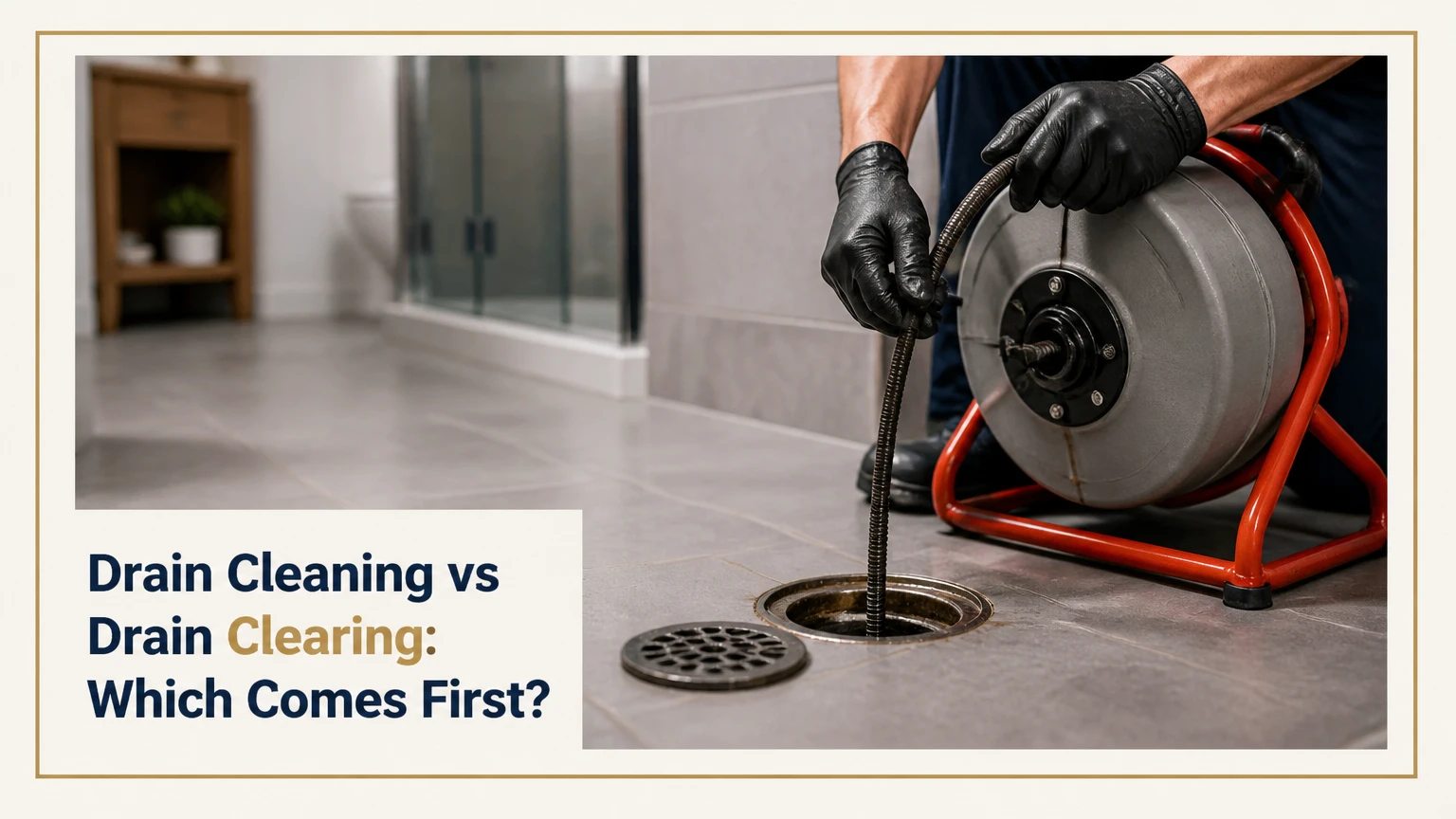
Drain cleaning removes accumulated material from pipe walls, while drain clearing removes an obstruction blocking water flow. Drain clearing is usually the faster emergency response for one clogged fixture; drain cleaning is the more thorough service for grease, scale, roots, or recurring blockages. The correct choice depends on symptoms, pipe condition, and cause.
Key Facts
Drain clearing restores passage through a blockage but may leave buildup attached to the pipe wall.
Drain cleaning removes more of the internal deposits that reduce diameter and catch new debris.
A plunger or small auger may clear a sink clog, while hydro-jetting is generally intended for accessible, structurally sound lines.
One blocked fixture usually indicates a local obstruction; several affected fixtures can indicate a branch or main sewer problem.
Typical residential clearing costs range from $150-$350, while professional cleaning commonly ranges from $400-$900.
Hydro-jetting cannot repair a collapsed, badly separated, or missing sewer pipe.
Drain Cleaning vs Drain Clearing: Core Difference
Drain clearing is a targeted service that creates or restores an open path through a blockage. Drain cleaning is a broader process that removes grease, sludge, mineral scale, roots, and biofilm from a substantial section of the pipe. The terms are not standardized across the plumbing industry, so a contractor’s written scope matters more than the label.
A cable machine may clear a blockage by boring a narrow channel through it. Water then moves, but a ring of grease or scale can remain around the cable path. A cleaning process attempts to remove more of that ring and restore usable internal diameter.
The distinction is easiest to understand through outcomes. Clearing answers, “Can wastewater pass now?” Cleaning answers, “What material is reducing the pipe’s capacity, and how much can safely be removed?”
A clearing visit can include limited cleaning, and a cleaning visit often begins with clearing an active obstruction. The services overlap in practice, but they are not interchangeable promises.
What does drain clearing remove?
Drain clearing removes the immediate obstruction, such as hair, paper, food debris, a small grease plug, or soft organic matter. A plumber may retrieve the material, break it apart, or push it farther downstream into a larger pipe.
Clearing does not necessarily remove deposits bonded to the pipe wall. It also cannot correct a damaged sewer lateral, inadequate slope, root intrusion, or a collapsed section.
What does drain cleaning remove?
Drain cleaning removes deposits from the interior surface of a line. Depending on the equipment and pipe material, the work may target grease, soap residue, mineral scale, sludge, bacterial film, or fine root growth.
Cleaning is not the same as pipe repair. A hydro-jetter can expose a crack or remove roots temporarily, but the roots will return if the pipe remains open to surrounding soil.
How Do the Two Services Work?
Drain clearing uses localized mechanical force, while drain cleaning uses broader scraping, cutting, or water-scouring action. The tool, access point, pipe diameter, blockage material, and pipe condition determine whether the procedure is safe and effective.
A typical clearing process begins at a fixture opening or nearby cleanout. The technician selects a plunger, hand auger, toilet auger, sectional cable, or drum machine, then advances the tool until it reaches resistance.
The cable may pierce a soft obstruction, hook hair, break up paper, or dislodge grease. The technician then retrieves the material where possible and runs water to test drainage. A camera is appropriate when the blockage recurs, affects a main line, or suggests roots, scale, or structural damage.
Cleaning requires more preparation. The technician may inspect the line, protect fixtures, establish hose access, and select a nozzle or rotating chain tool suited to the deposit. A post-service camera inspection is valuable when the line is expensive, inaccessible, old, or affected by roots.
| Method | Primary action | Typical use | Main limitation |
|---|---|---|---|
| Cup plunger | Pressure pulse | Sink, tub, shower | Ineffective against hard scale or deep roots |
| Hand auger | Local boring or retrieval | Hair and soft fixture clogs | Usually reaches 10-25 feet |
| Motorized cable | Cutting or puncturing | Branch and building drains | May leave wall deposits behind |
| Hydro-jetter | Multi-directional water scouring | Grease, sludge, scale, roots | Requires sound pipe and suitable access |
| Chain descaler | Mechanical scraping | Cast-iron scale | Can damage fragile or thin pipe |
| Camera inspection | Video diagnosis | Recurring or main-line faults | Diagnoses problems but does not remove them |
Is snaking drain clearing or drain cleaning?
Snaking is primarily drain clearing because a cable normally opens a route through the obstruction rather than removing every deposit around the pipe circumference. A cable with specialized cutters can remove some scale or roots, but the result depends on the cutter, pipe material, access, and operator.
A snake can be the right first service for a single kitchen sink or shower clog. It is a weaker long-term answer when the same line blocks every few months, because recurrence suggests deposits, roots, poor slope, or a damaged pipe.
What happens during hydro-jetting?
Hydro-jetting sends pressurized water through a hose with a directional nozzle. Rear-facing jets propel the nozzle and scour deposits from the wall, while forward-facing or specialty jets attack material ahead of the hose.
Pressure is not a universal quality measure. A small residential branch may require a different flow and nozzle from a six-inch commercial sewer. Excessive pressure or an unsuitable nozzle can worsen defects in brittle clay, heavily corroded cast iron, or Orangeburg pipe.
Which Service Fits the Symptom?
Drain clearing fits a sudden, isolated blockage with no evidence of pipe-wide deterioration. Drain cleaning fits recurring restrictions, widespread buildup, grease-heavy use, or a confirmed deposit problem. Multiple fixtures backing up require diagnosis before anyone chooses a tool.
The symptom pattern provides useful location evidence:
| Symptom pattern | Likely location | First professional action | Escalation trigger |
|---|---|---|---|
| One slow bathroom sink | Trap or fixture branch | Plunger, trap check, hand auger | Recurrence after two attempts |
| One blocked toilet | Toilet trap or branch | Toilet auger | Other fixtures gurgle or back up |
| Kitchen sink clog with grease | Sink branch | Cable clearing, trap cleaning | Repeat blockage within 30-90 days |
| Tub and lavatory both slow | Shared bathroom branch | Branch-line inspection and clearing | Sewage odor or standing wastewater |
| Several fixtures back up | Main building drain | Main cleanout access and camera | Roots, collapse, or repeated failure |
| Lowest floor backs up | Sewer lateral or municipal line | Stop water use and urgent diagnosis | Outdoor cleanout surcharge or sewage |
A blocked fixture often permits a limited clearing attempt. A backup at the lowest drain, sewage contamination, or wastewater rising when another fixture runs should be treated as a sanitation emergency.
Why does a drain clog again after clearing?
A drain reclogs because the clearing tool opened a passage without removing the underlying restriction, or because the original cause remains active. Grease rings, hair-coated sludge, mineral scale, tree roots, low slope, and pipe damage can all produce the same cycle.
The timing offers a clue. A clog that returns within days may indicate incomplete removal or a nearby obstruction. A return after several months often points to recurring deposits or a line that is undersized, sagging, or structurally compromised.
Repeated cable work without diagnosis can increase cost while delaying the necessary repair. After two or three failures in the same line, request a camera inspection and a written explanation of the observed cause.
Cost and Time Comparison
Typical residential drain clearing costs about $150-$350 and usually takes 30-90 minutes. Professional drain cleaning commonly costs $400-$900 and takes 1.5-4 hours, although access, pipe size, emergency timing, travel, and repair needs can move the price substantially.
These figures are practical North American residential ranges, not guaranteed quotes. A local contractor may charge a flat service fee, hourly labor, equipment time, or a bundled camera and jetting price.
| Service situation | Typical price | Typical duration | Common equipment |
|---|---|---|---|
| Sink or shower clearing | $100-$250 | 30-60 minutes | Plunger, hand auger, small cable |
| Toilet clearing | $125-$300 | 30-75 minutes | Toilet auger, closet auger |
| Main-line cable clearing | $250-$600 | 1-2 hours | Sectional or drum machine |
| Camera inspection | $150-$400 | 30-90 minutes | Push camera, locator |
| Residential hydro-jetting | $400-$900 | 1.5-4 hours | Jetter, cleanout hose, nozzle |
| Root or heavy-scale treatment | $600-$1,500 | 2-5 hours | Jetter, cutter, camera |
Emergency, weekend, and after-hours calls may add $75-$250 or more. Excavation, pipe replacement, trenchless lining, or municipal coordination is separate from both clearing and cleaning.
A low clearing price is not necessarily cheaper if the same blockage returns three times. Compare the expected total cost over 12 months, including repeat visits and any camera inspection.
Which Service Produces Longer-Lasting Results?
Drain cleaning generally lasts longer when removable buildup causes the restriction, but cleaning cannot guarantee permanent flow. Results depend on what enters the line, the pipe’s internal condition, drainage slope, root growth, and whether the plumbing has a hidden defect.
For example, hydro-jetting can remove a grease layer from a restaurant branch, but new fats, oils, and grease will accumulate without proper interceptor maintenance and disposal practices. Root removal can restore capacity, but roots usually return when a cracked joint remains untreated.
Drain clearing may last for years when a single accidental object caused the blockage. It may last only weeks when the line has a thick deposit or a structural defect.
How often should drains be cleaned?
There is no universal residential cleaning interval. A sound home line with no recurrence usually needs service only when symptoms appear, while a restaurant grease line may require scheduled cleaning every 3-6 months based on volume and inspection history.
Homeowners with old cast iron, clay, or Orangeburg lines should use symptoms and camera evidence rather than an arbitrary calendar. Preventive cleaning every 1-3 years may be reasonable for documented buildup, but unnecessary jetting adds cost and risk.
Commercial frequency should follow actual loading. A busy restaurant, food processor, or multi-unit building produces more grease and solids than a small office, so the maintenance schedule must reflect usage and local wastewater requirements.
Is Hydro-Jetting Safe for Old Pipes?
Hydro-jetting is generally safe for a sound pipe when the technician selects appropriate pressure, flow, nozzle, and access, but it is not automatically safe for deteriorated plumbing. A camera inspection can reveal cracks, open joints, severe corrosion, deformation, or a collapsed section before high-pressure cleaning.
Cast-iron scale deserves special caution. Thick corrosion can partially support a weak pipe, and removing it may reveal perforations that were already present. That does not mean the jetter caused the entire failure, but the work can expose a condition that requires repair.
Orangeburg, brittle clay, badly corroded steel, and collapsed lines require particular scrutiny. A responsible scope identifies the pipe material, proposes a pressure range, explains the risk, and states what happens if the camera finds structural damage.
When is cleaning the wrong solution?
Cleaning is the wrong solution when the pipe has collapsed, separated joints, severe belly or sag, major deformation, or a blockage caused by a foreign object that requires retrieval. Cleaning also fails when the source is a blocked municipal sewer, a failed backwater valve, or a venting problem.
The correct next step may be spot repair, sewer replacement, trenchless lining, excavation, root-resistant joint repair, or a municipal service call. More force cannot restore missing pipe.
Can You Clear a Drain Yourself?
A homeowner can usually attempt a plunger or correctly sized hand auger on a single fixture, provided no chemical drain opener is present and wastewater is not contaminated. DIY clearing should stop when the tool binds, the fixture is at risk, the blockage returns, or multiple drains are affected.
Use a cup plunger for a flat sink or tub opening and a flange plunger for a toilet. Protect overflow openings, use controlled strokes, and avoid forcing a cable through a porcelain trap or fragile plastic fitting.
Never mix drain chemicals. Sodium hydroxide and sulfuric-acid products can create caustic standing liquid, hazardous fumes, and chemical burns for the next person opening the trap or cleanout. The U.S. Consumer Product Safety Commission warns that corrosive drain cleaners can cause severe burns, which is why a plumber must be told about any product used.
What should you tell the plumber?
Provide the affected fixtures, symptom start time, recent clearing attempts, chemical products used, pipe age, and whether wastewater appears at a floor drain or cleanout. That information helps the technician choose protective equipment and avoid repeating an ineffective approach.
How Should a Professional Diagnose a Recurring Blockage?
A professional should identify the affected section, inspect accessible traps and cleanouts, clear the immediate obstruction when necessary, and use a camera when recurrence or main-line symptoms suggest a deeper cause. Diagnosis should precede hydro-jetting when pipe condition is uncertain.
A useful camera report identifies the pipe material, approximate distance, defect type, deposit location, and whether the camera reached the municipal connection. Ask for a recording or still images when the work involves a main sewer or a major maintenance decision.
Camera timing matters. A completely blocked line may need initial clearing before the camera can pass, but inspection should follow soon afterward if the blockage has a history of recurrence.
What Are the Most Common Costly Mistakes?
The most expensive mistake is treating a repeated symptom as a series of unrelated emergencies. A $250 clearing visit repeated four times can exceed the cost of one diagnostic inspection and targeted cleaning, while the underlying pipe defect continues to worsen.
Avoid these failure patterns:
- Using chemical opener in standing water: Tell the plumber, ventilate the area, and do not plunge a chemically charged drain.
- Using a toilet auger on a sink branch: Match the tool to the fixture and pipe diameter.
- Jetting without checking pipe condition: Request camera evidence for old, unknown, or root-affected lines.
- Assuming flow proves a complete fix: Run several fixtures and inspect for slow recovery, gurgling, or backup.
- Ignoring a cleanout surcharge: A pipe belly or collapsed section may collect debris even after cleaning.
- Accepting vague invoices: Require the method, access point, line treated, findings, price, and warranty limits.
A practitioner rule of thumb is simple: one isolated clog can justify clearing, but a repeat clog deserves a cause-based diagnosis. Flow restoration is a result, not a diagnosis.
Which Should You Choose?
Choose drain clearing for a first-time, single-fixture blockage when water must flow immediately and there are no signs of a main-line problem. Choose drain cleaning when inspection or history shows substantial deposits that are reducing capacity and causing repeat restrictions.
For homeowners with one blocked sink
Start with a plunger or hand auger if no chemicals were used. If the blockage returns within 30-90 days, request a camera-informed recommendation rather than another automatic cable visit.
For homes with several backed-up fixtures
Stop using water and call for main-line diagnosis. Clearing may restore flow, but the technician should determine whether the obstruction lies in the building drain, private sewer lateral, or municipal sewer.
For restaurants and commercial kitchens
Prioritize scheduled cleaning and grease-control practices. A restaurant that waits for a complete backup risks closure, contaminated work areas, emergency pricing, and violations associated with improper wastewater management.
For buyers evaluating an older home
Order a sewer scope before closing when the property has mature trees, old clay or cast-iron piping, repeated plumbing records, or no accessible cleanout. Use the video to distinguish cleanable deposits from repair-worthy defects.
| Decision factor | Choose clearing when | Choose cleaning when | Choose repair or diagnosis when |
|---|---|---|---|
| Number of fixtures | One fixture is affected | Several branch fixtures have recurring buildup | Multiple fixtures back up together |
| Recurrence | First event or rare event | Same line restricts repeatedly | Clearing fails or symptoms worsen |
| Material | Hair, paper, isolated object | Grease, sludge, scale, fine roots | Collapse, separation, severe corrosion |
| Urgency | Immediate flow is the priority | Capacity restoration is the priority | Sewage backup or sanitation hazard exists |
| Pipe condition | Modern, accessible, sound pipe | Sound pipe with documented deposits | Old or damaged pipe lacks inspection |
| Maintenance setting | Typical low-use residence | Restaurant or high-use building | Municipal line or structural defect |
The Bottom Line
Drain clearing and drain cleaning solve related but different plumbing problems. Clearing opens a blocked route quickly, while cleaning removes more of the material narrowing the pipe; the best decision depends on recurrence, the number of affected fixtures, deposit type, and pipe condition.
Use clearing for an isolated first-time blockage. Request camera inspection and possible cleaning when the same line repeatedly slows, when grease or scale is visible, or when multiple fixtures show symptoms. Avoid chemical mixtures and high-pressure work on unverified fragile pipe.
The phrase drain cleaning vs drain clearing describes a difference in scope, not a universal naming rule. Before approving work, ask exactly what the technician will remove, which section will be treated, how pipe safety will be checked, and what happens if the line is structurally defective.
Frequently Asked Questions
Does drain cleaning remove a clog completely?
Drain cleaning can remove a clog and surrounding deposits when the pipe is accessible and structurally sound. It cannot remove every obstruction, repair a collapsed line, or prevent new grease, hair, roots, and solids from entering. A camera inspection helps distinguish removable buildup from a defect that requires repair.
Is drain cleaner liquid the same as professional drain cleaning?
No. Liquid drain cleaner is a chemical product intended to dissolve or break down certain organic blockages, while professional drain cleaning uses mechanical equipment, water jetting, or scraping tools. Chemical products can create hazardous standing liquid and may damage some materials or endanger anyone who later opens the line.
Can drain clearing damage pipes?
Drain clearing can damage pipes when an oversized cable, aggressive cutter, or excessive force is used in fragile or deteriorated plumbing. The risk depends on pipe material, condition, tool selection, and operator technique. A binding cable, repeated failure, or unknown old sewer line warrants professional diagnosis.
Will hydro-jetting remove tree roots permanently?
Hydro-jetting can cut and flush many root intrusions, but it usually does not permanently eliminate roots entering through a cracked joint or open connection. Root growth commonly returns unless the damaged section is repaired, replaced, or treated with an appropriate long-term solution.
Should a slow drain always be professionally cleaned?
No. A single mildly slow sink may respond to fixture cleaning, a plunger, or a hand auger. Professional cleaning becomes more appropriate when the slowdown recurs, affects several fixtures, produces sewage odors, follows a history of roots or scale, or persists after correct local clearing.
What questions should I ask before approving service?
Ask whether the quote covers clearing, cleaning, camera inspection, or all three; which pipe section will be treated; what equipment and pressure will be used; and whether repairs are excluded. Also request the observed cause, total price, access requirements, expected result, and warranty limitations.