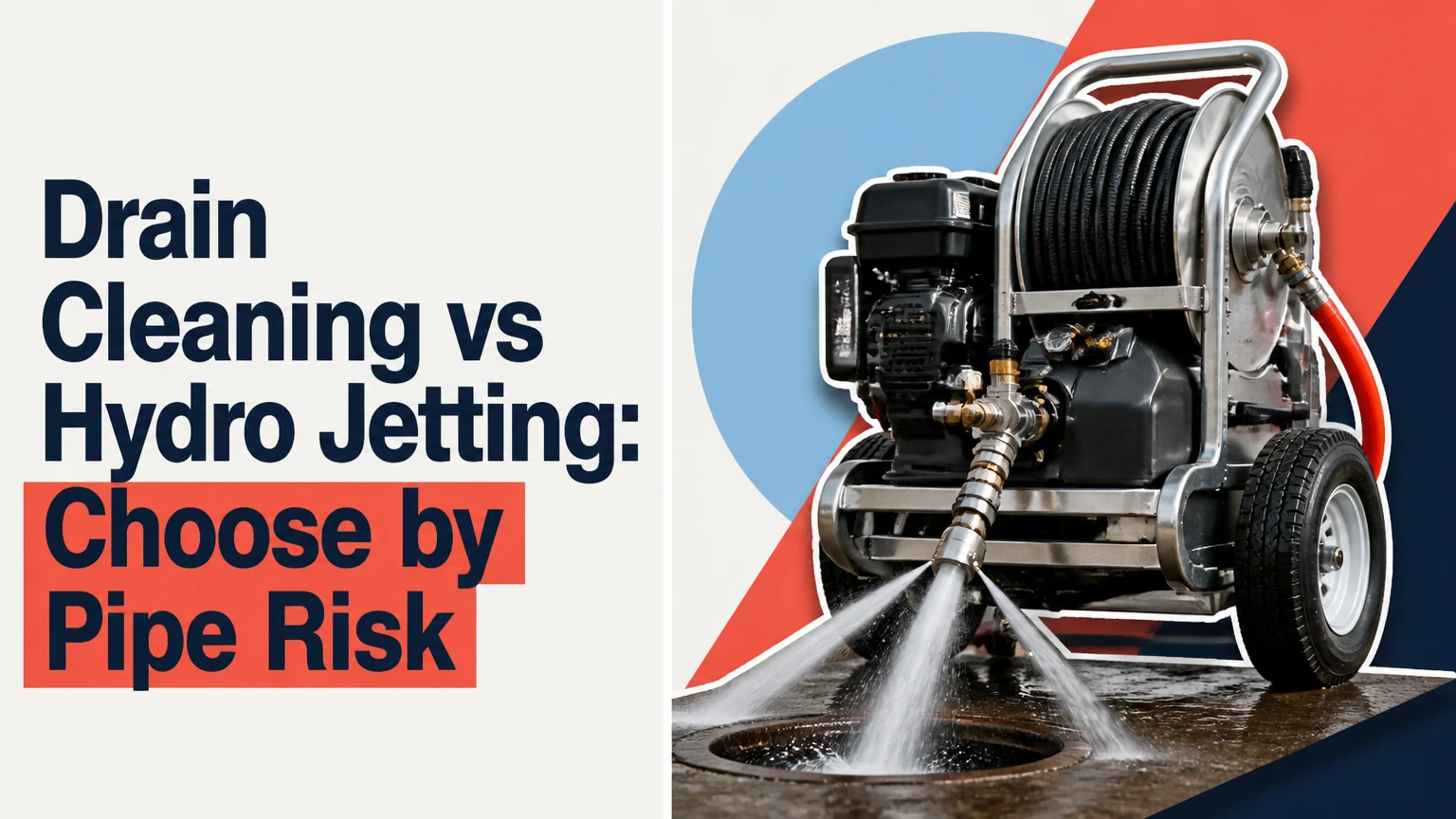
Drain cleaning vs hydro jetting is a choice between localized blockage removal and full-pipe scouring. Mechanical drain cleaning, commonly called snaking, is usually the safer and cheaper first response for a single soft clog, while hydro jetting is better for recurring grease, sludge, scale, or root-related restrictions in a structurally sound pipe.
Key Facts at a Glance
- A drain snake opens a passage through a blockage, but it usually does not wash deposits from the entire pipe wall.
- Hydro jetting uses pressurized water, with pressure and flow selected for the pipe diameter, material, access point, and obstruction.
- A camera inspection should precede hydro jetting when the line is old, damaged, root-affected, or otherwise uncertain.
- Typical U.S. residential snaking costs about $150-$400; hydro jetting commonly costs $350-$900 before unusually difficult access or excavation.
- Neither snaking nor hydro jetting repairs a collapsed, bellied, disconnected, badly cracked, or misaligned sewer pipe.
- A recurring backup is evidence of an unresolved cause, not automatic proof that hydro jetting is required.
Drain Cleaning vs Hydro Jetting: What Is the Difference?
The central difference is the area each method treats. A cable machine applies mechanical force at one point, cutting or piercing a path through the obstruction. A hydro jetter sends water through a fitted nozzle, using forward jets to attack the blockage and rear jets to move the hose and wash the pipe circumference.
The distinction affects cost, risk, and recurrence. A snake can restore a sink, toilet, or branch drain quickly with limited setup. Hydro jetting requires a suitable cleanout, water supply, trained operation, and a pipe that can tolerate the selected operating conditions.
Neither method is universally superior. A small hair obstruction in a bathroom lavatory does not justify main-line jetting, while a restaurant sewer repeatedly restricted by congealed fat may quickly defeat a cable-only approach.
| Decision factor | Mechanical snaking | Hydro jetting |
|---|---|---|
| Main action | Cuts or punctures a clog | Scours pipe walls with water |
| Typical residential price | $150-$400 | $350-$900 |
| Typical service time | 30-90 minutes | 2-5 hours with inspection |
| Best blockage type | Hair, paper, isolated objects | Grease, sludge, scale, recurring roots |
| Structural requirement | Lower pressure demand | Sound pipe and controlled pressure |
| Immediate result | Flow channel restored | Flow channel and deposits reduced |
| Main limitation | Residue remains | Cannot repair structural failure |
How Do the Two Methods Work?
Mechanical drain cleaning starts at a fixture opening, trap access, or exterior cleanout. The technician selects a hand auger, drum machine, or sectional machine, feeds a rotating cable into the line, and uses a head designed to cut, bore, retrieve, or break apart the obstruction. The technician then retrieves the cable and tests drainage.
Hydro jetting starts with access and diagnosis. A technician may run a CCTV camera through the pipe, identify the obstruction and pipe condition, select a nozzle, and adjust water pressure and flow. Forward-facing jets penetrate soft material, while rear-facing jets propel the hose and flush loosened material toward an approved downstream route.
What Counts as Mechanical Drain Cleaning?
Mechanical drain cleaning includes hand augers, powered drum machines, sectional cable machines, and specialized cutting heads. A hand auger typically reaches a shallow sink or toilet blockage. A drum machine can carry approximately 50-100 feet of cable, although actual reach depends on the machine and line layout. Sectional equipment uses separate cable sections and is often chosen for larger main drains or difficult roots.
Cable-head design changes the result. A spear head may open a soft obstruction, a retrieving head may catch an object, and a root-cutting blade may shave intruding roots. A root cutter does not remove the reason roots entered the pipe, so regrowth or further infiltration remains possible.
What Happens During Hydro Jetting?
A hydro jetting service usually follows five practical stages:
- Locate a suitable access point. Exterior cleanouts are preferred for many main lines because they reduce indoor mess and provide a straighter route.
- Inspect the line when risk warrants it. A camera can identify cracks, offsets, root intrusion, heavy scale, standing water, and collapse.
- Match equipment to the line. The technician selects nozzle size, hose size, pressure, and gallons per minute for the pipe.
- Jet in controlled passes. The nozzle moves through the line while water breaks down and transports deposits.
- Verify drainage and condition. A final camera view is useful when deposits were severe, roots were present, or the customer needs documentation.
A post-jetting camera is not mandatory for every simple residential service, but it is valuable when the original problem may involve a structural defect.
Which Method Fits the Blockage?
The best method depends on blockage composition, location, recurrence, and pipe condition. Snaking generally fits isolated obstructions, while hydro jetting fits broad deposits that reduce the internal diameter over a longer section.
| Blockage or symptom | Likely first choice | Typical reason | Important limitation |
|---|---|---|---|
| Bathroom sink hair | Hand auger or small cable | Localized, shallow restriction | Chemical cleaner may damage fixtures or seals |
| Toilet paper obstruction | Toilet auger | Protects the porcelain trap | Cannot clear a downstream sewer collapse |
| Kitchen grease buildup | Hydro jetting | Flushes deposits along the pipe wall | Grease source still needs correction |
| Tree-root intrusion | Camera plus cable or jetting | Opens the line and assesses entry points | Roots can return without pipe repair |
| Mineral scale in cast iron | Controlled jetting or descaling | Removes or reduces hard deposits | Thin pipe may fail under aggressive treatment |
| Wipes in a main line | Cable retrieval or jetting | Breaks or moves dense material | Wipes should not enter the sewer |
| Collapsed sewer | Pipe repair or replacement | Restores the damaged passage | Cleaning cannot rebuild missing pipe |
A snake is often the right first service when one fixture suddenly stops draining and nearby fixtures work normally. Hydro jetting becomes more reasonable when several fixtures are slow, the main line backs up, or the same restriction returns after cable cleaning.
Does Hydro Jetting Remove Tree Roots?
Hydro jetting can cut and flush many fine or moderate root intrusions, but it does not permanently eliminate roots that entered through a cracked or separated joint. Mechanical root cutters can also reopen a line, and a camera inspection can show whether the pipe needs spot repair, lining, or replacement.
Large woody roots, severe offsets, and collapsed sections require more than water pressure. A contractor who promises permanent root prevention from one cleaning is overstating what the service can do.
How Is Hydro Jetting Equipment Selected?
Hydro jetting performance depends on gallons per minute, pressure, nozzle geometry, hose diameter, and the resistance created by the pipe and obstruction. PSI indicates force, but GPM determines how much loosened material the system can carry away. High pressure with inadequate flow can leave debris downstream.
Typical equipment ranges are practical categories, not universal standards:
| Application | Typical pressure | Typical flow | Common target |
|---|---|---|---|
| Small residential branch | 1,500-2,500 PSI | 2-4 GPM | Hair, soap residue, soft sludge |
| Residential main sewer | 2,500-4,000 PSI | 6-12 GPM | Grease, sediment, moderate roots |
| Commercial kitchen line | 3,000-4,000 PSI | 8-18 GPM | Fat, oil, grease, food residue |
| Heavy scale or industrial line | 4,000-8,000+ PSI | 15-30+ GPM | Mineral scale and large mains |
Nozzle type also changes the treatment. Penetrating nozzles concentrate forward thrust, rotary nozzles scrub more evenly around the pipe wall, and chain-flail tools mechanically attack hard scale. A nozzle that is too large may fail to advance; one that is poorly matched may clean unevenly or damage a vulnerable surface.
A practitioner rule of thumb is simple: choose the lowest pressure and flow combination that clears the material effectively, then confirm that the hose can transport the loosened debris.
Is Hydro Jetting Safe for Old or Damaged Pipes?
Hydro jetting is conditionally safe for old pipes, not automatically safe because a particular material is present. Clay, cast iron, galvanized steel, Orangeburg, PVC, and concrete can have very different wall conditions, joints, and failure modes after decades underground.
A camera inspection should precede aggressive jetting when the property has original pre-1970 plumbing, repeated root intrusion, unexplained standing water, corrosion, pipe collapse, or a history of repairs. The inspection cannot guarantee that every defect is visible, but it can reveal major hazards that a blind cleaning would miss.
| Pipe condition | Jetting decision | Reason |
|---|---|---|
| Sound PVC with open joints | Usually suitable | Smooth walls and stable structure tolerate controlled service |
| Moderate cast-iron scale | Conditional | Scale may conceal thin walls or perforations |
| Cracked clay joint | Avoid aggressive pressure | Water can worsen separation or wash soil around the joint |
| Orangeburg deformation | Usually unsuitable | Flexible, deteriorated walls may collapse |
| Bellied or collapsed pipe | Not a cleaning solution | Standing water or missing passage remains |
| Galvanized line with heavy corrosion | Inspect first | Cable or water pressure may expose weak sections |
The risk is not limited to jetting. A rotating cable can catch an already damaged pipe, push a loose obstruction deeper, or become trapped in a distorted line. The safer method is the one matched to verified pipe condition.
How Much Do Snaking and Hydro Jetting Cost?
Typical U.S. residential snaking costs $150-$400 for a standard service, while hydro jetting commonly costs $350-$900. Emergency calls, difficult cleanout access, long lines, commercial equipment, after-hours labor, and required camera inspection can raise either price substantially.
| Service situation | Snaking typical range | Hydro jetting typical range | Time range |
|---|---|---|---|
| Single sink or toilet | $100-$250 | Usually not economical | 20-60 minutes |
| Residential branch drain | $150-$350 | $350-$650 | 1-3 hours |
| Main sewer line | $200-$500 | $500-$1,200 | 2-5 hours |
| Emergency or difficult access | $400-$700 | $900-$2,000 | 2-6 hours |
| Commercial kitchen line | $250-$700 | $700-$2,500 | 2-6 hours |
These are typical planning ranges, not a guaranteed market price. Local labor rates, municipal access requirements, wastewater handling, and whether the quote includes CCTV inspection can change the total.
The cheapest single visit is usually snaking. The lower long-term cost depends on recurrence: three $250 emergency cable visits can exceed one properly diagnosed $700 cleaning, but jetting a structurally failing line can waste the entire fee.
How Long Does Each Result Last?
A cable opening may last days, months, or years depending on the obstruction and pipe condition. Hydro jetting may provide longer relief when deposits caused the restriction, but no responsible technician can guarantee a two-year or four-year result without knowing the pipe, flow pattern, discharge habits, and source of contamination.
Restaurant grease lines often need scheduled cleaning every one to six months, depending on volume and local requirements. A residential line with a one-time paper blockage may never need another service. Recurrence is diagnostic information.
What Are the Advantages and Limitations?
Snaking offers lower upfront cost, fast deployment, and a lower water-pressure demand. It is useful for a localized clog and for retrieving objects that a jet may move farther down the line.
Snaking also has a defined weakness: the cable usually creates a channel rather than restoring the entire internal diameter. Grease film, biofilm, scale, and sediment can remain attached to the pipe wall, allowing the restriction to reform.
Hydro jetting cleans a longer section and can carry loosened material away when the setup has sufficient flow. Hydro jetting is poorly suited to a damaged pipe, a blockage that requires object retrieval, or a line without safe access.
What Should Happen Before Service?
A professional should identify the affected fixtures, ask when the symptoms began, locate cleanouts, and determine whether wastewater is backing up. The technician should explain whether the quote includes camera inspection, cleanup, a return visit, and any guarantee.
The customer should avoid repeated chemical drain cleaner before mechanical service. Caustic residue can injure workers, damage components, and complicate diagnosis. A pressure-washer attachment is not equivalent to a commercial jetter because consumer systems often lack the flow, hose control, nozzle selection, and debris-management procedure required for sewer cleaning.
Which Should You Choose?
Choose Snaking for a One-Time Local Clog
A homeowner with one slow sink, one blocked toilet, or a recently dropped object usually benefits from mechanical cleaning first. The service is faster, less expensive, and more proportionate to the problem.
Ask the technician to identify whether the cable retrieved material, reached the suspected location, and encountered unusual resistance. If the fixture clears but the same symptom returns quickly, the result should be treated as evidence of a deeper deposit or structural issue.
Choose Hydro Jetting for Recurring Deposits
Hydro jetting is a strong choice for recurring main-line backups caused by grease, sludge, scale, or widespread residue in a sound pipe. The method has more value when a camera confirms that the pipe is open enough for the nozzle to pass and strong enough for controlled water pressure.
Jetting is not automatically the next step after every failed snake. A failed cable may indicate a foreign object, severe offset, collapsed pipe, inaccessible cleanout, or a blockage beyond the equipment’s reach.
Choose Inspection and Repair for Structural Failure
Choose pipe repair, lining, or replacement when a camera shows collapse, severe belly, disconnected joints, large cracks, or repeated soil intrusion. Cleaning can temporarily move material through a damaged section, but it cannot restore slope, replace missing wall, or reconnect a separated joint.
A useful practitioner rule is to stop treating recurrence as a cleaning problem after the same line fails several times in a short period. The exact threshold varies, but repeated backups within a few months justify documented camera diagnosis.
Choose Scheduled Jetting for Commercial Kitchens
Commercial kitchens often need hydro jetting because fat, oil, and grease adhere to horizontal lines and accumulate beyond the trap. Cable machines can open a narrow route while leaving the grease blanket in place, which explains rapid recurrence in high-volume facilities.
Restaurant managers should document cleaning dates, line locations, recurring failure points, and disposal practices. The right interval may be monthly, quarterly, or semiannual, based on actual buildup rather than a generic calendar.
What If the Clog Returns?
A returning clog means the original cause may remain. Possible causes include residual grease, root regrowth, a downstream main obstruction, a sagged pipe, an offset joint, inadequate venting, or a fixture trap problem.
Use the symptom pattern to narrow the diagnosis:
- One fixture returns to slow drainage: inspect its trap, branch line, and local vent.
- Several fixtures back up together: investigate the building drain or sewer lateral.
- The line gurgles after clearing: check venting, partial obstruction, and standing water.
- A camera shows water remaining in a low section: evaluate a belly or settlement problem.
- A cable repeatedly stops at the same distance: compare the distance with cleanout locations, joints, and known landscaping.
- Wastewater appears in a lower fixture first: suspect a downstream restriction rather than an isolated sink clog.
Hydro jetting should stop when the nozzle cannot advance safely, the camera shows collapse, or water begins entering an unintended area. Those signs call for diagnosis and repair planning.
FAQ
Can hydro jetting damage a sewer line?
Hydro jetting can damage a weak or already defective sewer line if pressure, flow, nozzle, or access is poorly selected. Sound PVC and many sound cast-iron lines tolerate controlled cleaning, while deteriorated Orangeburg, cracked clay, and severely corroded metal require inspection and conservative settings first.
Is snaking better than chemical drain cleaner?
Snaking is generally more controllable than chemical drain cleaner because the technician removes or breaks the obstruction without leaving corrosive liquid in the pipe. Chemical products rarely solve recurring grease, roots, scale, or structural defects, and residual chemicals create a safety hazard during later service.
Can hydro jetting remove grease completely?
Hydro jetting can remove substantial grease deposits from accessible pipe walls, but “completely” depends on nozzle coverage, flow, pipe geometry, and downstream transport. A blocked or undersized downstream section can receive loosened material, so the technician must confirm that the debris has a clear route.
Should a camera inspection always come before snaking?
A camera inspection is not necessary for every simple sink clog. It becomes strongly advisable for recurring backups, main sewer problems, root intrusion, old or unknown pipe materials, suspected collapse, and situations where the customer needs evidence before authorizing repair or aggressive cleaning.
Can a homeowner hydro jet a drain with a pressure washer?
A homeowner should not assume that a pressure washer attachment can safely replace professional hydro jetting. Commercial jetters combine suitable GPM, hose control, nozzles, access procedures, and operator training; an attachment with inadequate flow may push debris deeper instead of transporting it away.
Is hydro jetting worth the higher price?
Hydro jetting is worth the higher price when a sound pipe contains widespread deposits or a commercial line repeatedly fails. Snaking is better value for a one-time localized clog. Neither service is good value when the actual problem is a collapsed, bellied, disconnected, or severely damaged pipe.
The Bottom Line
Drain cleaning vs hydro jetting is not a contest with one universal winner. Choose mechanical snaking for a localized, one-time obstruction and hydro jetting for recurring grease, sludge, scale, or root-related deposits after confirming that the pipe is structurally sound. If inspection shows collapse or separation, stop comparing cleaning methods and repair the line.