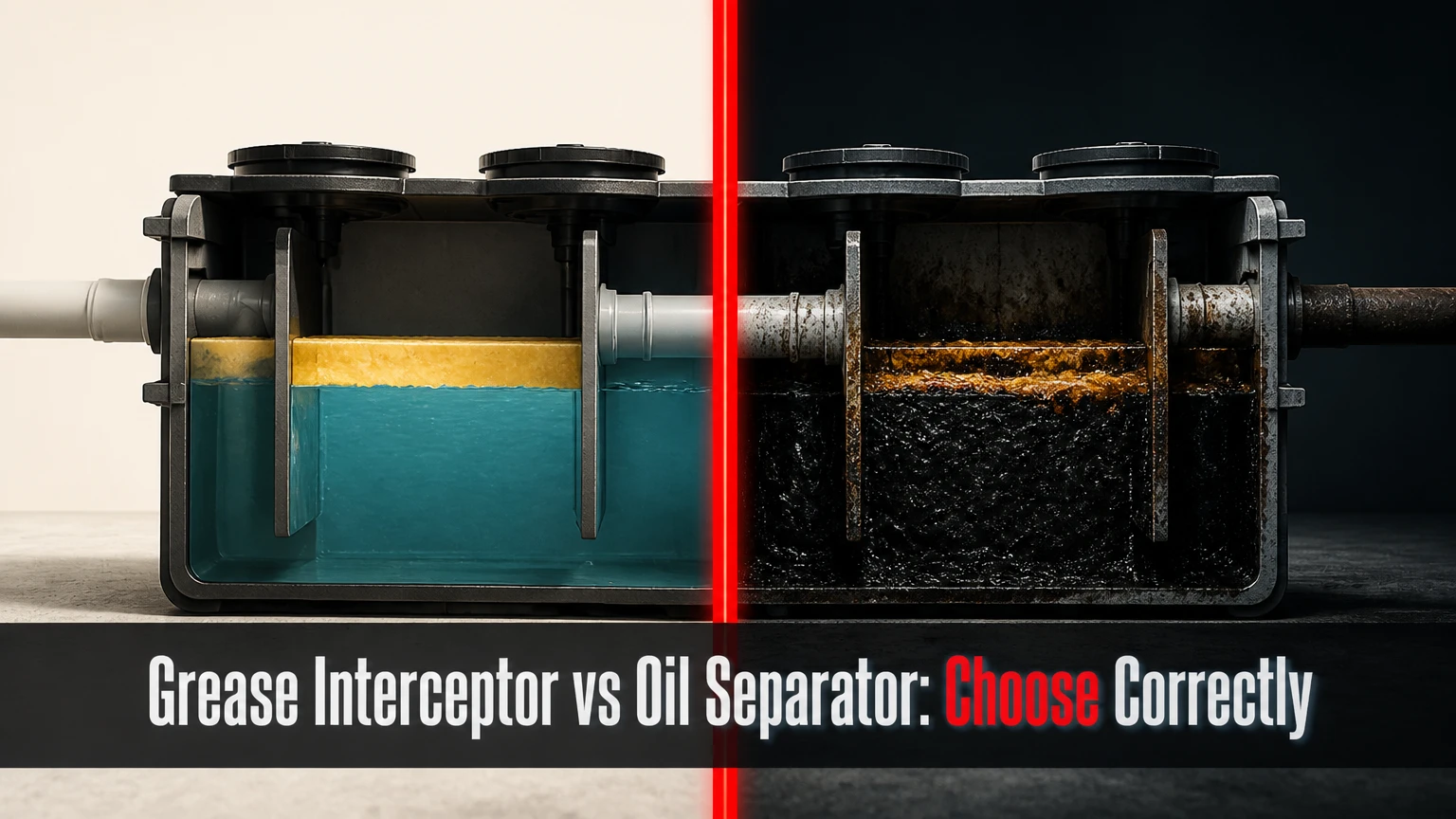
A grease interceptor captures food-related fats, oils, and grease (FOG) from commercial kitchen wastewater, while an oil separator captures petroleum hydrocarbons from industrial wash water or stormwater. The correct choice depends on the pollutant, drainage system, peak flow, discharge destination, and local plumbing or environmental approval. They are not interchangeable.
Key Facts at a Glance
- A grease interceptor targets animal fats, vegetable oils, grease, food solids, and kitchen sediment.
- An oil-water separator targets gasoline, diesel, lubricating oil, hydraulic fluid, and petroleum-contaminated sediment.
- Grease interceptors normally protect sanitary sewers from kitchen wastewater; oil separators often protect stormwater or industrial drainage.
- Gravity grease interceptors require adequate retention time, while coalescing oil separators improve removal of smaller oil droplets.
- A kitchen with food preparation usually needs a grease control device, not a petroleum oil separator.
- A vehicle wash bay usually needs sediment control plus an oil separator, not a kitchen grease interceptor.
Grease Interceptor vs Oil Separator: The Core Difference
The core difference is the waste stream each device is designed to treat. A grease interceptor removes buoyant organic FOG and food solids from kitchen plumbing, whereas an oil separator removes petroleum-based hydrocarbons, mineral oils, fuels, and grit from vehicle, industrial, or runoff drainage.
Both systems use density differences, but their design assumptions differ. Kitchen grease commonly cools and accumulates as a floating blanket; petroleum oil can remain dispersed in wash water, especially when detergents, pressure, heat, or turbulence create emulsions.
| Decision factor | Grease interceptor | Oil separator |
|---|---|---|
| Primary pollutant | Animal fats, vegetable oils, shortening, food grease | Gasoline, diesel, motor oil, hydraulic oil |
| Typical source | Restaurant sinks, dishwashers, food processing | Garages, fueling areas, wash bays, industrial yards |
| Main solids | Food particles, starch, organic sludge | Sand, gravel, metal fines, roadway sediment |
| Usual drainage | Commercial sanitary sewer | Stormwater or industrial wastewater drain |
| Separation method | Settling, cooling, flotation, baffles | Settling, flotation, coalescing media, shutoff |
| Typical access | Kitchen floor, exterior vault, buried tank | Exterior vault, wash-bay trench, buried separator |
| Waste classification | FOG and organic solids | Hydrocarbon liquid and contaminated sediment |
| Main maintenance task | Pump grease and settled food solids | Remove oil, sludge, and contaminated media |
A grease interceptor is not a general-purpose oil-treatment tank. An oil separator is not a substitute for a plumbing authority-approved grease interceptor.
How Does a Grease Interceptor Work?
A grease interceptor slows kitchen wastewater so heavy solids settle and buoyant FOG rises before partially clarified water leaves through the outlet. The inlet flow control, internal baffles, submerged outlet, and available retention volume determine whether the unit captures waste instead of flushing it downstream.
Kitchen wastewater first passes through a flow-control fitting or inlet arrangement that limits excessive velocity. Food solids settle in the lower zone, while cooling fats and grease rise into the upper zone. Baffles retain both layers and draw the middle water layer toward the outlet.
The process has four practical stages:
- Flow reduction: The device limits incoming hydraulic velocity.
- Solids settling: Rice, bones, starch, and food particles accumulate at the bottom.
- FOG flotation: Grease cools, separates, and forms a floating layer.
- Submerged discharge: The outlet draws water below the grease layer and above excessive sludge.
Hydromechanical grease interceptors use compact chambers, air entrainment, and engineered flow paths. Gravity grease interceptors use a larger tank and longer detention period. Automatic grease removal devices add a skimmer, heater, control panel, or external grease collection container.
What Does a Grease Interceptor Capture?
A grease interceptor captures free-floating and separable kitchen FOG, not every form of dissolved or chemically emulsified grease. It also retains food solids when the tank has sufficient lower storage and the inlet velocity remains within its rated flow.
Typical design terminology includes:
- FOG: Fats, oils, and grease from food preparation.
- TSS: Total suspended solids, including food particles and sediment.
- Hydromechanical grease interceptor (HGI): A compact, flow-rated plumbing device.
- Gravity grease interceptor (GGI): A larger tank that depends on volume and detention time.
- Automatic grease removal device (GRD): A mechanical unit that skims separated grease into a container.
The familiar “25% rule” is a maintenance trigger used by many authorities and service programs, but it is not a universal national rule. In jurisdictions that use it, pumping is required when the combined floating grease and settled solids occupy approximately 25% of the operating depth. The local sewer authority determines the enforceable interval.
How Does an Oil Separator Work?
An oil separator slows contaminated water so grit settles and free petroleum droplets rise, while coalescing media merge smaller droplets into larger ones. The separator then retains the oil layer and discharges treated water through an outlet, sometimes with a high-level alarm or automatic shutoff valve.
The inlet chamber reduces turbulence. Sand and heavy sediment fall into a grit compartment before water reaches the separation zone. In a coalescing separator, oil droplets contact oleophilic media, combine with adjacent droplets, and rise as larger, more buoyant globules.
A typical sequence is:
- Calming and screening: The inlet reduces splash and captures large debris.
- Grit removal: Sand, mud, and metal particles settle into a sump.
- Droplet separation: Free oil rises by gravity.
- Coalescence: Media increase effective droplet size and separation efficiency.
- Oil retention: A baffle prevents the surface layer from escaping.
- Discharge protection: A shutoff valve can close when oil reaches a defined level.
Oil separators cannot reliably remove dissolved hydrocarbons or stable detergent emulsions through gravity alone. Sites with emulsified oil may need source-control changes, chemical pretreatment, dissolved-air flotation, biological treatment, or a permitted industrial wastewater treatment system.
What Types of Oil Separators Are Available?
API-style gravity separators suit large flows and relatively large oil droplets, while coalescing plate separators provide greater separation performance in a smaller footprint. Bypass separators handle ordinary rainfall while directing high storm flows around the treatment chamber, and full-retention units treat the design flow.
| Separator type | Typical use | Typical design feature | Main limitation |
|---|---|---|---|
| API-style gravity basin | Refineries and large process sites | Long horizontal detention basin | Large footprint and lower performance on fine droplets |
| Coalescing plate separator | Garages, wash bays, industrial drainage | Inclined oleophilic plate pack | Media clog when grit control is poor |
| Full-retention separator | Fueling areas and high-risk yards | Treats the specified design flow | Higher capital and hydraulic requirements |
| Bypass separator | Parking areas and ordinary stormwater | Diverts extreme flows around treatment volume | Not suitable for every spill-risk location |
| Compact hydrocarbon interceptor | Small plant rooms or equipment areas | Small vessel with internal separator pack | Limited sludge and oil storage |
The terms “oil separator,” “oil-water separator,” and “petrol interceptor” can describe different products in different countries. Product names do not establish compliance. The approved standard, rated flow, discharge limit, and local authority acceptance do.
Where Should Each System Be Installed?
Grease interceptors belong on kitchen wastewater lines, while oil separators belong on drainage exposed to petroleum products. The drainage connection matters as much as the building’s business type because a single facility can contain separate sanitary, process, and stormwater systems.
| Facility or area | Likely pollutant | Correct primary device | Additional control |
|---|---|---|---|
| Restaurant kitchen | FOG and food solids | HGI or GGI | Dry scraping and screened sinks |
| Supermarket deli | FOG, starch, food debris | Grease interceptor | Separate mop and floor-drain review |
| Food-processing plant | FOG, solids, chemicals | Engineered GGI or treatment train | Process sampling and equalization |
| Auto repair shop | Motor oil, fuel, metal grit | Oil separator | Spill containment and dry cleanup |
| Vehicle wash bay | Oil, detergent, sand | Coalescing separator | Dedicated grit chamber |
| Fueling station | Fuel, oil, storm sediment | Full-retention oil separator | Automatic shutoff and spill plan |
| Parking garage | Dripped hydrocarbons and sediment | Oil separator where required | Stormwater permit review |
| Airport maintenance area | Jet fuel, lubricants, deicing chemicals | Engineered hydrocarbon system | Industrial permit and sampling |
A restaurant may also have a vehicle loading area requiring stormwater controls. Conversely, a fleet facility may contain a staff kitchen requiring a separate grease interceptor. One tank should not receive incompatible waste streams merely because both pollutants float.
Which Standards and Discharge Rules Apply?
Local plumbing and sewer authorities determine grease-interceptor requirements, while environmental permits and stormwater rules determine oil-separator requirements. ASME A112.14.3 and PDI-G101 are relevant to certain grease-control products in North America, while EN 858 is widely used for oil separators in Europe and other markets.
The United States Environmental Protection Agency regulates pollutant discharges through programs established under the Clean Water Act, but the EPA does not provide one universal oil-separator size for every facility. Municipal sewer-use ordinances may set local limits for oil and grease, and stormwater permits may require best management practices, inspections, or numeric hydrocarbon limits.
For procurement, verify:
- Product certification and applicable plumbing standard.
- Authority-approved flow rating.
- Required retention volume and sediment storage.
- Structural loading, buoyancy, and groundwater conditions.
- Venting, access covers, sampling points, and alarms.
- Discharge destination and sewer connection approval.
- Waste-hauler documentation and disposal requirements.
A device can be physically effective and still fail an inspection if it lacks the required certification, access, venting, or maintenance record.
How Are Grease Interceptors and Oil Separators Sized?
Sizing starts with peak hydraulic flow and pollutant loading, not pipe diameter alone. Grease systems must account for fixture flow, food solids, temperature, and retention, while oil systems must account for rainfall intensity, drainage area, sediment, spill risk, and the required treated flow.
| System class | Typical flow or capacity | Typical equipment cost | Typical installation period |
|---|---|---|---|
| Under-sink HGI | 4-75 gallons per minute | $500-$2,500 | 1-3 days |
| Automatic GRD | 4-100 gallons per minute | $4,500-$9,000 | 2-5 days |
| Outdoor GGI | 500-5,000 gallons liquid volume | $4,000-$12,000 | 2-4 weeks |
| Coalescing oil separator | 10-500 gallons per minute | $6,000-$35,000 | 3-6 weeks |
| Large industrial separator | 500+ gallons per minute | Project-specific | 6-16 weeks |
These are typical planning ranges, not quotations. Excavation, traffic control, concrete restoration, electrical work, groundwater, engineering, permits, and contaminated-waste disposal can exceed the equipment price.
Grease Interceptor Sizing Considerations
A commercial kitchen designer normally evaluates fixture discharge, simultaneous use, pipe configuration, grease production, and local sizing formulas. A dishwasher’s temperature and detergent load deserve special attention because hot, turbulent discharge can transport grease through a small device before separation occurs.
Typical compact units handle approximately 4-75 gallons per minute, while outdoor gravity tanks commonly range from several hundred to several thousand gallons. The correct rating is the approved design value, not the maximum marketing number printed on a product brochure.
Oil Separator Sizing Considerations
Oil-separator sizing uses the design flow from the contributing drainage area and the expected pollutant risk. For stormwater, engineers may calculate rainfall intensity, catchment area, runoff coefficient, and bypass behavior. For wash bays, they evaluate hose flow, pressure-washer flow, sediment load, and whether detergents are used.
A separator rated for 50 gallons per minute can be overwhelmed by a 100-gallon-per-minute wash system. High velocity can carry previously captured oil over the outlet baffle. Upstream sediment control is often the difference between a coalescing pack that operates for months and one that blinds within weeks.
What Are the Maintenance Requirements?
Grease interceptors require regular removal of floating FOG and settled food solids, while oil separators require removal of both floating hydrocarbons and bottom sediment. Inspection frequency should increase when a facility has high flow, heavy solids, detergents, seasonal storms, or a history of blockages.
| Maintenance activity | Grease interceptor | Oil separator |
|---|---|---|
| Surface layer | Pump FOG and inspect baffles | Vacuum oil and inspect retention baffle |
| Bottom layer | Remove food sludge and sediment | Remove grit and contaminated sludge |
| Internal parts | Check flow control and gaskets | Clean or replace coalescing media |
| Inspection trigger | Grease plus solids near local limit | Oil or sludge near rated storage |
| Typical service interval | Monthly to quarterly, site-dependent | Quarterly to annually, site-dependent |
| Records | Pump date, volume, condition, hauler | Oil, sludge, inspection, alarm, disposal records |
The most reliable maintenance plan uses measured accumulation rather than a generic calendar. A new restaurant may need monthly pumping during its first operating season, then move to a longer interval after actual accumulation is documented.
Oil separators require special waste handling because recovered oil and sediment may contain regulated hydrocarbons or metals. Pressure-washing separator contents into a drain defeats the treatment system and may create an illegal discharge.
What Happens When Detergents or Hot Water Emulsify Oil?
Detergents, solvents, high pressure, and excessive heat can create stable emulsions that gravity separators cannot remove efficiently. The immediate result is often cloudy effluent, elevated oil-and-grease readings, or hydrocarbon carryover despite an apparently clean tank.
Commercial kitchens should scrape plates and pans into waste containers before washing. Vehicle facilities should select detergents compatible with the separator and avoid assuming that a “biodegradable” label means the product is separator-safe.
Practitioner rules that prevent many failures include:
- Keep solvent cleaning out of gravity treatment lines.
- Install a grit trap before a coalescing media pack.
- Do not route roof runoff into a grease interceptor.
- Do not route kitchen wastewater into a stormwater oil separator.
- Control the source before buying a larger tank.
An oil separator is also a poor solution for a chemical process that dissolves hydrocarbons into water. Such a site needs wastewater characterization and treatment design rather than a larger passive separator.
What Are the Most Common Selection Mistakes?
The most damaging mistake is matching equipment to the business name instead of the waste stream. An auto shop with no wash water may need spill prevention and sealed drainage more than a large separator, while a restaurant with heavy frying may need a gravity interceptor even if its available pipe is only 2 inches.
| Mistake | Result | Corrective action |
|---|---|---|
| Choosing by pipe diameter | Hydraulic bypass and carryover | Calculate peak fixture or storm flow |
| Sending food waste to an oil separator | FOG buildup and unsuitable disposal | Install an approved grease interceptor |
| Sending fuel drainage to a grease interceptor | Hydrocarbon discharge and compliance risk | Use a hydrocarbon-rated separator |
| Omitting a grit chamber | Coalescing media clogging | Add upstream sediment storage |
| Using strong degreaser upstream | Stable emulsion and poor removal | Change chemicals and cleaning practice |
| Installing inaccessible covers | Missed inspections and unsafe service | Provide truck access and lifting clearance |
| Ignoring groundwater buoyancy | Tank movement or structural damage | Obtain structural and geotechnical review |
One counterintuitive point matters: a larger tank does not fix emulsification. Separation depends on droplet behavior, and a chemically stabilized droplet can remain suspended through a much larger gravity chamber.
Which System Should Your Facility Choose?
The correct system follows the pollutant and discharge route, not the equipment label. Use the following decision path before requesting bids:
- Restaurant or food-service kitchen: Specify an approved grease interceptor sized for fixture flow and local FOG rules.
- Food-processing operation: Characterize FOG, solids, temperature, cleaning chemicals, and process flow before selecting a gravity tank.
- Auto repair shop: Use oil-spill controls and an oil separator where contaminated drainage is permitted or required.
- Car wash or detailing bay: Install sediment pretreatment and a coalescing oil separator sized for simultaneous wash flow.
- Fueling or fleet yard: Use a hydrocarbon separator with spill containment and consider an automatic shutoff.
- Parking garage: Confirm whether local stormwater rules require treatment, then size for the contributing drainage area.
- Mixed commercial site: Keep kitchen, sanitary, industrial, and stormwater drainage separate unless an engineer designs a combined treatment train.
Can One Facility Need Both Devices?
A facility can need both systems when it contains separate food-service and petroleum-handling areas. The kitchen line should pass through a grease interceptor, while the garage, fueling, or wash-bay drainage should pass through an oil separator designed for hydrocarbons.
Combining the streams usually increases maintenance complexity and may make neither device compliant. A licensed plumbing designer or environmental engineer should confirm hydraulic connections, sampling locations, venting, and discharge authorization.
Alternatives to Passive Separation
Source control is often the least expensive alternative or supplement. Dry cleanup, absorbent materials, covered storage, screened drains, spill kits, low-flow wash equipment, and compatible detergents reduce pollutant loading before wastewater reaches a treatment device.
For difficult industrial waste, alternatives may include:
- Equalization tanks for variable batch flows.
- Dissolved-air flotation for emulsified fats and oils.
- Chemical treatment for stable emulsions.
- Membrane or biological treatment for dissolved contaminants.
- Vacuum recovery for vehicle wash water.
- Closed-loop wash-water recycling.
- Secondary containment with no routine drain discharge.
These alternatives require process testing and permit review. A grease interceptor or oil separator should not be represented as treatment for dissolved metals, solvents, emulsified hydrocarbons, or unrestricted hazardous waste.
Frequently Asked Questions
Is an oil separator the same as a grease trap?
No. A grease trap or grease interceptor targets food-related FOG and solids from kitchen wastewater. An oil separator targets petroleum hydrocarbons and mineral oils from vehicle, industrial, or stormwater drainage. Some jurisdictions use “interceptor” as a broad plumbing term, so the product specification and approved application matter more than the informal name.
Do storm drains need an oil separator?
Storm drains need an oil separator only when the authority, permit, risk assessment, or site design requires hydrocarbon treatment. Fueling stations, vehicle maintenance yards, airports, and contaminated parking areas present higher risk than ordinary roof runoff. Engineers must evaluate drainage area, rainfall, spill potential, bypass design, and the receiving water or sewer.
How often should a grease interceptor be pumped?
A grease interceptor may require monthly, quarterly, or less frequent service, depending on FOG production, tank size, fixture use, and local rules. Measure the grease and solids layers during inspections, follow the authority’s trigger, and keep manifests. Calendar-only pumping can under-service a busy kitchen or waste money at a lightly used site.
Can a grease interceptor remove motor oil?
A grease interceptor is not designed or approved as primary treatment for motor oil, gasoline, diesel, or other petroleum hydrocarbons. Some free oil may float temporarily, but the device lacks the hydrocarbon-specific storage, coalescing performance, alarms, and regulatory design required for vehicle or industrial drainage.
Can an oil separator handle restaurant wastewater?
An oil separator should not receive restaurant wastewater unless an engineered treatment system and authority approval specifically allow it. Food solids and sticky FOG can foul the separator, while detergents and hot water can emulsify fats. Commercial kitchens normally require a dedicated grease-control device connected to the sanitary drainage system.
What should be tested before selecting either device?
Test or document peak flow, pollutant type, temperature, solids loading, detergent or solvent use, drainage area, discharge destination, and required effluent limits. For industrial sites, laboratory characterization of oil concentration, emulsion stability, pH, and suspended solids can prevent an expensive unit mismatch.
The Bottom Line
A grease interceptor vs oil separator decision is fundamentally a pollutant and drainage decision. Choose a grease interceptor for food-service FOG and solids, choose an oil separator for petroleum hydrocarbons and sediment, and use separate systems when a facility produces both waste streams. Confirm sizing, certification, discharge approval, access, and maintenance requirements with the local authority before installation.