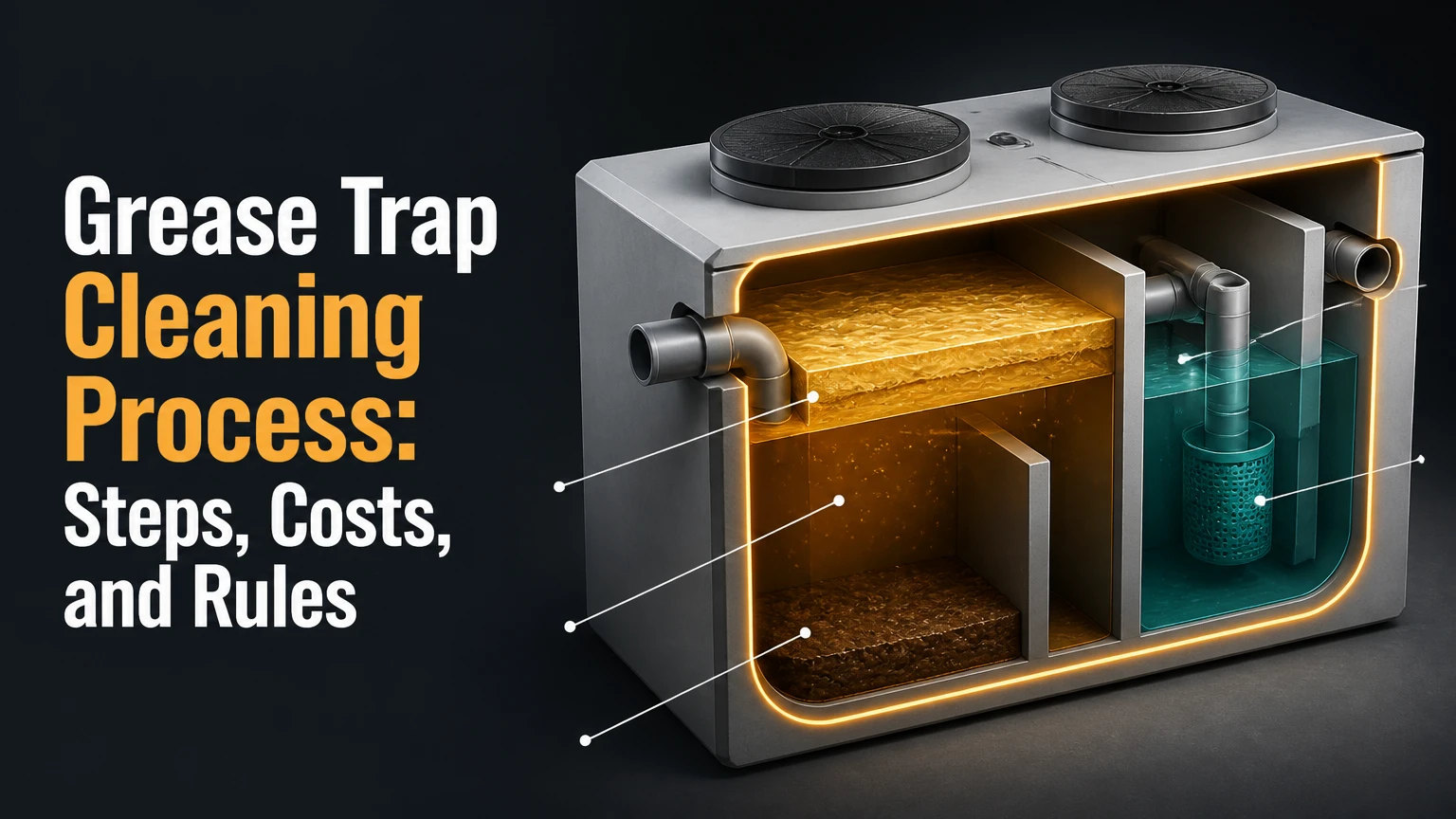
The grease trap cleaning process removes accumulated fats, oils, grease, wastewater, and settled food solids from a plumbing interceptor so the unit can separate waste before discharge. A complete service includes safe isolation, measurement, full pumping or removal, baffle and gasket inspection, interior cleaning, reassembly, flow testing, and a dated maintenance record.
Key Facts at a Glance
A grease trap works by slowing wastewater so lighter FOG floats and heavier solids settle.
The widely used one-quarter rule measures floating grease plus settled solids against the liquid depth, but local code determines the enforceable schedule.
A small indoor interceptor commonly takes 30-45 minutes to clean; a large outdoor interceptor commonly takes 1-2 hours.
Cleaning must remove both the surface grease layer and bottom sludge. Skimming alone leaves the trap functionally dirty.
Hot water, solvents, and emulsifying degreasers can move grease into the sewer instead of removing it.
A service record should identify the trap, date, measured accumulation, waste quantity, hauler, destination, and technician.
What Is a Grease Trap Cleaning Process?
A grease trap cleaning process is the controlled removal of FOG and solids from a hydromechanical grease interceptor or gravity grease interceptor. The work protects kitchen drainage, municipal sewer mains, wastewater treatment equipment, and the facility’s compliance record.
The terms are often used interchangeably, although equipment differs. A small under-sink unit is usually called a grease trap or hydromechanical grease interceptor. A large underground tank is generally called a grease interceptor. An automatic grease recovery unit, or AGRU, separates grease with mechanical skimming and still requires collection-tray emptying and periodic internal servicing.
FOG includes animal fats, vegetable oils, shortening, butter, sauces, and grease suspended in wash water. Food particles, starch, coffee grounds, and sediment form the heavier solids layer. When these materials accumulate, effective capacity falls and grease can pass through the outlet.
The process is therefore more than opening a lid and scooping a crust. A partial cleanout can leave sludge under the water, grease attached to baffles, and hardened deposits in the inlet and outlet tees.
How Does a Grease Trap Work?
A grease trap separates wastewater through controlled flow, cooling, buoyancy, and sedimentation. The inlet slows incoming water, the chamber provides separation space, baffles retain floating and settled material, and the outlet draws clarified water from an intermediate level.
Warm kitchen wastewater enters through an inlet tee or flow-control device. Reduced velocity gives water time to cool. Lower-density fats and oils rise to the surface, while food solids and grit settle at the bottom. The outlet tee is positioned to draw water from between those layers.
Many gravity interceptors have two chambers. The first chamber receives most of the solids and grease load; the second chamber provides additional clarification before discharge. A failed baffle, excessive flow, or insufficient capacity can defeat the separation process even when the tank was recently pumped.
A two-minute retention figure appears in some design guidance, but it is not a universal cleaning rule or a guarantee for every interceptor. Required capacity, flow rate, configuration, and retention time depend on the model, plumbing design, and authority having jurisdiction. The local plumbing or wastewater code controls.
What Does the One-Quarter Rule Measure?
The one-quarter rule means cleaning is due when floating grease and settled solids together occupy approximately 25% of the operating depth. A technician measures the surface grease layer and bottom sludge separately, then compares their combined thickness with the liquid depth.
For example, a trap with a 20-inch liquid depth reaches the threshold when the combined grease and solids layers measure about 5 inches. Some authorities specify a different measurement method, so a facility should use the local inspection form or approved procedure rather than assume that 25% applies identically everywhere.
The rule is a trigger, not permission to wait until the outlet backs up. High-volume kitchens may need service before the threshold because rapid loading can carry grease downstream between inspections.
Which Grease Trap Requires Which Cleaning Method?
Trap type determines the cleaning method, access requirements, labor, and realistic service interval. Small hydromechanical units can sometimes be cleaned by trained staff, while large outdoor interceptors generally require a permitted pumping contractor and a vacuum truck.
| Equipment type | Typical capacity | Cleaning method | Typical service pattern |
|---|---|---|---|
| Under-sink hydromechanical interceptor | 10-100 gallons | Manual removal or wet vacuum where permitted | Every 1-4 weeks |
| In-floor hydromechanical interceptor | 20-150 gallons | Full manual cleanout or portable pump | Every 1-4 weeks |
| Automatic grease recovery unit | 20-150 gallons | Daily tray emptying plus periodic internal service | Tray daily, unit per manufacturer |
| Outdoor gravity interceptor | 500-5,000+ gallons | Vacuum truck pump-out and washdown | Often 30-90 days |
| Multi-compartment interceptor | 1,000-10,000+ gallons | Pump all chambers and inspect baffles | Code- and load-based |
Hydromechanical Interceptors
Hydromechanical units use a compact chamber, flow control, and baffles. Their small volume allows grease to accumulate quickly, particularly in restaurants that fry food, wash cookware frequently, or operate dishwashers continuously.
Staff cleaning may be acceptable for a small unit only when local rules, the manufacturer, and the facility’s waste procedures permit it. A staff member should never improvise with a household vacuum, pour waste into a sink, or place liquid grease in an unapproved container.
Automatic Grease Recovery Units
AGRUs skim separated grease into a removable container. The collection tray may need emptying every day, but mechanical skimming does not remove settled solids or deposits on the tank walls. The manufacturer’s operating and cleaning instructions take priority because heaters, motors, scrapers, and sensors can be damaged by incorrect tools or chemicals.
AGRUs reduce grease handling frequency in some kitchens. They do not eliminate pumping, inspection, or documentation.
Gravity Grease Interceptors
Large gravity units rely on volume and retention time. Their manholes may be outdoors, below vehicle areas, or several feet from the building, so cleaning involves traffic control, hose routing, weather planning, and vacuum-truck access.
Professional service should remove the contents from every chamber, clean the walls and baffles, inspect inlet and outlet tees, and confirm that the lids reseal. Pumping only the first chamber leaves the system loaded.
Before You Start: Safety, Tools, and Access
A small indoor grease trap cleanout commonly requires 30-60 minutes, protective equipment, absorbent materials, a scraper, measurement tools, and an approved waste container. Large outdoor interceptors require a vacuum truck, trained personnel, traffic and access controls, and procedures for potentially hazardous wastewater exposure.
Before-You-Start Checklist
| Requirement | Typical specification | Why it matters |
|---|---|---|
| Protective gloves | Chemical-resistant, extended-cuff nitrile or neoprene | Limits skin contact with FOG and wastewater |
| Eye and face protection | Sealed goggles plus face shield | Controls splash exposure during pumping |
| Container | Lidded, leak-resistant, approved waste vessel | Prevents spills and unauthorized discharge |
| Measuring tool | Grease-depth stick or calibrated sludge judge | Documents the one-quarter threshold |
| Cleaning tools | Plastic scraper, stiff nylon brush, absorbent pads | Removes deposits without damaging surfaces |
| Work area | Shutoff, warning sign, dry footing, clear lid access | Prevents drainage and lifting injuries |
Stop dishwashing and avoid draining sinks during the service. Allow hot wastewater to cool, but do not rely on cooling to make an unsafe unit safe. Wastewater can contain pathogens, cleaning chemicals, sharp debris, and hydrogen sulfide in poorly ventilated spaces.
Never enter a grease interceptor. An underground interceptor is a potential confined space, and opening a manhole can expose workers to toxic gases, oxygen deficiency, traffic hazards, and engulfment. Professional contractors should use gas-monitoring and confined-space procedures where applicable.
What Is the Grease Trap Cleaning Process, Step by Step?
A complete grease trap cleaning process has eight operational stages: isolate the fixture, open and inspect the lid, measure accumulation, remove all contents, clean internal surfaces, inspect components, reassemble the unit, and verify flow. The success factor is complete removal rather than surface skimming.
Step 1: Shut Down the Connected Fixtures
Stop sinks, pot washers, dishwashers, and food-preparation drains connected to the interceptor. Place a sign on fixtures so another employee does not discharge water during the cleanout.
Checkpoint: No wastewater enters the trap while the lid is open.
Common mistake: Cleaning during active service, which raises the water level and creates splash exposure.
Step 2: Open the Lid and Inspect the Seal
Remove bolts or fasteners with the correct wrench, then lift the cover carefully. Grease trap lids can be heavy, slippery, and difficult to remove when gaskets have bonded to the rim.
Inspect the gasket, lid, fasteners, access frame, and odor seal. Photograph the internal layout before removing a baffle or tee, especially if the unit has removable components.
Checkpoint: The cover is stable, the gasket remains identifiable, and no crack or damaged fastener is overlooked.
Common mistake: Using excessive pry-bar force and warping the lid or frame.
Step 3: Measure Grease, Solids, and Liquid Depth
Measure the liquid depth from the normal reference point to the bottom. Measure the floating grease layer and settled solids layer separately, then record the readings before pumping.
A 20-inch liquid depth with 2 inches of grease and 3 inches of solids has reached a combined 5-inch, or 25%, accumulation level. Measurement records make service frequency defensible when an inspector asks why the interval changed.
Checkpoint: The record includes date, trap identification, total depth, grease depth, solids depth, and operator.
Common mistake: Measuring only the surface crust and ignoring bottom sludge.
Step 4: Remove the Entire Contents
For an outdoor interceptor, the vacuum truck should remove liquid, floating grease, and settled solids from each chamber. For an approved small-unit procedure, scoop surface FOG into a lined container, then remove wastewater and sludge with equipment authorized by the facility and local rules.
Do not drain trap contents into a sink, floor drain, storm drain, toilet, or exterior ground. Waste handling rules vary by jurisdiction, and some municipalities require a licensed transporter or documented disposal site.
Checkpoint: No standing liquid, visible sludge mound, or thick grease blanket remains.
Common mistake: Skimming the top and calling the trap clean while solids remain below the waterline.
Step 5: Scrape and Wash the Interior
Scrape grease from the walls, lid, inlet tee, outlet tee, baffle surfaces, and screens with a plastic scraper. Use warm water sparingly to loosen residue after the waste has been removed, and collect the wash water rather than sending concentrated grease downstream.
Avoid solvents, caustic degreasers, emulsifiers, and boiling water. These products can liquefy FOG and transport it through the outlet, where it may cool and harden in a sewer main.
Checkpoint: Baffles and tees are visible, openings are unobstructed, and no thick deposit remains on the outlet path.
Common mistake: Washing residue directly into the municipal sewer.
Step 6: Inspect Baffles, Tees, and Structural Parts
Confirm that each baffle is present, upright, secure, and installed in the manufacturer’s intended direction. Check for corrosion, cracks, missing seals, loose brackets, blocked flow-control devices, and damaged outlet fittings.
A trap that fills unusually quickly may have a broken baffle or a flow-control problem rather than a cleaning-frequency problem. Replacing a damaged component can restore separation; pumping alone cannot.
Checkpoint: Internal components match the original configuration and the outlet tee is intact.
Common mistake: Reinstalling a baffle backward or leaving a removable part outside the tank.
Step 7: Replace the Gasket and Secure the Lid
Clean the lid channel and gasket contact surfaces. Replace a cracked, hardened, compressed, or displaced gasket rather than relying on silicone grease to repair it.
Lower the lid evenly and tighten fasteners progressively. An uneven seal permits odors, leaks, and rainwater entry, while overtightening can distort the cover or damage the gasket.
Checkpoint: The lid sits level, fasteners are secure, and no visible gap remains around the perimeter.
Common mistake: Closing the lid with grease trapped on the gasket seat.
Step 8: Test Flow and Complete the Record
Run a controlled amount of clean water through the connected sink and observe the inlet, trap level, and outlet behavior. Check for leakage, slow drainage, unusual surging, or backup.
Record the service date, technician or employee, measured layers, estimated volume removed, equipment condition, additives used if any, waste transporter, disposal destination, and follow-up repairs.
Checkpoint: Water drains normally and the service record is complete before fixtures return to operation.
Common mistake: Assuming the absence of an immediate backup proves the downstream line is clear.
How Often Should a Grease Trap Be Cleaned?
Most small commercial grease traps require cleaning every 1-4 weeks, while large outdoor interceptors often receive service every 30-90 days. The correct interval is the shortest period required by local code, the manufacturer, the measured one-quarter rule, and the facility’s actual grease loading.
| Kitchen situation | Typical interval | Main reason for variation |
|---|---|---|
| Coffee shop with limited cooking | 3-4 weeks | Low FOG and solids loading |
| Café with daily food preparation | 2-3 weeks | Moderate wash-water volume |
| Frying-focused restaurant | 1-2 weeks | High oil, shortening, and solids load |
| Hotel or institutional kitchen | 2-8 weeks | Multiple fixtures and variable meal volume |
| Large outdoor interceptor | 30-90 days | Tank volume and local permit conditions |
The 90-day interval is not a universal legal maximum. Some authorities require quarterly service, while others require more frequent pumping or a documented performance-based schedule. Sacramento County, New York City, and other jurisdictions publish different requirements, so the facility must verify its own authority having jurisdiction.
Increase frequency after menu changes, holiday volume, a new dishwasher, repeated odors, rising grease measurements, or any downstream backup.
How Much Does Grease Trap Cleaning Cost?
Typical scheduled cleaning costs range from $125-$315 for a 20-100 gallon indoor trap and $350-$750 or more for a 1,000-2,500 gallon outdoor interceptor. Emergency pumping, difficult access, hardened deposits, line cleaning, disposal surcharges, and after-hours labor can raise the invoice substantially.
| Service type | Typical price range | Typical duration | Common cost driver |
|---|---|---|---|
| Small indoor trap | $125-$315 | 30-45 minutes | Access and waste volume |
| In-floor interceptor | $175-$400 | 45-75 minutes | Lid condition and pumping distance |
| Outdoor 1,000-2,500 gallon interceptor | $350-$750+ | 1-2 hours | Truck access and disposal |
| Emergency backup response | $400-$950+ | 1-3 hours | After-hours labor and line blockage |
| Hydro-jetting after pumping | $300-$1,000+ | 1-3 hours | Pipe length and hardened FOG |
These are typical North American service ranges, not regulated prices. A quote should state whether it includes all chambers, disposal, washdown, photographic documentation, manifests, odor treatment, and downstream pipe inspection.
The cheapest service is often a partial pump-out. Ask the contractor to specify the gallons removed and whether the truck vacuumed the bottom solids layer.
Can Additives Replace Grease Trap Cleaning?
Enzyme, bacterial, or biological additives cannot reliably replace physical grease trap cleaning or a legally required pump-out. Additives may reduce free grease under controlled conditions, but their performance depends on temperature, dosage, residence time, microbial activity, and the local authority’s rules.
Chemical emulsifiers are especially risky because they can keep grease suspended long enough to leave the interceptor. The grease then deposits farther downstream, where the facility has less access and a larger repair bill.
Some municipalities restrict additives because they interfere with interceptor measurement or shift FOG into public mains. Use an additive only when the manufacturer, wastewater authority, and service plan permit it, and never use it to extend an interval beyond a measured or mandated limit.
Which Mistakes Cause Repeat Grease Trap Failures?
The most expensive grease trap failures usually result from incomplete removal, incorrect discharge, damaged internal components, or a maintenance interval that ignores kitchen loading. Correcting employee habits reduces loading, but behavior changes cannot repair a blocked outlet or failed baffle.
- Using boiling water or degreaser: Liquefied FOG travels downstream and can solidify in cooler pipe sections. Use dry scraping and approved collection instead.
- Cleaning only the top layer: Bottom solids displace capacity and can rise into the outlet path. Pump or remove the full contents.
- Running food waste through a disposal: Ground solids still enter the interceptor and may fill it faster. Scrape plates into waste containers first.
- Reversing baffles: Incorrect orientation changes the hydraulic path and allows grease to escape. Photograph the arrangement before disassembly.
- Ignoring the lid gasket: A failed seal creates odor and leak complaints even when separation works. Replace deteriorated gaskets.
- Treating a backup as a trap-only problem: A clean interceptor cannot solve a downstream sewer blockage. Inspect and clear the connected line when flow remains poor.
- Skipping disposal records: An undocumented pump-out may not satisfy inspection requirements. Keep invoices and manifests with the maintenance log.
Expert Insight: The Outlet Is the Diagnostic Point
A trap can look clean from above while the outlet tee remains restricted by hardened grease. If water backs up immediately after a full pump-out, inspect the outlet and downstream line before repeating the same cleanout.
Expert Insight: High-Temperature Wastewater Can Reduce Separation
Hot water does not clean a grease trap. Excessive temperature keeps fats fluid, reduces early flotation, and can move FOG through the outlet before it cools. Source control, including plate scraping and controlled wash temperatures, usually outperforms chemical treatment.
Expert Insight: Pumping Frequency Should Follow Loading, Not Calendar Habit
Two restaurants with identical 1,000-gallon interceptors may require different schedules. A fryer-heavy restaurant can reach the threshold weeks earlier than a low-volume café, so measured accumulation and service records should guide interval changes.
How Should a Facility Document Cleaning and Waste Disposal?
A defensible grease trap record identifies what was cleaned, how much waste was removed, who performed the service, and where the waste went. Retain records for the period required by the local authority, commonly 12-24 months, although some jurisdictions require longer retention.
Include:
- Facility name and service address.
- Trap or interceptor location and capacity.
- Cleaning date and arrival time.
- Grease and solids measurements before service.
- Gallons or estimated volume removed.
- Chambers cleaned and components inspected.
- Repairs, gasket replacement, or line clearing.
- Hauler name, vehicle or license information where required.
- Disposal or recycling facility.
- Technician signature and invoice number.
Used cooking oil collected separately from a trap may have recycling value, but trap waste contains water and solids and follows different disposal rules. Never assume a used-oil recycler accepts interceptor contents.
Choosing a Maintenance Strategy by Facility Type
Low-volume cafés can often manage small interceptor cleaning with trained staff if local rules permit staff service and the waste route is approved. Medium-volume restaurants usually benefit from scheduled professional pumping because frequent production makes informal cleaning inconsistent.
High-volume restaurants, hotels, hospitals, and institutional kitchens should use a written FOG management plan. The plan should assign fixture responsibilities, require plate scraping, schedule inspections, define emergency contacts, and use a contractor able to provide manifests and pump-out documentation.
| Facility profile | Suitable equipment | Maintenance emphasis | Warning sign |
|---|---|---|---|
| Coffee shop, low solids | 10-50 gallon HGI | Weekly measurement, 3-4 week service | Odor near sink |
| Fast-food kitchen | 50-150 gallon HGI or AGRU | Frequent solids control, tray checks | Rapid surface buildup |
| Full-service restaurant | In-floor HGI or 500-1,500 gallon GGI | Scheduled pump-outs and records | Slow pot sink |
| Hotel or cafeteria | Multi-chamber GGI | Volume-based routing and inspections | Variable loading spikes |
| Hospital or institution | Large GGI with redundant access | Contractor plan and emergency response | Repeated compliance alerts |
When Should a Business Call a Professional?
Call a professional when the interceptor is underground, larger than a small indoor unit, inaccessible, overflowing, connected to a public backup, or subject to licensed-hauler requirements. Professional service is also appropriate when staff cannot verify safe waste disposal or when hydrogen sulfide, confined-space, or traffic hazards exist.
A contractor should pump the entire interceptor rather than skim the surface, identify damaged baffles, inspect inlet and outlet tees, and provide a written service record. Ask whether the truck can reach every chamber and whether the quoted price includes disposal.
A plumber, rather than only a pumping contractor, may be needed when flow remains restricted after cleaning. The problem may be a grease-filled building sewer, collapsed pipe, root intrusion, inadequate venting, or a failed flow-control device.
Troubleshooting Grease Trap Odors, Backups, and Escaping Grease
Why Does a Grease Trap Smell After Cleaning?
A persistent odor usually indicates residual sludge, a failed lid gasket, trapped debris in the inlet, poor ventilation, or biological decomposition inside the unit. Inspect the seal and internal surfaces first, then confirm that the trap was fully emptied rather than skimmed.
Do not mask the odor with fragrance chemicals. Correct the waste source, seal, or drainage condition.
Why Is Water Backing Up After Pumping?
A post-cleaning backup usually points to a blocked outlet tee, downstream building drain, insufficient venting, or a pump-out that left solids behind. A technician should test flow from the fixture to the interceptor and from the interceptor toward the sewer.
Hydro-jetting may remove hardened grease from downstream pipework, but jetting should follow proper waste capture and inspection. It does not substitute for regular interceptor cleaning.
Why Is Grease Escaping Into the Outlet?
Grease can escape because of excessive flow, inadequate capacity, a missing or broken baffle, an incorrectly installed outlet tee, hot wastewater, or a trap that exceeded its accumulation threshold. Inspect hydraulic components and compare actual kitchen flow with the interceptor’s design rating.
Do not solve repeated escape with more chemicals. Correct the hydraulic or maintenance cause.
Frequently Asked Questions
Can I clean a grease trap myself?
You may clean a small indoor interceptor yourself only when local regulations, the equipment manufacturer, and your waste-disposal system allow it. Staff must have protective equipment, approved containers, measurement tools, and training. Underground interceptors, overflowing units, and systems subject to licensed pumping rules require professional service.
How do I know whether my grease trap is full?
Measure the liquid depth, floating grease thickness, and settled solids thickness. When grease plus solids reaches roughly 25% of the liquid depth, service is commonly due under the one-quarter rule. Odor, slow drainage, or a backup can signal failure before the measured threshold is reached.
Should grease trap waste go in the dumpster?
Do not place liquid or wet interceptor waste in a dumpster unless the waste hauler and local rules specifically authorize that method. Trap contents can leak, create odors, attract pests, and violate disposal requirements. Use a sealed, approved container or a licensed contractor with documented disposal.
How long can a restaurant operate with a blocked grease trap?
A restaurant should stop using connected fixtures when wastewater backs up or the interceptor overflows. Continued discharge can spread contaminated water, damage floors, contaminate food-preparation areas, and push FOG into the public sewer. Emergency pumping and downstream line inspection should happen before normal operation resumes.
Does a grease trap need cleaning if an automatic recovery unit is installed?
Yes. An automatic grease recovery unit still requires routine collection-tray emptying, internal inspection, and periodic removal of settled solids. Follow the model-specific schedule and local code because mechanical skimming removes separated grease but does not eliminate sediment or deposits on internal components.
The Bottom Line
The grease trap cleaning process succeeds when the facility removes all FOG, wastewater, and settled solids, confirms that baffles and outlet tees work, reseals the lid, tests drainage, and documents disposal. Use the one-quarter rule as a practical trigger, but follow the local authority’s schedule and the interceptor manufacturer’s instructions. A clean trap cannot compensate for excessive flow, damaged plumbing, poor source control, or an obstructed downstream sewer line.