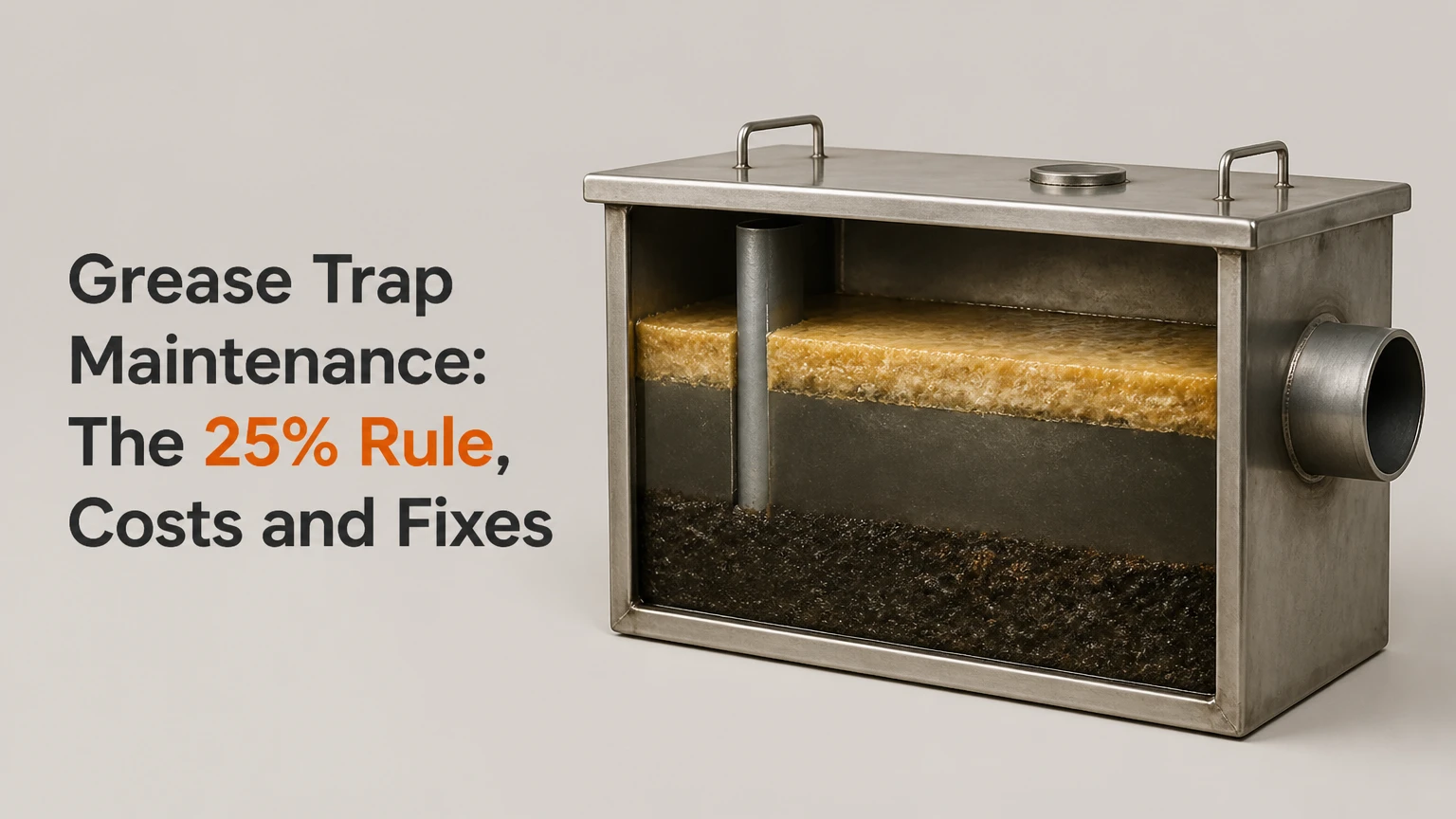
Grease trap maintenance is the inspection, measurement, cleaning, repair, and recordkeeping required to keep fats, oils, grease, and food solids out of sanitary sewer lines. A reliable program combines source control with cleaning before grease and sludge approach the limit set by the local sewer authority, commonly the 25% rule.
Key Facts at a Glance
A grease trap separates floating FOG from sinking food solids while wastewater passes through the middle layer.
The commonly cited 25% rule means grease and settled solids occupy no more than 25% of the trap’s operating capacity before service.
Cleaning frequency depends on loading, tank size, flow, temperature, and local code, so a fixed calendar interval is only a starting point.
Hot water and drain chemicals can move emulsified grease downstream without removing it from the wastewater system.
Under-sink traps may be serviced by trained staff, but large outdoor interceptors generally require a permitted vacuum service provider.
A complete maintenance record includes the service date, volume removed, waste destination, invoice or manifest, and observed defects.
What Is Grease Trap Maintenance?
Grease trap maintenance keeps a grease control device able to capture FOG and solids before wastewater reaches the building drain or public sewer. Maintenance includes daily kitchen practices, scheduled inspection, grease and sludge measurement, pump-out or manual cleaning, component checks, and documentation.
FOG includes animal fats, vegetable oils, shortening, butter, sauces, and cooking residues. FOG is less dense than water and tends to float after wastewater slows, while food particles, grit, and other heavy material settle at the bottom. If either layer becomes too deep, the trap loses effective separation volume.
A grease trap is often a small hydromechanical device installed beneath or near a sink. A grease interceptor usually refers to a larger gravity tank, commonly located outside underground, although local terminology varies. An automatic grease removal device, or AGRD, uses mechanical skimming to remove grease into a separate container.
Maintenance protects three systems at once: the kitchen plumbing, the municipal collection network, and the treatment process. A trap that looks acceptable from the lid can still have a blocked outlet baffle, damaged gasket, failed flow control, or grease-coated internal surfaces.
Why Does a Commercial Kitchen Need a Grease Trap?
Commercial kitchens need grease control because repeated FOG discharge can create building blockages, sewer overflows, odor complaints, and enforcement action. A restaurant that pours liquid fryer oil into a sink may send grease into a pipe where it cools and adheres to the wall, even if the grease trap appears to be functioning.
The U.S. Environmental Protection Agency identifies FOG as a major contributor to sanitary sewer overflows and recommends preventing FOG from entering drains. Municipal FOG programs commonly apply the practical instruction, “Keep grease out of the drain,” because source control reduces the load that the trap must capture.
A grease control device is not a substitute for waste reduction. Dry-scraping plates, collecting fryer oil, using drain screens, and preventing food scraps from entering sinks extend the device’s service interval.
How Does a Grease Trap Work?
A grease trap works by reducing wastewater velocity so density differences separate floating grease and sinking solids from water. Inlet piping and baffles limit turbulence, the grease layer rises, solids settle, and partially clarified water leaves through an outlet positioned between those layers.
The process has four stages:
- Inflow: Wastewater carrying FOG, food particles, detergent, and water enters the device.
- Flow reduction: A flow-control fitting and internal baffles reduce velocity and turbulence.
- Separation: FOG accumulates at the surface while heavy solids form sludge at the bottom.
- Discharge: The middle water layer passes toward the outlet without carrying most retained material.
Detergents, high water velocity, and hot discharge can interfere with separation. Surfactants suspend grease in small droplets, a condition called emulsification, while excessive flow carries those droplets through the outlet before they can coalesce and float.
What Do the Baffles and Flow Control Do?
Baffles divide the inlet and outlet zones, directing wastewater through the separation chamber instead of allowing a straight, turbulent path. A flow-control device limits the incoming rate so the tank receives wastewater at the hydraulic condition used during its design approval.
A missing, reversed, cracked, or obstructed baffle can cause immediate bypass. The same trap may separate adequately during a quiet period but fail when a dishwasher, pot sink, and prep sink discharge simultaneously.
Does the 25% Rule Apply to Every Grease Trap?
The 25% rule is a widely used service trigger, but the exact definition and enforcement method come from the local sewer authority or approved maintenance plan. In many programs, cleaning is required when the combined thickness of floating grease and settled solids reaches 25% of the operating depth, not necessarily 25% of the tank’s total physical volume.
For example, a 24-inch operating depth may reach the trigger when the measured grease and sludge layers together total about 6 inches. A technician must measure both layers rather than estimate from odor or surface appearance.
| Measurement | Example value | Maintenance meaning |
|---|---|---|
| Operating liquid depth | 24 inches | Approved working depth |
| Grease layer | 3.5 inches | Floating FOG accumulation |
| Sludge layer | 2.5 inches | Settled solids accumulation |
| Combined layer | 6 inches, 25% | Service trigger reached |
Some authorities specify a shorter interval, such as monthly pumping, regardless of measured accumulation. The legal requirement wins over a general rule of thumb.
What Types of Grease Control Devices Need Maintenance?
The three common device categories are passive hydromechanical traps, automatic grease removal devices, and gravity grease interceptors. Each requires routine service, but the service method, capacity, access conditions, and failure pattern differ substantially.
| Device type | Typical capacity or rate | Common location | Main maintenance task |
|---|---|---|---|
| Passive hydromechanical trap | 20-50 gallons per minute | Under a sink or inside a kitchen | Manual cleaning every 1-4 weeks |
| Automatic grease removal device | 25-100 gallons per minute | Near sinks or dishwashing equipment | Skimmer cleaning and container emptying |
| Gravity grease interceptor | 500-5,000+ gallons | Outdoor underground vault | Vacuum pump-out every 1-3 months |
| Solids interceptor or screen | 10-50 gallons per minute | Floor drain or fixture branch | Screen removal and solids disposal |
Passive Hydromechanical Traps
Passive traps are compact and require no electricity, making them practical for small cafes, bakeries, and limited-volume kitchens. Their weakness is dependence on staff access and consistent cleaning, particularly when the lid sits beneath stored equipment or a crowded sink cabinet.
Typical maintenance includes removing the lid, measuring layers, removing contents, cleaning the baffles, checking the gasket, and confirming correct reassembly. Staff should not treat a passive trap as a disposable filter.
Automatic Grease Removal Devices
An AGRD mechanically skims floating grease, often using a heated or rotating component, and transfers the recovered material to an external container. The device reduces manual tank scraping, but it does not eliminate inspection, solids removal, internal cleaning, or container management.
An AGRD is useful where high grease production or labor turnover makes manual service unreliable. Electrical controls, sensors, motors, heating elements, and skimmer settings create additional failure points.
Gravity Grease Interceptors
Gravity interceptors use a large tank and long flow path rather than active mechanical removal. Their service requires safe lid access, vacuum equipment, proper waste transport, and inspection of inlet and outlet structures.
An outdoor interceptor is unsuitable for neglect simply because it is large. A 1,000-gallon tank can fill faster than expected when a high-volume fryer operation, food plant, or institutional kitchen discharges continuously.
How Often Should a Grease Trap Be Cleaned?
A small passive grease trap is typically cleaned every 1-4 weeks, an AGRD receives daily or weekly attention, and a large gravity interceptor is often pumped every 1-3 months. Those ranges are operational starting points, not universal legal schedules.
Track measured accumulation for at least three service cycles. If a trap reaches the 25% trigger after 18 days, a 14-day schedule provides a practical safety margin; if it remains below the trigger after 30 days, the authority may still require more frequent service.
| Facility profile | Typical device | Starting service interval | Adjustment trigger |
|---|---|---|---|
| Coffee shop with light food preparation | 20-35 GPM passive trap | Every 2-4 weeks | Milk, cream, and food solids increase |
| Full-service restaurant | 35-75 GPM trap or interceptor | Every 2-8 weeks | Fryer volume and dishwasher surges |
| Fast-food kitchen | AGRD or 500-1,500 gallon interceptor | Daily skimming, monthly pump review | Heavy fryer and peak-hour loading |
| School or hospital kitchen | Gravity interceptor | Every 1-3 months | Meal volume and school calendar |
| Food processing facility | Engineered interceptor system | Weekly to monthly inspection | Production batch and washdown load |
The correct interval is the shortest of three limits: the measured accumulation limit, the permit or sewer authority schedule, and the interval needed to prevent operational symptoms.
What Changes the Cleaning Frequency?
Grease production, fixture count, water usage, tank size, wastewater temperature, detergent use, and staff behavior determine how quickly a trap fills. A new menu can invalidate an old schedule; adding a fryer or switching from plated meals to high-volume takeout often increases FOG loading sharply.
Measure after menu changes, equipment installation, seasonal volume increases, or repeated backups. Calendar-only maintenance is a common cause of premature service failure.
How Do You Clean an Under-Sink Grease Trap?
Trained staff can clean a small under-sink trap in approximately 30-60 minutes when the unit is accessible, cool, and legally permitted for in-house service. The job requires gloves, eye protection, absorbent material, sealed waste containers, a layer-measuring tool, scrapers, and a documented disposal method.
Before You Start
- Time: 30-60 minutes for a small unit
- Difficulty: Moderate, because contents may contain pathogens and sharp debris
- PPE: Chemical-resistant gloves, goggles, waterproof apron, and slip-resistant footwear
- Tools: Layer dipstick, bucket, scraper, stiff brush, absorbent pads, disinfectant
- Prerequisite: Confirm local rules permit staff cleaning and identify the approved waste route
Step 1: Stop Discharge and Protect the Work Area
Stop sink, dishwasher, and food preparation discharge connected to the trap. Place absorbent pads beneath the lid and keep food, utensils, and customers away from the work zone.
Checkpoint: No wastewater enters the unit during service.
Common mistake: Cleaning while another employee runs the dishwasher, which can cause overflow and contaminate the work area.
Step 2: Open the Lid Safely
Ventilate the area, loosen fasteners carefully, and lift the lid without damaging the gasket. Do not place your face over the opening, because trapped wastewater can release hydrogen sulfide and other unpleasant gases.
Checkpoint: The lid remains intact and the gasket is available for inspection.
Common mistake: Using excessive force on a corroded lid, which can create a leak or sharp metal edge.
Step 3: Measure Grease and Solids
Measure the floating grease layer and bottom sludge layer separately with a calibrated dipstick or approved device. Record the operating depth, grease depth, sludge depth, and combined percentage before removing material.
Checkpoint: The measurement identifies whether the local service threshold has been reached.
Common mistake: Measuring only the top crust and overlooking sludge that has reduced the tank’s working volume.
Step 4: Remove the Contents
Remove grease, solids, and wastewater with dedicated tools or approved pumping equipment. Place waste in leak-resistant, closable containers; never pour grease, sludge, or contaminated water onto soil, into a storm drain, or back into a sink.
Checkpoint: No visible grease or sludge remains on the tank bottom.
Common mistake: Returning bailed wastewater to the trap without confirming that local disposal rules allow it and that the material is not heavily contaminated.
Step 5: Clean the Tank and Components
Scrape internal walls, baffles, screens, and the lid, then wash them with warm water and an approved detergent. Avoid caustic drain openers, solvents, and unapproved biological products, because these substances can damage components or emulsify FOG into the sewer.
Checkpoint: Baffles, inlet openings, outlet openings, and screens are visible and unobstructed.
Common mistake: Removing a baffle and reinstalling it backward, which can create a direct bypass path.
Step 6: Inspect, Reassemble, and Test
Inspect the tank for cracks, corrosion, loose fittings, displaced baffles, damaged screens, and a hardened gasket. Reinstall every component according to the manufacturer’s configuration, tighten the lid evenly, and run a controlled flow test.
Checkpoint: Water enters and exits without leakage, backup, or visible grease carryover.
Common mistake: Applying general-purpose sealant to a failed gasket instead of replacing the gasket with the specified part.
Record the date, personnel, measured layers, quantity removed, defects found, cleaning method, and disposal destination. A photograph of the measurement or cleaned interior can strengthen an inspection record when local authorities accept photographic documentation.
Which Maintenance Practices Prevent Grease Buildup?
The most effective prevention strategy is to keep concentrated grease and food solids out of the drain before the trap has to separate them. Dry-scrape plates, collect fryer oil in a recycling container, install correctly sized drain screens, and train every shift on the same procedure.
| Prevention practice | Operating instruction | Maintenance effect |
|---|---|---|
| Plate scraping | Scrape food into solid-waste bins before rinsing | Reduces bottom sludge |
| Fryer oil recovery | Transfer used oil to a sealed collection drum | Prevents high-load FOG discharge |
| Drain screening | Clean screens each shift | Captures rice, bones, labels, and solids |
| Dishwashing control | Remove heavy grease before washing | Limits emulsified discharge |
| Staff inspection | Check sinks and odors at opening and closing | Finds problems before backups |
Do not use boiling-water flushes as a grease solution. Hot water may carry grease farther through the building drain, where it cools and attaches to pipe walls.
Biological additives and enzyme products also do not replace pumping. Some products reduce visible surface grease by emulsifying or digesting part of the load, but local sewer rules may prohibit them, and they cannot remove settled solids or repair a failed baffle.
How Much Does Grease Trap Maintenance Cost?
Typical professional service costs range from $150-$300 for a small passive trap, $200-$400 for an AGRD deep clean, and $400-$1,200 or more for a large outdoor interceptor pump-out. Actual pricing depends on access, tank size, waste volume, travel, emergency timing, disposal fees, and regional labor rates.
| Service type | Typical price | Typical duration | Cost driver |
|---|---|---|---|
| Small passive trap cleaning | $150-$300 | 30-60 minutes | Cabinet access and waste volume |
| AGRD deep cleaning | $200-$400 | 1-2 hours | Skimmer, motor, and solids removal |
| 500-1,500 gallon interceptor | $400-$900 | 1-2 hours | Vacuum truck access and hose distance |
| 1,500-5,000+ gallon interceptor | $700-$1,200+ | 2-4 hours | Tank volume and disposal weight |
| Emergency backup response | $500-$2,000+ | Same day | After-hours labor and drain restoration |
Typical purchase and installation costs are separate from recurring maintenance. A passive unit may cost $250-$1,500, an AGRD $3,500-$8,500 or more, and a gravity interceptor $5,000-$20,000 or more when excavation, permits, and connections are included.
The cheapest service visit is not always the lowest operating cost. A missed pump-out can add emergency plumbing, floor sanitation, spoiled food, regulatory penalties, and sewer restoration costs.
How Do Passive Traps, AGRDs, and Interceptors Compare?
Passive traps minimize initial cost and equipment complexity, AGRDs reduce manual skimming, and gravity interceptors provide the largest storage capacity. The right choice depends on approved flow rate, fixture load, available space, service access, and local plumbing requirements.
| Criterion | Passive trap | AGRD | Gravity interceptor |
|---|---|---|---|
| Typical flow rate | 20-50 GPM | 25-100 GPM | Engineered by tank volume and flow |
| Typical capacity | 7-100 gallons | 10-200 gallons | 500-5,000+ gallons |
| Electricity | Not required | Required | Not required for separation |
| Service access | Sink cabinet or floor | Kitchen equipment area | Exterior access covers |
| Best fit | Small, low-volume kitchen | High FOG, labor-sensitive kitchen | High-volume or institutional facility |
| Main failure risk | Neglected cleaning | Motor or sensor failure | Missed pump-out or blocked baffle |
A passive trap is not good for a high-volume fryer kitchen unless the approved design and service schedule support that load. An AGRD is not a license to ignore solids, and a gravity interceptor is not automatically adequate if its inlet flow exceeds the design rate.
Sizing should be performed from fixture discharge, peak flow, retention design, local requirements, and manufacturer data. Tank volume alone cannot compensate for an undersized inlet, poor baffle arrangement, or excessive simultaneous discharge.
What Causes Odors, Backups, and Grease Bypass?
Odors usually indicate retained organic material, a failed lid gasket, inadequate ventilation, or a dry plumbing trap. Backups usually indicate a full device, blocked inlet or outlet, downstream pipe buildup, or a collapsed component, while grease bypass often indicates excessive flow, emulsification, or damaged internal parts.
| Symptom | Likely cause | Immediate response |
|---|---|---|
| Rotten odor at lid | Failed gasket or dirty rim | Stop use, clean rim, inspect seal |
| Odor at sink drain | Dry P-trap or vent problem | Restore trap water and call plumber |
| Slow sink drainage | Full trap or blocked baffle | Stop discharge and arrange inspection |
| Wastewater backing up | Full interceptor or downstream blockage | Isolate fixtures and request pump-out |
| Grease in outlet | Excess flow or emulsification | Check flow control, temperature, detergents |
| Repeated failure after cleaning | Wrong size or damaged system | Obtain hydraulic and plumbing assessment |
A full pump-out does not fix a downstream sewer blockage. If clean water still backs up after the trap is emptied and the outlet is verified, the building drain or municipal lateral may require video inspection and mechanical cleaning.
Do not enter an interceptor. Confined-space hazards include toxic gases, oxygen deficiency, engulfment, and difficult rescue conditions. Keep covers secured and use qualified personnel for deep tanks.
What Should a Business Do During a Grease Backup?
During a grease backup, stop all connected fixtures, isolate the affected area, protect food and electrical equipment, and contact an approved pumping or drain contractor. Staff should not use caustic chemicals or hose contaminated wastewater into another drain.
Use this emergency sequence:
- Stop sinks, dishwashers, garbage disposals, and washdown operations.
- Keep customers and food away from contaminated surfaces.
- Photograph the overflow and identify the affected fixtures.
- Check whether the trap or interceptor is full, without entering it.
- Call the sewer authority if wastewater reached a storm drain or public area.
- Arrange pump-out and downstream line inspection.
- Clean and disinfect according to the local food safety procedure.
- Document the incident, waste removal, repairs, and corrective actions.
A sanitary sewer overflow may trigger immediate reporting requirements. A storm-drain discharge is especially serious because stormwater systems may carry pollutants directly to waterways without treatment.
What Records Should a Grease Trap Program Keep?
A commercial kitchen should retain a service log, invoices, waste manifests or receipts, inspection findings, repair records, and staff training documentation. Many sewer authorities require records for a defined period, often 2-5 years, but the local permit or ordinance controls.
A useful log records:
- Device identification and location
- Device type, capacity, and connected fixtures
- Service date and technician or employee
- Grease depth, sludge depth, and total measured depth
- Gallons or pounds removed
- Waste hauler and disposal or recycling destination
- Baffle, gasket, lid, flow-control, and vent condition
- Photographs, invoice number, and corrective action
- Next scheduled service date
Ask the service provider to state whether the tank was fully pumped, partially skimmed, or manually cleaned. “Serviced” is too vague to verify compliance.
Choosing a Practical Maintenance Program
Small cafes and bakeries usually need a compact passive trap, daily dry-scraping, and a measured cleaning schedule beginning around every two weeks. The schedule should tighten when dairy, sauces, frying, or heavy food preparation increases the grease load.
Full-service restaurants should coordinate dishwashing, fryer oil recovery, drain screening, and professional pump-outs. A manager should compare measured accumulation against sales volume and menu changes rather than relying on the previous owner’s schedule.
Fast-food operations with heavy fryer use may benefit from an AGRD or a larger approved interceptor. The device can reduce manual grease removal, but staff still need to empty recovery containers, remove solids, inspect alarms, and arrange periodic deep cleaning.
Schools, hospitals, and care facilities need a documented program that accounts for concentrated meal periods, school holidays, multiple kitchens, and sanitation controls. Food processing facilities generally require engineered pretreatment because washdown water may contain fats, solids, chemicals, and unusually high peak flows.
Frequently Asked Questions
Can I clean a grease trap without pumping it?
Small accessible traps may be manually cleaned if local rules and the manufacturer permit staff service. Large interceptors generally require full pump-out by a qualified hauler because sludge, wastewater, and grease must be removed safely and transported to an approved destination.
How long can a grease trap last?
A properly installed passive trap or interceptor can remain in service for many years, but lifespan depends on material, corrosion, cleaning quality, traffic loads, and component replacement. A damaged tank, cracked baffle, leaking lid, or structurally compromised underground interceptor should be repaired or replaced rather than repeatedly cleaned.
Should a dishwasher discharge into a grease trap?
A dishwasher may discharge into a grease control system only when the approved plumbing design allows it and the device can handle the temperature, flow, detergents, and grease load. Commercial dishwashers can create high-temperature, high-velocity discharges that reduce separation efficiency.
Is a grease trap the same as a grease interceptor?
Grease trap and grease interceptor are often used interchangeably, but many plumbing programs distinguish a small indoor hydromechanical trap from a larger outdoor gravity interceptor. The governing definition is the one used by the local sewer authority, plumbing code, permit, or approved equipment schedule.
Does a garbage disposal belong upstream of a grease trap?
A garbage disposal usually should not discharge to a grease trap unless the local authority and system design specifically allow it. Ground food waste increases sludge accumulation, reduces effective capacity, and can cause the trap to reach its service threshold much sooner.
The Bottom Line
Grease trap maintenance works when source control, measurement, cleaning, component inspection, and records operate as one program. Clean a passive trap before grease and sludge reach the locally enforced threshold, pump gravity interceptors on the approved schedule, and investigate every odor or backup instead of masking it with hot water or chemicals.
The best schedule is measured, not guessed. For a restaurant, begin with the local rule and a two- or four-week inspection cycle, record accumulation, then adjust service before the 25% trigger or any stricter legal limit. Effective grease trap maintenance protects plumbing, public sewers, food operations, and compliance costs at the same time.