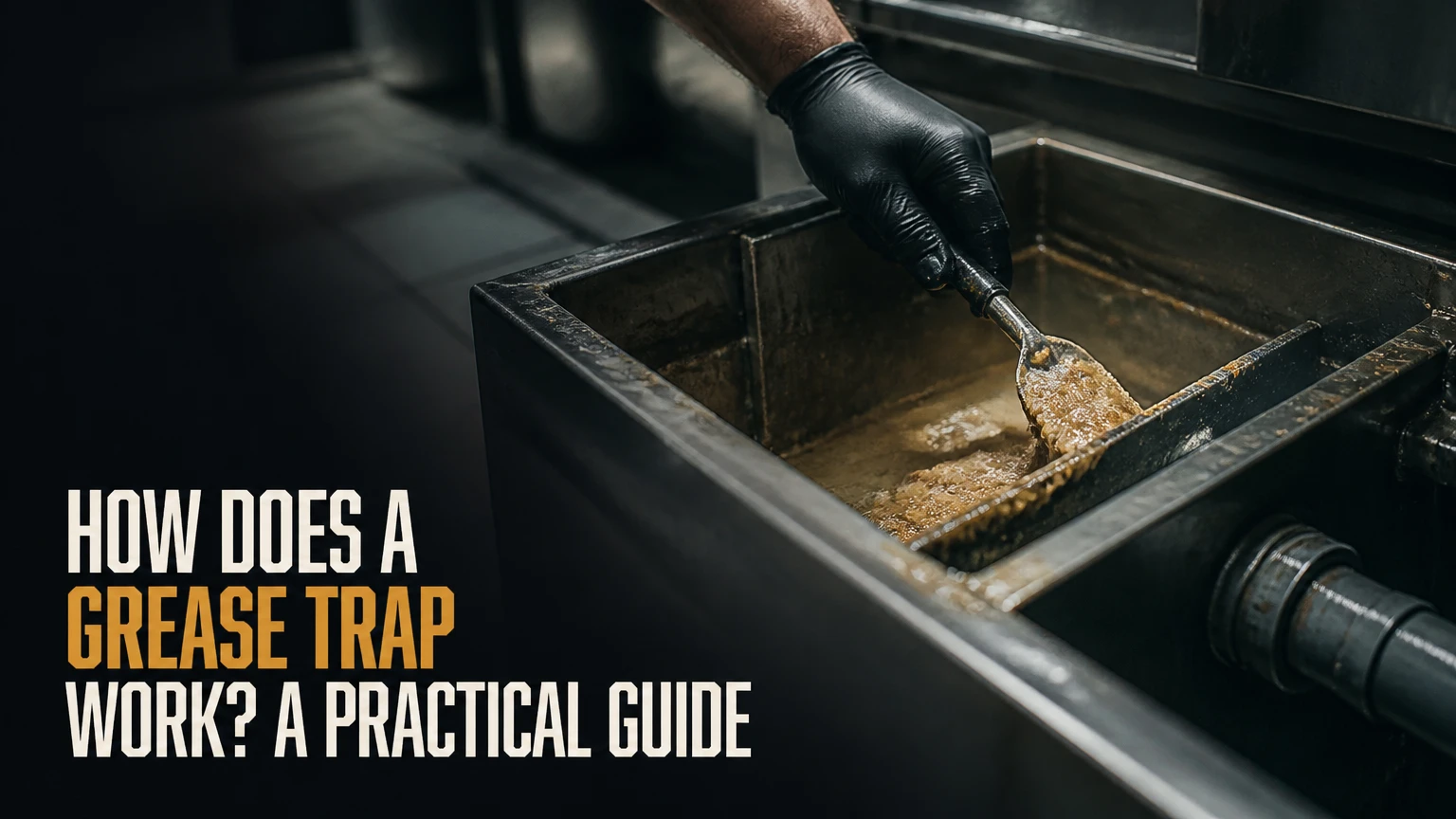
A grease trap is a plumbing device that separates fats, oils, grease, and settleable food solids from kitchen wastewater before discharge to a sewer. It slows the wastewater inside a baffled chamber, allowing lighter FOG to float, heavier solids to settle, and the clearer middle layer to leave through the outlet.
Key Facts at a Glance
- A grease trap removes FOG mainly through gravity, buoyancy, cooling, and detention time.
- The floating grease layer forms at the top, while food particles and sludge collect at the bottom.
- Baffles and flow-control devices reduce turbulence so separation can occur before discharge.
- A grease trap does not remove dissolved detergents, emulsified grease, pathogens, or every suspended pollutant.
- The common 25% cleaning rule is a regulatory benchmark in many jurisdictions, not a universal rule everywhere.
- Correct sizing depends on flow rate, fixture volume, wastewater temperature, local plumbing code, and cleaning access.
How Does a Grease Trap Work?
A grease trap works by slowing kitchen wastewater long enough for materials with different densities to separate. Fats, oils, and grease are generally less dense than water, so they rise to the surface; dense food particles sink, while relatively clarified water passes through the outlet zone.
The process depends on more than simple flotation. The inlet must reduce the wastewater’s velocity, the tank must provide sufficient retention volume, and the outlet must remain below the floating grease layer while staying above settled solids. If any of those conditions fails, FOG can pass into the sanitary sewer.
Warm wastewater also matters. Grease that enters as a liquid may cool inside the chamber and attach to the grease blanket, but very hot water, strong detergent, and high turbulence can keep grease dispersed. A small under-sink unit therefore performs poorly when a busy kitchen sends repeated surges from several fixtures at once.
What Happens Inside the Tank?
A typical hydromechanical grease interceptor contains an inlet, flow-control fitting, baffles, a retention chamber, an outlet, a removable lid, and sometimes a vent or air-relief arrangement. The inlet directs wastewater into the chamber, where the baffle limits a direct path to the outlet.
The tank develops three practical zones:
- Top zone: floating grease, oil, and lighter scum form a grease blanket.
- Middle zone: comparatively clarified wastewater moves toward the outlet.
- Bottom zone: food particles and heavier organic solids form sludge.
The outlet usually uses a submerged or inverted pipe arrangement. That geometry prevents the surface grease layer from flowing directly out, although no outlet design can compensate for a full tank, broken baffle, or excessive flow.
Why Do Baffles Matter?
Baffles separate the inlet and outlet pathways and dissipate energy from incoming wastewater. Without baffling or a properly adjusted flow-control device, wastewater can travel across the tank too quickly, carry floating grease into the outlet, and resuspend settled solids.
A baffle is not a filter screen. It does not trap every particle mechanically. Its main job is hydraulic control, which gives gravity time to act. Missing, damaged, incorrectly installed, or blocked baffles are common causes of grease carryover and sink backups.
Are a Grease Trap and Grease Interceptor Different?
A grease trap and grease interceptor perform the same broad function, but local codes and manufacturers often use the terms differently. “Grease trap” commonly describes a smaller indoor hydromechanical unit, while “grease interceptor” often refers to a larger outdoor gravity tank or any engineered FOG-separation device.
Terminology is inconsistent across plumbing regulations. A municipal authority may classify equipment by rated flow, tank volume, certification, or installation location rather than by the product name. Confirm the required device with the local sewer authority before purchasing equipment.
| Attribute | Small grease trap | Hydromechanical interceptor | Gravity grease interceptor |
|---|---|---|---|
| Typical location | Under sink or floor | Indoor or exterior vault | Underground exterior |
| Typical rated flow | 10-50 gallons per minute | 20-100 gallons per minute | 20-500+ gallons per minute |
| Typical tank volume | 20-100 gallons | 50-300 gallons | 500-5,000+ gallons |
| Main separation method | Baffles and gravity | Flow control and baffles | Long detention time and gravity |
| Typical servicing | Weekly to monthly | Weekly to monthly | Monthly to quarterly |
| Access method | Lid and manual removal | Lid, pump-out, or service port | Pump truck and access covers |
These figures are typical planning ranges, not approval values. A local authority may require a particular standard, certification, minimum capacity, sampling port, or pumping schedule.
Which Type Fits the Kitchen?
Small hydromechanical units suit low-volume facilities with short pipe runs and accessible service points. Automatic grease removal units suit kitchens that generate frequent grease and want mechanical skimming, while large gravity interceptors suit high-volume facilities with adequate outdoor space and pump-truck access.
Hydromechanical Grease Interceptors
Hydromechanical grease interceptors use flow control, internal baffles, and sometimes air entrainment to improve separation in a compact vessel. Stainless steel, polyethylene, fiberglass, and molded plastic are common materials.
These units can work well for a café with one or two sinks, especially when staff scrape plates and remove grease before washing. Their limitation is storage capacity. A small trap may separate FOG effectively but fill rapidly, so its cleaning schedule must match actual waste production rather than the manufacturer’s maximum interval.
Automatic Grease Removal Units
An automatic grease removal unit uses a motorized skimming mechanism, such as a wheel, belt, or disk, to collect floating grease in an external container. Some systems heat or aerate the contents to maintain flow, but the exact design varies by manufacturer.
Automatic removal reduces daily manual scooping and can improve consistency in medium-volume kitchens. It does not eliminate maintenance. Motors, controls, sensors, seals, heaters, and discharge lines require inspection, and the collected grease still needs lawful disposal or recycling.
Gravity Grease Interceptors
Gravity grease interceptors are large tanks, commonly made from concrete, fiberglass, or polyethylene, installed outside or below grade. Their larger volume gives wastewater more detention time and accommodates substantial grease and solids storage.
Gravity systems are common at hotels, hospitals, schools, food courts, and large restaurants. They need structural access, safe covers, suitable pipe slopes, and a route for a vacuum truck. Poor access can turn a technically effective interceptor into an expensive operational problem.
How Is a Grease Trap Sized?
Grease trap sizing starts with the kitchen’s peak wastewater flow, not with the number printed on a product label. Designers typically assess fixture flow, sink dimensions, dishwasher discharge, connected appliances, expected simultaneous use, retention requirements, and the local authority’s approved sizing formula.
A common preliminary estimate uses fixture volume and drainage time:
Flow rate = fixture volume ÷ drainage time
For example, a three-compartment sink measuring 6 feet by 2 feet with a 1-foot working depth contains about 90 cubic feet, or roughly 673 gallons, if completely filled. Actual sizing should use the local fixture-volume method and realistic operating levels, because a sink is rarely filled to its full geometric volume during normal work.
| Facility example | Connected fixtures | Typical preliminary unit range | Main sizing risk |
|---|---|---|---|
| Small café | 1-2 sinks, no high-volume dishwasher | 20-50 GPM | Short, intense wash surges |
| Casual restaurant | 3-compartment sink, prep sink, dishwasher | 50-100 GPM | Dishwasher discharge temperature |
| Ghost kitchen | Multiple prep and wash sinks | 100-300 GPM | Simultaneous peak flow |
| School cafeteria | Several sinks, pot wash, conveyor dishwasher | 100-500+ GPM | Scheduled high-volume surges |
| Hospital or hotel | Central kitchen and utility fixtures | 300-1,000+ GPM system capacity | Long pipe runs and code requirements |
A larger tank is not automatically better if the inlet flow overwhelms its rated performance or if staff cannot service it. The final design should be approved by the plumbing designer, authority having jurisdiction, and sewer utility where required.
How Often Should a Grease Trap Be Cleaned?
A grease trap should be cleaned before grease and settled solids together occupy the allowable storage fraction, with the common operational target set at 25% of the liquid depth or total effective capacity. The exact rule varies by municipality, equipment type, and permit, so the written local requirement controls.
The 25% benchmark matters because a trap loses separation capacity as the top and bottom layers expand. A full grease blanket can contact the outlet, while rising sludge can obstruct the inlet or reduce the effective retention zone.
Cleaning frequency can range from several times per week for a busy small trap to every one or three months for a large gravity interceptor. The correct interval comes from measured accumulation, not guesswork.
What Does Routine Cleaning Include?
A service technician should inspect the lid, gasket, inlet, outlet, baffles, and internal condition before removing waste. The technician then measures grease and solids, removes the contents, scrapes or rinses accessible surfaces as permitted, reinstalls the baffles, and checks that the cover seals correctly.
Many authorities require a waste manifest, service receipt, disposal record, or inspection log. Keep records showing the date, equipment identifier, volume removed, hauler, destination, and observed defects.
Never rely on enzyme products as a substitute for pumping. Biological additives may alter odors or break down some organic material, but they do not restore lost tank volume or guarantee compliance.
What Does a Grease Trap Cost?
Typical hardware prices range from about $250-$1,200 for a small hydromechanical unit, $2,000-$6,000 for an automatic removal unit, and $5,000-$15,000 or more for a large gravity interceptor. Installation, excavation, permits, venting, pipe changes, access covers, electrical work, and regional labor can substantially increase the final cost.
| Equipment type | Typical equipment cost | Typical installation time | Common extra cost |
|---|---|---|---|
| Under-sink HGI | $250-$1,200 | 2-4 hours | Plumbing alterations and service valves |
| Floor-mounted HGI | $800-$3,000 | 4-8 hours | Floor access and drain relocation |
| Automatic removal unit | $2,000-$6,000 | 3-8 hours | Electrical connection and control service |
| Outdoor gravity interceptor | $5,000-$15,000+ | 2-5 days | Excavation, concrete, traffic control, permits |
Regional prices vary widely. A quote that excludes excavation or disposal is not comparable with a complete installed price.
Why Do Hot Water and Detergent Cause Problems?
Very hot water and detergent can keep grease dispersed long enough to leave a grease trap, even though the grease may later cool and solidify in downstream sewer pipes. Detergents can emulsify FOG temporarily, and emulsified grease is harder for a gravity device to separate.
Commercial dishwashers create a difficult operating condition because they discharge hot, fast wastewater containing detergent and food residue. The correct response is not automatically to send dishwasher flow through a small under-sink unit. The plumbing designer may specify a larger interceptor, a dedicated connection, temperature management, or a code-approved arrangement.
Do not pour boiling water into a trap to dissolve accumulated grease. Do not use solvents, caustic drain cleaners, or unapproved emulsifiers to force grease through the system. These practices transfer the problem downstream and may violate sewer-use rules.
Can Dishwashers and Garbage Disposals Use One?
Dishwashers can connect to a grease interceptor only when the equipment is sized and approved for their flow, temperature, and detergent load. Garbage disposals usually require special consideration because ground food waste rapidly increases the sludge load and can make a small trap ineffective.
Use sink strainers and scrape plates into a waste container before washing. If a disposal is required, the sewer authority may demand a larger interceptor, solids separation, or prohibition of the disposal connection.
A dishwasher connection also needs correct plumbing details. An air gap, high loop, indirect waste arrangement, venting, and backflow protection may be required by local code. Grease equipment does not replace those protections.
What Causes Odors, Backups, and Escaping Grease?
Foul odors usually indicate accumulated organic waste, a damaged gasket, poor ventilation, stagnant wastewater, or a dry upstream plumbing trap. Sink backups usually indicate a blocked inlet, outlet, baffle, pipe, or tank that has exceeded its solids capacity.
Grease escaping through the outlet commonly results from a full interceptor, excessive incoming flow, high wastewater temperature, detergent emulsification, a missing baffle, or an incorrectly installed outlet tee.
Use this diagnostic sequence:
- Stop sending wastewater into the affected fixture.
- Check the service record and measure the grease and solids layers.
- Inspect the inlet, outlet, baffles, gasket, and cover.
- Confirm that connected fixtures match the approved design.
- Pump or clean the unit if storage capacity is compromised.
- Have a plumber inspect downstream piping if the problem continues.
Do not open a large underground interceptor alone. Hydrogen sulfide and other sewer gases can create a serious confined-space hazard.
What Does a Bad Installation Look Like?
A bad installation often places a small trap downstream of too many fixtures, omits a flow-control device, provides no service clearance, or uses a long unvented pipe run with poor slope. The equipment may appear correctly sized while the hydraulic arrangement prevents effective separation.
Access is an operational specification. A tank that requires moving cooking equipment or breaking concrete for every service call will be cleaned late, regardless of its theoretical capacity.
What Are the Alternatives?
Alternatives include source control, automatic grease removal, larger gravity interception, and process changes that reduce FOG entering the drain. No alternative removes the need to control food solids, maintain plumbing, and follow the sewer authority’s requirements.
| Approach | FOG control mechanism | Best operating condition | Main limitation |
|---|---|---|---|
| Source reduction | Scraping, dry wiping, oil recycling | Every commercial kitchen | Depends on staff compliance |
| Small HGI | Baffles and gravity | Low to moderate flow | Limited storage volume |
| Automatic removal | Mechanical surface skimming | Frequent, predictable FOG load | Electrical and mechanical maintenance |
| Large GGI | High volume and long detention | Large facilities with outdoor access | Excavation and pump-truck service |
| Process redesign | Separate high-temperature or solids-heavy flows | New construction or renovation | Requires engineering and approval |
A grease trap is not a wastewater treatment plant. It is not designed to remove dissolved fats, cleaning chemicals, bacteria, nitrogen, phosphorus, or all suspended solids. Facilities with unusual industrial wastewater need a separate pretreatment assessment.
Which System Should Each Facility Choose?
Small cafés generally need an approved 20-50 GPM hydromechanical interceptor when fixture flow is modest and staff can service the unit weekly. The lowest purchase price is useful only when the trap remains accessible and the cleaning schedule is realistic.
Medium restaurants and ghost kitchens often benefit from a larger hydromechanical system or automatic grease removal unit. Automatic skimming can reduce staff contact with waste, but its motor and controls create a maintenance obligation that a gravity-only unit does not have.
Hotels, hospitals, schools, and high-volume restaurants usually require an outdoor gravity interceptor or a designed combination of systems. These facilities generate large, synchronized discharge surges, so tank volume, access covers, pumping logistics, and municipal approval matter more than compact footprint.
Expert Insight: Capacity Is Not Storage
A unit’s rated gallons per minute describes hydraulic performance under specified conditions. It does not mean the unit can store that many gallons of grease or solids. A 50 GPM device can still require frequent cleaning if a kitchen produces heavy FOG or sends food waste through a disposal.
Expert Insight: The Outlet Is the Critical Zone
Many operators inspect only the visible grease blanket. The outlet tee and lower sludge zone are equally important because a damaged tee can release surface grease and rising solids can obstruct discharge even when the top layer looks moderate.
Expert Insight: Cleaning Records Improve Sizing
A measured service history is more useful than a generic calendar interval. If a unit reaches the allowable accumulation level in 12 days, moving service to every 14 days is unsafe; if it remains nearly empty for three months, the designer can evaluate whether the schedule or equipment arrangement is unnecessarily expensive.
Common Maintenance Mistakes and Their Fixes
- Pouring boiling water into the drain: Stop the practice and inspect downstream lines for hardened FOG. Hot water moves grease; it does not remove it from the wastewater system.
- Using solvents or emulsifiers: Discontinue unapproved chemicals and follow the sewer authority’s best-management practices. Pump the interceptor instead.
- Skipping the flow-control device: Restore the approved device and verify its setting. Unrestricted flow can defeat an otherwise adequate tank.
- Flushing food waste: Install fine strainers, scrape plates, and remove solids before washing. Pumping frequency will usually fall when sludge input falls.
- Ignoring the gasket: Replace a cracked or distorted gasket when odors escape from the lid. A sealed cover also reduces pest access and accidental spills.
- Cleaning without checking baffles: Confirm every baffle is present, secure, and oriented correctly before closing the tank.
How Should a Business Inspect a Grease Trap?
A business should inspect visible conditions daily and perform a documented internal inspection during each service visit. Staff can check for slow drains, odor, unusual surface buildup, missing covers, and spills without entering a tank or handling hazardous waste.
A practical inspection log records the date, fixtures connected, observed odor, approximate grease depth, approximate solids depth, last pumping date, and corrective action. Monthly trend review can reveal whether production changes, a new dishwasher, or a menu change has increased FOG loading.
Local rules may require licensed service providers, specific pumping frequencies, or disposal documentation. Compliance requirements take priority over manufacturer marketing claims.
FAQ
Does a grease trap remove all grease?
No. A grease trap removes separable fats, oils, grease, and settleable solids under suitable hydraulic conditions. Dissolved or detergent-emulsified grease can pass through, especially when wastewater is hot or flow is excessive. Source control, correct sizing, and routine pumping determine how much FOG the system actually captures.
How long does wastewater stay in a grease trap?
Typical effective detention time ranges from several minutes to more than 30 minutes, depending on the device type, flow rate, and tank volume. Large gravity interceptors provide longer retention than small under-sink units. The approved manufacturer rating and local design formula matter more than a generic time target.
Can a grease trap be installed outside?
Yes. Large gravity grease interceptors are commonly installed underground outside commercial kitchens. Outdoor installation requires structural design, traffic-rated covers where necessary, adequate access for a vacuum truck, correct pipe elevations, venting, and protection from groundwater or vehicle loading.
Why is grease trap water cloudy?
Cloudy discharge may result from high flow, food solids, detergent, emulsified grease, insufficient detention time, or a disturbed sludge layer. A brief cloudy event after cleaning may differ from continuous carryover. Inspect the baffles and outlet, verify flow-control equipment, and arrange professional servicing if the condition persists.
Can enzymes replace grease trap pumping?
No. Enzymes cannot restore tank capacity or guarantee removal of accumulated grease and solids. Some biological products may affect odor or organic breakdown, but their use can conflict with local sewer rules and can move FOG into downstream pipes. Pumping remains the dependable method for removing stored waste.
How much does grease trap pumping cost?
Typical small-unit pumping often costs about $150-$500 per visit, while large gravity interceptor service commonly costs $300-$1,500 or more, depending on access, waste volume, location, emergency timing, and disposal requirements. Businesses should compare written quotes that identify pumping, water removal, transport, disposal, and documentation.
The Bottom Line
A grease trap works by slowing kitchen wastewater so buoyant FOG floats, dense solids settle, and the clearer middle layer exits to the sewer. Effective performance depends on flow control, baffles, temperature management, adequate capacity, accessible installation, and cleaning before the grease and sludge layers consume the permitted storage volume.
The 25% rule is a useful maintenance benchmark, but local plumbing and sewer authorities may impose different requirements. For a café, restaurant, hotel, hospital, or institutional kitchen, the safest decision combines measured flow, fixture loading, dishwasher conditions, service access, and documented local approval. Understanding how a grease trap works makes equipment selection and troubleshooting far more predictable.