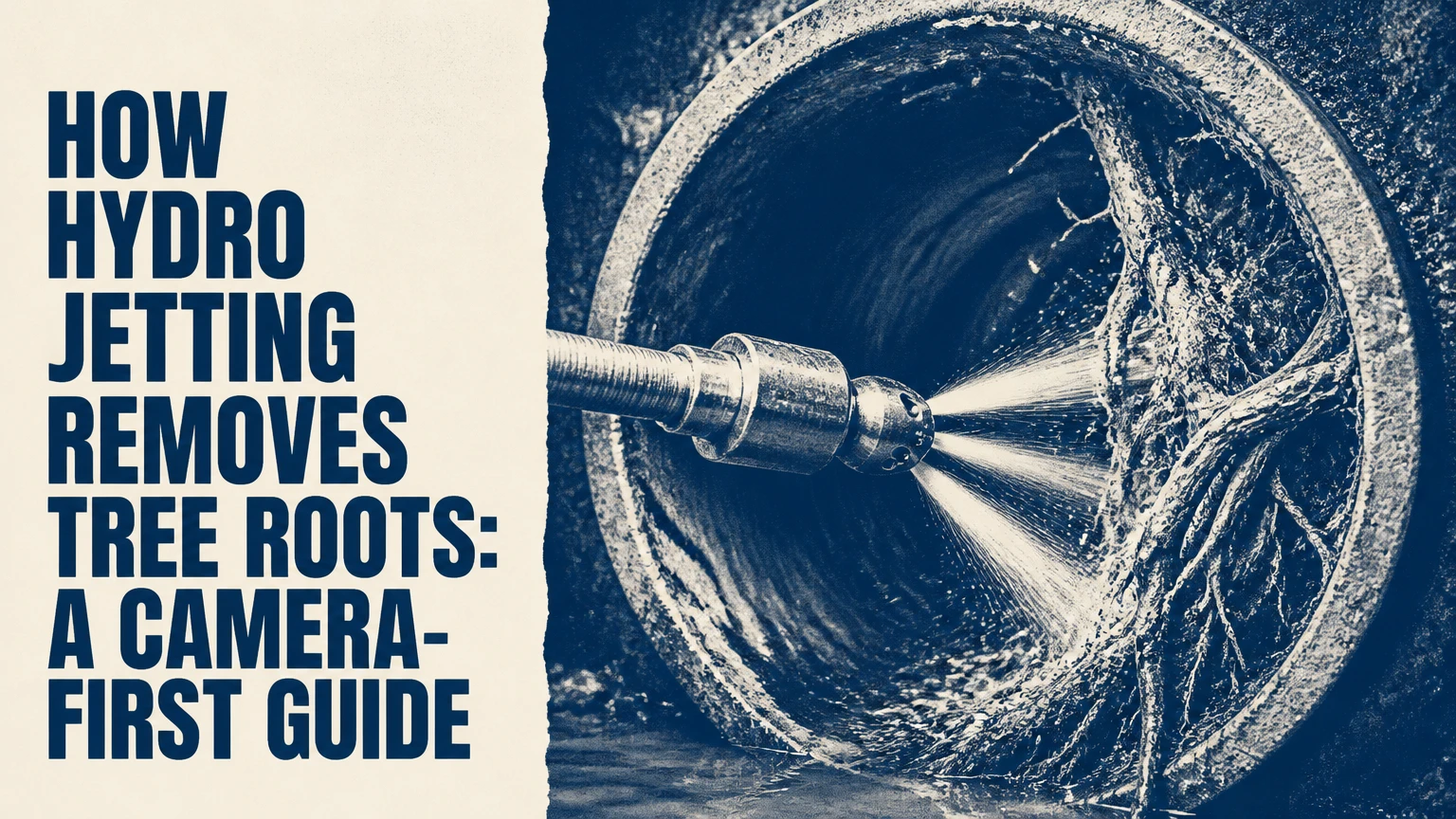
Hydro jetting removes tree roots from sewer pipes by directing high-pressure water through a specialized nozzle that cuts root fibers, shaves the remaining mass from pipe walls, and flushes the fragments downstream. A camera inspection must confirm that the pipe can withstand jetting, because water cleaning removes roots but cannot repair cracked, collapsed, or separated pipe.
Key Facts at a Glance
- Hydro jetting cleans the full pipe circumference, while a sewer auger usually creates a narrower passage through the blockage.
- Root removal depends on both water pressure and flow rate; a typical professional sewer jetter may use about 3,000-4,000 PSI and 8-18 gallons per minute.
- A sewer camera should identify pipe material, joint condition, collapse, offsets, and the root location before jetting begins.
- Hydro jetting is temporary when roots enter through an open crack or displaced joint; sealing or replacing the defect prevents renewed intrusion.
- A typical residential main-line service takes 1-3 hours and costs approximately $350-$900 in the United States, before major excavation or relining.
- Orangeburg, severely deteriorated clay, and badly fractured pipes may require repair rather than high-pressure cleaning.
What Is Hydro Jetting?
Hydro jetting is professional sewer cleaning that pumps water through a flexible hose and nozzle at high pressure and high volume. The nozzle’s forward jets penetrate the root mass, while angled rear jets propel the hose and scour deposits from the pipe’s inner circumference.
A mechanical auger mainly cuts a channel through the center of a blockage. Hydro jetting reaches the crown, invert, and sidewalls, where thin rootlets, grease, paper, mineral scale, and silt can remain attached after snaking. Full-wall cleaning can restore more usable cross-sectional area, although “100% flow restoration” is not guaranteed when the pipe has a permanent deformation or a substantial defect.
Tree roots usually enter through failed seals, open joints, cracks, or pipe separations. Sewer pipes contain moisture and nutrients, so a small opening can support fine root growth that later forms a dense mat. The nearby tree does not need to be directly above the pipe, because roots can travel horizontally through moist soil.
How Does Hydro Jetting Cut Tree Roots?
Hydro jetting cuts tree roots through water impact, shear stress, and abrasion from the moving root mass. A concentrated forward jet weakens and separates fibers, while rotating or multi-orifice nozzles expose more of the pipe wall to repeated water strikes.
Water pressure describes force per square inch at the pump or nozzle system, but flow rate determines how much water carries the cut material away. A high-pressure, low-flow unit may puncture a root mat without transporting the debris, whereas a suitable sewer jetter combines cutting force with enough volume for downstream flushing.
The cutting action is mechanical. Hydro jetting does not dissolve wood, sterilize the soil, or stop the tree from growing. Remaining roots can regenerate when the original pipe defect remains open, so a clean video inspection after jetting determines whether the service solved a blockage or merely restored flow temporarily.
How Hydro Jetting Removes Tree Roots, Step by Step
A professional root-removal visit normally follows seven stages, from camera diagnosis through final verification. The work commonly takes 1-3 hours for an accessible residential line, but long runs, severe root mats, poor cleanouts, and repeated flushing can extend the visit to 4-6 hours.
Step 1: Inspect the Sewer Line With a Camera
The technician sends a waterproof camera through a cleanout or drain opening to locate roots and assess pipe condition. The inspection should record the pipe material, approximate distance, root density, standing water, joint offsets, cracks, bellies, and any collapse.
The camera answers the safety question before the pump starts. A root mass hiding a missing pipe section can create the illusion of a simple clog, and jetting that section may wash soil into the pipe or enlarge the failure.
Success checkpoint: The operator can identify the root location and confirm a continuous, serviceable pipe route.
Common mistake: Approving jetting from a vague symptom such as “slow drains” without seeing the line.
Step 2: Establish a Suitable Access Point
The hose normally enters through an exterior sewer cleanout, although technicians may use a building drain access point when no cleanout exists. The operator protects the work area, confirms downstream flow, and identifies where wastewater and loosened debris can go.
A cleanout that is buried, damaged, or too small can complicate the job. Forcing a hose through a fragile cap or an obstructed fitting can create a separate repair.
Success checkpoint: The hose can enter the line without sharp bending, and the operator knows the upstream and downstream directions.
Common mistake: Jetting from a fixture opening when a proper cleanout would provide safer control.
Step 3: Match the Nozzle to the Root Mass
The technician selects a nozzle according to pipe diameter, material, access direction, root density, and deposits. A penetrating nozzle may open a narrow path first; a rotating sewer nozzle can then clean the full circumference and carry fragments away.
Nozzle selection affects both effectiveness and risk. A nozzle designed for a large, straight six-inch sewer can damage a small branch line or fail to turn through a tight fitting.
Success checkpoint: The nozzle fits the pipe and produces the intended forward penetration and rearward propulsion.
Common mistake: Choosing the highest-pressure setting without matching nozzle geometry to the pipe.
Step 4: Advance the Pressurized Hose Gradually
The operator starts water flow, controls pump pressure, and feeds the hose through the root obstruction in measured movements. Rear-facing jets pull the hose forward and scour the pipe behind the nozzle, while forward-facing jets work through the blockage.
Technicians may repeatedly advance and retract the hose. Retraction gives the water time to wash loosened fibers toward the downstream main instead of compacting them farther along the line.
Success checkpoint: Hose movement becomes smoother, pump pressure remains stable, and the blockage begins passing water.
Common mistake: Driving forward continuously when wastewater is backing up downstream.
Step 5: Flush the Root Debris Downstream
Hydro jetting must transport the cut roots, sludge, scale, and paper beyond the original obstruction. The technician monitors cleanout discharge and fixture levels because loosened debris can form a second blockage farther down the lateral.
A sewer line with inadequate slope, a belly, or a downstream obstruction may not carry root fragments effectively. In that situation, repeated jetting can increase the debris load without solving the drainage problem.
Success checkpoint: Flow remains open while the hose is withdrawn, and no fixture backs up during a controlled flush.
Common mistake: Ending the service immediately after the first trickle returns.
Step 6: Reinspect the Pipe
A second camera pass verifies that the root mass has been removed and documents defects that were hidden behind the roots. The video should show the previously obstructed section, nearby joints, and the downstream route as far as practical.
Post-cleaning inspection is also a quality-control measure. A clear pipe may reveal a cracked clay hub, a broken PVC fitting, a belly holding water, or a separated joint that explains why roots returned.
Success checkpoint: The camera reaches the target area and shows an open passage with no significant root ring or remaining collapse.
Common mistake: Treating restored flow as proof that the pipe is structurally sound.
Step 7: Choose Prevention or Repair
If the camera shows a sound pipe with a minor recurring intrusion, a technician may discuss an approved root-control product or scheduled cleaning. If the camera shows an open defect, the durable solution is localized repair, pipe replacement, or trenchless lining when the pipe meets installation requirements.
Copper sulfate and dichlobenil products have different labels, restrictions, and environmental risks. Product legality varies by jurisdiction, and root killer should never be poured into a system when the label prohibits that use or when discharge could affect a septic system, private well, storm drain, or receiving water.
Which Equipment and Nozzles Remove Sewer Roots?
Professional equipment varies by line size and blockage severity, but a root job usually requires more than a pump with a generic spray head. The following figures are typical operating categories, not universal specifications; manufacturers rate equipment differently, and the nozzle can substantially change pressure at the obstruction.
| Equipment or nozzle | Typical pressure and flow | Suitable line or condition | Main limitation |
|---|---|---|---|
| Compact electric jetter | 1,500-2,500 PSI, 1.5-4 GPM | 1.5-3 inch indoor drains | Often too little flow for dense main-line roots |
| Portable gas jetter | 2,500-4,000 PSI, 4-10 GPM | 3-4 inch residential laterals | Limited hose length and water capacity |
| Trailer-mounted jetter | 3,000-4,000 PSI, 10-18 GPM | 4-8 inch mains and severe root mats | Requires vehicle access and trained operation |
| Penetrating nozzle | 3,000-4,000 PSI, 4-12 GPM | Opening a concentrated root blockage | May leave roots attached to sidewalls |
| Rotating nozzle | 2,500-4,000 PSI, 6-18 GPM | Circumferential cleaning and root shaving | Needs adequate pipe clearance to rotate |
| Chain flail or chain knocker | Manufacturer-specific, often water-powered | Thick woody roots in suitable, sound pipes | Can damage weak, cracked, or brittle pipe |
A chain flail is not the same as a purely hydraulic cutting nozzle. Chain tools use rotating mechanical elements driven by water or a motor, so the operator must verify pipe material and condition before deployment. Many operators begin with a penetrating or controlled-rotation nozzle and reserve aggressive tooling for a confirmed, structurally sound line.
Does Higher PSI Always Remove Roots Better?
Higher PSI does not automatically produce safer or better root removal. Pressure, flow, nozzle orifice, hose length, pipe diameter, and the operator’s control determine the actual cleaning result.
Commercial sewer-cleaning guidance commonly places root work in the broad range of 3,000-4,000 PSI, but no responsible technician should promise that one pressure is safe for every pipe. A six-inch PVC lateral and a brittle, century-old clay line have different tolerances. The camera report and manufacturer guidance should control the setting.
When Is Hydro Jetting Safe for Different Pipes?
Hydro jetting is generally appropriate for a structurally sound PVC, ABS, or cast-iron sewer line when the operator uses suitable pressure, flow, hose, and nozzle. Hydro jetting is unsafe or poor value when the camera shows severe corrosion, missing sections, extensive cracks, major offsets, or a pipe wall that cannot contain the water.
| Pipe material | Typical service life context | Jetting outlook | Preferred decision |
|---|---|---|---|
| PVC or ABS | Common in post-1970 installations | Usually suitable when joints and fittings are intact | Jet, verify, then repair the entry defect |
| Cast iron | Often 50-100 years, condition varies widely | Suitable if wall thickness and joints remain sound | Use controlled settings after camera inspection |
| Vitrified clay | Frequently found in pre-1970 laterals | Possible for sound sections, risky at cracked hubs | Clean cautiously, then repair failed joints |
| Orangeburg | Common in some 1940s-1960s installations | Poor candidate because the wall can deform or collapse | Replace or reline after structural assessment |
| Corrugated or thin-wall plastic | Installation and quality vary | Risk depends on wall strength and fittings | Follow manufacturer and camera findings |
The practical safety rule is simple: hydro jetting cleans a pipe that can contain pressure; it does not strengthen a pipe that cannot. The National Association of Sewer Service Companies, commonly known as NASSCO, emphasizes condition assessment and documented inspection in sewer maintenance practice, which supports a camera-first workflow rather than blind jetting.
How Much Does Tree-Root Hydro Jetting Cost?
A typical United States residential main-line hydro-jetting visit costs about $350-$900 and takes 1-3 hours, including standard access and camera work. Long laterals, difficult cleanouts, commercial lines, emergency scheduling, traffic control, and repair after inspection can raise the total to $1,000-$2,500 or more.
| Cost driver | Typical range | Why the price changes |
|---|---|---|
| Camera inspection | $100-$400 | Access, recording, travel, and whether bundled with cleaning |
| Residential root jetting | $350-$900 | Four-inch line, accessible cleanout, moderate root mass |
| Commercial or severe root work | $1,000-$2,500+ | Larger equipment, longer runs, higher debris volume |
| Local sewer repair | $500-$4,000+ | Excavation, fitting replacement, depth, and surface restoration |
| Trenchless lining | $4,000-$12,000+ | Diameter, length, access pits, preparation, and contractor method |
Prices are practitioner ranges, not a national tariff. Ask whether the quote includes pre- and post-cleaning video, disposal or wastewater handling, a second attempt if debris relocates, and a written recommendation for the root-entry defect.
Hydro Jetting Versus Snaking, Chemicals, and Relining
Hydro jetting is usually the strongest cleaning method for a recurring root blockage in a sound pipe, but it is not the permanent answer to a defective sewer. Snaking provides fast passage restoration, chemical products can support prevention in limited situations, and relining or replacement addresses the opening that permits roots to enter.
| Method | Immediate root clearance | Pipe-wall cleaning | Structural repair | Typical use |
|---|---|---|---|---|
| Hydro jetting | High for sound, accessible lines | High across the internal circumference | None | Dense roots, grease, scale, recurring clogs |
| Mechanical auger | Moderate, usually a central channel | Low | None | Emergency opening or fragile lines needing caution |
| Foaming root control | Low during an active blockage | None | None | Suppressing regrowth after physical cleaning |
| Local excavation | High at the repaired section | Variable | High | Broken joint, collapse, separated pipe |
| Cured-in-place lining | High after preparation | Requires pre-cleaning | High when eligible | Sealing many cracks without full excavation |
A sewer auger can be the safer first intervention when the camera cannot pass or when a fragile line needs temporary drainage. However, an auger may leave a root collar attached to the wall, allowing recurrence sooner than a full hydro-jet cleaning.
Chemical root control does not remove a dense obstruction. Labels, local wastewater rules, septic-system restrictions, and environmental discharge requirements matter more than a product’s marketing claim. Relining cannot correct every belly, collapse, or severely misaligned section, and the contractor must confirm that the host pipe has enough shape and strength.
What Hydro Jetting Cannot Fix
Hydro jetting cannot repair a collapsed sewer, reconnect a separated joint, restore missing pipe, correct poor grade, or stop roots permanently when a crack remains open. Cleaning can improve drainage while leaving the underlying failure unchanged.
The distinction matters during diagnosis. If roots are the symptom and an open joint is the cause, repeated jetting treats the symptom at increasing cost. If the camera identifies one failed connection, a localized repair may cost less over several years than annual emergency cleaning.
When Should a Homeowner Avoid Jetting?
A homeowner should postpone hydro jetting when the camera shows a severely deteriorated or collapsed pipe, uncontrolled water discharge, inaccessible cleanout, or a material that cannot safely tolerate the proposed method. Total backups also require careful fixture protection and downstream flow planning before pumping begins.
Do not use consumer pressure-washer attachments as a substitute for professional sewer jetting. A hose can become lodged, contaminated wastewater can spray from an open fixture, and an operator may push debris into a larger obstruction without seeing the result.
Can Jetting Make Roots Grow Back Faster?
Hydro jetting does not biologically stimulate roots in a predictable way, but roots can regrow quickly after cutting because the tree remains alive and the pipe defect remains open. A clean pipe therefore may develop another intrusion within months to several years, depending on species, soil moisture, defect size, and local conditions.
The durable prevention sequence is camera inspection, physical cleaning, defect repair where feasible, and lawful root-control treatment when appropriate. Annual or 12-24-month maintenance is a reasonable planning interval for some properties with mature trees, but recurrence should be based on observed regrowth rather than an automatic calendar.
Common Problems During Root Jetting
Root jetting failures usually result from poor diagnosis, insufficient water volume, bad nozzle selection, or inadequate debris transport. Each failure has a distinct recovery approach.
- The hose or nozzle becomes stuck. Stop pressure immediately rather than pulling against a lodged tool. The technician may pulse water carefully, retract manually, or use a separate cable tool after confirming that the line is not collapsed.
- Water backs up inside the building. Withdraw the nozzle slightly and pause advancement so the loosened material can move downstream. Protect fixtures and stop the job if wastewater threatens electrical equipment or occupied spaces.
- Pump pressure falls suddenly. A clogged nozzle orifice, worn pump component, leaking connection, or insufficient water supply can reduce performance. Retrieve the hose, inspect the nozzle, and correct the supply problem before continuing.
- The blockage returns after several days. A remaining root ring, downstream debris pile, belly, or structural defect may be responsible. Request the post-service video instead of accepting another blind cleaning.
- The pipe leaks or collapses after cleaning. Jetting may expose a pre-existing weakness that roots and deposits had temporarily bridged. Stop further pressure work, document the condition, and obtain a repair assessment.
Which Approach Fits Your Situation?
Home With Mature Trees and a Sound PVC Line
Choose camera-guided hydro jetting when a four-inch PVC lateral has recurring roots but no cracks, offsets, or collapse. A follow-up discussion about lawful root control and a 12-24-month inspection interval can reduce emergency calls, although tree removal or sewer repair may be more durable.
Historic Home With Clay or Orangeburg Pipe
Prioritize diagnosis and temporary flow restoration over aggressive cleaning. Aged clay may tolerate controlled work in sound sections, while Orangeburg and severely deformed pipe often need relining or replacement rather than repeated high-pressure treatment.
Commercial Property With a Main-Line Risk
Schedule condition-based cleaning during low-occupancy periods and document video before and after service. A property manager should also confirm access, wastewater handling, tenant notification, and emergency overflow procedures because a blockage can interrupt operations and create sanitation problems.
Total Backup With No Visible Cleanout
Use a licensed drain professional rather than attempting a DIY jetter. The technician may need to locate or install access, isolate fixtures, remove the initial blockage mechanically, and inspect the line before selecting a nozzle.
Expert Rules That Prevent Expensive Mistakes
- Treat pressure and flow as separate specifications. A 4,000-PSI machine with inadequate gallons per minute can cut a hole without carrying the root mulch away.
- Inspect twice when roots are severe. The first video determines whether cleaning is safe; the second reveals defects hidden by the root mass.
- Price the defect, not only the blockage. A $600 cleaning every year can exceed the cost of a targeted joint repair within a few seasons.
- Never promise permanent root removal from jetting alone. Permanent control requires eliminating or sealing the entry route, or changing the surrounding risk.
- Do not confuse clear water flow with a healthy pipe. A collapsed line can drain temporarily through a small channel while remaining structurally unsound.
FAQ
Do tree roots keep growing after hydro jetting?
Tree roots can regrow after hydro jetting when the tree remains alive and the sewer defect stays open. Hydro jetting removes the existing intrusion but does not seal cracks or displaced joints. Post-cleaning video, targeted repair, and legally permitted root-control treatment provide better long-term control than repeated blind cleaning.
How often should a sewer line with trees be cleaned?
A sewer line with recurring root intrusion may need inspection or cleaning every 12-24 months, but the correct interval depends on regrowth, pipe condition, tree density, and rainfall. A line that remains clear for several years needs no automatic annual jetting, while rapid recurrence indicates an unresolved defect.
Can hydro jetting remove roots from a septic system line?
Hydro jetting may clean a private sewer lateral leading to a septic tank, but technicians must prevent excessive debris from entering the tank and follow local wastewater practices. The septic tank, distribution box, and drain field require separate assessment. Product labels also commonly restrict chemical root treatments around septic systems.
Is hydro jetting safe for a four-inch sewer pipe?
Hydro jetting is commonly used on four-inch sewer pipes when the pipe is structurally sound and the nozzle, pressure, flow, and access are appropriate. Four-inch PVC and intact cast iron are often suitable candidates, while cracked clay, Orangeburg, and collapsed sections require a different repair decision.
Can a pressure washer remove sewer roots?
A consumer pressure washer is not a safe substitute for professional sewer jetting. Sewer jetters use purpose-built hoses, nozzles, flow controls, backflow precautions, and retrieval procedures. Untrained use can lodge the hose, spread contaminated water, damage a weak pipe, or push root debris into a second blockage.
What is the permanent solution for tree roots in a sewer line?
The permanent solution is repair or replacement of the defective pipe section that allows root entry. Local excavation, spot repair, pipe replacement, or trenchless lining may be appropriate after camera inspection. Hydro jetting remains useful as preparation, because lining and some repairs require a clean, open pipe.
The Bottom Line
Hydro jetting removes tree roots by combining concentrated water impact with high-volume flushing, so the method cleans more of the pipe wall than ordinary snaking. The correct sequence is camera inspection, controlled nozzle selection, gradual jetting, complete downstream flushing, and final video verification.
For a sound PVC or cast-iron line, hydro jetting is often the most effective immediate cleaning method. For cracked clay, Orangeburg, collapsed pipe, or separated joints, cleaning alone is a temporary measure. Use the camera findings to decide whether the next step is maintenance, root control, localized repair, relining, or replacement. The best answer to how hydro jetting removes tree roots is therefore mechanical and conditional: water removes the obstruction, but pipe repair prevents its return.