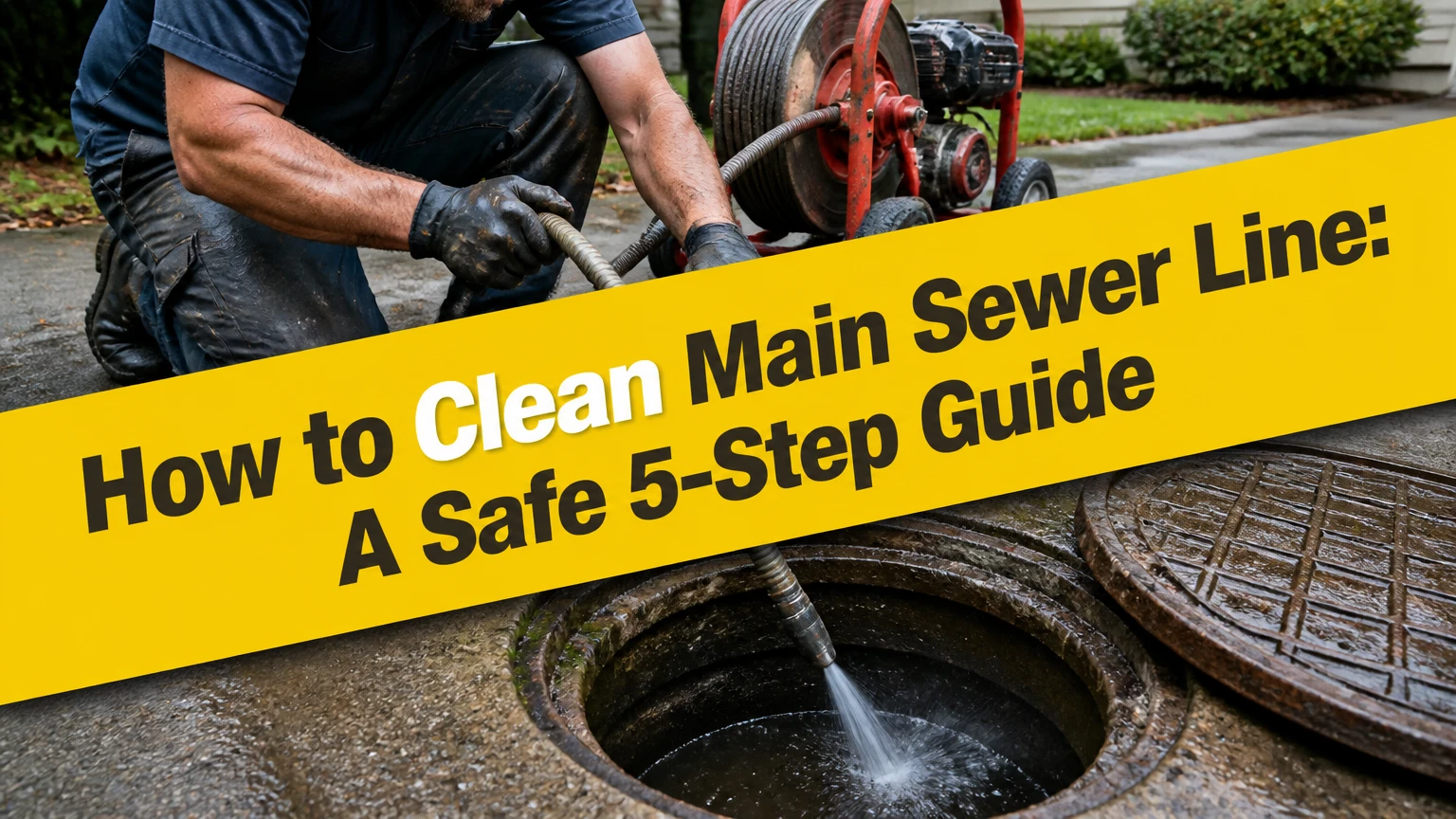
To clean a main sewer line, identify the blockage through the main cleanout, inspect the pipe with a sewer camera, then use mechanical cabling or hydro jetting suited to the pipe’s condition. A typical professional visit takes 1-3 hours and costs about $175-$900, but a collapsed or broken pipe requires repair rather than cleaning.
Key Facts
A residential main sewer line usually measures 3 or 4 inches in diameter and carries wastewater from multiple fixtures.
A main-line blockage commonly causes simultaneous backups in toilets, showers, tubs, and floor drains.
A camera inspection should precede hydro jetting or aggressive mechanical cleaning when pipe condition is unknown.
Mechanical snaking creates a passage through a clog; hydro jetting removes more grease, scale, sludge, and root material from pipe walls.
Typical professional pricing ranges from $175-$450 for main-line snaking and $350-$900 for hydro jetting.
Caustic drain cleaner is a poor choice for a blocked sewer main because it can remain trapped and injure the next person opening the line.
What Is a Main Sewer Line?
A main sewer line is the large drainpipe that collects wastewater from a home’s branch drains and carries it toward a municipal sewer main or private septic tank. The main cleanout provides access to that buried or concealed pipe, while a sink or toilet drain reaches only a smaller branch with traps and bends.
Most residential systems depend on gravity and a continuous downward slope, often near 1/4 inch per foot where local code and site conditions permit. The exact slope varies by pipe diameter, code jurisdiction, terrain, and installation age.
The private section is often called a sewer lateral. The lateral may run from the house to a public right-of-way, where ownership and maintenance responsibility can change. A blocked public main is different from a blocked private lateral, so the local wastewater utility should be contacted when neighboring properties show the same symptoms.
Which symptoms indicate a main-line blockage?
A main sewer blockage is likely when several fixtures drain poorly at the same time, especially when water from a washing machine or shower makes a toilet bubble. A single slow bathroom sink usually indicates a branch-drain problem instead.
| Symptom | Likely location | Immediate response |
|---|---|---|
| One sink drains slowly | Sink trap or branch drain | Stop using the sink and clear its branch |
| Toilet overflows alone | Toilet trap or toilet branch | Shut off the toilet supply valve |
| Shower and toilet back up together | Shared branch or main line | Stop using nearby fixtures |
| Basement floor drain overflows | Main lateral or lowest fixture | Stop all household water use |
| Several neighboring homes back up | Municipal sewer main | Call the wastewater utility |
| Odor without backup | Dry trap, cracked pipe, or vent issue | Add water to traps, then arrange diagnosis |
A foul odor in the yard can indicate a damaged buried pipe, a leaking cleanout, or a septic problem. Gurgling can also result from a blocked vent stack, so sound alone does not prove that the main line is obstructed.
Before You Start Cleaning the Main Sewer Line
Do not begin with a rented power snake when sewage is standing in the basement or when the pipe’s condition is unknown. First stop water use, locate the correct cleanout, identify the likely owner of the affected section, and decide whether a plumber or utility should inspect the line.
Safety and preparation checklist
| Item | Typical requirement | Why it matters |
|---|---|---|
| Household water use | 0 gallons during active backup | Prevents additional sewage discharge |
| Protective gloves | Nitrile under waterproof utility gloves | Limits contact with contaminated water |
| Eye and skin protection | Safety glasses, waterproof boots | Sewage can splash during cap removal |
| Catch container | 5-gallon bucket or larger | Controls residual wastewater |
| Ventilation | Open doors or use outdoor access | Reduces exposure to sewer gases |
| Camera inspection | 30-45 minutes typical | Finds defects before aggressive cleaning |
Sewage is a biological hazard. Avoid contact with skin, food, electrical equipment, and open wounds; keep children and pets away, and use a qualified remediation company when contaminated materials cannot be disinfected safely.
Locate the cleanout in a basement, crawlspace, garage, near the foundation, or in the yard. It is commonly a 3- or 4-inch capped pipe, but older installations may use unusual fittings or lack a convenient access point.
How do you open a backed-up cleanout?
Open the main cleanout cap slowly with a correctly sized wrench while standing to the side, not directly over the fitting. If liquid begins to seep or spray out, tighten the cap again and call a plumber unless you have suitable containment and contamination controls.
A cleanout full of wastewater confirms that water is trapped downstream, but an empty cleanout does not eliminate every possibility. The obstruction may be upstream of that opening, in another branch, inside a building drain, or farther toward the public main.
How to Clean Main Sewer Line in Five Steps
The safest cleaning sequence has five stages: stop water use, inspect the line, clear the obstruction, wash remaining deposits, and verify the result. The factor that most determines success is not machine power; it is knowing whether the pipe is structurally sound before applying a cable or high-pressure water.
Step 1: Stop water use and confirm the affected section
Turn off or avoid toilets, showers, sinks, dishwashers, washing machines, and water softeners. Check whether the problem affects one fixture, the whole building, adjacent properties, or a septic system.
If only one fixture is affected, a main-line machine is excessive. If several fixtures back up and the lowest drain overflows, the main building drain or private lateral becomes more likely.
Success checkpoint: No new wastewater enters the affected drain while you investigate.
Common mistake: Running a bathtub to “test” the system before clearing the restriction.
Step 2: Inspect through the main cleanout
Feed a waterproof sewer camera through the cleanout before heavy cleaning whenever access allows. The inspection should identify the blockage distance, pipe material, standing water, root intrusion, offsets, cracks, belly sections, and complete collapse.
A camera also helps locate a defect for excavation or trenchless lining. It cannot always see behind heavy water, thick grease, or a fully obstructed section, so a failed first inspection may require limited cabling before a second camera pass.
Success checkpoint: The operator records the obstruction location and pipe condition, not merely a statement that the line is clogged.
Common mistake: Treating a camera image of an open channel as proof that the pipe is structurally sound.
Step 3: Clear a suitable clog with mechanical cabling
Mechanical snaking, also called rodding or roto-rooting, uses a rotating steel cable and cutting head to create an opening through paper, solids, minor roots, or localized deposits. The operator should advance and withdraw the cable gradually, matching the cutter to the pipe diameter and blockage.
Mechanical cleaning is often the first response for an urgent, localized obstruction because it can restore flow without introducing large water volumes. It usually leaves some grease, scale, and root fragments on the pipe wall, so recurring problems may return.
A motorized sewer cable can kink, whip, or become trapped. Untrained users should not force a 3/4-inch commercial machine through resistance, especially in old clay, Orangeburg, brittle cast iron, or a line with an unknown collapse.
Success checkpoint: The cable reaches the intended downstream access or public-main direction, and water flows without immediate rebound.
Common mistake: Assuming a hole through the blockage equals a clean pipe.
Step 4: Hydro-jet deposits only after condition checks
Hydro jetting propels a specialized nozzle through the pipe with pressurized water, using rear-facing jets to pull the hose forward and scour deposits from the circumference. Professional equipment commonly operates across roughly 3,000-4,000 PSI, but pressure alone does not describe cleaning performance because flow rate, nozzle design, hose size, and pipe condition also matter.
Hydro jetting is effective against grease, sludge, mineral scale, sand, and substantial root residue. It is not a repair method. High-pressure water can worsen a cracked, badly offset, thin-walled, or collapsed line, and it can force water into a defect or eject contaminated material at an open fixture.
A professional should select the nozzle and operating pressure from the camera findings. “4,000 PSI” is not a universal safe setting for every residential sewer pipe.
Success checkpoint: Water flows steadily, the hose travels the planned section, and the post-cleaning camera shows open pipe walls without new damage.
Common mistake: Jetting an old line solely because it has recurring roots, without confirming that the roots are not holding a failing pipe together.
Step 5: Flush gradually and reinspect
After the obstruction is cleared, run clean water through fixtures one at a time, beginning with a low-volume fixture and progressing to a toilet or tub. Do not release a large volume immediately into a line that has not demonstrated stable flow.
Run the camera again when the blockage was severe, recurrent, root-related, or associated with an older pipe. The second inspection distinguishes a temporary opening from a genuinely clean passage and records whether the pipe needs lining, spot repair, replacement, or routine monitoring.
Success checkpoint: Several controlled discharges reach the sewer without backup, bubbling, or abnormal delay.
Common mistake: Closing the job after the first flush and missing roots, a belly, an offset joint, or a broken downstream section.
Which Sewer Cleaning Method Should You Choose?
Mechanical snaking is the better first tool for a localized solid clog or an urgent flow restoration when the pipe is sound but deposits are limited. Hydro jetting is the better cleaning method for broad grease, scale, sludge, or residual roots in a camera-verified, structurally stable pipe.
| Method | Best target | Typical duration | Main limitation |
|---|---|---|---|
| Hand auger | 1.5-2-inch fixture branch | 15-45 minutes | Cannot negotiate a main-line route |
| Mechanical cable | Paper, solids, localized roots | 1-2 hours | Often leaves wall deposits |
| Hydro jetting | Grease, scale, sludge, roots | 2-3 hours | Unsafe for defective pipe without assessment |
| Root inhibitor | Root regrowth prevention | 1-3 applications yearly | Does not open a complete blockage |
| Pipe lining or replacement | Cracks, collapse, repeated root entry | 1-5 days typical | Repairs the pipe rather than cleaning it |
A chemical root inhibitor may reduce regrowth after mechanical cleaning, but it cannot replace structural repair. Follow the product label and local wastewater rules, because copper-based and foaming products have environmental and septic-system restrictions.
Are chemical drain cleaners safe for a main sewer?
Caustic sodium hydroxide and acid drain cleaners are generally unsuitable for a fully blocked main sewer line. A large dose can remain trapped in the pipe, damage some materials, produce heat, and expose the next worker to corrosive liquid when the cleanout or fixture is opened.
Biological enzyme products are less aggressive but act slowly and have limited value against compacted solids, roots, scale, or a pipe collapse. Chemical products also make later diagnosis and cleaning more hazardous.
How Much Does Main Sewer Cleaning Cost?
Typical U.S. pricing is about $150-$400 for a camera inspection, $175-$450 for mechanical main-line cleaning, and $350-$900 for hydro jetting. After-hours service commonly adds $150-$300 or increases the base charge, while excavation and pipe repair cost substantially more.
| Service | Typical price | Typical time | What the price should include |
|---|---|---|---|
| Camera inspection | $150-$400 | 30-45 minutes | Video, distance measurements, findings |
| Main-line snaking | $175-$450 | 1-2 hours | Main cleanout access and cable clearing |
| Hydro jetting | $350-$900 | 2-3 hours | Pump, hose, nozzle, and setup |
| Emergency service | Base plus $150-$300 | Same day or after hours | Response surcharge and initial clearing |
| Spot repair | $1,000-$4,000 typical | 1-2 days | Local excavation and pipe replacement |
| Sewer lateral replacement | $5,000-$20,000 typical | 2-7 days | Excavation or trenchless installation |
Regional labor rates, access difficulty, depth, cleanout installation, wastewater contamination, and the distance to the blockage change the final invoice. A low quote may exclude the camera, second access point, cleanup, or repair recommendation.
A useful estimate separates diagnosis, cleaning, disposal, restoration, and repair. Ask whether the contractor will provide the camera recording, measured blockage location, pipe material, machine method, pressure and flow settings, and a written recommendation.
Why Does a Sewer Line Keep Clogging?
Recurring sewer clogs usually indicate root intrusion, grease deposition, pipe misalignment, a belly that holds sediment, undersized capacity, or a damaged pipe. Cleaning restores flow, but repeated cleaning cannot correct a structural defect that continually creates the blockage.
Tree roots typically enter through joints, cracks, or failed connections. Cutting roots can restore flow temporarily, while root control may slow regrowth; permanent correction requires a spot repair, cured-in-place lining, or replacement when the pipe condition permits.
A camera report should classify the defect rather than use “roots” as the whole diagnosis. Ask whether the roots are at a joint, whether the pipe is displaced, whether soil is visible, and whether the line has standing water after normal flow stops.
Practitioner rule: A blockage that returns at nearly the same camera distance is usually a location problem, not a cleaning-method problem. Record the distance and clock position after every service call.
Common Mistakes and How to Fix Them
| Mistake | Result | Safer correction |
|---|---|---|
| Opening the wrong cleanout | Wastewater spills indoors or upstream | Confirm flow direction and use containment |
| Skipping the camera on old pipe | Cable or jet damages a defect | Inspect material, joints, and collapse first |
| Forcing a cable | Kinked cable, trapped head, pipe damage | Stop, reverse safely, and reassess resistance |
| Using caustic drain opener | Corrosive liquid remains in the line | Tell the technician before opening the cleanout |
| Jetting a collapsed line | Water enters soil and damage worsens | Repair or replace the failed section |
| Flushing too quickly | Backup returns into the lowest fixture | Test with controlled, increasing flow |
One counterintuitive failure occurs when a line drains after snaking but backs up again during a washing-machine discharge. The cable may have made only a narrow channel, while accumulated grease still restricts the full pipe diameter.
Another occurs when a contractor recommends repeated root cutting without showing the root entry point. Roots are evidence of a pathway, so the lasting decision concerns the joint or crack, not the cutter brand.
What Should You Do in Different Situations?
If sewage is actively backing up
Stop all water use, keep people away from contaminated areas, and call a licensed drain professional or wastewater utility. Do not open a pressurized cleanout or use a chemical opener when sewage is standing above the pipe connection.
If electrical outlets, appliances, or a furnace may contact sewage, avoid the area and have electrical hazards evaluated before cleanup. Photograph damage for insurance and ask whether the policy covers sewer backup, service-line repair, or only interior contents.
If the home has a septic tank
A septic system changes the endpoint, not the need for diagnosis. A full tank, failed outlet baffle, blocked effluent filter, or saturated drain field can mimic a main-line clog, so check tank service history and contact a septic professional when the house-side line appears open.
Do not use copper sulfate or other root treatments without confirming septic compatibility and local rules. Septic systems rely on biological treatment and have different discharge constraints from municipal sewers.
If the home has old clay, cast iron, or Orangeburg pipe
Older materials require a camera before aggressive equipment. Orangeburg, a bituminized fiber pipe, may deform or deteriorate; brittle clay can have displaced joints, and corroded cast iron may lose wall thickness.
Mechanical cleaning at a controlled setting may be safer than immediate jetting, but no method is automatically safe for degraded pipe. If the camera shows collapse, severe ovaling, soil intrusion, or repeated joint failure, obtain a repair estimate instead of scheduling another cleaning.
If you are buying a house
Request a dedicated sewer scope before closing, especially for homes with mature trees, pre-1980 construction, clay or Orangeburg lines, additions, or a history of backups. A general home inspection usually does not visualize the entire buried lateral.
Ask for the video, pipe material, distance to the street, defects, cleanout locations, and whether the camera reached the municipal connection or septic tank. A scope is a diagnostic purchase, not a guarantee against future damage.
How Can You Prevent Another Main-Line Backup?
Preventive cleaning is most effective when it responds to a documented cause. Keep grease, wipes, paper towels, feminine products, diapers, litter, and food solids out of drains, and plant large-rooted trees away from buried sewer routes.
| Risk pattern | Practical interval | Preventive action |
|---|---|---|
| No history, newer PVC | No routine cleaning | Inspect only when symptoms occur |
| Grease-prone household | 12-24 months | Camera or clean based on buildup |
| Known root intrusion | 6-12 months | Inspect, clean, and assess root entry |
| Older clay or cast iron | 12-24 months | Scope before aggressive cleaning |
| Repeated backup at one location | Immediate diagnosis | Repair defect rather than repeat clearing |
| Septic property | Tank schedule from service provider | Inspect tank, filter, and house line |
A cleanout should remain visible and accessible. Labeling it, clearing soil or landscaping, and installing a proper cap can reduce emergency access time.
FAQ
Can I rent a sewer snake to clean the main line?
You can rent a main-line cable machine, but rental access does not equal safe operation. Large rotating cables can injure hands, catch on damaged pipe, or become trapped, and a machine can worsen a collapsed line. DIY work is most reasonable only for an accessible, known, structurally sound line with no sewage exposure.
How often should a residential sewer line be cleaned?
A healthy newer PVC sewer line usually needs no calendar-based cleaning. Homes with documented roots, grease, or recurring restrictions may need inspection or cleaning every 6-12 months, but repeated service at the same location should trigger a repair diagnosis rather than an automatic maintenance appointment.
Will boiling water unclog a main sewer line?
Boiling water is not a dependable main-line treatment. It may soften a small amount of grease near a kitchen branch, but it cannot reach or remove roots, scale, compacted solids, or a structural obstruction several metres underground. Large hot-water discharges can also stress some fittings and do not replace mechanical clearing.
Does homeowners insurance pay for sewer-line cleaning?
Most homeowners policies do not automatically cover routine sewer cleaning, and coverage for a buried service line or sewer backup depends on endorsements, exclusions, and the cause of damage. Review the policy before an emergency, then document the blockage, camera findings, invoices, and cleanup.
Who is responsible for a blocked sewer lateral?
Responsibility depends on local law, utility rules, easements, and the blockage location. The homeowner commonly maintains the private lateral, while the municipality maintains its public main, but some jurisdictions assign a section of the lateral to the utility. Call the wastewater provider when neighbors have the same backup.
What happens if sewer cleaning does not work?
If flow does not return, the obstruction may be beyond the access point, inside another branch, or caused by collapse, severe offset, belly, or a blocked municipal main. Stop repeated machine attempts, obtain a camera inspection from a second access point if possible, and request a written repair or utility diagnosis.
The Bottom Line
How to clean main sewer line problems safely depends on diagnosis before force: stop water use, access the correct cleanout, inspect the pipe, select snaking or hydro jetting for the documented condition, then flush gradually and reinspect. Cleaning can restore flow, but roots, cracks, collapse, and recurring defects require repair rather than another temporary opening.