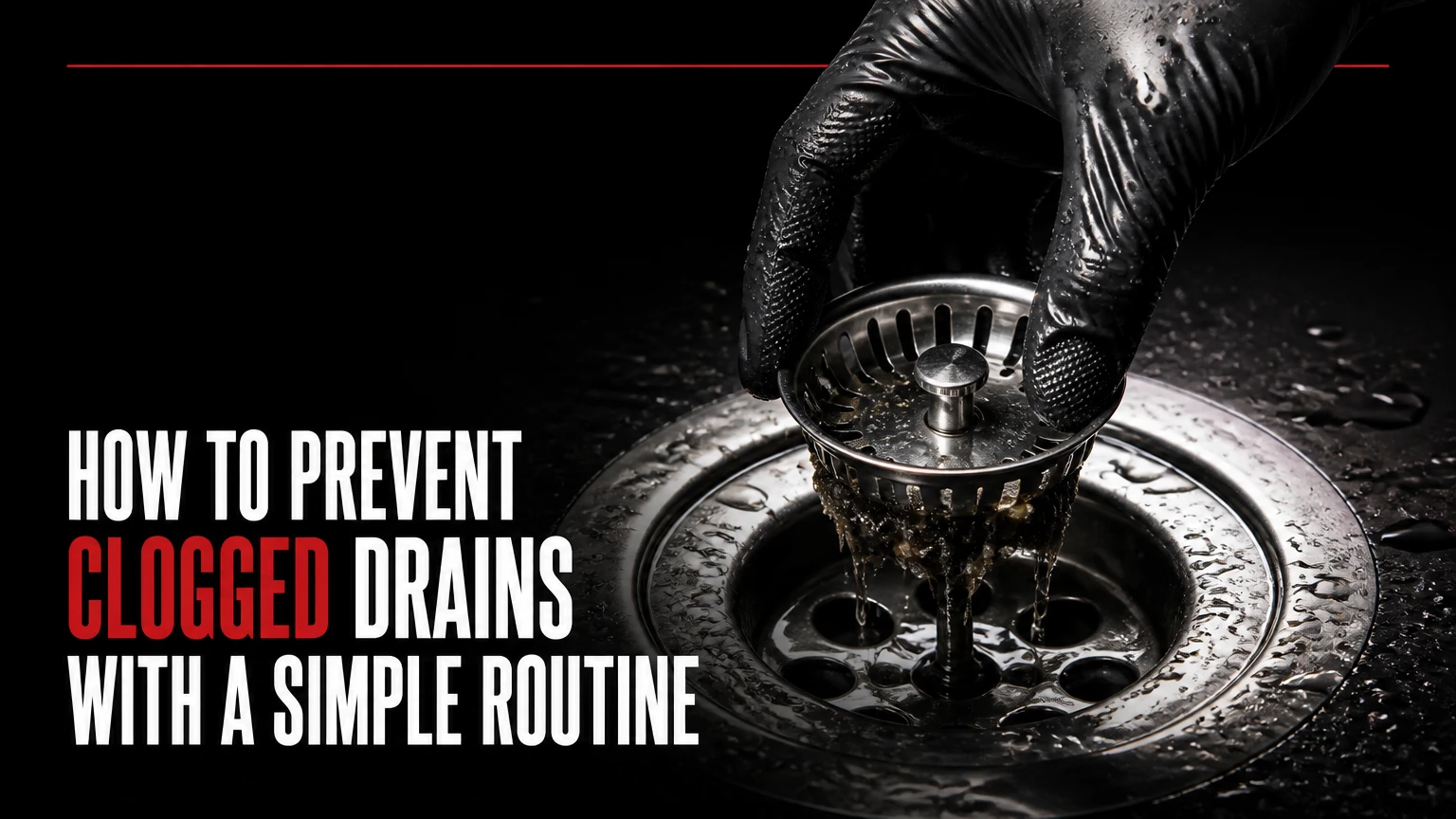
To prevent clogged drains, keep solids and grease out of the pipe, control hair and soap buildup with strainers, and inspect traps before flow slows. A practical household routine takes about 10 minutes per week, costs roughly $10-$40 for basic tools, and works best when prevention is matched to each fixture.
Key Facts at a Glance
- A drain strainer prevents hair, food particles, and other solids from entering the branch pipe, but it cannot stop grease or tree roots.
- Cooking oil, liquid fat, and grease belong in a sealed waste container, not in a kitchen sink, even when hot water is running.
- A slow drain is an early warning sign, not a normal operating condition; repeated slowing often indicates buildup or a structural defect.
- Baking soda and vinegar create carbon dioxide bubbles, but the reaction is not a dependable way to remove a substantial grease, hair, or root blockage.
- A plunger or hand auger is safer for most minor blockages than a caustic chemical drain opener.
- Multiple fixtures draining slowly, sewage odors, or wastewater returning through a floor drain can indicate a main-line problem.
What Causes a Drain to Clog?
A clogged drain forms when wastewater carries material that sticks to pipe walls, catches on an obstruction, settles in a low section, or combines with other debris. Grease cools and coats kitchen pipes, hair catches in bathroom drains, and mineral scale or corrosion creates rough surfaces that trap additional material.
The process usually develops gradually. A thin layer of grease, soap residue, biofilm, or mineral scale reduces the usable pipe diameter. Hair, food fibers, wipes, and sediment then attach to that layer. As the opening narrows, water moves more slowly, giving heavier particles more time to settle.
Pipe condition changes the risk. Smooth, correctly sloped PVC usually offers fewer attachment points than scaled cast iron, while a sagging or misaligned pipe can hold standing water regardless of how often a homeowner flushes it. Tree roots create a separate pathway by entering joints or cracks in underground sewer piping.
A “fatberg” is a mass formed when fats, oils, and grease bind together with flushed solids. The term is most associated with sewer systems, but the same adhesion process can begin in a household kitchen branch line.
How Can You Prevent Clogged Drains Every Day?
Daily drain prevention depends on interception and disposal: catch solids before they enter, wipe grease from cookware, and keep unsuitable products out of toilets and sinks. These actions require seconds but remove the materials most likely to form a persistent blockage.
Use a Strainer at Every Open Drain
Install a removable basket or silicone catcher in kitchen sinks, bathroom basins, showers, and tubs. A kitchen basket with openings around 1-2 millimeters catches food particles while allowing normal water flow; shower catchers need a design that captures hair without sitting so tightly that water pools.
Empty each catcher into the garbage before rinsing it. Rinsing hair or food into another drain simply transfers the blockage risk.
Keep Fats, Oils, and Grease Out
Allow frying oil, bacon fat, butter, and pan drippings to cool in the cookware. Pour liquid oil into a sealable container, or wipe small residues with paper towels before washing the pan. Restaurants need a grease interceptor sized and maintained according to local plumbing requirements.
Hot water does not neutralize grease. Hot water can carry liquid grease farther down a pipe, where colder surfaces allow it to solidify.
Treat the Garbage Disposal as a Grinder, Not a Bin
A disposal can process small food residues, but it is poorly suited to fibrous, starchy, expanding, or stringy materials. Put rice, pasta, flour, potato peels, celery, corn husks, onion skins, coffee grounds, bones, eggshells, and large quantities of food scraps in the waste or compost stream unless the manufacturer specifically permits them.
Run cold water while the disposal operates and for about 15 seconds afterward if the manufacturer recommends that practice. Cold water helps move ground particles and may keep grease more solid, but it does not make grease disposal safe. Scraping remains the better prevention step.
Follow the Three Drain Rules
- Flush toilets only with human waste and toilet paper.
- Put wet wipes, tissues, paper towels, cotton products, dental floss, and sanitary products in a waste bin.
- Never pour paint, plaster, cement slurry, solvents, or construction debris into household plumbing.
“Flushable” describes a marketing category, not a guarantee that a product will break down safely in every sewer system. Toilet paper is engineered to disperse rapidly; wipes commonly retain their structure much longer.
How Do You Prevent Kitchen Sink Clogs?
Kitchen drain prevention requires grease control, food interception, and correct disposal of disposal-unit waste. The highest-value action is wiping pans and plates before washing, because strainers cannot catch dissolved grease and a garbage disposal cannot remove it from the plumbing system.
| Kitchen material | Correct disposal | Drain risk | Prevention frequency |
|---|---|---|---|
| Cooking oil | Sealed container or approved recycling service | High, solidifies downstream | Every use |
| Coffee grounds | Garbage or compost | High, settles in traps | Every use |
| Rice and pasta | Garbage or compost | High, expands after absorbing water | Every use |
| Celery and onion skins | Garbage or compost | Medium to high, fibrous strands catch | Every use |
| Small food residue | Disposal if permitted | Low to medium | Cold-water rinse |
| Flour, batter, and dough | Garbage after wiping | High, forms sticky paste | Every use |
Clean the sink basket when particles become visible, typically once daily in a busy kitchen or every two to three days in a light-use kitchen. Remove and wash the disposal baffle monthly, following the manufacturer’s instructions, because slime and trapped food beneath the baffle can cause odors without a pipe blockage.
A small under-sink grease trap may help a high-volume cooking setup, but domestic units require regular emptying. An ignored interceptor becomes an odor source and can overflow grease into the same line it was meant to protect.
How Do You Stop Hair and Soap From Clogging Bathroom Drains?
Bathroom drain prevention works by capturing hair before it reaches the trap and removing residue from the stopper or catcher regularly. Hair combines with soap, skin oils, toothpaste, and mineral deposits, so a visible clump around a stopper should be removed immediately rather than pushed into the pipe.
For a bathroom sink, lift the stopper monthly and clean its pivot rod, drain opening, and underside. For a shower or tub, remove hair from the catcher after each use or at least twice weekly. A plastic barbed drain tool can retrieve shallow hair safely when used gently, but do not force it through a fixed grate.
Hard water increases mineral scale and soap residue. If white deposits appear around fixtures, clean the accessible metal parts with a manufacturer-approved descaler and maintain the water softener if the property has one. Do not assume a softener will repair existing scale inside a drain line.
Liquid soap may reduce solid soap residue, but switching products cannot compensate for missing strainers or infrequent cleaning. The physical source of the blockage matters more than the product label.
How Often Should You Clean Household Drains?
Most homes need continuous strainer use, weekly catcher cleaning, monthly accessible-trap inspection, and annual checks of recurring problem drains. A fixed calendar is less useful than a condition-based schedule: a family with long-haired residents may need shower-catcher cleaning daily, while a guest bathroom may need it weekly.
| Task | Typical time | Recommended frequency | Stop condition |
|---|---|---|---|
| Empty sink and shower strainers | 1-3 minutes | Daily to twice weekly | Water begins pooling |
| Wipe greasy cookware | 1-2 minutes | Every cooking session | Grease enters the sink |
| Wash disposal baffle | 5-10 minutes | Monthly | Odor or visible slime persists |
| Inspect and clean P-trap | 15-30 minutes | Every 6-12 months | Trap leaks after reassembly |
| Check outdoor cleanout | 5 minutes | Annually | Sewage, roots, or standing water appears |
| Professional sewer camera | 45-90 minutes | As needed or before purchase | Recurring main-line symptoms |
Avoid pouring a kettle of boiling water into a drain as a routine treatment. Very hot water may soften some plastic components, stress joints, or damage seals, and it cannot remove a thick blockage. Hot tap water is a lower-risk option for compatible kitchen plumbing, but it is not a substitute for grease disposal.
Which Drain Maintenance Methods Are Safest?
Mechanical interception and removal are the safest first-line methods for most homes. Strainers prevent entry, plungers use pressure without chemicals, and hand augers physically retrieve or break up accessible material; enzymatic products may support slow organic maintenance but cannot solve structural problems.
| Method | Best use | Typical time | Main limitation |
|---|---|---|---|
| Mesh strainer | Hair and food interception | 1-3 minutes | Requires frequent emptying |
| Cup or flange plunger | Localized soft blockage | 5-15 minutes | Needs a tight seal |
| Hand auger | Hair and nearby solid debris | 15-45 minutes | Limited reach and skill |
| Enzymatic cleaner | Slow organic maintenance | 6-12 hours | Cannot open a total blockage |
| Caustic drain opener | Last-resort label-approved use | 5-60 minutes | Burn, fume, and pipe risks |
| Hydro-jetting | Heavy internal buildup | 1-3 hours | Requires professional equipment |
Are Baking Soda and Vinegar Good Preventive Cleaners?
Baking soda and vinegar are poor substitutes for physical drain maintenance. Their reaction produces bubbles and a mildly diluted solution, but the fizzing action does not reliably dissolve hair, remove mineral scale, or clear accumulated grease throughout a branch line.
The mixture is generally less hazardous than a caustic opener when used alone, but it can create false confidence. A strainer, trap cleaning, and proper grease disposal prevent more material from entering the pipe. Never combine vinegar with bleach, ammonia, or a commercial drain product.
Do Enzymatic Drain Cleaners Prevent Blockages?
Enzymatic or biological drain treatments can reduce some organic residue when used consistently according to the product label. These products act slowly, often requiring several hours of contact, and they cannot remove roots, mineral scale, a solid object, or a collapsed pipe.
Check septic-system compatibility, avoid mixing products, and do not use an enzyme treatment immediately after a chemical opener. The chemical residue may inactivate the biological product and create a hazardous mixture.
Why Should You Avoid Frequent Chemical Openers?
Frequent caustic or acidic drain cleaners create more risk than prevention value. Sodium hydroxide products can generate heat and chemical burns, while acids can damage certain metals, seals, and finishes; residue also endangers anyone who later opens the trap or uses an auger.
Chemical openers are especially unsuitable when water stands in the fixture, the blockage location is unknown, or multiple drains are affected. If a product has already been used, tell the plumber its name and approximate amount. Never plunge a drain containing an unknown chemical.
How Do You Prevent Main Sewer Line Blockages?
Main sewer prevention requires controlling roots, wipes, structural defects, and excessive flow from the property. Household strainers cannot protect an underground sewer lateral, so recurring backups or multiple slow fixtures require diagnosis rather than repeated sink treatments.
Tree roots can enter cracked joints and grow toward moisture. Root-inhibiting products may be appropriate in some municipal systems, but copper sulfate and similar chemicals can harm plants, aquatic life, or septic systems and may be restricted locally. A licensed plumber can recommend mechanical root cutting, inspection, repair, or approved treatment after identifying the pipe condition.
A sewer camera is useful when a home has repeated backups, mature trees near the sewer route, an older clay or cast-iron line, or a blockage that returns soon after clearing. Camera inspection can distinguish grease from roots, a belly, separated joints, scale, or a collapsed section. Drain cleaners cannot correct any of those structural conditions.
Typical residential drain dimensions vary by code and building design. Bathroom branch lines are often about 38-50 millimeters, kitchen branches about 50 millimeters, and residential building sewers about 100 millimeters. These are typical values, not universal design specifications.
Can You Prevent Clogs in Old or Poorly Sloped Pipes?
Old plumbing needs gentler, more frequent monitoring because corrosion, internal scale, fragile joints, and reduced diameter create attachment points. Prevention cannot correct a pipe belly, inadequate slope, or collapsed section, although removing incoming solids can reduce the rate of symptom development.
A commonly used drainage design target is approximately a 2% slope, or 20 millimeters per meter, for many horizontal residential drain runs, but actual requirements depend on local code, pipe diameter, and system design. A pipe that has settled may hold water even when its original installation met the intended slope.
Do not use aggressive chemical cleaners as a routine response to cast-iron slow drains. Mechanical cleaning and camera inspection provide better information and reduce the chance of leaving corrosive liquid in a weakened line. Ask for a written diagnosis before approving hydro-jetting on severely corroded pipe.
What Should You Do When a Drain Starts Slowing?
A slowly draining fixture should be addressed with a strainer check, stopper cleaning, plunger, and then a carefully selected hand tool before chemical treatment. The sequence works because it starts with the least invasive explanation and escalates only when the blockage persists.
- Remove visible debris from the strainer and stopper.
- Add enough water to cover the cup of a sink plunger.
- Block the overflow opening with a damp cloth.
- Plunge with firm strokes for 15-20 seconds.
- If the fixture remains slow, clean the P-trap only when access is safe.
- Use a hand auger through the drain opening or cleanout, following the tool instructions.
- Stop and call a professional if the blockage returns, affects multiple fixtures, or causes sewage backup.
You will know a local soft clog has improved when the fixture drains continuously without gurgling and the water level does not rise during a normal flow test. Do not keep plunging a fixture connected to a full or chemically treated line.
Call promptly when toilets bubble during sink discharge, wastewater returns through a shower or floor drain, several fixtures slow at once, sewage odors persist, or an outdoor cleanout overflows. Those signs point beyond a simple hair plug.
What Do Drain Prevention and Repair Typically Cost?
Basic drain prevention usually costs $10-$40 for strainers, a plunger, and a simple hand tool, while professional inspection or cleaning commonly costs $100-$500 or more depending on location and access. Prices vary by region, emergency timing, pipe depth, and whether excavation or repair is required.
| Service or item | Typical cost range | Typical duration | Best use |
|---|---|---|---|
| Sink or shower strainer | $5-$25 each | 1-5 minutes | Continuous solid interception |
| Cup or flange plunger | $8-$25 | 5-15 minutes | Localized soft clog |
| Hand auger | $20-$80 | 15-45 minutes | Accessible hair or debris |
| Enzymatic treatment | $10-$30 per bottle | 6-12 hours | Slow organic maintenance |
| Camera inspection | $150-$500 | 45-90 minutes | Recurring or main-line symptoms |
| Hydro-jetting | $400-$1,200 | 1-3 hours | Heavy grease or scale buildup |
| Root cutting | $300-$1,000 | 1-3 hours | Root intrusion before repair |
These figures are typical consumer ranges, not guaranteed quotes. A recurring blockage that requires three service visits usually costs more than a single camera inspection that identifies a structural cause.
What Prevention Mistakes Cause More Trouble?
Several popular remedies fail because they move contaminants downstream, attack the wrong material, or conceal a structural defect. The most damaging mistakes are pouring grease into a sink, flushing wipes, repeatedly using caustic chemicals, and treating every slow drain as a simple clog.
Mistake 1: Using Hot Water to Dispose of Grease
Hot water transports grease rather than removing it. Grease can cool farther along the line and form a deeper blockage that is harder to access.
Fix: Wipe cookware, collect liquid oil, and discard it separately.
Mistake 2: Rinsing Coffee Grounds or Rice
Small particles settle in P-traps and low-flow sections. Rice and pasta can absorb water after disposal and enlarge the mass.
Fix: Use the garbage or compost container.
Mistake 3: Pouring Chemicals Into a Full Drain
Standing water increases splash risk and makes the chemical’s location uncertain. A later plunger or auger attempt can expose skin and eyes to the product.
Fix: Stop adding chemicals, ventilate the area, check the label, and disclose the product to a professional.
Mistake 4: Removing a P-Trap Without Checking Seals
Slip-joint washers can shift, harden, or reinstall incorrectly. A cleared trap followed by a leak can damage the cabinet floor.
Fix: Place a bucket underneath, photograph the assembly, replace damaged washers, and test every joint with running water.
Mistake 5: Treating a Recurrent Clog as a Routine Clog
A blockage that returns within days or weeks may indicate roots, scale, a belly, or a partial collapse.
Fix: Request a camera inspection instead of repeating the same chemical or snaking treatment.
Which Routine Fits Your Household?
Renters should use removable strainers, avoid chemicals, and report recurring slow drains to the property manager before disassembling shared or concealed plumbing. Apartment residents should also report simultaneous problems in neighboring fixtures because the obstruction may be in a shared branch or stack.
Homes with septic tanks should keep grease, wipes, harsh chemicals, and antibacterial products out of drains whenever possible. Use only products labeled compatible with septic systems, and remember that a septic-safe cleaner cannot repair a blocked outlet, failed baffle, or overloaded drain field.
Families with long-haired occupants or pets should empty shower catchers daily or every other day. Heavy cooks should wipe pans before washing and inspect grease-control equipment weekly. Properties with mature trees and older sewer laterals benefit from condition-based camera inspections rather than an arbitrary cleaning schedule.
FAQ
Can I pour boiling water down a drain to prevent clogs?
Boiling water is not a universal drain-prevention treatment. It may soften a small amount of kitchen grease, but it can stress plastic fittings, seals, and joints, and it cannot remove hair, roots, scale, or a deep blockage. Use hot tap water only when compatible with the plumbing and never rely on it instead of grease disposal.
Does salt prevent hair from clogging a shower drain?
Salt does not reliably prevent hair clogs. Salt crystals may pass through the opening while hair remains attached to soap residue and pipe surfaces, and concentrated salt can be unsuitable for some septic or metal systems. A properly fitted shower catcher and regular manual removal provide a more direct preventive effect.
How can I prevent toilet clogs in a house with children?
Teach children to flush only toilet paper and human waste, keep wipes and toys away from the toilet, and use a waste bin for tissues and hygiene products. If a toy enters the bowl, do not repeatedly flush or force it through with a chemical product. Remove it or call a plumber.
Should I use a drain cleaner once a month?
Monthly chemical drain cleaner use is usually unnecessary and may damage plumbing or create hazards during later repairs. A monthly inspection of strainers, stoppers, the disposal baffle, and accessible traps provides more useful prevention. Enzymatic products may suit some systems, but only when the label and septic requirements permit them.
Why do all my drains slow down at the same time?
Several slow drains usually indicate a restriction in a shared branch, main sewer, building stack, or septic system rather than separate fixture clogs. Stop running large volumes of water, avoid chemical cleaners, and arrange a plumbing assessment, particularly if toilets gurgle or wastewater backs up.
Can a water softener prevent drain clogs?
A water softener can reduce new mineral deposits caused by hard water, but it cannot remove existing scale from drain walls or prevent hair, grease, roots, and food debris. Correct softener maintenance may lower residue over time, while mechanical cleaning remains necessary for established buildup.
The Bottom Line
The most reliable way to prevent clogged drains is to keep grease, hair, food solids, wipes, and foreign objects out of the plumbing system. Use strainers continuously, wipe greasy cookware, clean accessible traps and stoppers on schedule, and treat a recurring or multi-fixture blockage as a possible sewer or structural problem. A simple 10-minute weekly routine prevents more trouble than repeated chemical treatments.