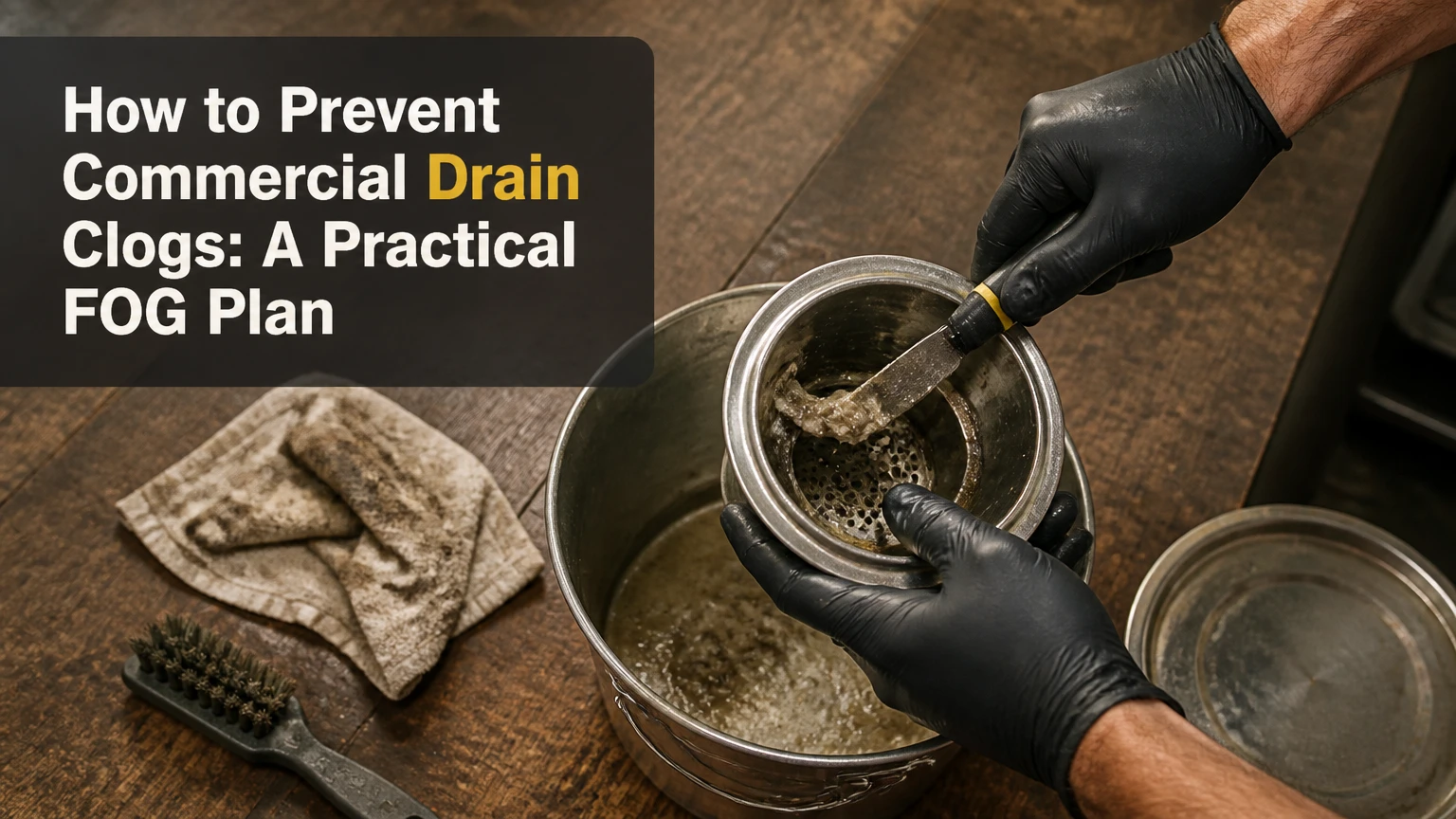
To prevent commercial drain clogs, control solids at the source, separate fats, oils, and grease before wastewater reaches building mains, inspect drainage assets on a schedule, and clean lines before flow becomes restricted. The most reliable program combines staff procedures, correctly sized grease-control equipment, documented pumping, targeted biological treatment, and periodic professional inspection.
Key Facts at a Glance
- Food scraps, paper, rags, sediment, and FOG are the main preventable contributors to commercial drainage restrictions.
- Grease traps and interceptors require measurement and servicing according to local sewer authority rules, not a universal calendar.
- The commonly cited 25% rule means pumping when floating FOG plus settled solids occupy about one-quarter of the liquid depth or capacity, where the local authority adopts that standard.
- Boiling water moves melted grease farther into a pipe; it does not remove the grease from the drainage system.
- Biological products can reduce organic film in suitable conditions, but they cannot replace solids removal, grease-trap pumping, or repairs.
- A camera inspection should precede repeated jetting when a line reclogs quickly, because roots, damaged joints, low spots, and poor pipe slope require repair.
What Commercial Drain Prevention Means
Commercial drain prevention is a planned system that keeps solids and FOG out of downstream pipes, captures material in maintainable equipment, and identifies restrictions before wastewater backs up. A restaurant kitchen needs grease control, while a warehouse may need sediment management, drain covers, and spill procedures instead.
Commercial drainage fails for different reasons in different zones. A prep sink usually accumulates food particles and grease. A floor drain may receive mop water, labels, broken glass, or packaging. A restroom branch can collect wipes and paper products, while a parking-lot inlet can fill with sand and leaves.
The prevention plan must therefore begin with a drainage map. Record every sink, floor drain, cleanout, interceptor, ejector, roof leader, and discharge point. Mark which fixtures connect to the kitchen waste line, sanitary sewer, stormwater system, or a dedicated process drain.
The U.S. Environmental Protection Agency describes source control as the most effective approach to fats, oils, and grease entering sewer systems. That principle has a practical consequence: removing one bucket of grease from a bin is safer and cheaper than allowing that grease to harden inside a branch line.
How Does a Commercial Drainage System Work?
A commercial drainage system uses gravity, pipe slope, flow velocity, and separation equipment to transport wastewater while retaining solids and FOG. Strainers catch large particles, grease traps slow flow for separation, and properly maintained pipes carry the clarified liquid toward the building sewer.
A hydromechanical grease interceptor reduces wastewater velocity inside a compact chamber. Lighter FOG rises, heavier solids settle, and the middle liquid layer exits through the outlet. The arrangement works only when the device is correctly sized, the flow-control fitting is present, and accumulated material is removed.
Hot water can temporarily keep grease liquid. As wastewater cools in a long lateral or outside interceptor, the grease can adhere to pipe walls and combine with food particles. Repeated deposits reduce the internal diameter, increase turbulence, and create a surface that captures more solids.
A trap does not make grease disappear. It relocates FOG into a controlled container that must be inspected, pumped, cleaned, and documented.
Which Causes Should the Plan Target?
| Drainage cause | Typical origin | First control | Escalation trigger |
|---|---|---|---|
| FOG deposits | Fryers, sauces, dairy, oily pans | Scrape and dry-wipe cookware | Repeat slow flow after trap service |
| Food solids | Prep sinks, dish areas | Removable basket strainer | Solids bypassing or damaged screen |
| Foreign objects | Floor cleaning, packaging, rags | Locked grate and waste bins | Object lodged beyond trap |
| Sediment | Loading bays, process washdown | Catch basin and sediment basket | More than 25 mm settled material |
| Roots or defects | Exterior sewer, older clay pipe | Camera inspection | Repeated blockage within 30-90 days |
| Low flow or slope | Long branches, poor installation | Pipe survey and flow review | Persistent standing water on camera |
A professional program distinguishes accumulation from infrastructure failure. Hydro-jetting can remove grease, but it cannot correct a collapsed pipe. Enzyme dosing can digest organic residue, but it cannot remove a rag or restore a missing cleanout cap.
Step 1: Map Sources and Enforce Waste Controls
Start by assigning every drain to a responsible work area and banning solids and liquid grease from sinks. Staff should scrape plates into lined waste containers, pour recovered fryer oil into a collection vessel, and dry-wipe oily pans before washing.
The procedure must match the workflow. Place a waste scraper beside the dish return, a sealed oil drum within the fryer service area, and a labeled solids bin near each prep sink. A policy posted 20 feet away from the workstation will not control behavior consistently.
Train employees during onboarding and repeat the instruction after any blockage. Managers should record the date, drain location, cause, corrective action, and employee group involved.
Success checkpoint: No visible food, wipes, labels, or oil enters a sink during a monitored shift.
Common mistake: Telling staff to “avoid grease” without supplying a scraper, oil container, or time allowance.
Step 2: Install and Maintain Point-of-Entry Barriers
Fit commercial sinks with removable basket strainers sized to the drain opening, and use secured floor-drain grates where loose objects could enter. Empty strainers at least once per shift in low-volume operations and after each rush period in high-volume kitchens.
Drain screens must not create a sanitation hazard. Stainless steel baskets should be removed, emptied into waste, washed, inspected for distortion, and returned to their seats. A bent basket allows particles to bypass the opening.
Floor-drain locks are useful in public or shared facilities because they prevent rags, packaging, and debris from being swept into the drainage system. They do not replace cleaning, and an overly fine screen can cause floor flooding if staff do not inspect it.
Success checkpoint: The basket sits flush, the grate is secure, and wastewater reaches the drain without pooling.
Common mistake: Installing a fine screen that blocks rapidly, then removing it instead of changing the cleaning interval.
Step 3: Match Grease Equipment to Flow and FOG Load
Choose grease-control equipment according to fixture flow, peak discharge, available space, local plumbing requirements, and maintenance access. A small under-sink trap may suit a coffee shop, while a high-volume restaurant generally needs an automatic grease removal device or a gravity grease interceptor.
| Equipment | Typical setting | Capacity or feature | Typical service pattern |
|---|---|---|---|
| Hydromechanical trap | Café or small kitchen | 20-50 gallons per minute | Inspect weekly, pump every 1-3 months |
| Automatic grease removal device | Medium restaurant | 4-20 gallons per minute per unit | Empty collection container daily |
| Gravity grease interceptor | Large kitchen or campus | 500-2,000+ gallons | Inspect monthly, pump by accumulation |
| Solids interceptor | Food prep or process area | 20-100 gallons chamber volume | Remove solids weekly or as measured |
Hydromechanical traps are compact but can demand frequent manual service. Automatic devices reduce labor by skimming separated grease into an external container, although motors, sensors, and collection components require inspection.
Large gravity interceptors provide retention volume and separation time. Their performance drops when inlet baffles are damaged, the outlet tee is missing, the cover leaks, or the tank is pumped without removing settled sludge.
The local sewer authority may specify an approved device, minimum capacity, access requirements, sampling ports, and pumping records. Confirm those requirements before installation.
Step 4: Inspect and Pump Before the 25% Threshold
Measure floating FOG and settled solids inside the interceptor, then schedule pumping before the combined accumulation reaches the threshold required by the local authority. The widely used 25% rule is a control point, not permission to wait until a backup occurs.
A service record should include the tank location, date, liquid depth, grease depth, sludge depth, total capacity, waste hauler, manifest number, and photographs when permitted. Measurements reveal whether a quarterly schedule is appropriate or whether the facility needs service every four weeks.
Do not rely on odor. A trap can smell normal while solids occupy valuable capacity, and a trap can smell foul because a gasket or water seal has failed even when the tank is not full.
| Service activity | Typical interval | Measured trigger | Responsible role |
|---|---|---|---|
| Empty sink baskets | Every shift | Visible solids at 25-50% basket fill | Kitchen employee |
| Inspect trap or interceptor | Weekly to monthly | Grease and sludge depth recorded | Facilities manager |
| Pump grease equipment | 1-3 months typical | Local 25% rule or authority schedule | Licensed hauler |
| Clean branch lines | 6-12 months typical | Flow reduction or inspection evidence | Drain contractor |
| Camera main sewer | 12-24 months typical | Repeat blockage or asset risk | Plumbing engineer |
A smaller trap may require more frequent pumping than a larger interceptor even when both serve the same number of fixtures. Peak flow and FOG concentration matter more than employee headcount alone.
Step 5: Use Biological Treatment Only as Maintenance
Biological dosing can reduce biodegradable grease film in compatible branch lines when the product, dose, temperature, and contact time are controlled. Automated pumps commonly apply treatment during low-flow periods, often overnight, but the manufacturer’s label and local discharge rules determine the correct dose.
Biological products are maintenance aids, not substitutes for source control. They do not reliably remove metal, glass, cloth, plastic, heavy sludge, roots, or a fully obstructed pipe. They also cannot correct a grease interceptor that is overdue for pumping.
Avoid combining bacterial products with bleach, quaternary sanitizers, strong acids, caustic cleaners, or disinfectants in the same dosing window. Those chemicals can kill the organisms or alter the conditions required for digestion.
Practitioner rule: If a line requires a cable machine every month, stop increasing the bacterial dose and investigate the pipe. Repeated mechanical clearing usually indicates a structural, hydraulic, or source-control problem.
Step 6: Schedule Cleaning From Evidence
Use preventative drain cleaning when inspection records show recurring film, declining flow, or predictable seasonal loading. Hydro-jetting is appropriate for grease-coated lines with sound pipe walls, while cable cleaning is more suitable for opening a localized obstruction or retrieving certain objects.
Camera inspection changes the decision. A contractor can identify roots, cracks, offsets, bellies, corrosion, construction debris, and abandoned connections before selecting pressure and nozzle type.
Typical commercial hydro-jetting costs range from $400-$900 for accessible branch or main-line work, while emergency service often costs more because of response time, access difficulty, wastewater cleanup, and after-hours labor. Prices vary by region, pipe diameter, length, and disposal requirements.
Never jet a fragile or damaged line without reviewing the camera evidence. High-pressure water can worsen a defective section or wash debris into a downstream restriction.
Which Prevention Method Fits the Facility?
| Facility profile | Primary risk | Recommended control | Typical monthly burden |
|---|---|---|---|
| Coffee shop, 1-2 sinks | Dairy and light FOG | Baskets plus compact trap | $175-$450 pumping when needed |
| Full-service restaurant | FOG, solids, peak flow | Trap or AGRD plus staff controls | $250-$900 maintenance |
| Hotel kitchen | High meal volume and long branches | Interceptor, dosing, scheduled jetting | $500-$1,500 typical |
| Office or warehouse | Paper, sediment, foreign objects | Drain screens and cleanout inspections | $50-$300 typical |
| Campus or mall | Multiple tenants and shared mains | Asset logs, interceptor contracts, cameras | $1,000+ across multiple assets |
An automatic grease removal device is most useful when labor is inconsistent and a suitable electrical connection exists. A passive trap is often more economical for a small café, provided staff can inspect and service it reliably.
Biological dosing is more defensible on long kitchen laterals than on short, easily accessible branches. Mechanical barriers remain the better investment when foreign objects cause the blockage.
What Does a Commercial Drain Prevention Program Cost?
A small facility may spend approximately $200-$600 for initial baskets, drain hardware, and a compact trap, while a larger kitchen can require several thousand dollars for a gravity interceptor, access work, pumping infrastructure, and installation. Recurring costs depend on loading rather than equipment price alone.
| Cost item | Typical range | Frequency | Main cost driver |
|---|---|---|---|
| Stainless sink basket | $20-$80 each | Replace as damaged | Size and material |
| Floor-drain lock or screen | $40-$120 each | One-time or damaged | Grate type and access |
| Trap pumping | $175-$450 | Every 1-3 months | Volume and disposal distance |
| Biological dosing fluid | $70-$150 | Monthly typical | Dose and product concentration |
| Automated dosing pump | $250-$600 | One-time hardware | Controls and installation |
| Hydro-jetting | $400-$900 | Every 6-12 months typical | Pipe length and access |
Treat these as planning ranges, not regulated prices. Municipal fees, wastewater disposal rules, emergency access, and regional labor rates can change the total substantially.
The financial comparison should include lost production, cleanup, food disposal, tenant disruption, water damage, and regulatory exposure. A low-cost trap that is repeatedly ignored can cost more than a larger system with measurable service requirements.
What Mistakes Cause Commercial Drain Programs to Fail?
Several popular practices create false confidence because they move contamination rather than remove it.
- Pouring boiling water into grease lines: Heat liquefies FOG temporarily, but the material can solidify farther downstream. Use source collection and approved cleaning procedures instead.
- Using acid or caustic drain openers: Strong chemicals can injure workers, damage seals, corrode metals, and create hazardous reactions with sanitizers. Mechanical service is safer for commercial obstructions.
- Emulsifying grease before an interceptor: Some cleaners disperse FOG so it passes through the trap and enters the public sewer. Confirm product acceptance with the sewer authority.
- Pumping only the liquid layer: Removing surface liquid while leaving sludge and settled grease preserves the blockage risk. A complete service removes accumulated material from the tank.
- Ignoring access covers: Buried or blocked covers turn routine inspection into emergency excavation. Keep interceptor lids accessible and visibly identified.
- Jetting without a camera after repeat failures: A clean pipe that blocks again within weeks may have roots, a belly, a broken joint, or an undersized connection.
One counterintuitive point matters: a drain can flow normally immediately after jetting while remaining operationally unhealthy. If the source behavior and interceptor capacity do not change, the same deposit often returns.
How Should Managers Build the Maintenance Schedule?
Assign tasks to shifts, facilities staff, and contractors, then verify completion with a short log. A schedule becomes effective when each task has a location, interval, measurable result, and escalation rule.
| Period | Required action | Record | Escalation |
|---|---|---|---|
| Each shift | Empty baskets and remove solids | Employee initials and drain ID | Supervisor retraining |
| Weekly | Check slow drains, odors, and screens | Inspection checklist | Open trap or clean branch |
| Monthly | Measure interceptor accumulation | FOG and sludge depths | Book pumping before threshold |
| Quarterly | Review service trends and invoices | Cost and blockage report | Change interval or equipment |
| Annually | Camera selected mains and inspect assets | Video file and condition grade | Repair defects or redesign |
Track blockage frequency by location. Three backups at one prep sink indicate a local control failure, while simultaneous slow drains throughout a building suggest a downstream main-line restriction.
Schedule inspections before peak seasons, menu changes, tenant turnover, or large events. A hotel kitchen serving a holiday banquet can generate several times its normal daily FOG load.
What If the Facility Has No Commercial Kitchen?
Non-food facilities still need drain prevention, but grease control may not be the central measure. Offices should control wipes and paper products, warehouses should manage sediment and spill debris, and laundries should address lint, fibers, and chemical compatibility.
Parking and loading-area drains need catch-basin cleaning, leaf removal, and spill containment. HVAC condensate lines need separate treatment because algae and biological slime, rather than FOG, commonly restrict those small pipes.
Do not connect stormwater drains to sanitary waste systems without confirming the approved design. A drain that appears to be part of the same building may discharge to a different system with different environmental requirements.
Early Warning Signs and the Correct Response
| Warning sign | Likely location | Immediate check | Professional response |
|---|---|---|---|
| Slow pre-rinse sink | P-trap or branch | Remove and inspect basket | Branch cleaning if restriction remains |
| Gurgling floor drain | Downstream branch or vent | Check nearby fixtures | Camera or jetting based on evidence |
| Grease odor near kitchen | Trap, gasket, or drain film | Inspect cover and water seal | Pump, reseal, or clean line |
| Multiple fixtures slow | Building main | Stop high-volume discharge | Main-line inspection and cleaning |
| Overflow from interceptor | Grease device or outlet | Stop flow and isolate area | Emergency pumping and code review |
| Repeated blockage | Defective pipe or source | Compare service records | Camera survey and corrective repair |
Stop using affected fixtures when wastewater rises, reaches food-contact areas, or enters occupied space. Protect workers from sewage exposure, document the incident, and use a licensed contractor when contaminated cleanup or confined-space access is involved.
Situational Recommendations by Business Type
Small Cafés
Use basket strainers, a correctly sized hydromechanical trap, and a strict wipe-before-wash policy. Empty baskets after busy service periods and inspect the trap weekly because compact devices lose effective capacity quickly.
High-Volume Restaurants
Prioritize flow calculations, an approved interceptor or AGRD, accessible cleanouts, and documented pumping. Add branch-line inspection when the kitchen has long runs, multiple dish machines, or a history of overnight backups.
Hotels and Campuses
Use an asset register for every kitchen, tenant, interceptor, floor drain, and shared main. Contract pumping and camera inspections centrally, but assign each tenant responsibility for source control and daily fixture checks.
Offices, Warehouses, and Retail Properties
Focus on drain covers, wipe disposal, sediment removal, spill response, and tenant communication. Do not install grease equipment where the wastewater profile does not justify it.
FAQ
How often should a commercial grease trap be cleaned?
A commercial grease trap may need pumping every 1-3 months, but the correct interval depends on measured FOG and sludge accumulation, fixture flow, trap capacity, and local sewer rules. Record accumulation after each service, then shorten or extend the interval only when measurements support the change.
Can enzyme drain cleaners prevent kitchen clogs?
Enzyme or bacterial drain treatments can help control biodegradable film in compatible lines, but they cannot remove solid food, cloth, plastic, roots, or structural defects. Use them only as a supplement to source control, interceptor maintenance, and mechanical inspection.
Are grease traps required for every commercial business?
Grease-control requirements typically apply to facilities that discharge fats, oils, or grease, especially food-service operations, but the exact requirement comes from the local plumbing code or sewer authority. Offices and warehouses may need screens or sediment controls instead of a grease trap.
Why does a commercial drain clog after professional cleaning?
A commercial drain can clog again when the underlying cause remains, including excessive FOG discharge, an undersized interceptor, root intrusion, a low section of pipe, poor slope, or a damaged joint. Review the cleaning report and request camera evidence when the recurrence interval is short.
Is hydro-jetting safe for older commercial pipes?
Hydro-jetting can be safe for older pipes when a contractor selects pressure and nozzle settings after assessing pipe material and condition. Camera inspection should precede aggressive jetting on brittle clay, heavily corroded cast iron, cracked vitrified pipe, or lines with suspected voids.
What should staff do during a commercial drain backup?
Stop using connected fixtures, isolate the affected area, keep wastewater away from food and electrical equipment, and notify the facilities manager. Do not add chemical opener. Record the location and symptoms, then use an appropriately licensed emergency plumbing or drainage contractor.
The Bottom Line
The most reliable way to prevent commercial drain clogs is to control solids and grease before they enter the pipe, maintain the correct interceptor, and use inspection data to schedule cleaning. Build the program around documented daily source control, measured grease accumulation, local code compliance, and camera-led investigation of repeat failures.
A facility should not treat biological dosing, boiling water, chemical cleaners, or emergency jetting as a complete solution. For the target query, how to prevent commercial drain clogs has a practical answer: reduce incoming contamination, capture what remains, verify system capacity, and repair the drainage defects that maintenance alone cannot solve.