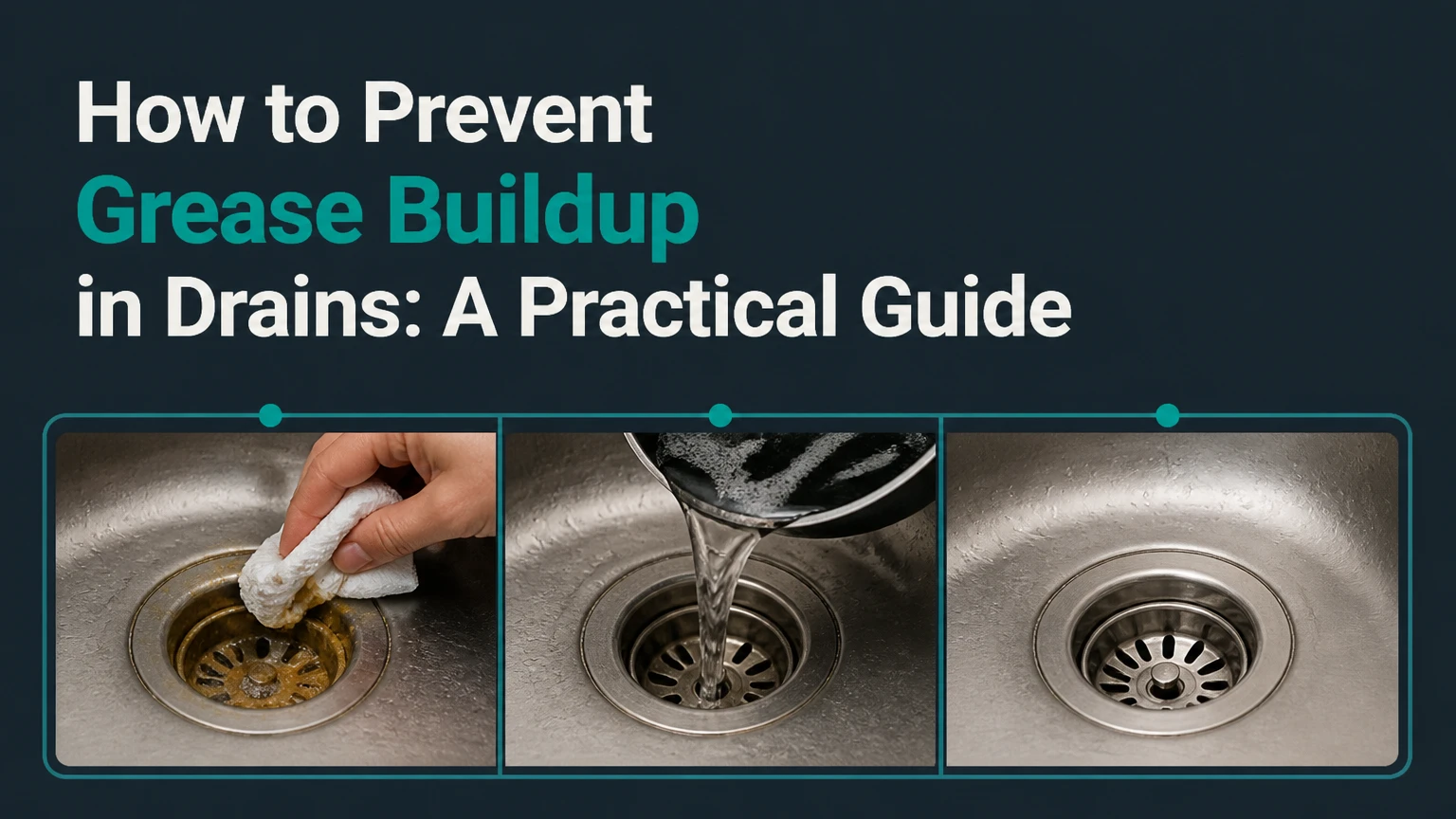
To prevent grease buildup in drains, keep fats, oils, and grease, known as FOG, out of the plumbing system before washing dishes. Scrape food into the trash, wipe oily cookware, collect liquid grease in a sealed container, use a sink strainer, and address slow drainage before residue hardens into a blockage.
Key Facts / At a Glance
Cooking oil, butter, animal fat, shortening, gravy, and mayonnaise can coat drain pipes even when they leave the pan as liquids.
A sink strainer catches food particles but does not remove dissolved or emulsified oil.
Freezing collected grease makes disposal cleaner; freezing never makes grease safe to pour into a drain.
Hot water and dish soap can move grease farther into a pipe instead of removing it from the plumbing system.
Enzyme or bacterial drain treatments may reduce organic film, but they cannot reliably remove a solid obstruction.
A commercial grease trap or interceptor must be sized, installed, and serviced according to local plumbing and wastewater rules.
How to Prevent Grease Buildup in Drains
The most reliable household method is source control: stop bulk FOG at the pan, remove residue mechanically, and dispose of collected grease in solid waste or an approved recycling program. A five-minute routine after cooking prevents more buildup than periodic chemical treatments because the grease never reaches the pipe.
Grease buildup usually begins as a thin coating inside the kitchen branch drain. Cooling fat adheres to that coating, while food particles, starch, hair, wipes, and mineral deposits create a rougher surface that restricts flow. Household clogs are often local, but FOG discharged by many properties can also contribute to larger sewer blockages.
Before You Start
| Requirement | Typical household value | Why it matters |
|---|---|---|
| Daily time | 2-5 minutes | Removes residue before washing |
| Startup cost | $5-$25 | Covers scraper, towels, strainer, and container |
| Collection container | 1 quart to 1 gallon | Holds several cooking sessions |
| Sink strainer | 1-2 mm mesh opening | Captures food solids and grease-bearing debris |
| Cleaning cloths | 1-2 disposable towels per greasy pan | Removes the film water cannot dissolve |
| Prerequisite | Cool pan enough to handle safely | Prevents burns and container damage |
Do not pour hot grease into a glass jar that may crack from thermal shock. Let the pan cool until the fat is pourable but no longer dangerously hot, or scrape solidified fat directly into a lined trash container.
Step 1: Scrape Every Greasy Surface
Scrape pans, plates, roasting trays, grill plates, and baking sheets into the trash before adding water. A silicone spatula or old plastic scraper removes bulk fat without scratching most cookware, and the collected material should go into a sealed bag, bin, or approved food-waste stream.
The largest preventable load comes from visible residue, not the trace film left after wiping. Scraping is especially important after frying bacon, cooking sausage, roasting meat, sautéing ground beef, making curry, or preparing sauces thickened with butter and flour.
Success checkpoint: The pan surface should show no pools, ribbons, or thick smears of fat before it reaches the sink.
Common mistake: Scraping liquid grease into an unlined indoor bin can create leaks and odors. Use a tied bag, lidded container, or absorbent material such as paper towels.
Step 2: Wipe Oily Cookware Before Washing
Wipe the remaining film from cookware with a paper towel, napkin, or reusable cloth designated for grease. One dry wipe often removes more oil than several minutes of rinsing because water does not dissolve hydrophobic fats, and detergent may only disperse them into smaller droplets.
Wipe the inside of pans, the underside of roasting racks, plates holding fried food, and the corners of baking trays. For a large catering pan, use absorbent paper or a small amount of cooled food waste to collect the film before washing.
Success checkpoint: A clean towel should not pick up a transparent oily sheen after the final wipe.
Common mistake: Using a wet towel first spreads grease across a larger surface. Start dry, then wash with detergent after the bulk film is gone.
Step 3: Install and Maintain a Sink Strainer
Fit a removable sink strainer over the kitchen drain and empty it into the trash after washing. A practical household strainer has openings around 1-2 millimeters, although the correct size depends on the sink and the manufacturer’s drainage design.
A strainer prevents rice, meat fragments, vegetable skins, coffee grounds, and other solids from carrying grease into the branch line. It cannot capture oil that is already liquid, dissolved, or emulsified in wastewater, so a strainer complements scraping and wiping rather than replacing them.
Success checkpoint: The strainer catches visible particles without holding standing water in the sink.
Common mistake: Leaving a dirty strainer in place allows grease and food debris to decompose, creating odor. Empty it daily and wash it with hot tap water and detergent away from the drain when possible.
Step 4: Collect Cooking Oil in a Sealed Container
Pour cooled liquid oil into a leak-resistant container instead of the sink. Suitable options include the original oil bottle, a screw-top plastic bottle, a sturdy metal can, a purpose-made grease container, or a foil-lined disposal bag rated for food waste.
Do not mix hot oil with water, and do not fill a container beyond a level that makes it difficult to close safely. Restaurants and high-volume households may qualify for used-cooking-oil collection, while municipal rules differ for household quantities.
| Disposal method | Suitable volume | Typical handling | Main limitation |
|---|---|---|---|
| Original oil bottle | 250 ml-2 litres | Cool oil, pour, cap, bin or recycle as directed | Bottle must remain intact |
| Metal can with lid | 500 ml-4 litres | Cool, fill, seal, place in trash | Can may rust if stored wet |
| Foil-lined grease bag | 250 ml-1 litre | Pour below fill line, seal, discard | Not suitable for very hot oil |
| Local oil collection | 1-20+ litres | Store separately and follow program rules | Availability varies by municipality |
| Solidified fat in food waste | 100 g-2 kg | Confirm organics-program acceptance | Many programs reject fats and oils |
Success checkpoint: The container is sealed, upright, cool, and stored where it cannot be knocked over.
Common mistake: Treating a drain, toilet, storm drain, or outdoor soil as an alternative disposal route simply transfers the pollution and blockage risk.
Step 5: Freeze or Absorb Small Amounts for Cleaner Disposal
Freeze a sealed container of grease when you need to prevent spills, or absorb small amounts with paper towels before placing them in the trash. Freezing changes the handling condition, not the environmental status of the material, so frozen grease must still follow local waste or recycling instructions.
Freezing works well for bacon fat, poultry drippings, and small quantities of shortening. It is less practical for several litres of oil, where a capped bottle or licensed collection service is safer.
Success checkpoint: The grease remains inside the container during normal bin handling.
Common mistake: Putting a hot container directly into a freezer can damage the container, contaminate food, or create a burn hazard. Cool it first.
Step 6: Wash With Controlled Water Flow
After scraping and wiping, wash cookware with normal hot tap water and dish detergent. Allow the water to carry only the thin residue that remains after mechanical removal, then keep the drain flowing normally rather than using a large surge of boiling water.
Cold-water flushing is not a dependable grease-prevention method. Some utilities recommend cool water to reduce melting and transport of solid fats, while others recommend water appropriate to the detergent and fixture; the consistent rule is to remove bulk FOG before it enters the pipe.
Success checkpoint: Water drains promptly during washing, with no floating grease, pooling, or fresh odor afterward.
Common mistake: Pouring boiling water onto a cup of grease can liquefy the fat temporarily and push it into a cooler section of pipe. The grease can solidify again farther downstream, where access is more difficult.
Step 7: Inspect Early Warning Signs
Treat a slow kitchen drain, recurring gurgling, or rancid odor as an inspection signal rather than a cue to add more chemicals. A partial restriction can worsen when new grease adheres to the narrowed section, and repeated symptoms may indicate a trap, branch line, vent, or main sewer problem.
Check whether the issue affects one fixture or several. One slow sink often points to the trap or nearby branch line; simultaneous backup at a sink, dishwasher, floor drain, or toilet suggests a larger shared-line restriction.
Success checkpoint: The sink drains at its previous rate after routine cleaning, and no odor returns when the cabinet remains dry.
Common mistake: Ignoring a slow drain because water still moves. A partial blockage is easier and less expensive to remove than a complete backup.
Which Prevention Options Work Best?
For most homes, manual disposal is the best option because it removes the largest quantity of grease before wastewater reaches the plumbing. Enzyme products can support maintenance, while grease traps belong mainly in commercial or unusually high-volume food-preparation settings.
| Option | Typical purchase or installation cost | Maintenance interval | Best application | Main limitation |
|---|---|---|---|---|
| Scraper, towels, container | $5-$25 | Every cooking session | Apartments and homes | Requires consistent behavior |
| Sink strainer | $5-$20 | Empty daily, wash weekly | Food-particle control | Does not capture dissolved oil |
| Enzyme or bacterial product | $10-$35 per bottle | Product-specific, often weekly or monthly | Light organic film | Cannot clear hard clogs |
| Under-sink grease trap | $150-$600 installed | Inspect weekly, clean every 1-3 months | High-volume residential or small food service | Odor, cabinet space, servicing |
| Automatic grease removal unit | $2,000-$8,000 or more | Routine inspection, scheduled servicing | Commercial kitchens | Cost, power, professional sizing |
| Professional drain cleaning | $150-$500 typical residential visit | As needed after diagnosis | Existing restriction | Does not prevent new discharge |
Costs vary substantially by country, access, pipe configuration, labor rates, and local code. The figures above are typical planning ranges, not quotations.
Are Enzyme Drain Cleaners Worth Using?
Enzyme and bacterial treatments are optional maintenance aids, not substitutes for grease disposal. Products containing lipase or microbial cultures may break down some organic residue when the label permits use in the plumbing system, but the treatment requires contact time and cannot reliably dissolve a compacted fat, mineral, and debris blockage.
Use only one product according to its label, and never combine biological treatments with bleach, acid, caustic drain opener, or disinfectant. Septic owners should confirm compatibility with the septic manufacturer or service professional.
Practitioner rule: A treatment that requires six to eight hours without water cannot compensate for a sink that receives fresh grease every evening.
Does a Household Need a Grease Trap?
Most ordinary homes do not need a commercial-style grease trap when residents scrape, wipe, and collect fats correctly. A trap may be justified for a home bakery, frequent frying operation, shared commercial-style kitchen, or property with a documented grease-related branch-line problem, subject to local plumbing approval.
Passive traps separate grease through reduced flow and cooling. They also accumulate foul sludge, require access for cleaning, and can fail when undersized or bypassed. A device installed under a sink must match the fixture flow, connection type, available cabinet space, and local requirements.
Commercial kitchens generally need a properly sized grease interceptor or grease removal device. The U.S. Environmental Protection Agency identifies fats, oils, and grease as a significant source of sanitary sewer blockages, while local wastewater authorities set the enforceable design, inspection, and pumping requirements.
What Mistakes Make Grease Buildup Worse?
The most damaging mistake is using water to transport grease instead of removing it. Dish soap may emulsify fat temporarily, but emulsified droplets can travel through the trap and later separate as wastewater cools.
Avoid these practices:
- Pouring oil, gravy, butter, or meat drippings into the sink: Collect them even when the amount seems small.
- Using boiling water as a routine flush: Heat can relocate the problem downstream.
- Relying on a garbage disposal: Grinding food does not destroy its fat content.
- Flushing wipes or paper products: “Flushable” labeling does not mean rapid sewer disintegration, and wipes can combine with grease and solids.
- Adding caustic or acidic drain opener repeatedly: Sodium hydroxide and sulfuric-acid products can injure users, damage some plumbing materials, and leave a hazardous mixture for the next person opening the trap.
- Pouring grease into a toilet or storm drain: A larger pipe does not make FOG harmless.
Baking soda and vinegar are often recommended for odors, but their foaming reaction is not a dependable grease solvent. The mixture may loosen light surface debris, yet it will not remove a hardened obstruction or replace mechanical cleaning.
How Do You Handle an Existing Grease Restriction?
For a minor, localized slowdown, remove and clean the sink strainer, clean the accessible trap if you can do so safely, and use a plunger with enough water to cover the cup. Stop if water backs up from another fixture, the trap cannot be removed safely, or chemical cleaner has already entered the line.
A plumber may use a hand auger, sectional cable, or hydro-jetting after diagnosing the pipe. Hydro-jetting can remove adherent grease from suitable lines, but it is not automatically appropriate for fragile, damaged, or severely corroded plumbing.
| Symptom pattern | Likely location | First response | Escalation point |
|---|---|---|---|
| One sink drains slowly | Strainer, trap, or branch line | Clean strainer and inspect trap | No improvement after safe plunging |
| Sink smells but drains normally | Strainer, trap, or biofilm | Wash strainer and clean accessible surfaces | Odor persists for 48 hours |
| Several fixtures back up | Shared branch or main line | Stop water use | Call a plumber promptly |
| Gurgling follows dishwasher discharge | Partial restriction or vent issue | Check for pooling and slow flow | Recurring sound or backup |
| Grease returns after cleaning | Upstream source or damaged line | Stop FOG discharge | Camera inspection or professional cleaning |
Never plunge a drain after pouring caustic cleaner into it unless the product instructions and protective procedure specifically permit that action. Chemical splashback can cause serious burns.
How Should Apartments, Septic Homes, and Businesses Adapt?
Apartment residents should use source control and notify building management when multiple fixtures drain slowly. A recurring blockage in a shared stack may not be caused by one tenant, and pouring chemicals into a communal line can create a hazard for maintenance staff.
Septic-system owners should be stricter because grease can accumulate in the septic tank scum layer and contribute to drain-field loading. Manual collection is the safest default; enzyme additives do not make regular grease discharge acceptable, and local septic professionals may recommend different practices for a particular system.
Commercial kitchens need a written FOG-control procedure covering scraping, dry wiping, sink strainers, interceptor inspection, employee training, and waste transfer. Local authorities may specify grease depth, pumping frequency, manifests, access requirements, and discharge limits, so a restaurant should follow its sewer-use ordinance rather than a generic online schedule.
Commercial Cleaning Thresholds
Many wastewater programs use a grease-depth or total-solids trigger, but the exact threshold is jurisdiction-specific. A commonly used operational rule is to arrange service when floating grease and settled solids together approach 25 percent of the liquid depth, unless the authority or equipment manufacturer specifies another limit.
| Commercial control | Typical frequency | Responsible person | Record to keep |
|---|---|---|---|
| Scrape and dry wipe | Every batch or service period | Cooking staff | Opening and closing checklist |
| Strainer emptying | Daily or each shift | Kitchen employee | Shift log |
| Interceptor inspection | Weekly to monthly | Manager or contractor | Inspection record |
| Pumping or trap cleaning | Every 1-3 months, or by measured condition | Licensed service provider | Manifest and invoice |
| Employee refresher training | Every 6-12 months | Operations manager | Attendance record |
A grease interceptor is a containment device, not a license to discharge unlimited oil. Oversized or neglected equipment can still pass grease into the sewer.
When Should a Plumber Inspect the Drain?
Call a plumber when multiple fixtures back up, wastewater returns after plunging, a drain repeatedly slows within days, or a camera inspection is needed to evaluate old cast-iron, clay, or damaged plastic pipe. Professional diagnosis is also appropriate when grease buildup follows a kitchen renovation or when a commercial interceptor cannot maintain compliance.
Older cast-iron lines may have internal scale that traps grease more readily than smooth modern pipe. Aggressive cleaning can expose defects, so the cleaning method should match the pipe’s condition, diameter, access points, and history.
Frequently Asked Questions
Can I pour a small amount of oil down the sink?
No. Even small amounts can coat the trap and branch line, particularly when repeated daily. Wipe the container or pan with a paper towel, collect liquid oil in a sealed bottle, and follow local trash, food-waste, or cooking-oil recycling instructions.
Does dish soap dissolve grease safely in plumbing?
Dish soap disperses grease into smaller droplets, but it does not guarantee that the fat leaves the drainage system. Hot water and detergent can move emulsified grease downstream, where cooling, mineral deposits, and solids may produce a restriction.
Are grease clogs more common in PVC or cast-iron pipes?
Grease can accumulate in both materials, but corroded or scaled cast-iron pipe provides a rougher surface that may retain more residue. PVC does not make improper disposal safe; repeated FOG discharge can still form a coating inside smooth plastic drainage lines.
How often should I clean a kitchen drain?
Clean the strainer daily, wipe greasy cookware after every use, and inspect the trap when odor or slow flow appears. Preventive deep cleaning has no universal calendar because cooking volume, pipe condition, and household habits determine how quickly residue accumulates.
Can vinegar remove hardened grease from a drain?
Vinegar may help with mineral scale or odor in limited circumstances, but it is not a reliable solvent for hardened cooking fat. Mechanical removal, an auger, or professional cleaning is more appropriate when water drains slowly or grease has formed a compacted obstruction.
Is a garbage disposal safe for greasy food?
A garbage disposal can process some small food scraps, but it does not eliminate fats, oils, or grease. Scrape greasy food into the trash first, and use the disposal only for the quantity and food types allowed by the manufacturer.
The Bottom Line
The most effective way to prevent grease buildup in drains is to remove FOG before washing: scrape cookware, wipe the remaining film, strain food particles, collect oil, and dispose of it through an approved waste route. Do not rely on boiling water, dish soap, garbage disposals, vinegar, or chemical openers to erase repeated grease discharge. For commercial kitchens, pair source control with a correctly sized, documented, and regularly serviced grease interceptor. Consistent disposal prevents more clogs than emergency treatment.