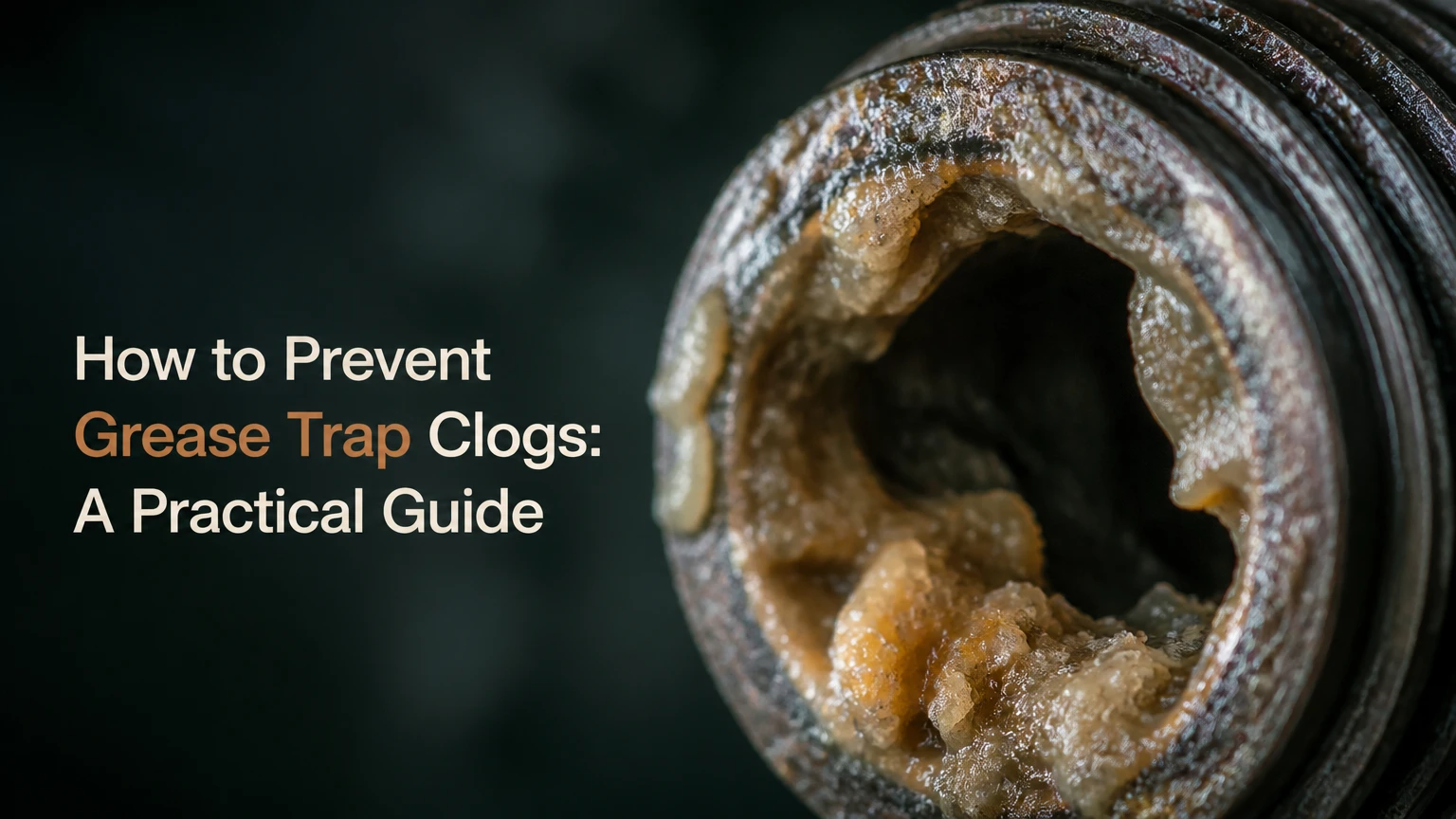
To prevent grease trap clogs, keep fats, oils, grease, and food solids out of wastewater, control incoming flow, inspect accumulation, and pump the trap before grease and sludge occupy 25% of its liquid capacity. Train staff at every sink, clean strainers during each shift, avoid chemical drain cleaners, and adjust service frequency to actual kitchen loading and local rules.
Key Facts at a Glance
- A grease trap separates floating FOG from heavier food solids before wastewater reaches the sanitary sewer.
- Dry scraping and wiping remove grease more reliably than flushing it with hot water.
- The commonly used 25% rule measures the combined thickness of floating grease and settled solids against the operating depth, but local authorities may impose stricter schedules.
- Enzymes and bacteria may reduce odors or pipe-film buildup, but biological products do not replace physical pump-outs.
- Boiling water can move melted grease beyond the trap, where it may cool and harden inside downstream pipes.
- A recurring backup after cleaning often indicates undersizing, excessive flow, blocked baffles, a faulty outlet, or a downstream sewer problem.
What Does a Grease Trap Do?
A grease trap, also called a hydromechanical grease interceptor, slows kitchen wastewater so FOG rises and food particles settle. The middle layer of relatively clearer water leaves through the outlet, while inlet and outlet baffles prevent floating grease and settled solids from escaping during normal flow.
Commercial kitchens use grease traps because liquid grease does not remain liquid throughout a drainage system. Wastewater cools inside pipes, fats adhere to pipe walls, and repeated deposits narrow the effective opening. Food solids then catch on the sticky surface and create a dense blockage.
A small indoor trap commonly serves sinks, prep basins, and selected fixtures. A larger outdoor gravity interceptor provides greater retention volume and usually serves a building’s kitchen drainage network. Local plumbing and wastewater authorities determine which fixtures must connect and how the device must be sized.
How Does Grease Separate Inside the Tank?
Grease separation depends on time, temperature, density, and controlled flow. Wastewater enters through a flow-control fitting, loses velocity in the first chamber, and passes around baffles that encourage FOG to float and solids to settle.
The tank develops three zones:
- Top layer: floating grease, oil, and scum.
- Middle layer: wastewater moving toward the outlet.
- Bottom layer: food solids, sludge, and heavier sediment.
A sudden surge from a dishwasher, kettle, or multiple sinks can disturb these layers. If the trap is undersized or the baffles are damaged, grease can pass directly to the outlet, a condition called hydraulic short-circuiting.
How to Prevent Grease Trap Clogs
The most reliable prevention system combines source control, flow management, inspection, and scheduled extraction. The highest-value intervention occurs before wastewater reaches the drain, because removing grease with a towel costs less and prevents more buildup than trying to separate the same grease after dilution.
Before You Start
| Requirement | Typical specification | Why it matters |
|---|---|---|
| Staff briefing | 10-15 minutes per shift | Converts prevention into repeatable behavior |
| Sink strainers | 1-3 mm perforated or fine-mesh baskets | Captures rice, grounds, scraps, and solids |
| Scraping tools | 1 rubber spatula per prep or dish station | Removes food and grease before washing |
| Inspection tools | Nitrile gloves, flashlight, measuring stick, log sheet | Supports safe, repeatable checks |
| Service budget | $125-$500 per routine visit | Covers typical indoor or outdoor pumping ranges |
| Inspection frequency | Daily visual check, weekly review | Finds process failures before backups |
Never enter a grease interceptor. Tanks can contain hydrogen sulfide, methane, and oxygen-deficient air. Workers should keep the lid secured, avoid placing their face over an opening, and call a qualified service provider for internal cleaning or unsafe conditions.
Step 1: Scrape and Wipe Cookware Before Washing
Require employees to scrape pans, plates, fryer baskets, and food containers into a waste bin, then wipe visible grease with a disposable towel. Dry removal prevents FOG from entering the trap and limits the amount of solids that settle around baffles.
The procedure should cover fryer oil, bacon fat, gravy, cream sauces, salad dressing, marinades, and oily residues on sheet pans. A scraping station positioned beside the dish area works better than a rule posted far from the sink.
Success checkpoint: Wastewater entering the wash sink contains no visible oil film from routine cookware.
Common mistake: Staff use a strong spray of hot water to “clean” pans before scraping, sending emulsified grease into the drainage line.
Step 2: Keep Food Solids Out of Every Drain
Install a properly fitted basket strainer in each sink connected to the grease-control system. Empty strainers into solid waste several times per shift, especially after vegetable preparation, coffee service, or high-volume dishwashing.
Coffee grounds, flour, rice, pasta, eggshells, fibrous vegetables, and meat scraps do not dissolve quickly in a grease trap. Starch absorbs water and expands, while fibrous material can bridge across an outlet or baffle opening.
Success checkpoint: The strainer contains solids at collection points, and no food scraps are visible in the trap during inspection.
Common mistake: Employees remove the basket because a slow sink seems to drain faster without it. The apparent improvement transfers the blockage downstream.
Step 3: Separate Used Cooking Oil for Recovery
Collect fryer oil and bulk liquid grease in a labeled, leak-resistant container. Do not pour either material into a sink, floor drain, toilet, outdoor catch basin, or storm drain.
A restaurant producing several gallons of waste oil each week should arrange collection with a rendering or used-cooking-oil service. The container must remain stable and covered, and staff need a safe transfer procedure that prevents burns and spills.
Small amounts left on cookware still belong in the dry-wipe process. Oil recovery removes the largest FOG loads before they reach the plumbing system.
Success checkpoint: No employee uses a drain as an oil-disposal route, and the collection container has a documented pickup or disposal routine.
Common mistake: Pouring warm oil into a sink and following it with detergent. Detergent disperses oil temporarily; it does not eliminate the total grease load.
Step 4: Control Water Temperature and Flow
Use normal hot tap water for washing, but do not use boiling water as a preventive purge. Boiling water may liquefy grease near the drain, allowing it to travel farther before cooling and adhering to downstream pipe walls.
Flow control matters as much as temperature. The inlet flow-control device limits surges so the wastewater remains in the trap long enough for separation. Do not remove, bypass, or obstruct that fitting to make a sink drain faster.
Dishwashers and high-temperature equipment require particular attention. Their discharge can carry emulsified grease and arrive at a high flow rate, so the plumbing design must follow the trap manufacturer’s instructions and local plumbing code.
Success checkpoint: Fixtures drain without surges, the flow-control fitting remains installed, and wastewater does not visibly churn across the outlet chamber.
Common mistake: Connecting extra fixtures to an existing trap without recalculating flow and fixture load.
Step 5: Clean Accessible Components and Use Biological Products Carefully
Clean the removable strainer, lid gasket, inlet screen, and accessible baffle surfaces according to the manufacturer’s instructions. A qualified technician should remove accumulated grease and sludge from the tank during a pump-out rather than relying on a chemical treatment.
Enzyme or bacterial products can sometimes reduce odor and thin organic deposits in connected lines. They cannot remove mineral scale, plastic debris, hardened soap, large food solids, or a tank already filled with grease. They also may conflict with wastewater rules or a service provider’s treatment method.
If a facility uses a biological product, select one approved by the local authority or specified by the equipment manufacturer. Dose consistently at the labeled rate, usually during a low-flow closing period, and record the product, quantity, and date.
Success checkpoint: Odors and recurring light film decrease without extending the pump-out interval beyond the measured accumulation limit.
Common mistake: Treating an additive as a substitute for extraction.
Step 6: Measure Accumulation and Pump Before the Limit
Schedule a professional pump-out when the combined floating grease and bottom sludge approaches the locally permitted limit. The widely used 25% rule means the combined layers should not exceed one-quarter of the operating liquid depth, although some jurisdictions require a fixed calendar schedule or a different threshold.
A technician should measure both layers rather than judging the surface visually. The measurement should account for the trap’s baffles, liquid depth, and manufacturer design. A full pump-out removes liquid, grease, solids, and settled material; skimming only the top layer leaves the sludge that reduces effective volume.
Typical service intervals range from every 1-4 weeks for heavily used indoor traps to every 1-3 months for larger outdoor interceptors, but production volume and inspection data should determine the actual schedule.
Success checkpoint: A service record shows the date, measured grease and sludge depth, pumped volume, technician observations, and disposal documentation.
Common mistake: Waiting for a backup because the trap appears to have unused space above the grease layer.
What Maintenance Schedule Prevents Most Clogs?
A daily source-control routine, weekly equipment review, and measured pump-out schedule prevent more failures than occasional emergency cleaning. The schedule below is a practical starting point, but the facility should shorten intervals when inspections show rapid accumulation or when local regulations require more frequent service.
| Frequency | Task | Acceptance measure |
|---|---|---|
| Every shift | Scrape cookware and empty strainers | No visible food waste at drain openings |
| Daily | Check sink drainage, odors, leaks, and lid condition | No slow fixtures or leaking seals |
| Weekly | Review staff compliance and inspect accessible fittings | Flow-control device and baffles remain intact |
| Monthly | Measure or arrange measurement of grease and sludge | Combined layers remain below the permitted threshold |
| Every 1-4 weeks | Pump a heavily used indoor trap as needed | Pump-out interval follows measured loading |
| Every 1-3 months | Service a typical outdoor interceptor as needed | No overflow, bypass, or excessive bottom solids |
| After each service | File manifest and technician report | Complete compliance record |
A trap that reaches the threshold in two weeks requires a two-week service interval, even if a quarterly calendar appointment was previously convenient. Conversely, a lightly used unit should not be pumped less often than local rules allow simply because it appears clean.
Which Grease-Control System Fits the Facility?
Hydromechanical traps suit low-to-moderate flow near a sink, outdoor gravity interceptors suit larger facilities with space and tanker access, and automatic grease removal devices suit operations that need frequent separation in a compact area. Smart sensors improve monitoring but do not eliminate cleaning, inspection, or legal responsibility.
| System | Typical capacity or size | Typical installed cost | Typical service pattern |
|---|---|---|---|
| Indoor hydromechanical trap | 10-75 gallons per minute | $1,200-$5,000 | Clean or pump every 1-4 weeks |
| Outdoor gravity interceptor | 500-3,000+ gallons | $8,000-$40,000+ | Pump every 1-3 months or by measurement |
| Automatic grease removal device | 15-50 gallons per minute | $5,000-$15,000 | Empty solids basket daily; service mechanical parts |
| Sensor-equipped system | Under-sink to large interceptor | Equipment-specific | Alerts support condition-based scheduling |
Grease Trap Versus Grease Interceptor
A grease trap usually describes a smaller indoor hydromechanical unit, while a grease interceptor commonly describes a larger outdoor gravity tank. The terms overlap in ordinary usage, so the permitted equipment type depends on local code, fixture flow, access, and the wastewater authority’s approval.
Outdoor interceptors hold more accumulated material and keep odors away from food preparation areas, but excavation, permits, traffic access, and tanker clearance increase installation complexity. Indoor units cost less to install but require more frequent service and create greater disruption when neglected.
Is an Automatic Grease Removal Device Better?
An automatic grease removal device can reduce manual skimming by mechanically separating grease during operation, but the equipment does not remove the need for solids control, basket emptying, electrical maintenance, or scheduled inspection. It is most useful where indoor space is limited and FOG production is consistently high.
Automatic units add motors, heaters, skimmer components, sensors, and controls that can fail. A passive outdoor interceptor may be more reliable for a facility with adequate land and service-truck access.
How Should a Grease Trap Be Sized?
A grease trap should be sized from fixture flow, drainage fixture units, wastewater temperature, retention requirements, and local code rather than sink dimensions alone. Adding a high-flow dishwasher or pot sink to an existing unit can overwhelm a trap that previously handled a small prep sink.
The designer should identify every connected fixture, its discharge rate, the peak simultaneous flow, and the manufacturer’s rated capacity. A flow-control device must match the approved trap configuration. Oversizing does not excuse poor source control, while undersizing causes short retention time and grease carryover.
A useful pre-installation checklist includes:
- Fixture inventory, including sinks, floor drains, dishwashers, wok ranges, and prep basins.
- Peak flow estimate during the busiest washing period.
- Required retention volume and flow-control specification.
- Access for lid removal, vacuum hoses, and safe maintenance.
- Local approval, plumbing permit, venting, and discharge requirements.
- Manufacturer instructions for temperature, detergents, and connected equipment.
What Does Grease Trap Cleaning Cost?
Typical routine pumping costs range from $125-$250 for an indoor trap and $225-$500 for an outdoor interceptor. Emergency backups can cost approximately $500-$2,000 or more when hydro-jetting, after-hours labor, excavation, or downstream repairs become necessary.
| Service or project | Typical cost range | Main cost variables |
|---|---|---|
| Indoor routine pump-out | $125-$250 | Tank size, access, city, waste volume |
| Outdoor routine pump-out | $225-$500 | Tank capacity, hose distance, travel |
| Emergency drain clearing | $500-$2,000+ | Timing, blockage depth, jetting requirement |
| Indoor trap installation | $1,200-$5,000 | Capacity, materials, permits, plumbing changes |
| Automatic unit installation | $5,000-$15,000 | Electrical work, controls, connection changes |
| Outdoor interceptor installation | $8,000-$40,000+ | Excavation, concrete, utilities, permits |
These are typical planning ranges, not universal prices. Local wastewater fees, access restrictions, waste-hauling rules, and the condition of the downstream lateral can change the final invoice substantially.
Common Mistakes That Cause Grease Trap Clogs
The most damaging mistakes move grease rather than remove it. Correcting employee behavior usually costs less than adding chemicals, larger equipment, or emergency drain work.
| Mistake | Immediate effect | Corrective action |
|---|---|---|
| Pouring fryer oil into a sink | Adds a concentrated FOG load | Use a labeled oil-recovery container |
| Flushing boiling water | Moves liquefied grease downstream | Use normal washing water and dry wiping |
| Using chemical drain cleaner | Can damage plumbing or create hazardous mixtures | Stop chemical dosing and call a qualified plumber |
| Removing the strainer | Sends solids into the trap and sewer line | Reinstall a fitted basket and empty it often |
| Bypassing flow control | Reduces retention and increases carryover | Restore the approved fitting |
| Skimming only surface grease | Leaves sludge and lost capacity | Arrange a complete pump-out |
| Adding fixtures without sizing | Creates peak-flow overload | Recalculate the drainage system |
| Ignoring a damaged baffle | Allows direct outlet bypass | Inspect and repair the internal assembly |
Bleach and caustic chemicals also introduce worker-safety and wastewater concerns. Never mix drain chemicals with bleach, acids, detergents, or biological products.
How Do You Respond to a Slow Drain or Backup?
Stop using affected fixtures immediately, protect food and electrical equipment, and call a qualified plumber or grease-trap service provider. Do not repeatedly flush the line, add chemicals, or open a tank in an enclosed or poorly ventilated area.
A technician should determine whether the restriction is in the sink strainer, inlet fitting, trap, outlet line, building lateral, or municipal sewer. If the trap is full, a complete pump-out may be required. If the trap is empty, camera inspection or mechanical clearing can identify a downstream blockage.
A backup after a recent pump-out points toward a blocked outlet, displaced baffle, undersized equipment, excessive flow, or a downstream pipe obstruction. The service invoice should document the actual cause rather than simply recording “cleaned.”
Why Does a Clean Trap Still Smell?
Persistent odor after pumping usually comes from residue on the lid, walls, baffles, gasket, or connected drain lines, although sewer-gas entry can also result from a failed seal or missing trap primer. Hydrogen sulfide exposure can be dangerous at high concentrations, so strong rotten-egg odor requires ventilation and professional assessment.
Clean accessible surfaces, inspect the lid gasket, confirm that water seals remain filled, and verify that the venting arrangement is intact. Biological products may help with organic odor, but a dosing increase should follow the label and local approval.
Why Does Grease Bypass the Trap?
Grease bypasses a trap when hydraulic flow is too high, retention time is too short, baffles are damaged or missing, the outlet is obstructed, or the unit is undersized for connected fixtures. A recently cleaned tank can still discharge grease if the design or flow conditions are wrong.
Check the inlet flow-control device first. Then verify baffle position, outlet configuration, fixture connections, and actual peak flow. A licensed plumber or engineer should review the installation when repeated bypass occurs.
Which Rules and Records Matter?
Local sewer authorities establish discharge limits, approved equipment, inspection rights, pumping intervals, and waste-manifest requirements. The U.S. Environmental Protection Agency’s national pretreatment framework gives municipalities authority to control industrial and commercial discharges, but the specific grease rules come from the local sewer-use ordinance.
A useful grease-management file contains:
- Facility name, address, trap type, capacity, and connected fixtures.
- Daily or shift-based cleaning checklist.
- Pump-out date, measured layer depth, pumped volume, and hauler name.
- Waste manifest or disposal receipt.
- Repairs to baffles, flow controls, gaskets, vents, or downstream pipes.
- Staff training dates and corrective actions.
- Inspection notices and correspondence with the wastewater authority.
The United States Environmental Protection Agency identifies FOG as a cause of sanitary sewer blockages and promotes source-control programs because preventing discharge at the food-service facility reduces downstream maintenance. Local requirements still control the facility’s legal obligations.
Practical Plans for Different Facilities
A café with one preparation sink may need strainers, dry wiping, and a small indoor trap serviced every few weeks. A full-service restaurant with fryers, dishwashers, and several sinks needs fixture-specific controls, frequent measurements, and a service plan based on peak production.
| Facility scenario | Highest-risk load | Practical prevention plan | Typical starting service interval |
|---|---|---|---|
| Coffee shop or bakery | Grounds, dairy fat, flour, wash water | Fine strainer, dry wiping, solids control | Every 4-12 weeks |
| Small deli | Dressings, sliced food, prep waste | Scrape station, oil container, daily strainer cleaning | Every 2-8 weeks |
| Full-service restaurant | Fryer oil, sauces, dishwasher flow | Separate oil recovery, flow review, measured pumping | Every 1-4 weeks |
| Institutional kitchen | High meal volume, variable staffing | Written SOP, training audits, outdoor interceptor | Every 1-3 months |
| Food-production facility | Continuous FOG and solids | Engineered pretreatment and monitoring | Based on load testing and permit |
These intervals are typical starting points, not permissions to ignore measurements or municipal schedules. Facilities with seasonal peaks should increase inspections before festivals, holidays, or production changes.
Expert Rules of Thumb
The upstream towel is more valuable than the downstream additive. A paper towel removes grease before dilution, while a biological product receives only the fraction that has already entered the wastewater stream.
A trap can look clean and still be hydraulically failing. A thin surface layer does not prove adequate retention if the outlet baffle is missing, the flow-control device is wrong, or a new dishwasher has doubled peak discharge.
Service frequency should follow accumulation velocity. If inspection records show that grease and sludge reach 20% in 18 days, a 30-day interval leaves little safety margin, regardless of what the previous contractor recommended.
The 25% rule is a maintenance trigger, not a sizing formula. Pumping at the threshold cannot compensate for a unit that lacks the capacity to handle peak flow or a fixture configuration that violates the approved design.
Frequently Asked Questions
Can I Use a Garbage Disposal With a Grease Trap?
Commercial garbage disposals usually increase food solids and hydraulic loading, making grease-trap performance harder to control. Many wastewater authorities prohibit or restrict food grinders in food-service kitchens connected to grease-control equipment. Confirm local rules before installation, and use scraping and straining instead.
How Often Should I Inspect a Grease Trap?
Inspect accessible conditions daily and measure grease and sludge at an interval that reveals accumulation before the permitted threshold. High-volume restaurants may need weekly measurement, while low-volume facilities may use monthly measurement if records demonstrate slow loading and local rules permit that schedule.
Can Enzymes Unclog a Grease Trap?
Enzymes cannot reliably unclog a tank filled with grease and solids. Biological products may reduce organic film or odor under controlled conditions, but physical pumping remains the appropriate response when accumulation reaches the permitted limit or wastewater backs up.
Does a Home Kitchen Need a Grease Trap?
A typical home kitchen does not require a commercial grease trap, but a residence with a commercial food operation, frequent catering production, or a private wastewater permit may have special requirements. Never pour cooking oil into a household drain; cool it, contain it, and dispose of it through an approved route.
Should Dishwasher Water Enter a Grease Trap?
Dishwasher discharge may enter a grease trap only when the trap, flow control, temperature conditions, and plumbing design are approved for that equipment. High-temperature, high-flow discharge can reduce separation performance, so a plumber should verify the installation rather than assuming an existing sink trap is adequate.
What Should I Do if the Trap Backs Up After Pumping?
Stop wastewater use, prevent contact with contaminated water, and request a diagnostic service call. The likely causes include a blocked outlet, damaged baffle, undersized trap, excessive flow, or a downstream sewer restriction. Ask the technician to identify and document the blockage location.
The Bottom Line
The best way to prevent grease trap clogs is to stop FOG and food solids at the source, maintain controlled flow, and pump the grease trap before the combined grease and sludge layer reaches the permitted threshold. Use strainers, dry scraping, oil recovery, safe wash temperatures, documented inspections, and facility-specific service intervals. For the target problem of how to prevent grease trap clogs, consistent source control is more dependable than chemicals, boiling water, or last-minute emergency cleaning.