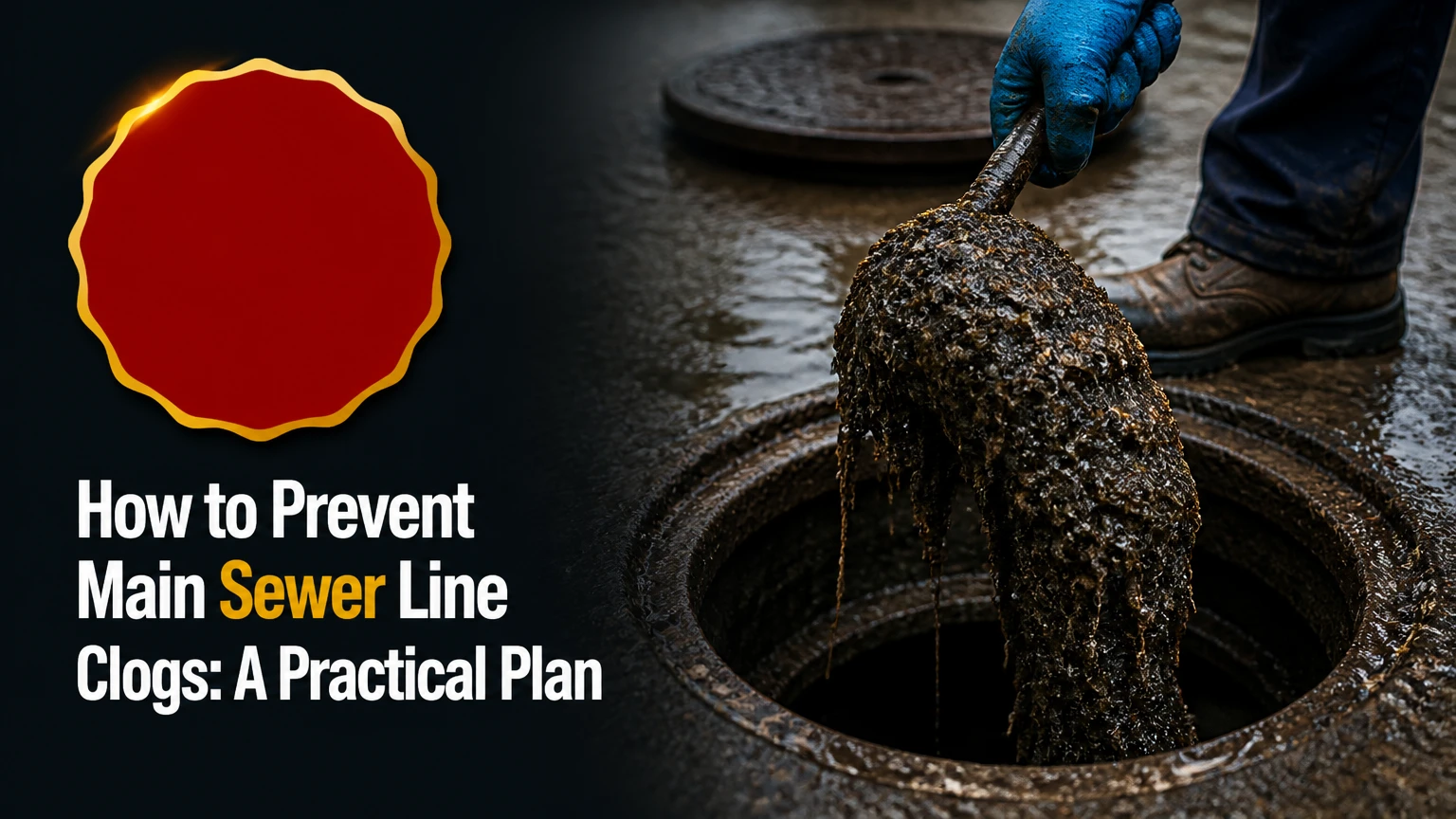
To prevent main sewer line clogs, control grease and solids inside the home, protect the private sewer lateral from roots, keep the cleanout accessible, and investigate slow multi-fixture drainage early. A camera inspection establishes pipe condition, while cleaning, root treatment, repair, or a backwater valve addresses the specific risk.
Key Facts
A private sewer lateral commonly measures 4-6 inches and carries wastewater from the house to a municipal sewer or septic tank.
A main-line restriction usually affects several fixtures, while a branch-drain clog normally affects one fixture.
Flushable wipes, cooking grease, sanitary products, paper towels, and cat litter belong in the trash, not the toilet.
Root treatment can slow recurring intrusion, but it cannot correct a cracked, sagging, separated, or collapsed pipe.
Hydro jetting should follow a condition assessment when a line is old, damaged, or made from brittle clay.
Typical professional costs range from $150-$450 for a camera inspection and $350-$900 for hydro jetting.
What Is a Main Sewer Line Clog?
A main sewer line clog is an obstruction in the private building sewer, also called the house sewer or sewer lateral, after multiple household drains join together. The pipe usually carries wastewater by gravity toward a city connection, shared private main, or septic tank, although some properties use a sewage ejector pump.
The exact pipe diameter varies by local code, construction era, and property type. Residential laterals commonly use 4-inch or 6-inch pipe, while older properties may contain vitrified clay, cast iron, concrete, Orangeburg fiber pipe, PVC, or ABS.
A branch clog stops water from one sink, toilet, or shower. A main-line restriction collects discharge from many fixtures, so a washing machine, shower, or toilet can force water into a basement floor drain or first-floor tub. The lowest open fixture often becomes the overflow point because gravity directs backed-up wastewater there.
Who owns the pipe?
Homeowners commonly own the private lateral from the building to the municipal connection, but the boundary differs by city. Some utilities maintain the portion in the public right of way, while others assign the entire lateral to the property owner.
Call the local sewer utility before authorizing excavation in the street. The utility can often identify the public main, confirm responsibility, and tell you whether a municipal blockage or surcharge is affecting nearby properties.
Why Do Main Sewer Lines Clog?
Grease, root intrusion, pipe deformation, and non-dispersible solids cause most residential main-line blockages. A line can also restrict because of mineral scale, a failed joint, construction debris, improper slope, or a septic tank that has reached its sludge capacity.
| Cause | How the blockage develops | Typical evidence |
|---|---|---|
| Fats, oils, and grease | Liquid residue cools and adheres to pipe walls, trapping solids | Kitchen discharge, recurring stoppages, greasy inspection footage |
| Tree or shrub roots | Roots enter joints or cracks seeking moisture and expand inside the line | Mature trees, seasonal recurrence, root masses on camera |
| Sag or belly | A low section retains water and sediment instead of draining fully | Standing water on camera, repeated clog at the same location |
| Scale and corrosion | Cast iron or concrete sheds rough material that narrows the opening | Rust flakes, reduced diameter, older plumbing |
| Wipes and paper products | Dense fibers remain intact and combine with grease or roots | Clogged toilet, cable retrieval of fibrous material |
| Collapse or offset | Broken or shifted pipe blocks flow and catches debris | Persistent backup after cleaning, soil settlement, voids |
A useful practitioner rule is to treat recurrence as evidence of a condition, not bad luck. If the same lateral blocks every few months after cable cleaning, the cable may be reopening a small passage without resolving roots, scale, a belly, or a damaged joint.
How Do You Prevent Main Sewer Line Clogs?
Prevention combines daily disposal controls with condition-based professional maintenance. The strongest plan begins with a camera inspection if the line is old, has recurring trouble, or has never been evaluated, because cleaning frequency cannot compensate for a collapsed or badly sagging pipe.
Before You Start
| Requirement | Typical specification |
|---|---|
| Inspection time | 1-2 hours for a residential lateral |
| DIY prevention time | 5-10 minutes weekly for disposal controls |
| Professional camera cost | $150-$450 in typical US markets |
| Professional cleaning cost | $150-$400 for cabling, $350-$900 for jetting |
| Useful information | Pipe material, cleanout location, tree locations, sewer responsibility |
| Safety equipment | Gloves, eye protection, disinfectant, bucket, flashlight |
Do not remove a cleanout cap casually if sewage may be standing behind it. Pressure can release contaminated water unexpectedly, and the opening can expose occupants to sewer gas. A licensed plumber should inspect a suspected full line through the cleanout, especially when several fixtures are backing up.
Step 1: Find and Protect the Main Cleanout
Locate the capped access point in the basement, crawlspace, garage, side yard, or front yard. Outdoor cleanouts may sit flush with soil or pavement, while indoor cleanouts often use a threaded ABS, PVC, cast-iron, or brass cap.
Keep the cap visible, intact, and reachable. Do not bury it beneath landscaping, decks, paving, stored equipment, or permanent cabinetry. A missing cap can allow soil, rainwater, insects, or rodents into the lateral.
You will know this step worked when: the cleanout can be identified without digging and a plumber can reach it with standard equipment.
Common mistake: assuming a small capped pipe is the main cleanout. Confirm the pipe’s direction and diameter with a plumber or sewer map before using it.
Step 2: Establish Pipe Condition With a Camera
Arrange a sewer camera inspection when the home has clay, cast iron, concrete, or Orangeburg pipe; when a stoppage recurs; or before buying an older property. The camera should record the full route to the municipal connection or septic tank, not stop after the first open section.
Ask for the defect location measured from a fixed access point. A useful report identifies roots, cracks, offsets, scale, standing water, joint failures, pipe material, and approximate depth if a locating transmitter is used.
You will know this step worked when: you receive video or still images that identify both the defect and its distance from the cleanout.
Common mistake: approving hydro jetting solely because the pipe is clogged. High-pressure water can worsen a severely cracked or unsupported line, so condition determines the safe cleaning method.
Step 3: Stop Grease and Solids at the Fixtures
Scrape pans into the trash and allow small quantities of oil to cool before disposal. Wipe greasy cookware with a paper towel, then discard the towel. Restaurants use grease interceptors because fats, oils, and grease, commonly abbreviated FOG, cause persistent pipe deposits.
Flush only human waste and toilet paper. Keep wipes, paper towels, tissues, dental floss, cotton swabs, diapers, menstrual products, condoms, and cat litter out of the toilet, even when packaging labels a wipe “flushable.”
Install hair strainers in showers and tubs. A strainer protects branch drains first, but it also reduces the solids that eventually reach the lateral.
You will know this step worked when: kitchen wastewater drains without greasy residue and no non-toilet material enters the toilet.
Common mistake: using hot water and dish soap to “flush” grease. That may move grease farther downstream, where cooler soil temperatures allow it to harden.
Step 4: Manage Roots According to the Inspection
Roots do not normally penetrate an intact, glued PVC joint. Root intrusion indicates an opening, failed gasket, crack, offset, or deteriorated pipe section that provides moisture and entry space.
If a camera confirms minor root intrusion without structural failure, a labeled foaming root-control product may slow recurrence. Copper sulfate and dichlobenil products differ in use directions, environmental restrictions, treatment frequency, and local legality, so follow the product label and check municipal or septic-system rules.
Root treatment is not tree removal and does not seal the pipe. A line that needs repeated treatment may require joint repair, spot repair, lining, or replacement.
You will know this step worked when: follow-up inspection shows reduced root mass and the line remains structurally open for the expected interval.
Common mistake: pouring an unlabeled herbicide into a toilet. Household chemicals can harm treatment systems, violate local rules, or damage vegetation without repairing the entry point.
Step 5: Choose Cable Cleaning or Hydro Jetting
Use mechanical cabling when the immediate goal is to open a passage through roots or a localized obstruction. Use hydro jetting when inspection confirms a sound pipe with grease, sludge, or broad scale deposits that need wall cleaning.
Typical residential jetting equipment operates around 2,500-4,000 PSI at the machine, but pressure at the nozzle and nozzle design determine the force delivered to the pipe. A plumber should select pressure and flow for the pipe material and condition rather than apply a universal setting.
You will know this step worked when: all fixtures drain during a controlled test and the cleaning equipment retrieves or flushes the identified obstruction.
Common mistake: jetting a brittle, fractured, or badly offset line without a camera assessment. Cleaning can expose a defect that was already present and may push debris into a damaged section.
Step 6: Test the System and Record the Baseline
After service, run a measured discharge test. Flush a toilet, run a sink, operate a shower, and discharge a washing machine or several gallons of water while observing the lowest drain.
Record the date, service method, pipe material, defect location, photographs, invoice, and next recommended inspection. A maintenance record makes recurrence easier to diagnose and supports insurance or home-sale documentation.
You will know this step worked when: water leaves every fixture without gurgling, slow drainage, sewage odor, or rise in the lowest drain.
Common mistake: testing only the fixture nearest the cleanout. A partial opening may pass a sink but fail when the washing machine releases a larger volume.
How Often Should a Sewer Line Be Cleaned?
There is no reliable universal annual or biannual cleaning interval. A sound PVC lateral with no history of blockage may need no routine jetting, while a root-affected clay line may need inspection or cleaning every 6-24 months until repair is completed.
| Property condition | Camera inspection | Cleaning approach | Review interval |
|---|---|---|---|
| New PVC or ABS, no symptoms | At purchase or when symptoms appear | No scheduled cleaning | Reassess after 5 years or symptoms |
| Older cast iron, no symptoms | Every 3-5 years | Descaling only if camera supports it | Review corrosion and flow |
| Clay line with minor roots | Every 1-2 years | Cable or labeled root control | Reassess after each recurrence |
| Repeated blockage | After each significant event | Condition-specific cleaning | Repair decision within 30-90 days |
| Septic lateral and tank system | Camera when flow problems occur | Tank pumping by local schedule | Follow tank inspection and pumping records |
| Flood-prone or low-elevation home | Inspect valve annually | Clean lateral as condition requires | Test backwater valve at least annually |
The “annual maintenance” recommendation is often misapplied. Annual observation of symptoms and cleanout access is sensible, but opening a pressurized or sewage-filled cleanout on a fixed schedule is not a safe homeowner ritual.
Which Sewer Cleaning Method Is Best?
Hydro jetting is usually the better cleaning method for a structurally sound pipe coated with grease or scale, while mechanical snaking is usually better for quickly opening a root or solid obstruction. Neither method repairs a collapsed, bellied, severely cracked, or separated lateral.
| Method | Typical cost | Best use | Main limitation |
|---|---|---|---|
| Mechanical cable | $150-$400 | Roots, localized soft blockages, urgent opening | May leave deposits and root remnants |
| Hydro jetting | $350-$900 | Grease, sludge, broad scale in sound pipe | Unsafe or ineffective for major structural defects |
| Camera inspection | $150-$450 | Locate defects before treatment | Diagnoses a problem but does not clear it |
| Spot repair | $1,000-$4,000 | One accessible cracked or offset section | Requires excavation and leaves other sections unchanged |
| Trenchless lining | $4,000-$12,000 typical | Multiple cracks in a suitable, continuous pipe | Does not correct every belly or collapsed section |
| Full replacement | $5,000-$20,000 or more | Collapse, severe deformation, extensive failure | Highest disruption and site-dependent cost |
Mechanical snaking is often the correct first response during an active backup because it can restore flow quickly. The limitation is important: a cutting head may create a channel through roots while leaving the remaining root mat attached to the pipe wall.
Hydro jetting removes more wall residue when the pipe can safely tolerate it. A jetting nozzle cannot correct poor slope, a separated joint, or a missing section of pipe. The camera determines whether cleaning is maintenance or temporary symptom relief.
Are Enzyme Cleaners or Root Killers Worth Using?
Enzyme and bacterial drain products are low-risk for some routine branch-drain maintenance, but they should not be treated as proven insurance against a main sewer blockage. These products cannot remove a root mass, restore pipe slope, dissolve a collapsed pipe, or guarantee prevention.
Root-control products have a narrower use case. A labeled product can reduce or slow root growth inside a line after roots have entered, but repeated use signals an underlying pipe defect. Products also differ in compatibility with septic tanks, local wastewater rules, plants, and aquatic environments.
Avoid sulfuric acid, hydrochloric acid, sodium hydroxide, and other caustic drain openers in a suspected main-line blockage. The chemicals may remain trapped, create heat, injure anyone opening the line, and corrode older metal plumbing. A professional must also know about chemical use before cabling or jetting.
What Are the Early Warning Signs?
A gurgling toilet, simultaneous slow fixtures, or water rising in a bathtub when a washing machine drains indicates a possible main-line restriction. Persistent sewer odor, sewage near a cleanout, or a new wet or unusually green strip over the lateral suggests a leak, surcharge, or structural defect rather than an ordinary fixture clog.
| Warning sign | Likely meaning | Immediate response |
|---|---|---|
| One slow sink | Branch drain restriction | Stop solids, clean trap or branch line |
| Several slow fixtures | Main lateral restriction | Stop water use and call a plumber |
| Toilet bubbles during laundry | Shared line or vent restriction | Reduce discharge and arrange diagnosis |
| Sewage at floor drain | Main backup or surcharge | Stop all water, isolate area, seek emergency service |
| Rotten-egg odor outdoors | Sewer gas, leak, or dry trap | Ventilate, avoid flames, inspect source |
| Green or wet lawn patch | Possible leaking lateral or septic issue | Check utility records and schedule camera inspection |
Stop using toilets, showers, sinks, dishwashers, and washing machines when multiple fixtures back up. Keep people and pets away from contaminated water, avoid electrical equipment in wet areas, and contact the sewer utility if neighbors have similar symptoms.
How Can Older Homes Avoid Repeated Clogs?
Older homes need condition-based maintenance because clay, concrete, cast iron, and Orangeburg pipes fail in different ways. Cast iron can corrode and scale internally, clay can develop open or offset joints, and Orangeburg can deform or flatten under soil pressure.
A sewer scope is especially valuable before buying a pre-1980 home. Request the original video, defect measurements, pipe material, and a repair estimate rather than accepting a report that says only “line cleared.”
| Pipe material | Common risk | Appropriate prevention |
|---|---|---|
| PVC or ABS | Settling, poor joints, grease | Disposal control and symptom-based inspection |
| Cast iron | Scale, corrosion, bellies | Camera inspection and controlled descaling |
| Vitrified clay | Roots, offsets, cracked joints | Camera checks and targeted repair |
| Concrete | Joint failure, infiltration, scale | Inspection and structural assessment |
| Orangeburg | Flattening, softening, collapse | Replacement planning rather than repeated cleaning |
A clean line is not automatically a healthy line. Cleaning removes an obstruction, while inspection determines whether the pipe can continue performing safely.
Do Trees Need to Be Removed Near a Sewer Lateral?
Tree removal is not the default response to sewer roots. Root intrusion requires an opening in the pipe, so repairing the defect is usually more durable than removing a single tree while leaving the failed joint in place.
When landscaping, obtain the lateral route before planting. Maintain separation according to local arborist and utility guidance because mature root systems vary by species, soil, irrigation, and climate. Willow, poplar, elm, and some maples often seek consistent moisture, but no tree species can be judged safely by name alone.
Do not cut roots near a structural foundation or public utility without professional advice. A tree can remain stable only when its root plate and major support roots remain intact.
When Is a Backwater Valve Appropriate?
A backwater valve is appropriate when a building’s lowest fixtures sit below a municipal surcharge level or when local flooding repeatedly pushes sewage toward the property. The valve allows normal outbound flow and closes when wastewater attempts to reverse direction.
A backwater valve does not prevent a private lateral clog upstream of the valve. It also needs an accessible cleanout, periodic inspection, and maintenance because sediment can keep the flap from sealing.
| Risk condition | Valve value | Additional measure |
|---|---|---|
| Basement drain below street level | Reduces reverse-flow risk | Annual inspection and cleaning |
| Heavy-rain sewer surcharge | Helps isolate property | Utility flood guidance and sump protection |
| Private lateral root blockage | Limited protection | Camera inspection and root repair |
| Septic system backup | Usually not the primary solution | Tank inspection and pumping |
| Shared sewer in a low area | Often useful if locally approved | Licensed design and permit review |
Have a licensed plumber verify valve placement and local code requirements. Some installations require protected fixtures, an alarm, a bypass arrangement, or a dedicated maintenance access.
How Much Does Prevention Cost?
Typical US prevention costs range from almost nothing for disposal controls to several thousand dollars for structural protection. Prices vary with access, region, depth, pipe material, traffic control, permits, and whether the contractor must excavate.
| Prevention action | Typical cost | Typical time | Best trigger |
|---|---|---|---|
| Hair strainers and disposal controls | $10-$50 | 10 minutes | Every household |
| Camera inspection | $150-$450 | 1-2 hours | Older line or recurrence |
| Mechanical cleaning | $150-$400 | 1-3 hours | Active or root blockage |
| Hydro jetting | $350-$900 | 2-4 hours | Grease or scale in sound pipe |
| Root treatment | $30-$100 | 30-60 minutes | Confirmed minor root intrusion |
| Spot repair | $1,000-$4,000 | 1-2 days | Local crack or offset |
| Backwater valve | $1,500-$4,000 | 1-2 days | Reverse-flow exposure |
Use a camera before paying for repeated cleaning. Three $300 cleanings in one year cost roughly $900 and may still leave the underlying defect, while a $350 inspection can identify whether repair is the more economical decision.
Common Prevention Mistakes and Their Fixes
- Opening a cleanout during a suspected backup: Stop water use and have a professional assess pressure and contamination risk.
- Using a chemical opener before calling a plumber: Tell the plumber exactly what product was used and do not mix chemicals.
- Treating every gurgle as a vent problem: Test several fixtures because a shared restriction can mimic poor venting.
- Jetting without reviewing camera footage: Confirm pipe integrity, access direction, and nozzle suitability first.
- Relying on root killer indefinitely: Set a repair threshold, such as recurrence within 6-12 months or visible joint failure.
- Ignoring the public-private boundary: Ask the sewer utility to investigate municipal surcharges before paying for private excavation.
FAQ
Can I prevent a main sewer clog with boiling water?
Boiling water is not a dependable main-line prevention method. Hot water may move a small amount of fresh grease through a nearby kitchen branch, but it cannot remove deposits farther underground and may soften certain plastic components or damage seals. Scraping grease into the trash is safer and more effective.
Does a septic tank change the prevention plan?
A septic system adds tank capacity and soil-absorption risks. Keep wipes and grease out of the plumbing, inspect the tank according to local pumping requirements, and investigate slow drainage before sewage reaches the tank inlet. A full tank, failed baffle, or saturated drain field can resemble a main-line blockage.
Can a sewer line clog during heavy rain even when my plumbing is healthy?
Yes. A municipal sewer surcharge, inflow and infiltration, or flooding can force wastewater toward private laterals without an indoor obstruction. Utility confirmation, neighboring reports, and the timing of the event help distinguish a public-system surcharge from a private blockage. A backwater valve may reduce reverse-flow damage in vulnerable homes.
Should I buy a sewer camera inspection for a new home?
A sewer scope is usually worthwhile for older homes, properties with mature trees, and homes with finished basements or uncertain plumbing records. New PVC or ABS reduces some risks but does not eliminate settling, improper slope, construction debris, or damaged joints. The inspection cost is small compared with excavation or remediation.
How do I know whether a clog is in a branch drain or the main line?
A branch clog usually affects one fixture. A main-line restriction commonly causes several slow fixtures, toilet bubbling during discharge, or wastewater rising from a lower drain. Stop using water when multiple fixtures are involved, because continued discharge can turn a partial restriction into an indoor sewage backup.
The Bottom Line
The most reliable way to prevent main sewer line clogs is to combine zero-waste disposal habits with condition-based inspection. Keep grease and wipes out of the system, protect and locate the cleanout, inspect older or recurring lines by camera, and choose cabling, hydro jetting, root treatment, or repair according to the confirmed defect. For homes exposed to municipal surcharge, add a maintained backwater valve.