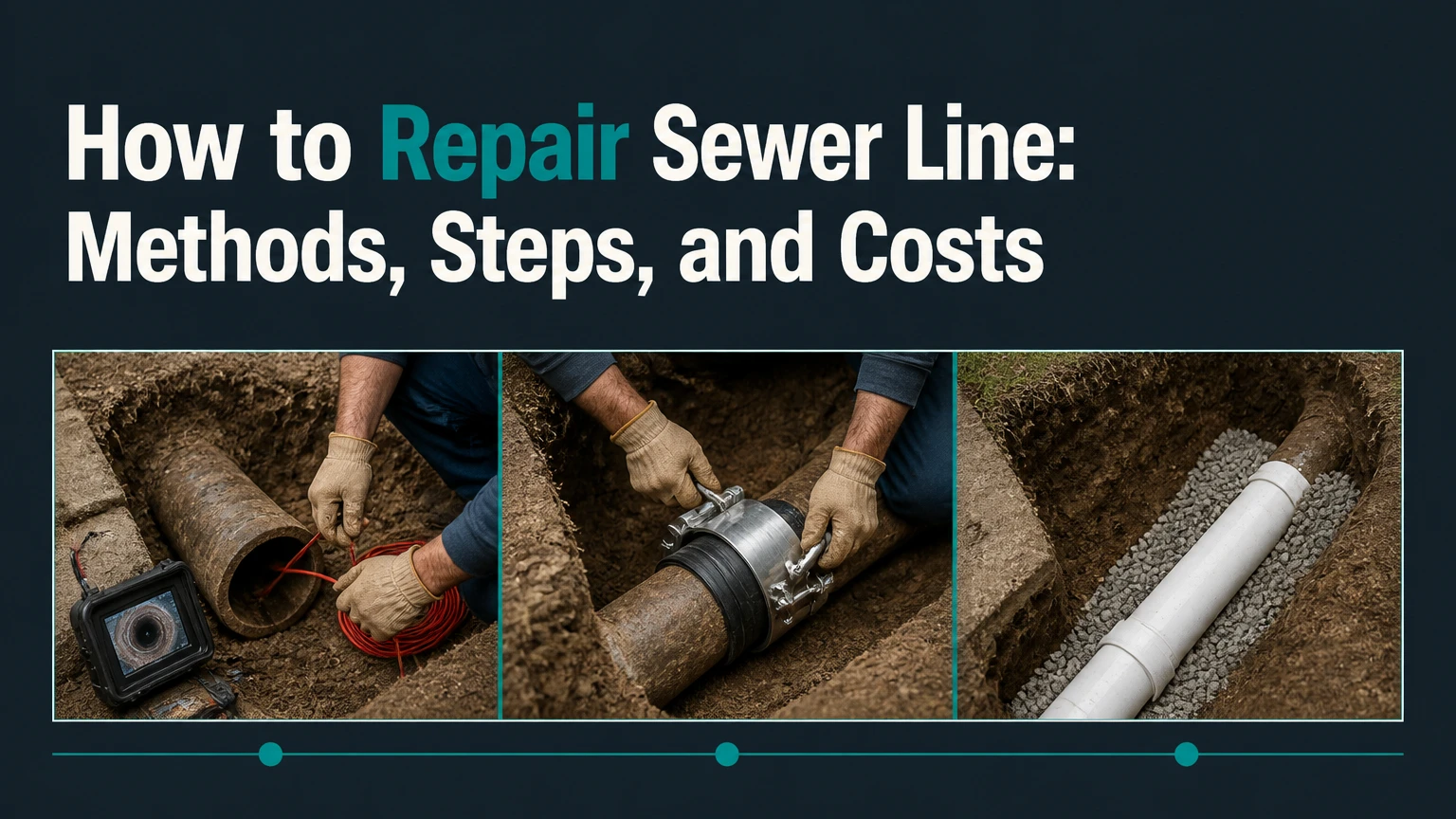
To repair a sewer line, first confirm the failure with a sewer camera, clear the pipe only when appropriate, then choose spot repair, open excavation, pipe bursting, or CIPP lining based on damage, alignment, depth, access, and surface restoration. A licensed contractor normally completes permits, utility locating, testing, final video inspection, and backfill.
Key Facts at a Glance
A residential sewer lateral commonly uses 4-inch pipe and carries wastewater from the building drain to a municipal main or septic tank.
A camera inspection identifies blockage location, pipe material, roots, fractures, offsets, bellies, and collapse before excavation begins.
CIPP lining repairs many cracks and leaking joints, but it does not correct a sagging pipe or an inaccessible collapse.
Pipe bursting replaces the old line with HDPE while limiting surface disturbance, but it requires suitable alignment and access pits.
Typical residential repair costs range from about $1,000 for a localized spot repair to $15,000 or more for difficult excavation and restoration.
Stop using water during an active sewage backup, and keep people and pets away from contaminated surfaces.
What a Sewer Line Does
A sewer line is the sloped underground pipe that transports wastewater by gravity from a building’s plumbing system to a public sewer main, private treatment system, or septic tank. The indoor building drain connects to a private sewer lateral, while the municipality usually owns the public main and may own only part of the connection.
Wastewater needs both a clear passage and air movement. Plumbing vents, which usually terminate above the roof, balance pressure so traps retain water and drains do not siphon. A typical residential lateral is 4 inches in diameter, although local requirements, commercial connections, and public mains may use 6-inch or larger pipe.
Pipe slope is important, but the often-repeated rule of 1/4 inch per foot is not universal. The International Plumbing Code commonly permits a minimum slope of 1/8 inch per foot for 4-inch horizontal drainage pipe under specified conditions, while local codes and engineered designs control the actual requirement. A sewer contractor should measure elevation rather than assume a slope from the pipe’s age.
Who Is Responsible for a Private Sewer Lateral?
Responsibility depends on the municipality, easements, and the exact failure location. Homeowners commonly maintain the line from the building to the property line, but some utilities own or maintain the section extending to the public main, and shared laterals can create different obligations.
Call the sewer department before authorizing excavation near the street. Ask for the ownership boundary, cleanout records, permit requirements, and whether the public main has been inspected. A private blockage that begins inside the property line is not the same claim as a municipal main obstruction.
What Causes Sewer Line Failure?
Sewer lines fail through blockage, loss of structural strength, movement, leakage, or a combination of those conditions. Roots enter through open joints, grease coats rough interiors, brittle clay fractures, cast iron scales internally, and Orangeburg pipe can deform under soil pressure.
A camera report should name the defect, clock position, approximate distance from the access point, and severity. “Bad sewer” is not a repair diagnosis.
Which Pipe Materials Need Different Repairs?
| Pipe material | Common installation period | Typical failure | Repair implication |
|---|---|---|---|
| Cast iron | Before about 1980 | Rust scale, pinholes, fractures, joint leaks | Descaling may expose thin walls; lining or replacement may be necessary |
| Vitrified clay | Older homes, often pre-1960 | Root-filled joints, cracks, offsets | Spot repair, CIPP, or bursting can work if alignment remains stable |
| Orangeburg | Approximately 1940s-1970s | Flattening, blistering, soft walls | Replacement is often more reliable than lining severely deformed sections |
| PVC or ABS | Common since the late 20th century | Joint separation, impact cracks, improper bedding | Localized excavation or replacement usually provides a durable repair |
| Concrete or transite | Site and era dependent | Cracking, abrasion, joint movement | Material testing and contractor-specific rehabilitation planning may be needed |
Material alone does not select the method. A nearly intact clay line with root-filled joints may be a lining candidate, while a newer PVC line with one displaced joint may need only a short excavation.
How to Repair Sewer Line Problems Safely
Professional sewer-line repair follows seven connected stages: control the backup, inspect the line, clean it when safe, locate utilities, select and permit the repair, verify the completed work, and restore the ground. The camera diagnosis is the decision point that prevents unnecessary replacement.
Step 1: Stop the Wastewater Flow
Stop flushing toilets, running washing machines, using showers, and operating dishwashers when multiple fixtures back up. Close the building’s main water valve if someone may accidentally use water, then keep children and animals away from sewage.
Do not pour chemical drain cleaner into a main sewer blockage. Caustic chemicals can injure the next technician, damage older pipe, and contaminate soil when a line is broken.
Success checkpoint: No additional wastewater enters the affected fixtures.
Common mistake: Treating a main-line backup as a single-sink clog and continuing to use plumbing.
Step 2: Check the Cleanout and Call for Diagnosis
Locate the exterior cleanout, which may be near the foundation, property line, basement, or driveway. A capped cleanout containing standing sewage suggests a downstream obstruction, although a dry cleanout does not eliminate an indoor or buried problem.
A sewer camera inspection typically takes 1-2 hours and may cost about $250-$500 in many United States markets. Request the recording, distance readings, defect labels, and still images rather than accepting only a verbal conclusion.
Success checkpoint: The report identifies the defect and its approximate location from a named access point.
Common mistake: Approving replacement because a cable encountered resistance without viewing the pipe.
Step 3: Clear the Pipe Only When Inspection Requires It
A drain cable can open a passage through soft blockage or roots, but it does not rebuild a failed pipe. Hydro jetting uses high-pressure water to remove grease, sludge, and root remnants; typical residential service may cost $350-$800, with pressure selected for the pipe’s condition.
Jetting an unsound Orangeburg or heavily corroded cast-iron line can worsen a failure. The contractor should inspect first or explain why an emergency opening procedure is necessary.
Success checkpoint: The camera can travel through the full relevant run, and the cleaned wall reveals the actual defect.
Common mistake: Repeating root cutting every few months while leaving an open joint untreated.
Step 4: Mark Utilities, Ownership, and Access
The contractor should contact 811 before digging in the United States, but 811 markings may not identify private lines, irrigation, low-voltage wiring, or sewer depth. Confirm utility locations, easements, permit requirements, access for equipment, and the proposed restoration boundary.
A repair beneath a driveway may require concrete saw cutting, traffic control, engineering, or a separate restoration contractor. A repair in a public right-of-way usually requires municipal approval.
Success checkpoint: The work area, utility conflicts, permit, and ownership boundary appear in the written proposal.
Common mistake: Assuming the camera distance equals the exact surface location. Ground tracing and depth measurement are still required.
Step 5: Select the Repair Method
Choose the least invasive method that corrects the actual structural problem, not merely the visible symptom. Spot excavation is efficient for one localized defect; full replacement is appropriate for widespread collapse, severe misalignment, or a failed material; trenchless methods preserve surfaces when geometry permits.
Which Repair Method Fits the Damage?
| Method | Best condition | Typical duration | Typical residential cost |
|---|---|---|---|
| Spot excavation | One joint, crack, or shallow localized break | 1-2 days | $1,000-$4,000 |
| Open-trench replacement | Collapse, severe offset, belly, or multiple defects | 3-5 days | $4,000-$15,000+ |
| Pipe bursting | Replaceable line with suitable alignment and pit access | 1-2 days | $5,000-$12,000 |
| CIPP lining | Structurally continuous pipe with cracks or leaking joints | About 1 day | $4,000-$10,000 |
| Spray or brush coating | Pinholes, corrosion, short runs, or selected vertical stacks | 1-2 days | $2,000-$8,000 |
Costs are typical planning ranges, not bids. Depth, linear footage, regional labor rates, permits, groundwater, rock, access, and landscape restoration can change the total substantially.
When Is Open-Trench Replacement the Better Choice?
Open excavation is usually the correct choice when the line has a belly, complete collapse, major offset, inadequate slope, or severe displacement. The crew exposes the pipe, removes the failed section, installs approved pipe on stable bedding, reconnects the lateral, tests flow, and compacts soil in lifts.
The method is disruptive because trees, patios, driveways, retaining walls, and utilities may obstruct the trench. Its advantage is direct access: the contractor can correct grade, inspect bedding, replace damaged connections, and address conditions that a liner cannot change.
Winner: Open trench wins when alignment or elevation is the defect.
When Does Pipe Bursting Make Sense?
Pipe bursting pulls a bursting head through the existing alignment while drawing a new HDPE pipe behind it. The process usually needs a launch pit and receiving pit, and the surrounding soil must allow the old pipe to expand without damaging nearby utilities or structures.
Bursting replaces the old pipe rather than leaving it in place, making it useful for extensive cracking and deteriorated clay. It is a poor choice for a severe belly, an inaccessible route, unstable soil, or a line whose path would place expansion forces against foundations or other utilities.
Winner: Pipe bursting wins when full replacement is needed and the existing route remains geometrically suitable.
Can CIPP Lining Repair a Collapsed Sewer Line?
CIPP lining cannot reliably repair a completely collapsed or severely misaligned sewer because the liner needs a continuous host path and adequate access. A resin-saturated felt tube is inserted, inflated, and cured with hot water, steam, or light, forming a structural pipe inside the old pipe.
CIPP can bridge cracks, seal leaking joints, and reduce roughness without a continuous trench. It slightly reduces internal diameter, and lateral connections must be reopened after curing. A belly remains a belly because lining follows the existing grade.
Winner: CIPP wins for accessible, substantially continuous pipe with structural wall defects but acceptable alignment.
Step 6: Install and Connect the New Pipe
For an excavated repair, the crew should use approved pipe, stable bedding, correct slope, restrained transitions, and compatible fittings. Shielded no-hub couplings with stainless-steel bands are commonly used for approved material transitions, but the exact fitting must comply with local code and manufacturer instructions.
Do not bury an unapproved rubber sleeve or rely on a loose clamp to connect mismatched materials. The connection should resist shear, maintain a smooth interior, and remain accessible if the design requires a cleanout.
Success checkpoint: The installed segment has continuous support, correct grade, sealed joints, and a documented connection to sound pipe.
Common mistake: Replacing a broken segment while leaving a nearby offset or root-filled joint that caused the original blockage.
Step 7: Test, Inspect, and Restore
Request a final camera inspection after replacement, bursting, or lining. The video should show an open channel, smooth transitions, reopened laterals, no liner wrinkles, and no construction debris.
Flow testing confirms drainage, but testing requirements vary by jurisdiction. Backfill should be placed and compacted in lifts suited to the soil, because rushed backfill can settle beneath a driveway or foundation-adjacent area.
Success checkpoint: Final video, test result, depth, material, and repair location are included in the closeout record.
Common mistake: Allowing full backfill before reviewing the final footage.
How Much Does Sewer Line Repair Cost?
Typical sewer-line repair costs range from $1,000-$4,000 for a localized spot repair, $4,000-$15,000 or more for open replacement, and $4,000-$12,000 for common trenchless projects. Surface restoration, excavation depth, rock, permits, and pipe length often influence the invoice more than the pipe material alone.
| Service or condition | Typical price range | Typical time | Main cost driver |
|---|---|---|---|
| Camera inspection | $250-$500 | 1-2 hours | Access, recording, locating |
| Cable cleaning | $200-$600 | 1-3 hours | Roots, distance, access |
| Hydro jetting | $350-$800 | 2-4 hours | Grease, roots, pipe condition |
| Spot repair | $1,000-$4,000 | 1-2 days | Depth and surface removal |
| CIPP lining | $4,000-$10,000 | About 1 day | Length, diameter, access |
| Pipe bursting | $5,000-$12,000 | 1-2 days | Pits, soil, utility clearance |
| Open replacement | $4,000-$15,000+ | 3-5 days | Length, depth, restoration |
A low quote may exclude engineering, permits, bypass pumping, lateral reconnection, pavement replacement, sod, tree replacement, or post-repair inspection. Compare written scopes line by line.
Which Situations Change the Best Repair?
Surface type changes the financial calculation, but it does not override structural requirements. Trenchless repair can reduce restoration work under concrete, mature landscaping, or finished hardscape, while excavation may remain necessary when grade correction is the objective.
Roots in a Clay or Cast-Iron Line
Roots usually indicate an opening at a joint or crack, not a root problem alone. Mechanical cutting or jetting restores flow temporarily; CIPP can seal suitable joints, while replacement is more appropriate when the pipe is displaced or brittle.
Root-killing chemicals do not close the structural opening. Repeated cutting without a camera follow-up is a maintenance cycle, not a permanent repair.
A Sewer Belly or Back-Pitched Section
A belly is a low section where wastewater and solids remain after flow stops. The practical repair is excavation and regrading or replacement, because lining and bursting generally follow the existing route and cannot restore lost elevation.
A contractor should document the sag’s length, depth, and effect on flow. A short, shallow depression may receive a maintenance recommendation in some cases, but chronic solids accumulation supports corrective excavation.
Sewer Line Under a Driveway or Patio
CIPP or bursting may reduce surface demolition when the pipe is suitable, but the contractor must verify cleanout access, line geometry, lateral connections, and nearby utilities. A short spot excavation can cost less than a full trenchless setup if the defect is close to an edge.
Ask for two totals: the plumbing work and the surface restoration. That separation makes an apparently cheap trenchless quote easier to compare with excavation.
Old Orangeburg Pipe
Orangeburg is a bituminous fiber pipe that can absorb moisture, flatten, blister, and lose its circular shape. Minor defects may receive specialized rehabilitation, but widespread deformation often makes replacement more predictable than lining.
A camera report should distinguish a soft or flattened wall from ordinary root intrusion. The material’s age raises suspicion; only direct inspection establishes the failure.
Common Mistakes and How to Fix Them
- Replacing the entire line after one blockage.
Require camera evidence showing the failure’s length and severity. A single accessible joint may need a spot repair. - Lining a belly.
Reject a proposal that promises lining will restore slope. Ask for measured elevation and a correction plan. - Using high-pressure jetting on fragile pipe.
Inspect first when cast iron is heavily scaled or Orangeburg is suspected. A damaged wall can turn cleaning into excavation. - Accepting a repair without final video.
Make final footage a written payment milestone. The recording should cover the repaired segment and connections. - Ignoring private utility lines.
Call 811 and identify private irrigation, lighting, gas, and water lines before digging. Public marking is not a complete private-property survey. - Treating insurance as automatic coverage.
Many standard homeowners policies exclude wear, maintenance, roots, and some exterior lines. A service-line endorsement may cover specified sudden damage, but exclusions and deductibles control the claim.
How to Choose a Sewer Contractor
Choose a contractor who diagnoses before selling a method and provides a dated camera recording. The proposal should identify pipe material, defect location, length, depth, repair method, permit responsibility, restoration, testing, warranty terms, and exclusions.
Ask these questions before signing:
- Who owns the failed section?
- What exact camera observation supports replacement?
- Is the line suitable for CIPP or bursting?
- How will the contractor verify slope and depth?
- Are laterals, cleanouts, permits, utility locating, and restoration included?
- Who pays for damage to unmarked private utilities?
- What final video and flow test will be supplied?
- Does the warranty cover infiltration, reconnection failure, and settlement?
A second opinion is especially valuable when a contractor recommends full replacement without showing the footage, describes a belly without elevation measurements, or refuses to separate repair from restoration costs.
Can a Homeowner Repair a Sewer Line?
A homeowner can often locate a cleanout, stop water use, document symptoms, and arrange a camera inspection. Excavating, cutting, reconnecting, lining, or working in a public right-of-way normally requires trained equipment, code compliance, permits, and sanitation controls.
Sewage contains pathogens, and a buried line may cross gas, electric, water, or communication utilities. DIY digging is not appropriate near those hazards or beneath foundations, retaining walls, or load-bearing slabs.
For a minor exposed connection on private property, local law may permit owner work, but the repair still needs approved materials, proper bedding, testing, and inspection. Check the authority having jurisdiction first.
FAQ
How long does a repaired sewer line last?
PVC and HDPE installations can provide several decades of service when properly bedded, graded, joined, and protected from excavation damage. CIPP service life depends on resin design, curing, installation quality, and host conditions. A contractor’s warranty is not the same as a guaranteed lifetime, so retain the final video and material records.
Does homeowners insurance pay for sewer line repair?
Homeowners insurance often excludes gradual deterioration, neglected maintenance, and root intrusion, while some policies offer optional service-line coverage for qualifying exterior damage. Coverage varies by insurer, cause, deductible, and endorsement language. Photograph the damage, prevent further water use, and call the insurer before authorizing nonemergency work.
Will a sewer camera find every problem?
A camera can identify visible cracks, roots, offsets, deposits, collapse, and standing water, but it may not reveal an inaccessible segment, a hidden leak outside the pipe, or the full extent of a belly without elevation data. Inspection quality also depends on access, water level, debris, camera resolution, and operator interpretation.
Is sewer-line replacement tax deductible?
A private sewer repair is generally a property expense rather than a routine personal tax deduction, but rental, business, casualty, and capital-improvement treatment can differ. Keep invoices, permits, videos, and restoration costs, then ask a qualified tax professional about the property’s use and local rules.
Should I inspect a sewer line before buying an older home?
Yes, an independent sewer scope is sensible for an older home, a property with mature trees, recurring drain problems, or unknown pipe material. A standard home inspection may not include the buried lateral. The scope can identify Orangeburg, roots, offsets, bellies, and repair costs before the purchase becomes final.
The Bottom Line
The reliable way to repair a sewer line is to diagnose the actual pipe failure before choosing a construction method. Use spot repair for localized damage, open excavation for bellies and severe collapse, pipe bursting for suitable full replacement, and CIPP for structurally continuous lines with cracks or leaking joints. Stop wastewater use, document the camera findings, confirm responsibility and permits, and require final video and flow testing. The right answer to how to repair sewer line is therefore a measured, failure-specific repair, not repeated snaking or an automatic full replacement.