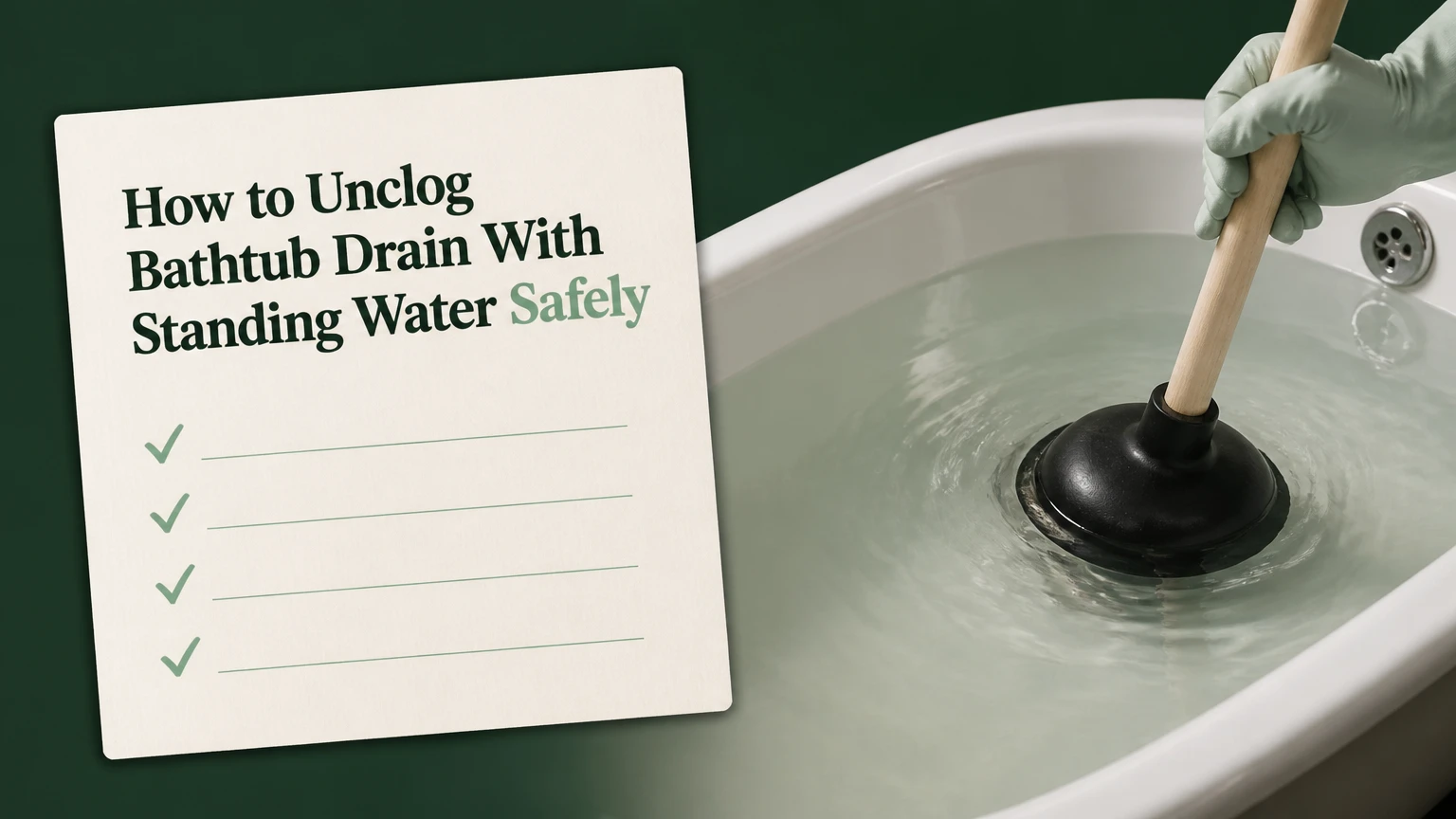
To unclog a bathtub drain with standing water, first remove the stopper, bail out enough water to work safely, and pull out hair with a plastic drain tool or hand auger. If extraction fails, seal the overflow opening and plunge with a flat cup plunger. Avoid chemical cleaner if the tub remains blocked.
Key Facts
A bathtub hair clog is usually closest to the stopper or trap, so mechanical removal should come before chemicals.
A cup plunger needs a sealed overflow opening to transfer pressure into the drainpipe.
Chemical drain cleaner in standing water creates a splash and exposure hazard, especially during plunging or snaking.
Typical DIY clearing takes 20-45 minutes and costs $5-$35 when a plastic hair tool or plunger is already available.
Gurgling fixtures, sewage odor, or several backed-up drains indicate a possible shared-line problem rather than an isolated tub clog.
Baking soda and vinegar may reduce light residue, but their fizz does not reliably move a compact hair blockage.
Before You Start: Time, Tools, and Safety
A typical bathtub drain unclogging job takes 20-45 minutes, requires basic hand tools, and has low difficulty when the obstruction sits near the drain opening. The factor that most affects success is locating and physically removing the hair mass before pushing it deeper into the waste line.
You will usually need:
- Rubber gloves and eye protection
- A cup, small bucket, or wet-dry vacuum for removing water
- A plastic barbed drain-cleaning tool, 18-24 inches long
- A flat-bottom cup plunger
- A screwdriver or adjustable pliers
- Paper towels or a disposable bag
- A flashlight
- A wet rag for sealing the overflow opening
Do not begin plunging or snaking if commercial drain cleaner has already been poured into the tub. Read the product label, keep skin and eyes away from the water, ventilate the room, and contact a plumber if the label does not provide a safe next step. Tell the plumber exactly which product and approximate quantity entered the drain.
Do not mix drain cleaner with bleach, vinegar, ammonia, toilet cleaner, or another drain product. Mixing acids, oxidizers, and alkaline cleaners can release heat or hazardous vapors.
How Much Water Should You Remove?
Remove enough water to expose the drain and leave approximately 1-2 inches of water for plunging. For extraction, bail out nearly all water because a visible drain opening lets you see the tool and reduces contamination from splashes.
A bathtub typically holds far more water than a sink, so use a stable bucket rather than repeatedly carrying a full container across a wet floor. If the water looks like sewage, contains fecal material, or came from a shared backup, stop DIY work and arrange professional cleanup.
Where Is the Clog in a Bathtub Drain?
A bathtub waste system normally includes the basin drain, stopper, overflow opening, trap, branch waste pipe, and vented building drain. Hair commonly catches at the stopper linkage or drain crossbars, while a deeper blockage may sit in the trap or branch line beneath the tub.
The overflow opening is not merely a flood outlet. On many pop-up and trip-lever tubs, the overflow plate also provides access to a rod and spring linkage that controls the stopper. Pulling that linkage without supporting it can drop parts into the pipe, so remove it slowly and keep the assembly aligned.
The P-trap retains water to block sewer gases. The trap is a frequent clog location, but the exact position varies with the tub design, pipe slope, stopper hardware, and amount of hair entering the drain. A precise universal percentage for P-trap clogs is not reliable.
What Creates a Bathtub Blockage?
Human hair and pet fur form the central structure of many tub clogs. Soap residue, conditioner, body oil, mineral scale, and skin particles adhere to that structure until the mass becomes dense enough to slow or stop flow.
A slow drain that gradually becomes a complete blockage usually points to accumulated material. A tub that stops suddenly after construction, a dropped object, or another plumbing repair may have a different obstruction and may require an auger or inspection.
How to Unclog Bathtub Drain With Standing Water
The safest sequence is: remove or expose the stopper, extract hair, plunge with the overflow sealed, rinse with hot tap water, and escalate if the blockage remains. Most isolated bathtub clogs respond to extraction or plunging, while persistent backups involving other fixtures need a drain professional.
Step 1: Check for a Larger Plumbing Backup
Before touching the tub drain, run a simple fixture check. Look at the bathroom sink, toilet, shower, floor drain, and any nearby laundry fixture for slow drainage, rising water, gurgling, or sewage odor.
A single tub with clean household water usually indicates a local branch clog. A tub that backs up when the toilet flushes, or a toilet that bubbles when the tub drains, suggests a shared waste-line or venting problem.
You will know this step is complete when: the tub is the only affected fixture and no sewage odor or contaminated water is present.
Common mistake: repeatedly flushing a toilet to test the system. A shared blockage can turn a partial backup into an overflow.
Step 2: Remove the Stopper Without Losing the Linkage
Identify the stopper before applying force.
- Lift-and-turn: raise the stopper, hold the body, and turn the knob counterclockwise. Some models require a small set screw to be loosened.
- Toe-touch: press the stopper open, then turn the cap counterclockwise. Remove the cap and lift the body if the model allows it.
- Pop-up: lift it carefully. If the stopper is attached to overflow linkage, remove the overflow plate and withdraw the rod assembly slowly.
- Trip-lever: remove the two overflow-plate screws, then pull the plunger or linkage straight out while supporting its weight.
- Strainer only: remove the central screw or lift the strainer according to its design, but do not pry against a fragile finish.
Place screws and small parts in a cup. Photograph the linkage before removal, because a reversed plunger or misplaced washer can leave the stopper unable to seal.
You will know this step is complete when: the drain opening and its crossbars are visible and the stopper parts are safely outside the tub.
Common mistake: forcing a threaded stopper with a large wrench. Excessive torque can damage the drain shoe or scratch the tub finish.
Step 3: Pull Out Hair With a Plastic Drain Tool
Feed an 18-24-inch plastic barbed drain tool slowly through the open drain. Rotate the tool lightly as it passes the crossbars, stop when the barbs meet resistance, and pull upward without jerking.
A typical residential tub clog may sit within the first 6-18 inches, but tool depth is not a dependable map of the P-trap. The plastic tool is most effective against fibrous material near the opening; it cannot reliably remove a hard object or a blockage far inside the branch line.
Wipe the extracted material into a bag rather than pushing it into a sink or toilet. Repeat the insertion two to four times, changing the angle slightly, until the tool returns with little or no hair.
You will know this step worked when: the standing water drops noticeably or disappears as the hair mass is removed.
Common mistake: pushing after meeting firm resistance. A barbed tool should retrieve soft debris, not force a solid obstruction deeper into the pipe.
Step 4: Use a Hand Auger When the Plastic Tool Fails
Choose a small hand-crank drain auger with a 15-25-foot cable when extraction reaches no debris and the tub remains blocked. Feed the cable gradually, rotate the handle clockwise, and advance only while the cable moves without excessive resistance.
When the cable catches, rotate it several times, pull back 6-12 inches, and advance again. This action can break through soap-coated hair or hook a compact mass. Withdraw the cable slowly, clean it, and repeat until the cable comes out relatively clean.
A hand auger is not automatically safer simply because it is manual. Do not force a cable through a fragile, corroded, or inaccessible drain, and do not use a power drill on an unknown tub waste line unless you understand the equipment and pipe condition.
You will know this step worked when: the water level falls during cable work or drains freely after the cable is withdrawn.
Common mistake: treating a cable that stops at the same depth every time as proof of a clog. It may be contacting a bend, stopper crossbar, or trap fitting.
Step 5: Seal the Overflow and Plunge
Remove the overflow plate if practical, then press a soaking-wet rag firmly over the overflow opening. The seal prevents air from escaping through the overflow passage instead of moving pressure toward the blockage.
Use a flat cup plunger, not a toilet flange plunger. Keep 1-2 inches of water over the cup rim, center the cup over the drain, and press down gently once to remove trapped air. Follow with 15-20 controlled push-pull strokes while maintaining the seal.
Finish with one firm upward pull, then observe the water. If the level drops, run hot tap water for two to five minutes and check whether drainage remains steady.
You will know this step worked when: the water swirls toward the drain, falls between strokes, or drains rapidly after the final pull.
Common mistake: plunging with an unsealed overflow. The plunger may move, but the pressure change at the clog is too small to clear it.
Step 6: Rinse and Reassemble the Drain
Flush the cleared drain with hot tap water for two to five minutes. Hot water helps carry loosened soap residue, but it does not dissolve a large hair plug and is safer for mixed plumbing systems than pouring a kettle of boiling water.
Clean the stopper, linkage, and drain cover before reinstalling them. Remove hair wrapped around the rod or spring, inspect the gasket, and tighten screws evenly without over-tightening.
You will know this step worked when: a full tub drains without pooling and the stopper opens and closes correctly.
Common mistake: reinstalling a dirty stopper. Hair around the linkage can recreate a blockage within days.
Which Drain-Clearing Method Should You Choose?
Manual extraction is the best first method for a typical hair clog, while plunging is better for a deeper soft blockage. A hand auger reaches farther, and a plumber is the correct choice when chemicals, shared-line symptoms, damaged pipes, or repeated failure change the risk.
| Method | Typical cost | Typical time | Best reach or target | Main limitation |
|---|---|---|---|---|
| Plastic barbed tool | $5-$15 | 5-15 minutes | First 6-24 inches; hair and fur | Cannot handle hard objects |
| Flat cup plunger | $10-$25 | 5-10 minutes | Soft blockage in trap or branch | Needs a sealed overflow |
| Hand-crank auger | $20-$60 | 15-30 minutes | Approximately 15-25 feet | Can snag or damage fragile piping |
| Wet-dry vacuum | $60-$180 | 10-20 minutes | Loose surface debris and water | Requires a suitable drain seal |
| Licensed plumber | $100-$500 typical service range | 1-3 hours | Deep branch or shared line | Higher cost and scheduling |
These are typical North American consumer and service ranges, not fixed prices. Access behind a finished wall, emergency timing, local labor rates, and whether a camera inspection or powered auger is needed can change the invoice substantially.
Is Baking Soda and Vinegar Worth Trying?
Baking soda and vinegar are reasonable for light surface residue after most standing water has been removed, but they are a poor primary treatment for a compact hair clog. The reaction produces carbon dioxide, water, and sodium acetate; the visible fizz does not provide the sustained mechanical force of a plunger or auger.
Do not combine the mixture with commercial drain cleaner. If used after mechanical clearing, remove standing water, place approximately 1 cup of baking soda into the drain, add approximately 1 cup of white vinegar, wait 15-30 minutes, and rinse with hot tap water.
Avoid boiling water in tubs with uncertain plumbing, old solvent joints, acrylic components, or plastic piping. Water from a household hot tap is a more conservative rinse.
Should You Use Chemical Drain Cleaner?
Chemical drain cleaner should not be the next step when standing water remains and the blockage has resisted mechanical methods. The product can remain concentrated in the trap, splash during plunging, damage some materials, and expose a later plumber to corrosive liquid.
Some manufacturer labels permit use in bathtubs, but label permission does not remove the splash hazard or guarantee compatibility with every stopper, pipe, gasket, and finish. Never use a chemical product after another cleaner, and never snake or plunge a drain containing an unknown chemical.
What If Drain Cleaner Is Already in the Tub?
Stop mechanical work immediately if drain cleaner has entered the standing water. Keep children and pets away, avoid contact with the water, increase ventilation without placing yourself over the drain, and follow the product label or poison-control guidance for exposure.
Do not bail contaminated water into a toilet, sink, yard, or storm drain. Do not neutralize it with vinegar, baking soda, bleach, or another product. A plumber needs the brand, active ingredient, approximate amount, and time of application before choosing protective equipment and a clearing method.
For skin or eye contact, flush with clean running water and contact local emergency or poison-control services. Follow the product safety data sheet for inhalation or ingestion incidents.
Common Mistakes and How to Fix Them
Plunging Without Covering the Overflow
Problem: Air escapes through the overflow rather than pushing against the blockage.
Fix: Remove or loosen the overflow plate and use a wet rag or purpose-made overflow plug.
Using the Wrong Plunger
Problem: A toilet flange plunger does not sit flat over a bathtub drain.
Fix: Use a flat cup plunger sized to cover the drain opening completely.
Pushing Hair Into the Pipe
Problem: A rigid tool compacts the hair mass deeper in the trap.
Fix: Pull gently, clean the tool after each pass, and change the insertion angle.
Pouring Boiling Water Into Unknown Plumbing
Problem: Very hot water can soften some plastic components and damage finishes, while it rarely removes a hair plug.
Fix: Use hot tap water after mechanical clearing.
Repeating Chemical Treatments
Problem: Additional product increases corrosive concentration without improving access to the clog.
Fix: Stop after the label-directed application fails and arrange mechanical service.
Removing Linkage Without Recording Its Position
Problem: A trip-lever or pop-up stopper may be reinstalled at the wrong height.
Fix: Photograph the assembly, keep washers in order, and test the stopper before tightening the plate.
When Should You Call a Plumber?
Call a plumber when two mechanical methods fail, multiple fixtures back up, the tub refills when another fixture drains, or sewage odor accompanies the standing water. Professional service is also appropriate for rental units, inaccessible traps, corroded drain hardware, recurring clogs, and any drain containing chemical cleaner.
A plumber may use a longer sectional or drum auger, access a branch cleanout, inspect the line with a camera, or test the building drain. Hydro-jetting can clean heavy grease and scale in suitable lines, but it is not the first choice for a small hair plug and can be inappropriate for damaged piping.
| Symptom | More likely location | Appropriate next action | DIY limit |
|---|---|---|---|
| Hair appears on plastic tool | Stopper or drain throat | Repeat extraction, then rinse | Stop if tool cannot pass |
| Plunger causes swirling only | Trap or short branch | Reseal overflow and retry | Use an auger after two attempts |
| Tub and sink drain slowly | Shared bathroom branch | Arrange professional diagnosis | Do not add chemicals |
| Toilet bubbles during tub drainage | Shared waste line or vent | Call a plumber promptly | Basin tools may not reach it |
| Sewage returns into tub | Main drain or sewer connection | Stop water use and call service | Treat as contaminated water |
| Clog returns within days | Residual buildup or pipe defect | Camera inspection or deeper cleaning | Repeated DIY may mask damage |
A single failed attempt does not prove a main-line blockage. Repeated recurrence and cross-fixture symptoms provide stronger evidence than the depth at which a hand auger meets resistance.
How Can You Prevent Another Bathtub Clog?
Install a removable hair catcher that fits over the drain without preventing the stopper from sealing. Empty it after each bath or shower, clean the stopper monthly, and inspect the drain opening whenever water begins pooling.
Do not send hair, cotton swabs, wipes, plastic packaging, bath-toy fragments, or large amounts of bath salts into the drain. Conditioner and bar soap can increase residue, but changing products will not compensate for a missing hair screen.
A practical maintenance schedule is:
- Empty the hair catcher after every use.
- Clean the stopper and visible crossbars every four weeks.
- Use a plastic drain tool every three to six months in a high-hair household.
- Arrange deeper service when a cleared drain becomes slow again within 30 days.
A mesh screen prevents new material from entering, but it cannot remove an existing plug below the stopper. Prevention begins after the pipe has been cleared.
Variations for Difficult Situations
What If You Have No Plunger?
Remove as much water as possible, expose the drain, and use a plastic barbed tool or a flexible drain brush. A wet cloth pressed over the overflow can improve the seal if you later attempt controlled plunging with a suitable cup.
Do not substitute a wire coat hanger. Its sharp end can scratch the drain finish, catch on crossbars, or puncture a thin obstruction without removing it.
What If the Stopper Will Not Come Out?
Clean visible hair around the stopper first. For a stuck threaded stopper, use the correct screwdriver or pliers with a cloth barrier, apply moderate force, and stop if the drain fitting begins turning in the tub.
A rotating drain shoe can break the seal below the tub and create a leak. That repair may require access through a ceiling, closet panel, or service opening.
What If the Tub Is in an Apartment?
Notify building maintenance before using chemical cleaner or dismantling shared plumbing. Apartment stacks can connect several fixtures, and a tub backup may originate outside the individual unit.
If the blockage affects only your tub, maintenance may still prefer its own auger or approved product because chemical residues create hazards for staff and contractors.
Bathtub Drain Clog Cost and Time Guide
The cheapest successful repair is often a $5-$15 plastic extraction tool used during the first 15 minutes of work. A typical plumber visit costs more because the service may include diagnosis, protective equipment, access, powered equipment, disposal, and a workmanship guarantee.
| Situation | Typical material or service cost | Typical duration | Likely first choice |
|---|---|---|---|
| Visible hair at drain | $5-$15 | 5-15 minutes | Plastic barbed tool |
| Soft local blockage | $10-$25 | 10-20 minutes | Cup plunger |
| Repeated local clog | $20-$60 | 20-45 minutes | Hand auger |
| Chemical-contaminated drain | $150-$500 | 1-3 hours | Licensed plumber |
| Multiple backed-up fixtures | $200-$800 | 1-4 hours | Main-line diagnosis |
| Emergency evening service | $250-$1,000 | 1-4 hours | Emergency plumber |
Prices vary by region and building access. These ranges are planning figures, not a quote, and sewer or septic repairs can exceed them.
FAQ
Can I unclog a bathtub without removing the standing water?
You can try plunging with standing water present, because water transmits pressure better than air, but extraction is safer after removing most of the water. Leave approximately 1-2 inches over the plunger cup for a seal, and bail out the remainder if the water is dirty or contaminated.
Will salt, dish soap, or laundry detergent clear a bathtub clog?
Salt and detergent may loosen minor residue but will not reliably dissolve a compact hair-and-soap plug. Dish soap can reduce surface tension, yet it does not replace a drain tool, plunger, or auger. Mechanical removal remains the more predictable approach for a blocked tub.
How long should I plunge a bathtub drain?
Use 15-20 controlled strokes per attempt, then check the water level. Complete two or three attempts after confirming that the cup seals the drain and the overflow is blocked. Continuous plunging for several minutes adds splash and fatigue without correcting a poor seal.
Can a wet-dry vacuum unclog a tub drain?
A wet-dry vacuum can remove standing water and sometimes pull loose debris when its hose forms a reliable seal over the drain. It is less dependable against a compact hair plug and can spread contaminated water if the vacuum is not rated and configured for wet use.
Why does my bathtub clog again after I clear it?
A recurring tub clog usually means hair remains in the branch line, the stopper continues catching debris, or the pipe has scale, poor slope, or damage. If the drain slows again within 30 days, stop repeating surface treatments and request deeper snaking or camera inspection.
Is a bathtub clog an emergency?
An isolated tub clog is usually not an emergency, but sewage backup, rapidly rising water, several affected fixtures, or a chemical-contaminated drain requires prompt professional attention. Stop using water throughout the home when a main-line blockage is suspected.
The Bottom Line
To unclog a bathtub drain with standing water, remove the stopper, bail out enough water to work safely, extract hair with a plastic tool, then seal the overflow and plunge. Use a hand auger for a deeper local blockage, avoid chemical cleaner in a full tub, and call a plumber when other fixtures back up or the clog returns.