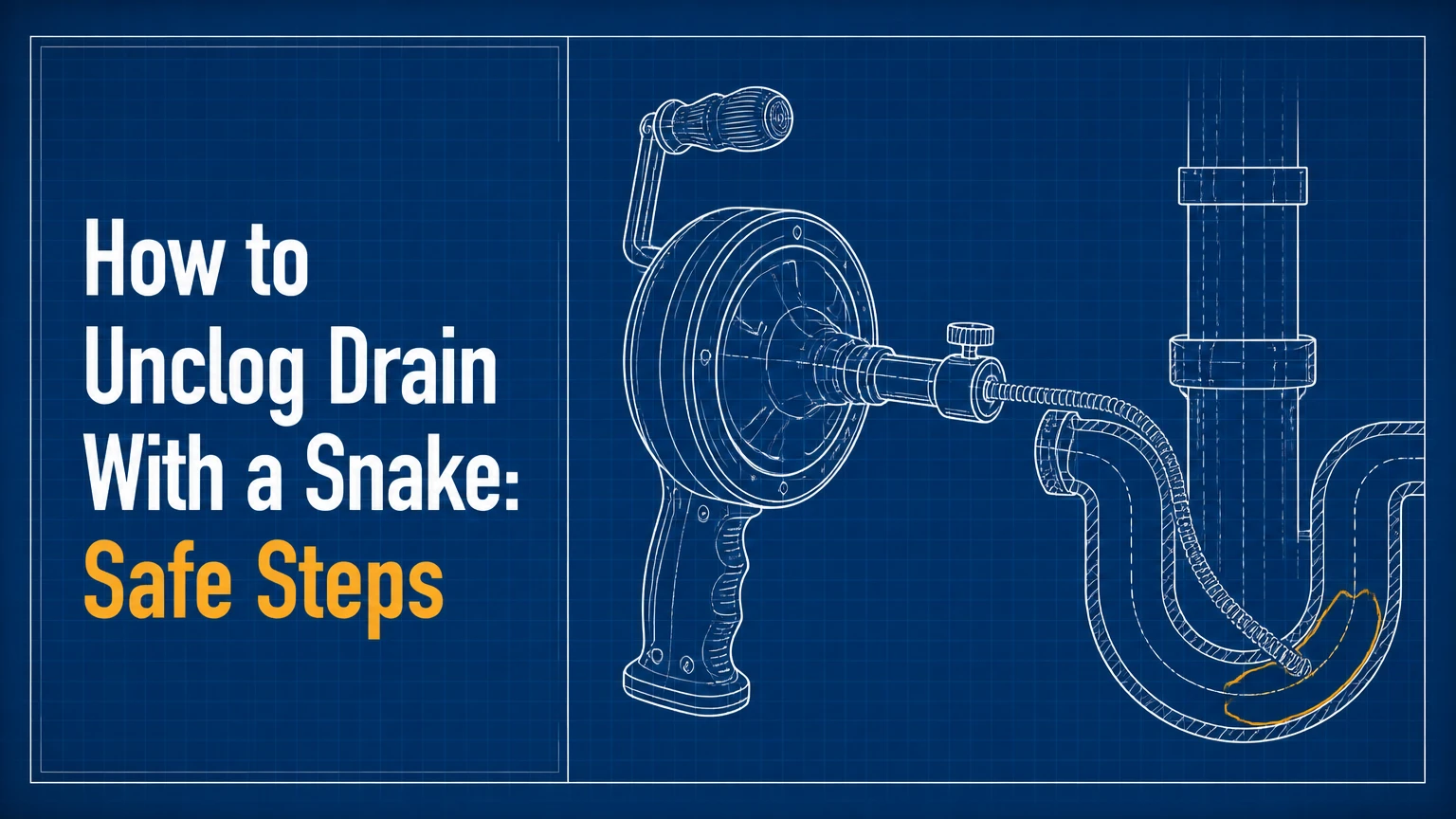
To unclog a drain with a snake, choose an auger suited to the fixture, remove the stopper or access the cleanout, feed the cable until it meets resistance, then rotate while applying controlled forward pressure. Retract the cable, remove debris, and test with hot water. Most sink and tub clogs take 15-45 minutes when the cable reaches the blockage.
Key Facts at a Glance
A hand drum auger with a 1/4-inch cable and 15-25 feet of reach fits most sink, tub, and shower clogs.
A toilet requires a closet auger with a protective guide, not a bare standard drain snake.
Rotate clockwise while advancing, and never force a cable that binds or kinks.
A clean cable does not prove the pipe is clear because grease, sludge, or a distant branch-line clog can close again.
Stop DIY work when multiple fixtures back up, sewage appears, or the cable will not retract.
Typical homeowner tool costs range from $5 for a plastic hair tool to $50 for a dedicated toilet auger.
What Is a Drain Snake?
A drain snake, also called a plumbing auger, is a flexible steel cable with a formed tip that travels through a drain and mechanically engages an obstruction. Rotation allows the tip to bore through soft material such as hair, food residue, and grease, while the coil can hook and retrieve fibrous debris.
The tool does not chemically dissolve a blockage. It creates a passage through the obstruction, pulls material back, or shifts the clog far enough downstream for water to carry it away. A small hand auger is therefore effective against localized bathroom and sink blockages but is not a universal solution for collapsed pipe, heavy root intrusion, or a buried sewer defect.
The National Association of Clean Water Agencies describes sanitary sewer overflows as preventable through proper maintenance, but a household hand snake cannot inspect or maintain an entire municipal or private sewer system. That distinction matters when several fixtures show the same symptom.
How does a plumbing auger work?
A drain auger transfers hand torque through a rotating cable to a corkscrew, bulb, or cutting head. The head either penetrates soft blockage material, catches hair and wipes, or scrapes deposits from the pipe wall as the operator advances and retracts the cable.
The operator should maintain only enough forward pressure to keep the head engaged. Excessive force can kink the cable, wedge the head in a fitting, or damage deteriorated pipe. A sudden reduction in resistance usually means the head passed through or entered the clog, not necessarily that every fragment has been removed.
Which Drain Snake Should You Use?
The correct drain snake depends on the fixture, opening size, cable diameter, reach, and obstruction. Use a plastic hair tool for a shallow bathroom clog, a 1/4-inch hand auger for most sinks and tubs, a closet auger for toilets, and a larger powered machine only when the blockage lies deep in a branch or main drain.
| Tool type | Typical cable or length | Suitable fixtures | Typical cost |
|---|---|---|---|
| Plastic barbed hair tool | 18-24 inches, about 1/4 inch wide | Shower, tub, bathroom sink | $5-$10 |
| Hand drum auger | 15-25 feet, 1/4-5/16 inch cable | Kitchen sink, bathroom sink, tub | $15-$35 |
| Closet auger | 3-6 feet, about 1/2 inch cable | Toilet bowl and trap | $20-$50 |
| Small powered auger | 25-50 feet, 1/4-3/8 inch cable | Branch drains and difficult sinks | $40-$100 rental or $150-$400 purchase |
| Sectional or drum sewer machine | 50-100 feet, 3/8-1/2 inch cable | Long branch or main sewer lines | $40-$100 per day rental, commonly $250-$600 purchase |
A longer cable is not automatically better. Extra cable increases retrieval difficulty and can allow the head to pass into a branch, while an oversized cable can stress small fittings and trap assemblies.
Match the cable to the fixture
A 1/4-inch cable is a practical starting size for residential sink and tub drains because it bends through common traps without excessive force. A 5/16-inch cable provides greater stiffness for longer runs, but it demands better control around fittings and older pipe.
Toilet traps have tight curves and porcelain surfaces. A closet auger places the cable inside a guide tube that protects the bowl and limits the operating path. Do not substitute a bare steel hand snake unless the tool manufacturer specifically permits that use.
Before You Start
Prepare 20-30 minutes, protective equipment, a bucket, absorbent towels, a screwdriver, a trash bag, and the correct auger before opening the drain. Remove standing water only when necessary, and identify whether the blockage affects one fixture or several because that observation determines whether a local snake is appropriate.
Preparation checklist
| Item | Quantity or specification | Purpose |
|---|---|---|
| Chemical-resistant gloves | 1 pair, long cuff | Protect hands from contaminated water and sharp debris |
| Eye protection | 1 pair with side coverage | Reduce splash exposure during retrieval |
| Bucket | 1, 2-5 gallons | Catch trap or cleanout water |
| Towels or rags | 3-6 | Control spills and wipe the cable |
| Hand auger | 15-25 feet for most sinks | Reach a local obstruction |
| Trash bag | 1 heavy-duty bag | Contain hair, food, and contaminated material |
| Adjustable pliers or screwdriver | 1 tool | Remove traps, strainers, or cleanout covers |
Check the drain opening before selecting the access point. A sink clog can often be reached through the strainer or by removing the P-trap, while a bathtub clog may require removing the overflow cover because the stopper assembly blocks a straight path.
Chemical cleaner safety
Do not snake a drain immediately after using a chemical drain opener. Residual sodium hydroxide or acid can remain in the trap and splash onto skin, eyes, clothing, or the cable. Read the product label, inform anyone assisting you, and contact poison-control or emergency services for exposure rather than attempting more mechanical work.
If chemical cleaner entered the drain and the blockage remains, professional service is the safer option. Never mix drain chemicals with bleach, ammonia, vinegar, or another drain product.
How to Unclog Drain With a Snake Safely
To unclog drain with a snake, expose the drain opening, feed a properly sized cable to the resistance point, rotate clockwise with measured pressure, and retract the cable in short controlled pulls. A typical sink or tub attempt takes 10-20 minutes of active work, and the success factor is maintaining cable contact without forcing it.
Step 1: Remove the stopper or choose the access point
Remove a sink stopper by lifting or twisting it, then detach the pivot rod if the stopper is connected below the drain. For a tub, remove the overflow plate and linkage when possible; that opening often provides a cleaner route than the drain shoe.
Place towels around the opening and position the bucket under a sink trap. If the trap contains visible debris, removing and cleaning it can solve the clog without sending a cable through the fitting.
Success checkpoint: The cable can enter the pipe without striking the stopper mechanism.
Common mistake: Pushing a cable through a sink pop-up assembly and bending the linkage.
Step 2: Set the cable and leave minimal slack
Loosen the auger’s thumbscrew or cable lock. Feed the cable by hand until the tip reaches the first bend or obstruction, then position the drum close to the opening, leaving roughly 4-6 inches of working cable exposed.
Lock the cable before rotating. Too much unsupported cable forms loops outside the drain, which reduces the turning force at the head and creates kinks.
Success checkpoint: The exposed cable remains nearly straight while the drum stays stable.
Common mistake: Holding 12 inches or more of loose cable outside the drain.
Step 3: Rotate through the first bend
Turn the handle clockwise while applying gentle forward pressure. At a P-trap or sharp elbow, use short rotations and a slight push-pull motion rather than one sustained shove.
A bend feels springy and may release suddenly. A clog usually feels denser, with the cable tip repeatedly stopping at the same distance. Do not treat every stop as a blockage.
Success checkpoint: The cable advances a few inches after several controlled rotations.
Common mistake: Forcing the head around an elbow until the cable locks.
Step 4: Engage and work the blockage
When the cable reaches the obstruction, rotate clockwise for 5-10 seconds, then advance 1-2 inches. Retract 2-4 inches, rotate again, and repeat the cycle. This motion lets a corkscrew head bite into fibrous material and lets a boring head enlarge a passage through soft sludge.
When resistance drops, keep rotating while advancing another 6-12 inches if the cable allows. A single puncture may drain standing water while leaving most of the blockage attached to the pipe wall.
Success checkpoint: Water begins moving, or the cable returns with hair, food, paper, or greasy residue.
Common mistake: Stopping immediately after the first gurgle.
Step 5: Retract and remove the debris
Lock the cable, pull it back slowly, and wipe the exposed section with a rag as it exits. Keep the bucket or trash bag directly below the work area because retrieved debris can drip contaminated water onto flooring.
If the head feels caught, do not yank the drum. Rotate counterclockwise a small amount to release the engagement, then withdraw with steady tension. A stuck cable can break at a fitting when pulled aggressively.
Success checkpoint: The entire cable returns without permanent bends or missing sections.
Common mistake: Releasing the cable lock while pulling, which allows the cable to retract into the drum unpredictably.
Step 6: Flush and test the drain
Reinstall the stopper, trap, or overflow plate only after confirming that all seals and washers are correctly positioned. Run cool or warm water slowly for 30 seconds, inspect for leaks, then increase the flow for 2-3 minutes.
Use hot tap water for grease residue, but avoid pouring boiling water into older PVC, glued joints, or fixtures that manufacturers do not rate for extreme temperatures. Hot water can move softened grease; it cannot repair a structural blockage.
Success checkpoint: The fixture drains continuously at full flow without rising water, gurgling, or leakage below the sink.
Common mistake: Testing with a full basin first, which can release several gallons before a partial clog is noticed.
What Changes for a Sink, Tub, Shower, or Toilet?
Fixture geometry determines the safest entry point and auger style. A sink generally offers trap access, a tub often requires the overflow opening, a shower drain favors a short hair tool first, and a toilet needs a porcelain-safe closet auger.
| Fixture | Preferred entry point | First tool | Typical reach | Main caution |
|---|---|---|---|---|
| Bathroom sink | Strainer or trap outlet | 1/4-inch hand auger | 15-25 feet | Protect pop-up linkage |
| Kitchen sink | Strainer after removing basket if needed | 1/4-5/16-inch hand auger | 15-25 feet | Grease may recur after a narrow passage |
| Bathtub | Overflow opening | 1/4-inch hand auger | 15-25 feet | Stopper linkage can obstruct the drain shoe |
| Shower | Drain grate | Plastic hair tool, then hand auger | 18 inches to 25 feet | Hair often sits near the trap |
| Toilet | Bowl opening | 3-6-foot closet auger | 3-6 feet | Bare cable can scratch porcelain |
Kitchen sink method
Remove standing water with a cup or wet-dry vacuum, then cover the other basin opening if the sink has two bowls. A double-bowl sink shares a branch connection, so an open second drain can release pressure instead of directing force toward the blockage.
Do not use a sink plunger or auger against a garbage disposal opening without disconnecting power and following the disposal manufacturer’s instructions. Never place hands inside a disposal chamber.
Bathtub and shower method
A plastic barbed hair snake can remove a shallow hair mat without disassembly. If that tool returns little material, use the overflow opening for a hand auger because the overflow route commonly bypasses the stopper and gives the cable a more direct path into the trap.
Shower clogs may combine hair with soap solids. A cable can open the passage while leaving a coating on the pipe wall, so repeated slow drainage may require trap cleaning or professional mechanical cleaning.
Toilet method
Use a closet auger with a guide shoe, insert the protected tip through the bowl outlet, and turn the handle while advancing only as far as the tool permits. The auger is designed for toilet-trap obstructions such as paper, small objects, and compacted waste.
If a toy, brush, or other solid object is visible, retrieve it rather than pushing it deeper. A plunger may move a soft toilet blockage, but repeated plunging can force an object beyond the trap.
How Much Does Snaking a Drain Cost?
A DIY drain-snake attempt typically costs $5-$50 for a suitable hand tool, while a rental power auger commonly costs about $40-$100 per day before deposits and damage fees. Professional drain cleaning often costs roughly $150-$500 for a localized residential blockage, with higher charges for cameras, roots, excavation, or after-hours work.
| Approach | Typical direct cost | Typical active time | Appropriate reach |
|---|---|---|---|
| Plastic hair tool | $5-$10 | 5-15 minutes | 18-24 inches |
| Manual hand auger | $15-$35 | 15-45 minutes | 15-25 feet |
| Toilet auger | $20-$50 | 10-30 minutes | 3-6 feet |
| Powered auger rental | $40-$100 per day | 30-90 minutes | 25-100 feet |
| Professional local clearing | $150-$500 | 30-120 minutes | Fixture to branch line |
Prices vary by region, access, time of service, and whether the plumber finds a pipe defect. A low-cost tool is economical for a first local attempt, but renting a large machine is not economical if the blockage is caused by a collapsed line that requires repair.
Manual, Electric, Plunger, or Hydro Jetting?
Manual augers are the safest first choice for most localized sink, tub, and shower clogs, while powered augers suit longer branch lines only when the operator understands cable control and pipe condition. A plunger is faster for soft pressure-responsive clogs, and hydro jetting provides more thorough wall cleaning but requires professional equipment in many homes.
| Method | Best for | Typical cost | Main limitation |
|---|---|---|---|
| Cup or flange plunger | Soft sink or toilet blockage | $8-$25 | Cannot hook hair or inspect debris |
| Manual hand auger | Local hair, food, paper, and sludge | $15-$35 | Limited reach and physical effort |
| Powered auger | Deep branch obstruction | $40-$100 rental | Can damage weak pipe or injure operator |
| Hydro jetting | Grease, scale, and recurring line deposits | $300-$1,000 professional service | Requires suitable pipe condition and water management |
| Camera inspection | Recurring or unexplained blockage | $150-$500 typical add-on | Diagnoses the line but does not clear it |
A plunger should generally precede a snake when the clog is soft and the fixture can hold enough water to cover the cup. A snake becomes more useful when plunging produces no movement, hair is suspected, or the blockage returns immediately after temporary drainage.
Hydro jetting is not simply a stronger drain snake. Pressurized water can clean a pipe’s interior, but it can also expose weaknesses in cracked, offset, or badly corroded lines. Inspection is prudent before aggressive cleaning of an old sewer.
Common Problems and How to Fix Them
Why does the snake keep kinking outside the drain?
A drain snake kinks outside the drain when too much cable remains unsupported between the drum and opening. Retract the cable, leave 4-6 inches exposed, lock the drum, and advance in short increments.
A kinked cable can whip, cut gloves, or form a permanent weak point. Replace a cable with sharp repeated bends because a damaged section can break inside the pipe.
When the cable stops at a bend
A cable that stops at the same shallow distance is often meeting a P-trap or elbow rather than the clog. Keep the drum close, rotate clockwise, and use slight alternating pressure until the head rounds the bend.
If the cable advances only when excessive force is applied, stop. The fitting may be misaligned, the cable may be too large, or the pipe may be damaged.
Why does the snake come out clean?
A clean snake with no drainage improvement usually indicates that the clog lies beyond the cable’s reach, the cable passed through a narrow hole in sludge, or the obstruction is a solid object that the head did not engage. A drain can appear open briefly while the remaining material closes the passage again.
Try one controlled second pass, preferably from a removable trap or cleanout. If the same result occurs, a longer auger, camera inspection, or professional clearing is more appropriate than repeated force.
What if the cable will not come back?
Stop rotating forward and reverse the handle slowly while maintaining light withdrawal tension. Do not use a vehicle, drill at high speed, or excessive pulling force to free a stuck cable.
If the cable remains trapped, close the fixture’s water supply where relevant and call a plumber. A broken cable inside a wall or buried drain creates a larger extraction problem than the original clog.
When to Stop DIY Work
Call a plumber when two or more fixtures back up together, sewage enters a tub or floor drain, the cleanout overflows, or a drain repeatedly clogs after successful snaking. These patterns point toward a shared branch, main sewer, root intrusion, pipe collapse, or inadequate drainage slope rather than a single fixture clog.
Stop immediately when you smell gas, encounter electrical equipment near standing water, see damaged pipe, or cannot identify whether chemical cleaner is present. Property renters should also report recurring or building-wide drainage problems to the landlord before disassembling shared plumbing.
A powered auger is particularly unsuitable for uncertain pipe condition. Old cast iron, Orangeburg, brittle clay, badly corroded steel, and damaged PVC can fail under cable torque; a professional can select a camera, locator, sectional machine, or repair method based on the line’s condition.
How to Prevent the Next Drain Clog
Preventive habits reduce the material reaching the trap, although they cannot correct a structural pipe problem. Use a sink strainer, remove hair from shower screens weekly, keep grease out of drains, and never flush wipes, paper towels, cotton products, or cat litter.
Run warm water for about 30 seconds after washing greasy cookware, then wipe heavy oil into a container for disposal. Do not rely on boiling water as routine maintenance for plastic plumbing.
For a household with recurring kitchen clogs, note the interval between cleanings and the affected fixtures. A blockage returning every few weeks despite careful use deserves inspection rather than increasingly strong chemical treatments.
Frequently Asked Questions
Can I use a drain snake after plunging?
Yes, provided no chemical drain cleaner is present and the plunger did not create a hazardous splash condition. Remove excess water, protect your eyes and hands, then snake through the most direct access point. Plunging first can loosen soft material, while the auger retrieves hair or compacted debris.
How far should a drain snake go?
A local sink, tub, or shower snake commonly travels 15-25 feet, but the useful distance depends on the trap, branch layout, and clog location. Advance only until resistance changes or the cable reaches its rated length. For a blockage beyond a cleanout or in a main sewer, use appropriate equipment rather than forcing more cable through a fixture.
Should I turn a drain snake clockwise or counterclockwise?
Turn the auger clockwise while advancing because most hand-auger heads are designed to bore or catch material in that direction. Counterclockwise rotation can loosen a wound cable or release debris. Use limited reverse rotation only to disengage a caught head during withdrawal.
Can a drain snake damage PVC pipes?
A correctly sized manual auger used with controlled pressure is unlikely to damage sound PVC, but forceful or powered snaking can harm weak joints, fittings, or deteriorated pipe. Cable resistance should be managed by rotating and withdrawing, not by applying progressively greater force.
Why does my drain clog again after snaking?
A drain may reclog because the snake created only a small channel through grease or sludge, left hair attached to the pipe wall, or failed to reach the true obstruction. Recurring clogs can also indicate roots, scale, pipe misalignment, or inadequate slope. Camera inspection helps distinguish residue from structural failure.
Is a drain snake better than chemical drain cleaner?
A drain snake is usually the safer and more informative first choice for hair, food, paper, and localized obstructions because it physically removes material without adding corrosive chemicals. Chemical cleaners may soften some organic residue, but they do not repair pipe defects and create a serious hazard during later mechanical work.
The Bottom Line
To unclog drain with a snake, use the smallest suitable auger, keep the cable nearly straight, rotate clockwise through bends, work the clog in short cycles, and retract debris carefully. A 15-25-foot hand auger handles most residential sink and tub attempts, while toilets require a closet auger. If several fixtures back up or the blockage returns, stop repeating DIY passes and investigate the shared drain line.