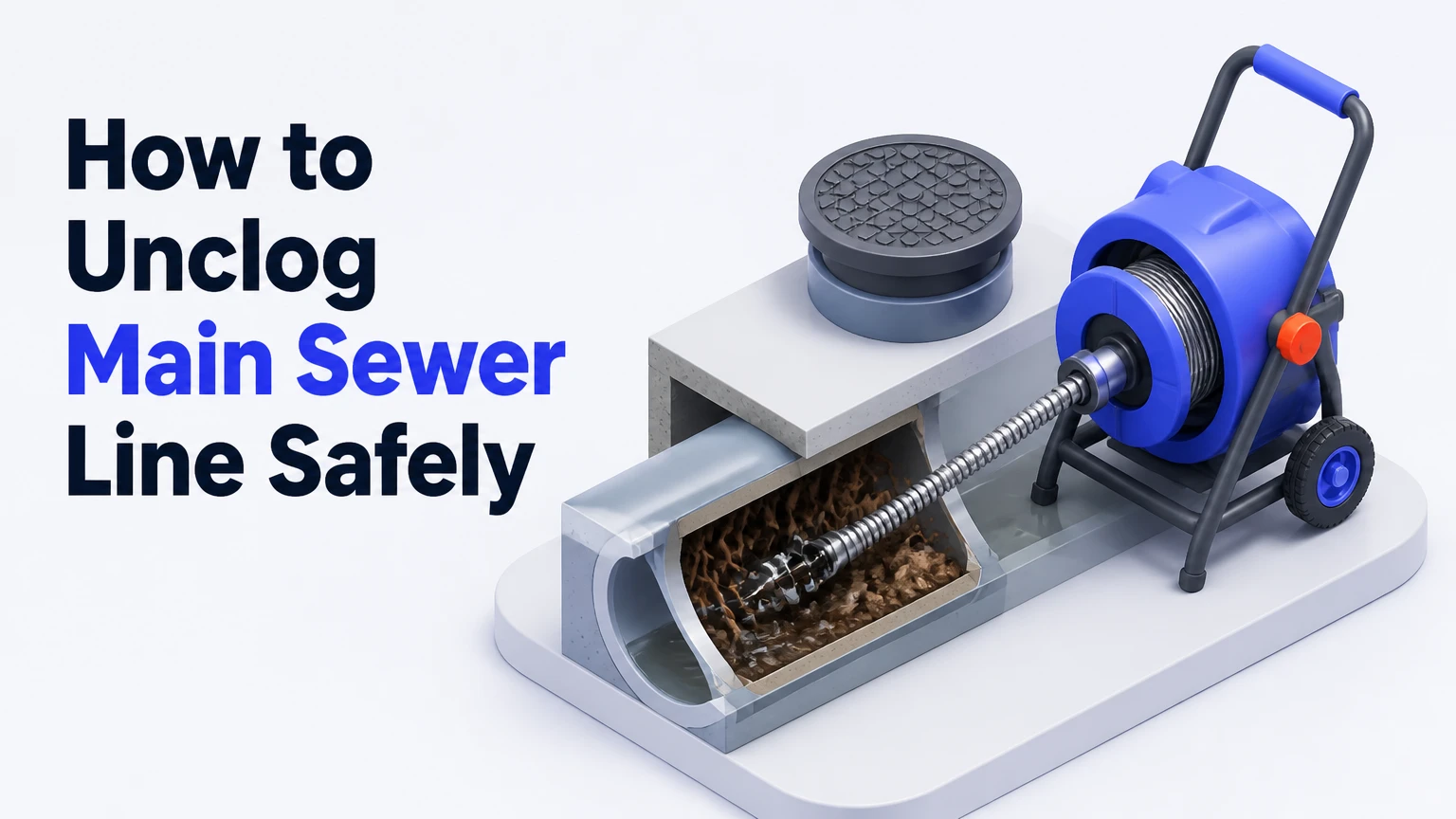
To unclog a main sewer line, stop all water use, locate and carefully open the proper cleanout, then clear the obstruction with a correctly sized sewer auger or professional hydro jetter. A homeowner should attempt only a low-risk, accessible cleanout blockage; suspected roots, collapsed pipes, sewage exposure, or a stuck cable require a licensed plumber and camera inspection.
Key Facts at a Glance
A main sewer line usually measures 3-6 inches in diameter and carries wastewater from branch drains to a municipal sewer or septic tank.
Multiple slow drains, toilet bubbling, or wastewater backing up from a shower indicate a mainline problem more strongly than one isolated slow sink.
Never pour caustic drain opener into a completely blocked main line because concentrated chemicals can remain trapped and injure the next person opening the cleanout.
Mechanical cabling typically costs about $200-$500 professionally and takes 1-2 hours, while hydro jetting commonly costs $600-$1,400.
A camera inspection should precede hydro jetting in old clay, Orangeburg, brittle cast-iron, cracked, or repeatedly blocked pipes.
A sewage backup is a sanitation event, not an ordinary drain-cleaning nuisance. The CDC advises, “Avoid contact with sewage and wastewater.”
What Is a Main Sewer Line?
A main sewer line is the large drainpipe that receives wastewater from toilets, sinks, showers, tubs, and appliances before carrying it to a public sewer or private septic system. Most residential mainlines are 3 or 4 inches inside the house and may increase to 6 inches near the property connection, although local plumbing codes and construction age vary.
Branch drains serve individual fixtures. The building drain combines those branches, and the building sewer, often called the sewer lateral, carries flow from the structure toward the street or septic tank. A blockage downstream of several branch connections causes several fixtures to react at once.
The homeowner may own the private lateral from the house to the municipal connection, while the utility owns the public sewer. The exact boundary varies by city, easement, and service agreement. Call the sewer utility before excavating or paying for work near the street.
How Can You Tell It Is the Mainline?
A main sewer blockage affects two or more lower fixtures, especially when one fixture discharges and another fills or gurgles. A single slow bathroom sink usually has a local trap or branch-line obstruction instead.
| Symptom | Likely location | Immediate action |
|---|---|---|
| One sink drains slowly | Sink trap or branch drain | Clean the trap or use a small hand auger |
| Toilet bubbles when a tub drains | Shared branch or mainline | Stop water use and inspect the main cleanout |
| Basement floor drain rises | Mainline downstream of the drain | Keep people and pets away from wastewater |
| Washing machine causes toilet overflow | Mainline or large shared branch | Do not run another discharge cycle |
| Sewage exits outdoor cleanout | Blockage downstream of cleanout | Close the cap loosely and call a plumber if flow continues |
The lowest fixture often overflows first because gravity directs backed-up wastewater toward the lowest available opening. A washing machine can reveal the problem because its pump releases a large volume quickly.
Why Do Main Sewer Lines Clog?
Main sewer lines clog when an obstruction reduces the pipe’s open cross-section below the volume needed for normal discharge. Grease, paper, wipes, roots, mineral scale, and foreign objects cause blockages, while defective pipe geometry can create repeated obstructions even after cleaning.
Tree roots enter through cracked joints and failed seals because the pipe opening provides moisture and nutrients. Roots do not usually create a defect in an intact, properly joined pipe. Removing roots without repairing the entry point treats the symptom, so regrowth can return within months.
Common structural causes include a belly, which is a sag that holds sediment; an offset joint, where pipe sections no longer align; a collapsed section; and Orangeburg pipe, a fiber conduit found in some older properties. Sewer-line defects need inspection and repair rather than increasingly aggressive cleaning.
Before You Start: Safety, Tools, and Decision Rules
Main sewer clearing requires a cleanout, protective equipment, controlled water testing, and a way to stop safely when the pipe or cable behaves abnormally. The practical difficulty is moderate with a cleanout and light blockage, but it becomes high when sewage is standing, the pipe material is unknown, or powered equipment is required.
| Requirement | Typical value | Why it matters |
|---|---|---|
| DIY time | 1-3 hours | Includes setup, cabling, retrieval, and testing |
| Professional service | 1-4 hours | Depends on access, inspection, and cleaning method |
| Rental sewer auger | $50-$150 per day | Typical US equipment range |
| Protective equipment | Gloves, eye protection, boots, coveralls | Limits sewage and cable exposure |
| Cable reach | 50-100 feet for many rentals | Must reach the obstruction without overextending |
| Cleanout access | 3-4 inch threaded opening | Provides a direct route into the mainline |
Use waterproof chemical-resistant gloves, eye protection, non-slip waterproof boots, and disposable coveralls. Wash hands with soap and water after the work, disinfect hard surfaces, and launder contaminated clothing separately. Do not mix sewage cleanup with bleach, acids, or commercial drain opener.
Do not proceed if raw sewage is actively flooding living space, electricity is near standing water, the cleanout is buried or damaged, a cable is already stuck, or the line may be collapsed. Those conditions justify a plumber, sanitation cleanup, or both.
Step 1: Stop Water Use and Locate the Correct Cleanout
Turn off or avoid every fixture that discharges into the drainage system, including toilets, showers, faucets, dishwashers, and washing machines. Locate the main cleanout inside a basement or crawlspace, or outside near the foundation, where a capped 3- or 4-inch pipe provides access to the building sewer.
Do not automatically turn off the home’s main water valve if doing so prevents needed handwashing or creates another hazard. The essential action is stopping wastewater flow. Place a notice on toilets and tell everyone in the home not to use plumbing.
Cleanouts may have a square-head plug, a raised hexagonal cap, or a flush cap at ground level. A cleanout with sewage standing behind the cap is under pressure. Put a bucket and absorbent material below the opening before loosening it.
You will know this step worked when: the correct access point is identified and nobody is adding water to the blocked system.
Common mistake: opening a yard drain or stormwater cleanout instead of the sanitary sewer cleanout. Storm drains and sanitary drains are separate systems.
Step 2: Release Cleanout Pressure Slowly
Loosen the cleanout cap by one or two turns while standing to the side, not directly in front of the opening. If sewage begins escaping under pressure, retighten the cap and call a plumber unless the flow is minor and can be contained safely.
Never remove a pressurized cap quickly. A full sewer lateral can release contaminated water suddenly, spray the operator, and spread pathogens across the work area. A face shield provides better protection than ordinary glasses when pressure is suspected.
If the cap is seized, cracked, buried, or made from brittle plastic, stop rather than applying extreme force. Breaking the fitting can create an excavation or pipe-repair problem. The cleanout opening should expose a clear pipe path, not a solid wall of sewage or a damaged fitting.
You will know this step worked when: the cap is removed without a surge and the pipe opening remains intact.
Common mistake: using a torch, penetrating heat, or a long cheater bar near a plastic fitting. Heat can deform the pipe, and excessive torque can break an underground connection.
Step 3: Choose and Operate the Clearing Tool
Use a mainline electric drum auger or sectional sewer machine only when the pipe is accessible, the obstruction appears mechanical, and you understand the rental equipment. A 2-inch sink snake is too small for many 3- or 4-inch sewer lines, while an oversized cutter can damage weak pipe.
Start with a penetrating or spearhead cutter. A larger root cutter should be selected only after the cable passes through the line and the pipe’s condition is reasonably known. Feed the cable toward the municipal sewer or septic tank if the cleanout orientation confirms that direction.
Keep both hands away from the rotating cable, use the machine’s ground-fault protection, and follow the rental manufacturer’s operating instructions. Never wear loose clothing, jewelry, or gloves that can catch in rotating equipment. A cable can pull a hand into the machine faster than a person can release a foot pedal.
Advance gradually. If the cable binds, stop the motor, reverse according to the machine instructions, and retrieve it. Do not force the cable through an obstruction that feels immovable.
You will know this step worked when: the cable advances past the resistance and the standing water level drops without violent surging.
Common mistake: running the cutter continuously against a hard stop. That can kink or break the cable, enlarge a defect, or drive a root mass farther into the line.
Step 4: Confirm Flow and Test the Drainage System
After the obstruction gives way, wait for the pipe to drain before adding water. A falling level and a sustained flow indicate progress, but a temporary trickle may represent only a pinhole through grease or paper.
Pull the cable back slowly while inspecting the retrieved material. Roots, fibrous wipes, grease, or broken pipe fragments provide useful evidence about the cause. Do not push a garden hose deep into an open cleanout at full pressure, because uncontrolled flow can refill the building drain and force contaminated water into fixtures.
Test with a small amount of cold water from a nearby faucet, then flush one toilet while watching the cleanout and lowest fixtures. Add volume in stages. If water rises again, stop immediately and arrange a professional clearing or camera inspection.
You will know this step worked when: several fixtures discharge normally, no toilet bubbles, and the cleanout level remains stable during a controlled test.
Common mistake: assuming one sudden rush proves the line is permanently clear. Partial openings often close again when accumulated grease or roots remain on the pipe wall.
Which Main Sewer Clearing Method Fits the Blockage?
Mechanical cabling is the best first clearing method for many discrete obstructions, while hydro jetting is better for heavy grease and deposits in a structurally sound pipe. Chemical root treatments are maintenance tools, not reliable solutions for a complete blockage, and sewer bladders are limited to short, accessible soft clogs.
| Method | Best target | Typical cost | Typical duration | Main limitation |
|---|---|---|---|---|
| Mainline auger | Roots, wipes, paper, objects | $200-$500 professional | 1-2 hours | May leave residue or roots behind |
| Hydro jetting | Grease, sludge, scale, fine roots | $600-$1,400 professional | 2-4 hours | Can damage defective pipes |
| Sewer bladder | Soft blockage near cleanout | $20-$50 tool | 15-30 minutes | Can push blockage downstream |
| Foaming root treatment | Recurring minor root growth | $30-$100 product | 12-24 hours | Cannot clear a full stoppage |
| Camera inspection | Unknown or recurring failure | $150-$500 typical | 30-90 minutes | Diagnoses rather than clears |
When Is Hydro Jetting Better Than Snaking?
Hydro jetting is preferable when inspection shows grease, sludge, mineral scale, or fine roots coating a sound pipe. A professional jetter uses a water hose and nozzle selected for the pipe diameter, access point, and obstruction; the operator controls pressure and flow rather than simply applying a fixed 4,000 PSI.
The AI Overview’s broad claim that PVC can “easily handle 4,000 PSI” is unsafe as a homeowner rule. Jet pressure at the pump is not the same as pressure at the pipe wall, and a cracked joint, failed transition, weak cleanout, or blocked nozzle can change the force distribution. Pipe condition and nozzle selection matter more than a material label.
A camera inspection should precede jetting in old clay, cast iron, Orangeburg, brittle vitrified clay, or any line with repeated failures. Hydro jetting cleans the interior; it does not fix a belly, collapse, separated joint, or root-entry defect.
Should You Use Chemical Drain Opener?
Do not use standard caustic drain opener in a fully blocked main sewer line. Sodium hydroxide or acid products can remain concentrated in the line, burn a person opening the cleanout, corrode vulnerable materials, and create hazardous wastewater for the plumber.
Copper sulfate and foaming root-control products have a narrower role. Local regulations, septic-system instructions, and product labels govern their use, and some municipalities restrict copper discharge. Root treatment may slow regrowth after mechanical removal, but it cannot restore a collapsed pipe or clear a solid stoppage.
How Much Does It Cost to Unclog a Main Sewer Line?
Professional main sewer clearing typically costs $200-$500 for mechanical cabling, $600-$1,400 for hydro jetting, and about $150-$500 for a camera inspection in the United States. Excavation, relining, replacement, emergency hours, difficult access, and municipal permits can raise the total substantially.
| Service or repair | Typical US price | Typical time | When it is needed |
|---|---|---|---|
| Basic mainline cabling | $200-$500 | 1-2 hours | Discrete blockage |
| Camera inspection | $150-$500 | 30-90 minutes | Recurring or uncertain clog |
| Hydro jetting | $600-$1,400 | 2-4 hours | Grease, scale, sludge |
| Spot repair | $1,000-$4,000 | 1-2 days | One damaged section |
| Sewer lateral replacement | $5,000-$20,000+ | 2-7 days | Extensive collapse or defects |
| Emergency after-hours call | Add 25%-100% | Same day | Active backup outside normal hours |
Prices vary by region, access, pipe depth, and whether the provider includes a post-cleaning camera recording. Ask whether the quote includes travel, setup, disposal, inspection, and a written location of the defect.
A low-cost cable clearing can be appropriate when a single paper blockage caused the event. Repeated backups at three-month intervals usually make another blind cleaning poor value because the underlying cause may be roots, grease, or structural failure.
When Should You Stop DIY and Call a Plumber?
Stop DIY when the cable meets a rigid obstruction, returns with fragments of pipe, repeatedly binds at the same distance, or cannot reach the suspected blockage. Those signs can indicate a collapsed section, offset joint, heavy root mass, or incorrect equipment, and additional force can worsen the damage.
Call a licensed plumber immediately for sewage inside living areas, a suspected gas or electrical hazard, a buried or broken cleanout, a blocked line in a multi-unit building, or a backup that returns after clearing. Renters should notify the landlord or property manager before authorizing work.
Request a camera inspection when the line has failed more than once, the property is older, roots are present, or the cable only creates temporary flow. Ask for the inspection distance, pipe material, defect location, and video file. A location measurement helps distinguish a repairable private lateral from a public sewer problem.
Troubleshooting Main Sewer Line Problems
| Observation | Most likely explanation | Correct next step |
|---|---|---|
| Cable stops at identical distance | Offset, collapse, or root mass | Stop forcing; camera-inspect |
| Cleanout fills immediately | Blockage is downstream | Limit water use; clear toward street |
| Cleanout stays empty but fixtures back up | Wrong cleanout or upstream blockage | Verify drainage layout and second cleanout |
| Water drains briefly, then returns | Partial opening or structural defect | Camera inspection and targeted cleaning |
| Roots return within months | Cracked joint or failed seal | Root removal plus repair or approved treatment |
| Entire neighborhood has backups | Public sewer restriction | Contact municipal wastewater utility |
What If the Property Uses a Septic Tank?
A septic property can have a blocked building sewer, a full septic tank, a failed effluent filter, or a saturated drain field. If the mainline appears open but toilets remain slow, check the tank service interval and contact a septic professional rather than repeatedly snaking the house drain.
Do not direct a sewer bladder toward a septic tank without knowing the system layout. High-volume discharge can disturb tank contents or move a blockage into a less accessible section. Septic tank pumping does not repair a collapsed house sewer.
Who Owns the Blocked Sewer Lateral?
Ownership depends on local utility rules, but the homeowner commonly maintains the private line from the building to the municipal connection. Some utilities accept responsibility at the property line, while others maintain the public main and part of the lateral.
Call the utility before paying for excavation near the street. Utility staff may inspect the public main, confirm whether neighboring properties are affected, and identify the maintenance boundary. Keep the service ticket if a later billing dispute arises.
Common Mistakes and How to Fix Them
- Opening the cap directly in front of your face: Move to the side, loosen gradually, and contain any discharge before complete removal.
- Using a small sink snake: Rent a properly rated mainline machine with sufficient cable length and a cutter sized for the pipe.
- Forcing a stuck cable: Stop the motor, reverse safely, and inspect the line. Do not convert a diagnostic warning into pipe damage.
- Hydro-jetting an unknown old pipe: Obtain a camera inspection first, especially for clay, Orangeburg, or severely corroded cast iron.
- Flushing wipes because they are labeled flushable: Plumbing and Drainage Institute guidance and wastewater utilities commonly warn that wipes can accumulate, even when marketed as flushable.
- Ignoring temporary success: Record the cable distance and schedule inspection if the backup returns, because recurrence is evidence of an unresolved cause.
A counterintuitive practitioner rule is that the first successful opening is often the least informative moment. Flow restoration removes the immediate symptom, but the material on the cable and the obstruction distance determine whether the line needs cleaning, repair, or monitoring.
Variations for Common Situations
If There Is No Accessible Cleanout
Do not remove a toilet as a first choice unless a plumber confirms that the toilet flange provides the safest access. A missing cleanout may require installing one, and cutting an underground line without locating utilities and confirming pipe direction creates avoidable damage.
If the Blockage Is Outside
Keep people and pets away from sewage on soil or pavement. Photograph the location, limit water use, and determine whether the discharge is from a sanitary cleanout, septic component, or storm drain before arranging cleanup.
If You Live in an Apartment
Do not operate a powered sewer machine or open a shared cleanout without authorization. A blockage may affect several units, and the building owner or manager typically controls shared drainage equipment and sanitation response.
FAQ
Can boiling water unclog a main sewer line?
Boiling water is unlikely to clear a main sewer blockage because the obstruction is usually too large, too distant, or structural. Hot water may soften a small grease deposit in a nearby branch drain, but it cannot remove roots, wipes, collapsed pipe, or a full septic tank.
How long does a main sewer line cleaning last?
A simple paper blockage may remain clear for years after proper removal, while root or grease problems can recur within weeks or months. The service life depends on whether the cleaner only punches an opening or removes deposits and whether a pipe defect continues admitting roots.
Is a sewer bladder safe for PVC pipe?
A sewer bladder can be acceptable for a soft, nearby obstruction in a sound line, but it is not a universal PVC solution. Pressure can force a blockage downstream, stress weak joints, or conceal a collapsed section. Never use one when the pipe route or condition is unknown.
Why does my sewer line keep clogging after snaking?
Repeated clogging after snaking usually means the cable created a narrow passage without removing grease, roots, or scale, or that a structural defect remains. A camera inspection can identify the obstruction type and distance, allowing hydro jetting or repair to match the actual cause.
Can tree roots be permanently removed from a sewer line?
Mechanical cutting removes existing roots but does not permanently prevent regrowth when roots enter through a cracked joint or separated connection. Permanent correction requires repairing or replacing the defective section; approved root-control treatment may provide interim maintenance where local rules permit it.
Should I call the city for a sewer backup?
Call the city or wastewater utility when the public main may be involved, neighbors report similar backups, or the blockage is near the street connection. The utility can confirm its maintenance boundary and inspect its main before you authorize private excavation or lateral replacement.
The Bottom Line
How to unclog main sewer line problems safely depends first on diagnosis, not force. Stop water use, identify the correct cleanout, release pressure cautiously, and use a properly rated mainline auger only when access and conditions are safe. Choose hydro jetting for deposits in a sound pipe, obtain a camera inspection for recurring or structural problems, and call a plumber for sewage exposure, stuck equipment, roots, or suspected collapse.