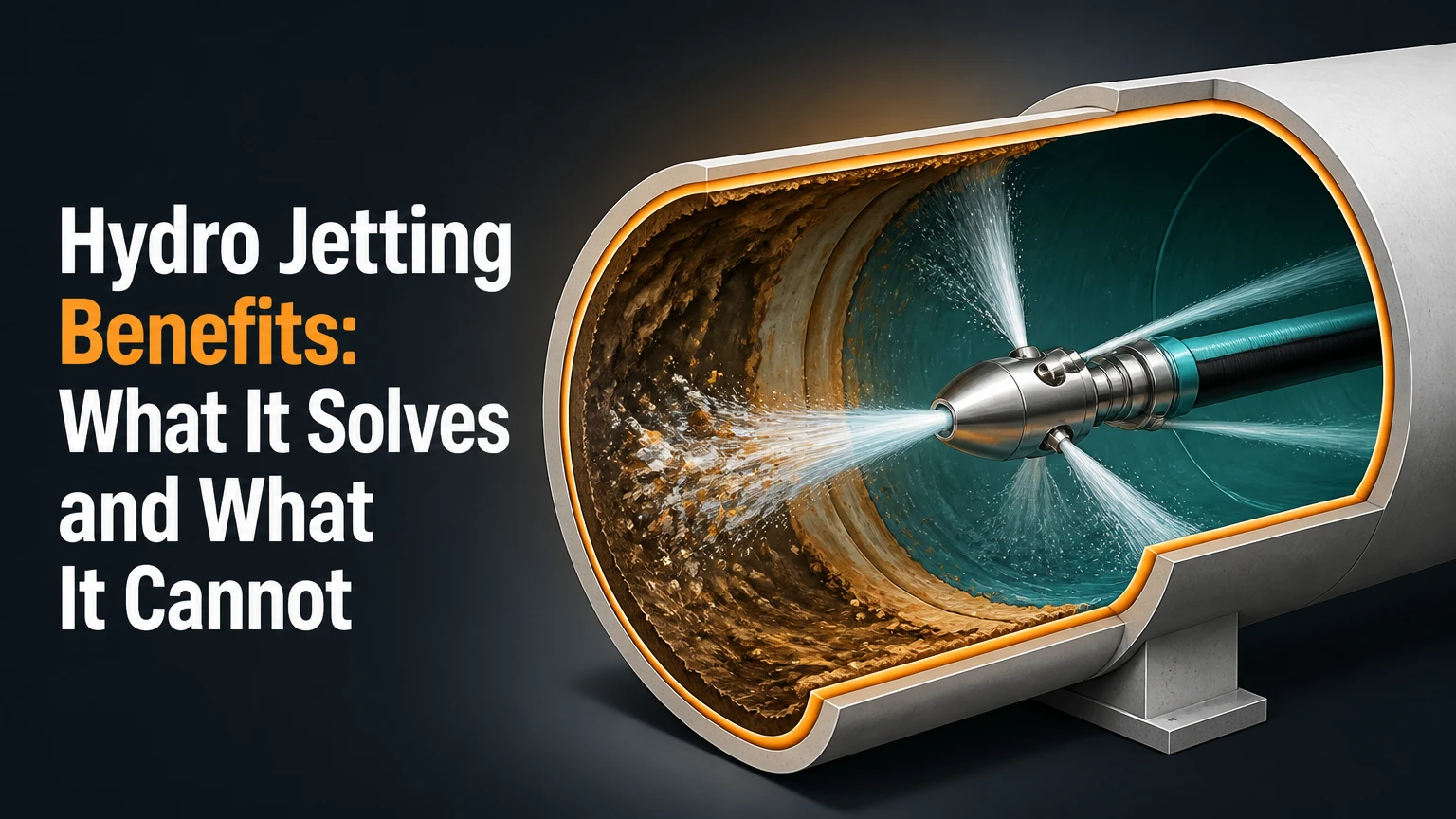
Hydro jetting benefits include removing grease, scale, sludge, biological film, and many tree-root obstructions from the full interior of a drain or sewer pipe. A professional jetter can restore flow more completely than an auger, but hydro jetting cannot repair a collapsed, badly cracked, or structurally unstable pipe and should follow a camera inspection.
Key Facts at a Glance
- Residential hydro jetting commonly uses 1,500-4,000 PSI and 2-15 gallons per minute, depending on the line and nozzle.
- Water flow scrubs and transports loosened debris, while pressure supplies cutting and cleaning force.
- A sewer camera inspection should precede jetting when pipe age, material, or structural condition is uncertain.
- Typical residential sewer-line hydro jetting costs $350-$700 and takes approximately 1-2 hours.
- Hydro jetting removes accumulated material; it does not correct pipe collapse, severe displacement, or defective connections.
- Snaking usually restores an opening, while hydro jetting cleans more of the pipe circumference.
What Are the Main Hydro Jetting Benefits?
Hydro jetting’s main benefit is full-bore cleaning: pressurized water removes material attached to the pipe walls instead of creating a narrow passage through the blockage. That distinction matters when grease, mineral scale, roots, or sludge has reduced the usable diameter of a sewer line.
A drain auger can restore immediate flow by breaking through a blockage. Residue often remains around the cable’s path, so a recurring restriction can return after weeks or months. Hydro jetting uses forward and rear-facing nozzle jets to cut deposits, wash the pipe walls, and carry loosened material toward an approved downstream outlet.
The practical benefits include:
- More complete cleaning: Grease films, paper sludge, soap residue, and soft deposits can be removed around much of the pipe circumference.
- Better root control: Root-cutting nozzles can sever fine and moderate root growth inside a sound line.
- Longer intervals between blockages: A cleaner internal surface gives grease and debris fewer places to accumulate.
- Reduced excavation: Technicians usually work through an existing cleanout, avoiding yard or floor excavation.
- Chemical-free cleaning: The process uses water rather than caustic drain chemicals, although wastewater still requires responsible handling.
- Adaptable equipment: Portable units can serve branch drains, while trailer-mounted systems handle larger sewer lines.
Hydro jetting does not make every pipe “like new.” A line with missing sections, extensive corrosion, a belly, or a collapsed wall requires repair or replacement after the blockage is addressed.
How Hydro Jetting Works
Hydro jetting works by transferring pump energy into a controlled stream of water that exits through a specialized nozzle. Rear-facing jets propel the hose and push debris downstream, while forward-facing or rotating jets attack obstructions and deposits ahead of the nozzle.
The technician inserts a flexible hose through a cleanout or other access point. Pump pressure and nozzle geometry determine how the water interacts with the pipe. A penetrating nozzle may open a dense grease plug, while a rotary nozzle can provide more uniform cleaning around the pipe circumference.
Pressure, Flow, and Nozzle Selection
Pressure is measured in pounds per square inch, or PSI. Flow is measured in gallons per minute, or GPM. PSI helps cut or dislodge material, while GPM provides the volume needed to flush loosened debris through the line.
| Equipment or application | Typical pressure | Typical flow | Common use |
|---|---|---|---|
| Portable residential jetter | 1,500-3,000 PSI | 2-4 GPM | Sinks, branch drains, light grease |
| Residential main-line jetter | 2,500-4,000 PSI | 5-10 GPM | Building sewer lines |
| Trailer-mounted sewer jetter | 3,000-4,000+ PSI | 9-15 GPM | Long lines, roots, commercial drains |
| Industrial water-jetting system | 5,000-10,000+ PSI | 4-20+ GPM | Specialized industrial deposits |
These figures are equipment ranges, not universal operating settings. A technician should select pressure, flow, hose size, and nozzle design according to pipe diameter, material, access, blockage type, and downstream capacity.
A common practitioner error is choosing the highest PSI available. High pressure without enough flow can cut a passage through debris while leaving deposits behind. Excessive pressure can also expose weak joints or damage brittle pipe material.
Which Problems Does Hydro Jetting Solve?
Hydro jetting is most effective against organic buildup and deposits that cling to pipe walls. The method is particularly useful for recurring sewer restrictions, restaurant grease, mineral scale, sludge, and fine-to-moderate root intrusion inside a structurally sound line.
| Problem | Hydro jetting result | Limitation | Preferred equipment |
|---|---|---|---|
| Kitchen grease | Melts or dislodges deposits; flushes residue | Heavy hardened grease may require repeated passes | Hot-water jetter |
| Mineral scale | Breaks scale from interior walls | Severe corrosion may expose pipe defects | Rotary or descaling nozzle |
| Fine tree roots | Cuts and washes away roots | Roots usually return if the joint remains open | Root-cutting nozzle |
| Sand and sludge | Suspends and transports loose material | A downstream blockage can cause backup | High-flow sewer jetter |
| Paper and organic debris | Clears accumulated material | Cannot correct a collapsed line | General sewer nozzle |
| Concrete or hardened construction material | May remove limited deposits with specialized tools | Major deposits may need mechanical or abrasive methods | Specialist equipment |
Tree roots deserve careful interpretation. Hydro jetting can remove roots from a pipe, but it does not stop future growth when roots enter through a cracked joint or separated connection. Repeated jetting may control symptoms while a permanent repair addresses the entry point.
Hydro jetting is also poorly suited to a simple toilet clog caused by excess paper or a small object. A closet auger or conventional drain snake is usually faster, cheaper, and less disruptive in that situation.
What Happens During Professional Service?
A standard residential hydro jetting visit takes about 1-2 hours, although long lines, difficult access, severe roots, and multiple cleaning passes can extend the work to 3-5 hours. The most important quality-control step is the camera inspection before cleaning.
Step 1: Inspect the Line
The technician runs a sewer camera through the accessible line to identify the blockage and assess pipe condition. The inspection should look for cracks, open joints, corrosion, offsets, bellies, root entry, and collapse.
Step 2: Establish Safe Access
The technician locates a cleanout, protects the work area, and confirms where wastewater can discharge. Access through a roof vent or removed fixture may be possible, but a purpose-built cleanout is usually safer and more efficient.
Step 3: Match the Nozzle to the Deposit
The nozzle choice should correspond to the obstruction. Penetrating nozzles open dense plugs, flushing nozzles move loose debris, rotary nozzles clean circumferentially, and root-cutting heads address vegetation inside suitable lines.
Step 4: Jet in Controlled Passes
The technician feeds the hose into the pipe while regulating pressure and hose speed. Pulling the nozzle back slowly often produces better wall cleaning than rapidly withdrawing it after the first opening appears.
Step 5: Manage the Wastewater
The downstream line must accept the water and loosened debris. If water backs up inside a building, the technician should stop or reduce the flow rather than continue filling a blocked system.
Step 6: Verify the Result
A post-jetting camera inspection confirms whether the deposit has been removed and whether structural defects remain visible. A professional should provide the customer with findings, photographs, or video when the service terms include inspection.
How Much Does Hydro Jetting Cost?
Typical residential hydro jetting costs $350-$700 for a standard sewer-line cleaning. Commercial work commonly costs $500-$1,200 or more, with price driven by line length, access, deposit severity, water requirements, and the number of cleaning passes.
| Service condition | Typical price | Typical duration | Main cost driver |
|---|---|---|---|
| Small branch drain | $250-$500 | 1-2 hours | Access and indoor setup |
| Residential main sewer line | $350-$700 | 1-2 hours | Camera inspection and line length |
| Root-heavy residential line | $500-$1,000 | 2-4 hours | Multiple passes and root nozzle |
| Restaurant or commercial line | $500-$1,200+ | 2-5 hours | Grease, access, and high flow |
| Emergency or difficult-access service | $700-$1,500+ | 2-6 hours | After-hours labor and access work |
These are typical planning ranges, not a national price standard. Local labor rates, regional regulations, travel distance, and whether the estimate includes camera inspection can change the final invoice.
An estimate should state whether it includes pre-service inspection, post-service video, cleanout access, water supply, wastewater handling, descaling, root cutting, and repairs discovered during the visit. A low quote that excludes camera work may become expensive when access or structural defects appear.
Hydro Jetting vs. Other Drain-Cleaning Methods
Hydro jetting is usually the better choice for recurring buildup across a long line, while snaking is often the better first response to a localized household clog. Chemical cleaners have the narrowest use case because they may fail against roots and scale while creating handling, corrosion, and wastewater concerns.
| Decision factor | Hydro jetting | Drain snaking | Chemical cleaner |
|---|---|---|---|
| Main action | Flushes and scrubs pipe walls | Opens a passage through a clog | Reacts with selected deposits |
| Typical residential price | $350-$700 | $100-$400 | $8-$30 |
| Best target | Grease, scale, sludge, roots | Hair, paper, localized objects | Limited soft organic residue |
| Structural assessment | Camera commonly used | Camera sometimes used | No assessment |
| Recurring buildup | Often reduces recurrence | Often leaves residue | Usually provides short relief |
| Pipe risk | Significant if the line is weak | Lower structural force | Corrosion or chemical exposure risk |
| Excavation required | Usually no | Usually no | No |
| Professional control | Strongly recommended | Professional or limited DIY use | Manufacturer instructions required |
Snaking remains valuable because it can quickly open a line and retrieve some objects. It is less effective when the pipe has a broad coating of grease or scale. Chemical cleaners should never be combined, poured into a line that may be opened by a technician, or used in systems with unknown pipe damage.
Which Method Fits the Situation?
- Single sink or tub clog: Start with a plunger or appropriate auger.
- Toilet blocked by paper or a small object: Use a closet auger or plumber.
- Repeated main-line backup: Schedule a camera inspection and consider hydro jetting.
- Restaurant FOG accumulation: Use hot-water jetting within a documented maintenance plan.
- Root intrusion: Jet the line for immediate clearance, then evaluate joint repair or replacement.
- Collapsed or severely offset pipe: Repair the line; jetting alone cannot restore its shape.
When Is Hydro Jetting Unsafe?
Hydro jetting is unsafe when inspection shows a collapsed, severely cracked, badly corroded, or structurally unstable pipe. Water pressure may remove deposits while also enlarging a defect, dislodging a fragile section, or exposing a connection that cannot contain normal flow.
Older Orangeburg pipe presents a particular concern because its fiber-based walls can deform and deteriorate over time. Clay and cast-iron lines may tolerate controlled cleaning when structurally sound, but age alone does not prove safety. PVC is generally durable, yet fittings, joints, and transitions can still be damaged by poor technique or excessive force.
| Pipe or condition | Jetting decision | Required safeguard |
|---|---|---|
| Sound PVC, 1.5-12 inches | Often suitable | Correct pressure and nozzle |
| Sound cast iron | Possible with controlled settings | Camera inspection and experienced operator |
| Clay with open joints | Conditional | Assess displacement and root entry |
| Orangeburg or heavily corroded pipe | Often unsuitable | Consider repair or replacement |
| Collapsed or belly section | Does not solve defect | Repair after access and diagnosis |
| Septic line with limited tank capacity | Conditional | Confirm tank and outlet capacity |
A responsible technician should explain the risk before pressurizing the line. The customer should receive a clear distinction between “the line is open” and “the line is structurally serviceable.”
Is Hydro Jetting Safe for Septic Systems?
Hydro jetting can be used on some septic-connected drain lines, but the technician must account for tank capacity, baffles, outlet filters, and the destination of flushed material. Sending a large volume of water and debris into an already full or poorly maintained septic tank can worsen backups.
The service provider should identify whether the blockage is in the building drain, the line to the tank, the tank outlet, or the soil absorption area. Jetting the wrong segment may move material toward a septic tank without correcting a saturated drain field or blocked effluent filter.
Water use also varies by equipment. A 10 GPM jetter operating for 60 minutes uses approximately 600 gallons before accounting for pauses and recovery. That volume may be acceptable for a municipal sewer connection but requires planning on a private septic system.
Who Benefits Most From Preventive Jetting?
Preventive hydro jetting benefits properties where deposits accumulate faster than ordinary maintenance can control them. Restaurants, multi-unit buildings, food-processing facilities, and homes with documented recurring main-line restrictions usually gain more from scheduled cleaning than homes with one isolated clog.
Typical scheduling follows the cause rather than a universal calendar:
- Restaurants: Quarterly to twice-yearly cleaning may be appropriate for grease-heavy lines, coordinated with grease-trap maintenance.
- Commercial buildings: Annual or every 1-2 years can suit lines with repeated tenant or kitchen backups.
- Older homes: Inspect first; jet only when the pipe is structurally suitable and recurrence justifies the cost.
- Single-family homes with no recurrence: Routine jetting is usually unnecessary.
- Root-affected lines: Schedule based on recurrence, inspection findings, and planned repair.
Preventive service should be based on records. A facility manager can compare blockage dates, affected fixtures, line location, and cleaning duration to determine whether jetting prevents expensive interruptions.
What Hydro Jetting Cannot Fix
Hydro jetting cannot rebuild a missing pipe wall, correct a collapsed sewer, raise a sunken pipe, seal a separated joint, or repair a failed connection. It can remove material that hides those problems, which is why a clean line may still require excavation or trenchless repair.
Hydro jetting also cannot guarantee permanent root prevention. Root cutting removes current growth, but roots can return through the same opening. Chemical root treatments, joint sealing, pipe lining, spot repair, or replacement may be considered after diagnosis, subject to local rules and pipe condition.
A line that backs up immediately after jetting may have a downstream obstruction, inadequate slope, a belly that retains solids, or a structural failure. Repeating the same cleaning without reviewing the camera footage treats the symptom rather than the cause.
How to Choose a Hydro Jetting Provider
Choose a provider that diagnoses the pipe before selecting pressure. The estimate should identify the access point, inspection method, proposed nozzle, operating range, wastewater plan, and post-service verification.
Ask these questions before authorizing work:
- Will you provide a camera inspection before jetting?
- What pipe defects would make you stop or change methods?
- Which PSI and GPM range will you use for this line?
- Does the price include a post-cleaning camera video?
- How will you prevent wastewater from backing up indoors?
- Will you separate cleaning costs from repair recommendations?
- Are you insured and trained for high-pressure water equipment?
- What happens if the hose encounters a collapsed or offset section?
A reputable technician should not promise that every line will become “100 percent clean” before viewing the pipe. The provider should also avoid guaranteeing a specific duration of relief when roots, grease sources, or structural defects remain.
Common Problems During Jetting and Safe Responses
A stuck hose, sudden indoor backup, or loss of flow requires an immediate controlled response. The operator should release pressure, stop adding water, and diagnose the obstruction rather than forcing the hose or increasing PSI.
| Operating symptom | Likely cause | Safe response |
|---|---|---|
| Hose stops advancing | Root mass, offset joint, or collapse | Stop pressure; inspect with camera |
| Water rises indoors | Downstream evacuation is inadequate | Pause pump and protect fixtures |
| Flow returns briefly | Deposit was pierced, not removed | Perform slower cleaning passes |
| Nozzle loses traction | Wrong nozzle or excessive hose size | Reassess nozzle and line diameter |
| Debris remains on camera | Insufficient flushing or blocked outlet | Clear downstream path and reinspect |
Never pull a pressurized hose with force. A nozzle caught on a shifted joint can damage the pipe or injure the operator if the hose releases suddenly. High-pressure water can penetrate skin and cause serious tissue damage even when the external wound appears small, so equipment safety procedures and protective clothing matter.
How to Judge Whether the Service Worked
Successful hydro jetting should produce restored flow, a clear downstream discharge, and camera evidence that the targeted deposit has been removed. A technician should also identify defects that became visible after cleaning, because a clean pipe can reveal the actual reason for recurring failure.
Look for these results:
- Fixtures drain at normal speed without gurgling.
- The camera shows a substantially open pipe circumference.
- Root entry, scale, or grease is documented rather than described vaguely.
- The technician confirms that water reached the intended downstream point.
- The invoice records the line cleaned, access used, and any remaining defect.
- The provider gives a recommendation based on recurrence risk, not an automatic upsell.
A temporary return of flow is not proof of complete cleaning. If symptoms return within days, request the post-service video and compare the affected location with the original inspection.
FAQ
Can hydro jetting remove all tree roots?
Hydro jetting can cut and flush many roots from a structurally sound sewer line, but it does not permanently close the joint or crack that allowed roots inside. Fine roots may return within months or years, depending on the opening, nearby vegetation, moisture, and pipe condition. Permanent control requires repair, lining, or replacement when appropriate.
How long do hydro jetting benefits last?
Hydro jetting benefits may last months to several years, but no fixed interval applies to every property. Grease-producing restaurants, root-affected lines, and pipes with poor slope usually recur faster than clean residential lines. Inspection history and the time between previous backups provide better scheduling evidence than a generic guarantee.
Can hydro jetting unclog a toilet?
Hydro jetting can clean a building sewer line connected to a toilet, but it is usually excessive for a single toilet clog caused by paper or a small object. A plunger or closet auger normally costs less and requires less setup. Jetting becomes more appropriate when several fixtures back up or the main line repeatedly restricts.
Does hydro jetting use environmentally harmful chemicals?
Standard hydro jetting uses pressurized water rather than caustic drain-cleaning chemicals. The process still produces contaminated wastewater containing grease, sewage, scale, and debris, so discharge must follow local plumbing, sewer, and environmental requirements. Chemical additives, if proposed, should be identified separately and approved for the specific system.
Should a camera inspection be included in the price?
A camera inspection should be included when the line is old, repeatedly blocked, root-affected, or structurally uncertain. Pre-service video protects the pipe by revealing collapse and post-service video verifies the result. For a simple, accessible branch-drain blockage, a camera may not always be necessary, but the provider should explain that choice.
The Bottom Line
The strongest hydro jetting benefits appear when a sound drain or sewer line has recurring grease, scale, sludge, or root buildup across a meaningful length. Hydro jetting cleans more completely than snaking and avoids chemical drain products, but it costs more and can damage a weak pipe. Use a camera inspection first, match PSI and GPM to the line, and treat structural defects as repair problems rather than cleaning problems.