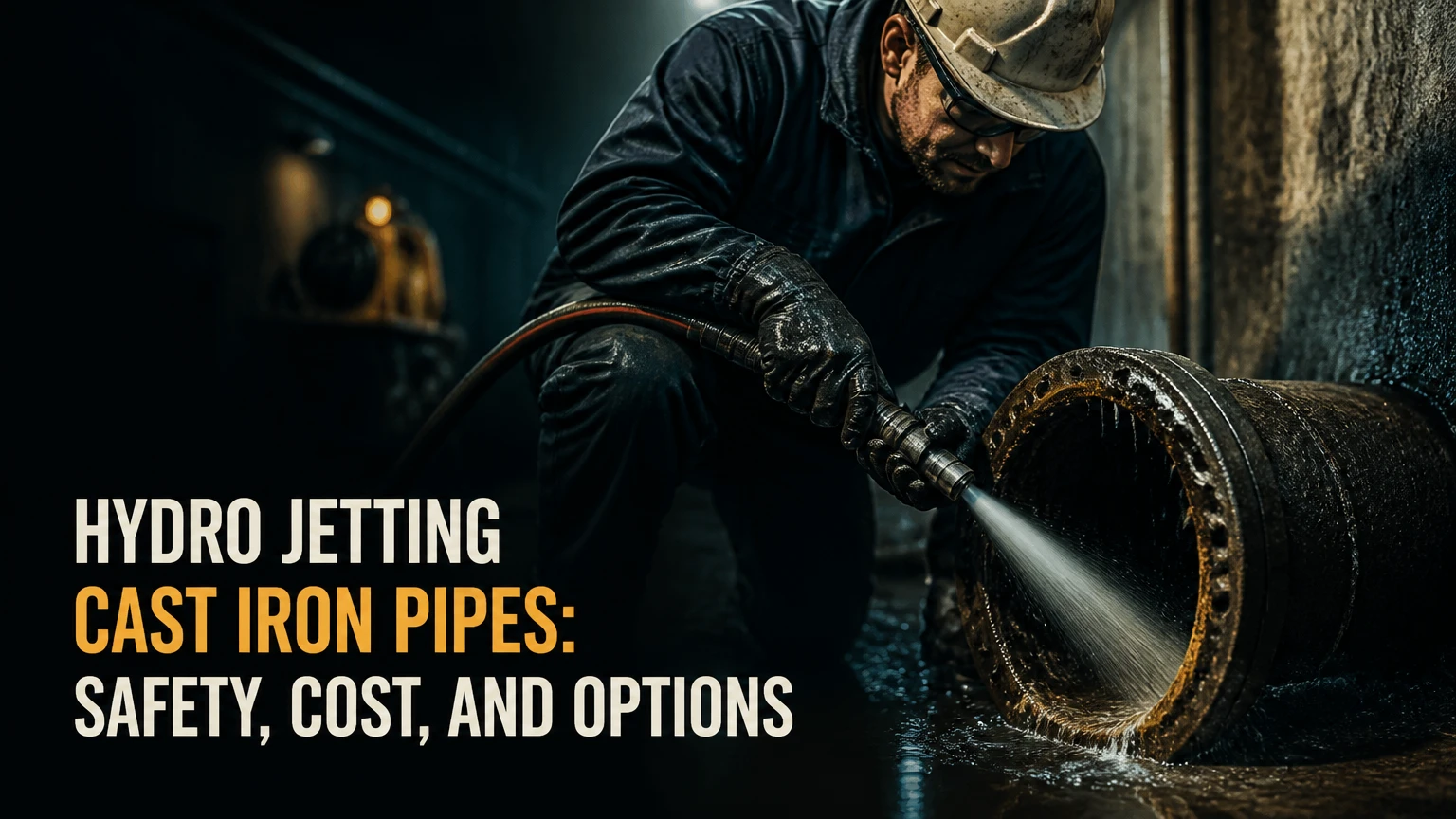
Hydro jetting cast iron pipes uses a high-pressure water pump, flexible hose, and engineered nozzle to remove grease, roots, sludge, and mineral scale from the pipe interior. The method can restore flow across much of the bore, but a camera inspection must confirm that the line still has enough wall strength to withstand controlled water pressure.
Key Facts at a Glance
- Hydro jetting cleans the pipe wall and carries loosened debris away; a drain snake usually creates a narrower passage through the blockage.
- Cast iron has no universal safe hydro-jetting PSI limit because wall thickness, corrosion, diameter, joints, and nozzle distance change the risk.
- A sewer camera inspection should precede jetting when the line is old, repeatedly blocked, root-affected, or structurally uncertain.
- Typical U.S. residential hydro-jetting costs range from $450-$1,200, with access, camera work, pipe length, and blockage severity driving the price.
- Hydro jetting removes deposits but does not repair corrosion, restore missing pipe wall, correct poor slope, or reconnect separated joints.
- Rotary descaling, mechanical milling, spot repair, cured-in-place lining, or full replacement may be better when cast iron has structural failure.
What Is Hydro Jetting Cast Iron Pipes?
Hydro jetting cast iron pipes is a drain-cleaning process that sends pressurized water through a nozzle inside a cast-iron building drain or sewer lateral. Forward-facing jets attack the obstruction, while angled rear jets push the hose through the line and propel loosened material toward an approved downstream access point.
The equipment normally includes a water tank, pump, pressure regulator, high-pressure hose, foot valve, hose reel, and interchangeable nozzle. Residential machines may operate from a compact cart, while larger sewer lines often require a trailer-mounted unit with a larger tank and higher sustained flow.
Hydro jetting is a cleaning method, not a structural repair. Water can remove tuberculation and grease from an intact pipe, but it cannot rebuild a corroded invert, seal a leaking hub, stabilize a sag, or replace a collapsed section. That distinction determines whether cleaning solves the problem or merely exposes the next repair.
How Does the Cleaning Process Work?
Hydro jetting removes deposits through a combination of impact, shear force, turbulence, and water volume. The nozzle operator advances the hose under controlled pressure, then retrieves it slowly so the rear spray pattern washes the circumference instead of leaving deposits on the upper or lower wall.
The forward jet is useful for opening a blocked path. Rear jets are angled backward, so they create thrust and flush material behind the nozzle. A rotating nozzle changes the spray pattern continuously, which helps clean a broad section of pipe without leaving a fixed jet aimed at one fragile location.
Flow rate matters as much as pressure. Pressure supplies impact at the orifice, while gallons per minute determine how effectively the system transports sludge and scale out of the line. A low-flow machine can cut a narrow channel through a blockage and still leave heavy debris inside the sewer.
Is Hydro Jetting Cast Iron Pipes Safe?
Hydro jetting cast iron pipes is generally appropriate when a camera shows a continuous, reasonably round pipe with adequate remaining wall and stable joints. Jetting becomes unsafe when the inspection shows a collapse, severe channeling, an open void, a large displaced joint, or corrosion so advanced that the nozzle could break through the wall.
Cast iron condition varies widely. A 60-year-old line with surface rust may tolerate controlled cleaning, while a 30-year-old line exposed to aggressive soil can have serious external or internal deterioration. Age is a screening clue, not a pressure specification.
No responsible technician should promise that a particular PSI is safe from the material name alone. The technician should evaluate the inspection, pipe diameter, nozzle type, hose position, water volume, access point, and cleaning objective before selecting operating parameters.
What Camera Findings Rule Out Jetting?
A technician should postpone or reject hydro jetting when the inspection shows structural defects that water pressure could worsen. The appropriate alternative may be snaking, excavation, spot repair, pipe lining, or replacement, depending on the defect and the line’s location.
| Camera finding | Immediate risk | More suitable next action |
|---|---|---|
| Fully collapsed section | Hose obstruction and soil washout | Excavation, spot repair, or replacement |
| Severe bottom channeling | Nozzle can leave the pipe path | Limited mechanical cleaning or rehabilitation |
| Open or separated joint | Water and debris can enter surrounding soil | Joint repair, excavation, or lining assessment |
| Large hole from corrosion | Jet can enlarge the defect | Structural repair before cleaning |
| Heavy roots with intact wall | Repeated blockage after cleaning | Root cutting, jetting, and root-management plan |
| Moderate tuberculation with sound profile | Reduced flow area | Controlled rotary descaling and post-camera review |
A camera image should be interpreted with the pipe’s location and consequences in mind. A small defect under a finished basement may justify a different repair sequence from the same defect in an accessible yard.
What Pressure and Flow Should Be Used?
There is no code-approved universal “cast-iron maximum” of 1,500, 2,000, or 2,500 PSI. Professional operating pressure is selected at the pump and at the nozzle, and those values differ because hose length, nozzle orifice, flow, friction, and trigger position affect actual cleaning force.
Typical residential sewer-jetting equipment may be rated around 3,000-4,000 PSI, but a technician can use substantially less pressure for an aged line. Many cast-iron cleaning jobs prioritize moderate pressure with adequate flow, rather than applying the machine’s maximum rating.
| Variable | Typical service range | Why it matters |
|---|---|---|
| Small interior branch line | 1,500-2,500 PSI | Lower diameter and more fragile fittings |
| Residential building sewer | 2,000-3,500 PSI | Depends on condition and obstruction |
| Water flow | 6-18 GPM | Carries loosened debris downstream |
| Small drain hose | 1/4-3/8 inch | Fits 2-3 inch lines and branch drains |
| Sewer hose | 3/8-1/2 inch | Supports longer runs and larger nozzles |
| Initial cleaning pass | Reduced pressure | Tests the pipe response before escalation |
These figures are typical field ranges, not universal prescriptions. Manufacturer nozzle charts and the technician’s inspection should control the setup. A contractor who gives a PSI number without discussing GPM, nozzle geometry, pipe condition, and camera findings is leaving out the variables that determine risk.
Equipment and Nozzles
Hydro-jetting equipment should match the pipe diameter, obstruction, access point, and cleaning distance. A compact electric unit may handle a 2-inch kitchen branch, but a long 6-inch sewer with roots usually needs a trailer-mounted machine, larger hose, higher water volume, and a recovery plan for removed material.
| Equipment or nozzle | Typical application | Cast-iron limitation | Typical line size |
|---|---|---|---|
| Compact cart jetter | Kitchen branches and short drains | Limited flushing distance | 2-3 inches |
| Trailer-mounted jetter | Long building sewers | Requires trained setup and access | 4-8 inches |
| Penetrator nozzle | Grease plug or compacted sludge | Can concentrate force at one point | 2-6 inches |
| Rotary nozzle | Broad scale and wall cleaning | Must keep moving in weak pipe | 3-8 inches |
| Root-cutting nozzle | Fine to moderate root intrusion | Mechanical action can expose defects | 4-8 inches |
| Flushing nozzle | Transporting loosened debris | Ineffective against hard scale alone | 4-12 inches |
A penetrator nozzle opens a route but is not automatically the right descaling tool. A rotary nozzle usually gives more uniform wall contact, while a root-cutting head is appropriate only after the technician confirms that the pipe can tolerate the cutting action.
Nozzle selection is a risk decision. The most aggressive head is not the most professional choice when corrosion has reduced the remaining wall.
The Professional Procedure
A careful cast-iron jetting service normally follows inspection, controlled cleaning, verification, and documentation. The total visit often takes 2-4 hours for a residential main line, although access problems, long runs, severe scale, and repeated passes can extend the appointment.
Step 1: Inspect the Line With a Camera
The technician should record the pipe from an accessible cleanout, not rely only on the symptom description. The inspection identifies the blockage location, internal diameter, roots, scale, channeling, joint displacement, standing water, and collapse.
Success checkpoint: The technician can explain whether the line is structurally suitable for cleaning.
Common mistake: Jetting immediately because a fixture is backing up, without distinguishing a blockage from a collapsed pipe.
Step 2: Establish Safe Access and Flow Control
The operator selects a cleanout or other access point that allows the hose to enter without damaging fixtures. Downstream access is valuable because loosened debris needs a route out of the system, and a vacuum truck or drain machine may be needed for large commercial deposits.
Success checkpoint: The hose path and discharge path are controlled before the pump starts.
Common mistake: Working from an unsuitable indoor opening and allowing sludge to return through a lower fixture.
Step 3: Select the Hose, Nozzle, and Initial Settings
The technician chooses a nozzle based on the obstruction rather than using one universal head. The first pass should establish how the pipe responds, with pressure and flow adjusted to the inspection and the line diameter.
Success checkpoint: The nozzle advances without violent binding, pipe movement, or uncontrolled backflow.
Common mistake: Using maximum pump pressure to compensate for an undersized nozzle or insufficient water volume.
Step 4: Clean the Pipe With Moving Passes
The hose is advanced and retrieved gradually, allowing the nozzle to scour deposits and carry them downstream. The operator should not leave a high-pressure nozzle stationary against one area of old cast iron, especially where the camera showed deep corrosion.
Success checkpoint: Flow improves and the return water contains less scale, grease, and debris on successive passes.
Common mistake: Stopping after the hose reaches the blockage, even though a small channel may remain while deposits still cover the pipe wall.
Step 5: Reinspect and Document the Result
A second camera inspection verifies the cleaning result and reveals defects hidden by scale. The recording should show the cleaned section, remaining deposits, roots, joints, and any structural problem that requires a separate repair.
Success checkpoint: The customer receives a clear explanation of what was removed and what remains.
Common mistake: Treating restored flow as proof that the pipe is healthy.
What Does Hydro Jetting Remove?
Hydro jetting is most effective against grease, sludge, soft deposits, loose rust scale, and many root intrusions in a structurally sound line. Hard mineral deposits, heavy tuberculation, concrete intrusion, and thick calcite may require rotary descaling or mechanical milling before water can fully clean the bore.
Roots, Grease, and Mineral Scale
Tree roots enter through joints, cracks, and failed seals. Jetting can cut and flush many roots, but it does not remove the tree or permanently seal the entry path. Recurrence depends on the joint condition, root growth, soil moisture, and the selected repair.
Grease is common in restaurant and multifamily drainage systems. Water jetting can remove a large grease mass more completely than a cable that drills through its center, but grease-management practices remain necessary. A kitchen that repeatedly discharges fats, oils, and grease will recreate the blockage.
Mineral scale often develops as rough, layered tuberculation inside aging cast iron. Rotary cleaning can improve the opening, but aggressive removal may reveal pinholes or thin wall sections. That result is not jetting damage in every case; the deposits may have been concealing pre-existing corrosion.
How Much Does Cast-Iron Hydro Jetting Cost?
Typical U.S. residential hydro jetting costs about $450-$1,200 for an accessible sewer or main drain, while complex work with two camera inspections, difficult access, severe roots, or extensive scale can exceed $1,500. Commercial work commonly starts around $1,000 and rises with pipe diameter, length, water supply, traffic control, and waste handling.
| Service situation | Typical price | Typical duration | Main cost driver |
|---|---|---|---|
| Short 2-3 inch branch | $350-$700 | 1-2 hours | Interior access and setup |
| Residential 4-6 inch sewer | $450-$1,200 | 2-4 hours | Camera work and pipe length |
| Root-heavy lateral | $700-$1,500 | 2-5 hours | Cutting passes and flushing |
| Restaurant grease line | $600-$1,800 | 2-6 hours | FOG volume and disposal |
| Commercial main sewer | $1,000-$4,000+ | 3-8 hours | Diameter, access, and equipment |
| Pre-lining cleaning | $800-$2,500+ | 3-8 hours | Descaling standard and documentation |
Prices vary substantially by region and emergency timing. A transparent quote should identify camera inspection, jetting, additional passes, access opening, water supply, cleanup, disposal, and post-service video as separate line items.
Hydro Jetting Versus Other Methods
Hydro jetting is the strongest general cleaning option for a sound pipe with deposits across the wall, but it is not the safest first choice for every cast-iron defect. Mechanical cables are less dependent on pipe strength, while milling and rehabilitation address situations that water alone cannot resolve.
| Method | Typical cost | Best use | Main limitation |
|---|---|---|---|
| Drain cable or snake | $150-$500 | Emergency opening and fragile lines | Leaves wall deposits behind |
| Hydro jetting | $450-$1,500 | Grease, sludge, roots, and broad scale | Requires structural screening |
| Chain flail or milling | $800-$2,500+ | Hard tuberculation and pre-lining cleaning | Aggressive against thin walls |
| Enzyme maintenance | $20-$100 monthly | Grease prevention support | Does not clear major blockages |
| Spot repair | $1,500-$6,000+ | Localized break or separated joint | Does not treat the entire line |
| Cured-in-place lining | $4,000-$15,000+ | Sound alignment with leaking walls | Requires cleaning and suitable geometry |
| Sewer replacement | $5,000-$30,000+ | Collapse or widespread failure | Highest disruption and cost |
A snake is often the prudent emergency tool when the camera cannot pass far enough to evaluate the pipe. Hydro jetting becomes more attractive after the operator confirms a continuous line and identifies deposits as the primary cause.
When Should Cleaning Precede Pipe Lining?
Hydro jetting or mechanical descaling commonly precedes pipe lining because liners need a clean, measurable host pipe. Roots, grease, loose tuberculation, and debris can prevent resin or an inner liner from bonding correctly or achieving the intended diameter.
Cleaning does not make every cast-iron sewer suitable for lining. A liner may require a continuous route, acceptable diameter, manageable bends, stable endpoints, and no obstruction that prevents installation. A qualified contractor should inspect before cleaning, clean to the proposed lining standard, and inspect again before installing the liner.
A pre-lining quote should state the cleaning method, the required cleanliness level, the post-cleaning video, lateral reinstatement, liner material, expected service conditions, and how the contractor handles a newly discovered collapse.
Common Risks and Failure Modes
The main hydro-jetting risk is not that water automatically destroys cast iron. The risk is applying force to a pipe whose corrosion, joints, or surrounding soil cannot withstand cleaning or the loss of deposits that were masking defects.
- Jetting a collapsed line: The hose cannot safely pass, and water may enter soil through the failure. Stop and repair the defective section.
- Using maximum pressure by default: High pump ratings do not prove that the nozzle setup is appropriate. Start conservatively and increase only when inspection supports it.
- Leaving the nozzle stationary: A fixed spray can concentrate force on one weakened area. Keep the head moving.
- Ignoring downstream debris: Removed scale can settle in a branch or lower fixture. Maintain a discharge path and remove accumulated solids.
- Confusing improved flow with restored structure: A clean pipe can still have thin walls, leaks, and failing joints. Use the post-camera footage to plan the next decision.
- Skipping root-entry treatment: Cutting roots without addressing the failed joint often produces another blockage within months or seasons.
A hose that binds should not be forced under pressure. The operator should stop the pump, relieve pressure, locate the nozzle with a camera if possible, and withdraw it carefully rather than twisting aggressively against a damaged section.
How Often Should Cast Iron Be Jetted?
A reasonable maintenance interval is condition-based, not a fixed one-to-three-year rule. Commercial kitchens with recurring FOG problems may need cleaning every 6-12 months, while a residential sewer with sound walls and no recurring deposits may require service only after symptoms or a documented inspection.
| Property condition | Starting interval | Better maintenance control |
|---|---|---|
| Restaurant kitchen sewer | 6-12 months | Grease interceptor and FOG practices |
| Multifamily cast-iron main | 12-24 months | Flow monitoring and recorded inspections |
| Historic residence with scale | 24-60 months | Camera comparison after symptoms |
| Root-affected lateral | 6-18 months | Root entry repair or rehabilitation |
| Sound, low-use residential line | As needed | Avoid unnecessary aggressive cleaning |
| Pre-lining project | One preparation event | Post-cleaning camera acceptance |
Routine jetting cannot compensate for a broken pipe, failed slope, or recurring root entry. If the same section blocks after two cleanings, investigate repair or rehabilitation rather than shortening the interval indefinitely.
Which Alternative Is Better for a Weak Pipe?
A cable machine is usually the safer immediate option when cast iron is structurally weak and the urgent goal is to restore limited flow without broad wall cleaning. Mechanical milling can remove hard scale when the pipe is strong enough, while lining or replacement is necessary when the underlying failure is structural.
For Homeowners in Older Properties
Ask for the camera recording, defect location, pipe diameter, recommended nozzle, proposed pressure range, flow rate, and post-cleaning inspection. Reject a quote that promises a “safe PSI” without explaining how the technician assessed wall condition.
A historic home may have cast iron under floors, in walls, or beneath a slab. Cleaning can be worthwhile when the pipe is intact, but a contractor should explain the consequence if scale removal exposes pinholes and whether emergency repair access is available.
For Restaurants and Commercial Facilities
Commercial operators should combine jetting with grease control, accessible cleanouts, documented flow checks, and scheduling outside peak service hours. A 6-12 month maintenance plan may be sensible for recurring FOG, but the interval should follow blockage history and inspection evidence.
The facility should also confirm who supplies water, who handles wastewater, whether a vacuum truck is required, and how the contractor protects food-service areas from contaminated splash and runoff.
For Plumbing and Drain Professionals
The practical rule is to match nozzle aggressiveness to the defect, not to the pump’s maximum rating. Record the inspection, use controlled passes, prevent debris migration, and give the customer a structural interpretation rather than a simple “line cleared” statement.
How Should You Choose a Contractor?
Choose a contractor who treats hydro jetting as an inspected cleaning operation rather than a pressure contest. The minimum service package for questionable cast iron should include a pre-service camera, written scope, controlled equipment selection, cleanup, and a post-service video.
Verify these items before authorizing work:
- Does the price include both camera inspections?
- Will the contractor provide the video files?
- What defects would cause the technician to stop?
- What pressure and flow range will be used, and why?
- Is the nozzle appropriate for grease, roots, or scale?
- How will loosened debris be prevented from backing into fixtures?
- What repair options follow if the camera shows channeling or pinholes?
- Is emergency access available if the pipe fails during cleaning?
Two itemized estimates are more useful than comparing a single low headline price. The cheapest quote may omit inspection, additional passes, disposal, or the documentation needed to decide whether rehabilitation is warranted.
FAQ
Can hydro jetting remove rust from cast iron?
Hydro jetting can remove loose rust, sludge, and some tuberculation from cast iron, especially with a rotary nozzle and sufficient flushing volume. It cannot restore metal lost to corrosion. If cleaning reveals pinholes, channeling, or a thin invert, the next step is structural repair, lining assessment, or replacement.
Will hydro jetting stop tree roots permanently?
No. Hydro jetting can cut and flush roots, but roots usually entered through a crack, failed joint, or missing seal. The blockage is likely to recur unless the entry point is repaired, lined, replaced, or managed with an appropriate root-control program approved for the site.
Can I hydro jet a cast-iron toilet drain myself?
DIY jetting is generally unsuitable for a cast-iron toilet drain because household access is limited, hose control is difficult, and contaminated water can return through fixtures. A professional can identify whether the obstruction is in the branch, building drain, or sewer lateral before selecting a cleaning method.
Does hydro jetting make an old pipe more likely to leak?
Hydro jetting does not automatically create leaks, but cleaning can expose pre-existing corrosion and remove deposits that were temporarily covering weak areas. A camera inspection before and after service distinguishes newly observed structural defects from deposits that previously obscured them.
Is pipe lining better than hydro jetting for cast iron?
Pipe lining is better when the cast-iron line has widespread leakage or corrosion but still has a continuous, properly aligned route. Hydro jetting is better for cleaning deposits in a structurally sound line. Lining normally requires cleaning and inspection first, so the options are often sequential rather than mutually exclusive.
What should happen if the pipe blocks again after jetting?
A repeat blockage within a short period warrants a second camera inspection, not automatically another high-pressure cleaning. The inspection should look for roots, a belly, joint displacement, remaining scale, a downstream obstruction, or a structural defect that cleaning cannot correct.
The Bottom Line
Hydro jetting cast iron pipes is an effective way to remove wall deposits, grease, sludge, and many roots when the line remains structurally sound. The safest decision comes from a camera-first assessment, controlled pressure and flow, an appropriate nozzle, and a documented post-cleaning inspection. Hydro jetting cleans cast iron; it does not rebuild it.