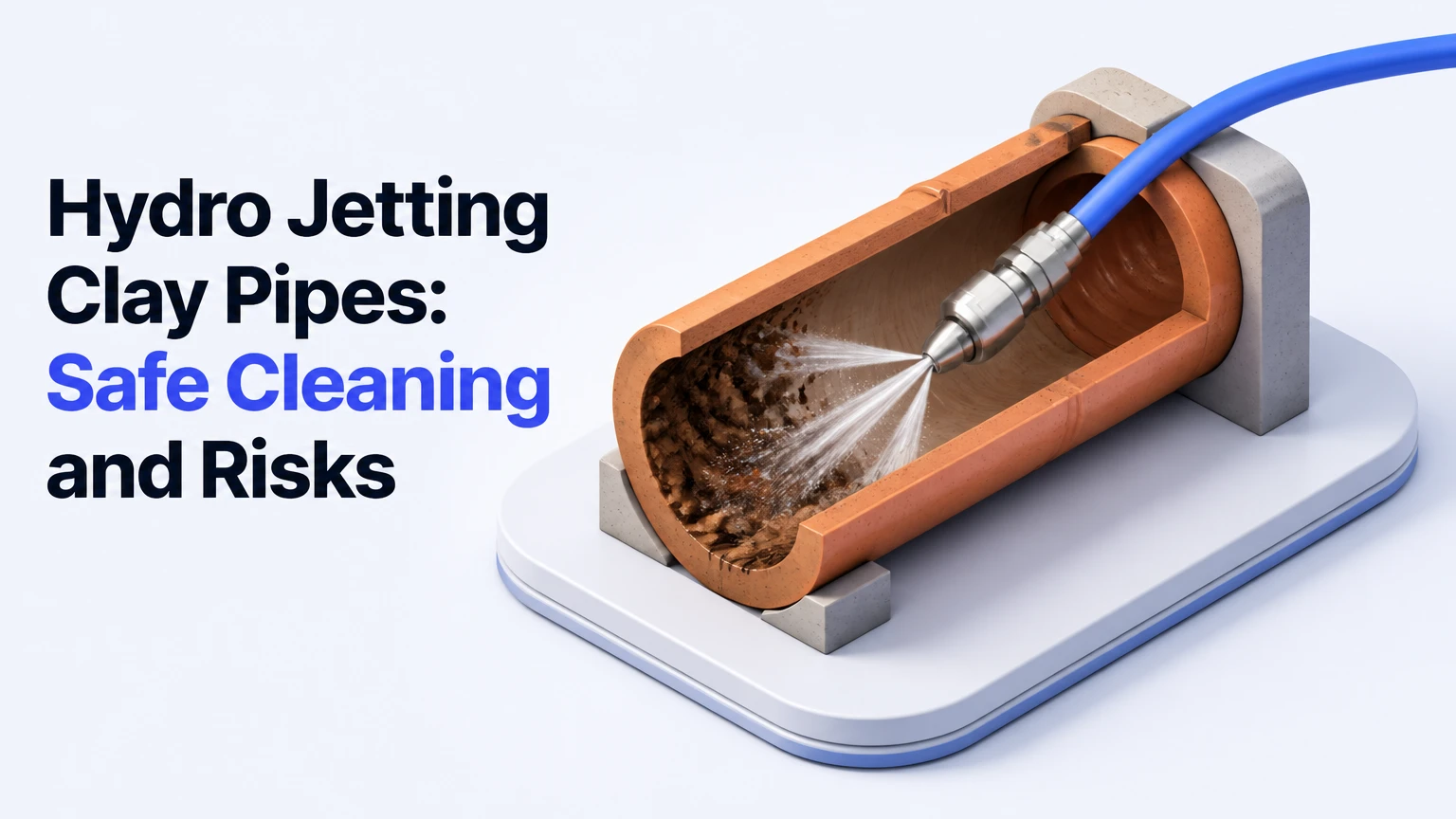
Hydro jetting clay pipes uses a high-pressure water jet to remove roots, grease, mineral deposits, sand, and sludge from a clay sewer line without excavating the ground. The method can restore the pipe’s internal passage, but it should follow a camera inspection because water jetting cleans a structurally sound pipe; it does not repair cracks, open joints, collapses, or severe deformation.
Key facts at a glance
A sewer camera should determine whether a clay pipe can safely accept water jetting.
Flow rate, nozzle design, operator control, and pipe condition matter as much as pressure.
Typical residential work uses approximately 4-12 gallons per minute, but equipment settings vary by line size and defect.
Hydro jetting removes roots temporarily unless the root entry point is repaired or managed afterward.
A standard residential service commonly takes 1.5-3 hours and costs roughly $350-$900 in many U.S. markets.
Jetting cannot restore missing pipe sections or stabilize a fractured, collapsed, or badly offset clay sewer.
What Is Hydro Jetting Clay Pipes?
Hydro jetting clay pipes is a drain-cleaning procedure that sends pressurized water through a flexible hose and specialized nozzle inside a vitrified clay sewer. Forward jets penetrate or loosen an obstruction, while angled rear jets propel the hose and wash material toward an access point. The result is a cleaned pipe bore rather than a narrow hole through a clog.
Clay, terracotta, and vitrified clay sewer sections often have bell-and-spigot joints. Older installations may also contain mortar deterioration, root-filled joints, offsets, or sections that have settled. These conditions create entry points for roots and places where sediment accumulates.
Hydro jetting is therefore a cleaning method, not a structural repair. If a camera finds a collapsed segment, extensive cracking, a large void, or a displaced joint, cleaning may expose the defect but will not make the line watertight or mechanically stable.
Why Do Clay Sewer Lines Develop Blockages?
Tree roots commonly enter clay sewer lines through joints, service connections, and small fractures. Roots follow moisture and nutrients outside the pipe, then expand inside the joint as the root mass traps toilet paper, grease, and soil.
| Blockage condition | Typical location | What jetting can do | What it cannot do |
|---|---|---|---|
| Fine root hairs | Bell-and-spigot joint | Wash and cut roots from the bore | Permanently seal the joint |
| Dense root ball | Joint or crack | Break apart and flush the mass | Remove the tree or close the entry path |
| Grease and sludge | Low-slope section | Strip deposits from the wall | Correct inadequate pipe fall |
| Sand and soil | Open or failed joint | Flush loose material | Stop soil entering through the defect |
| Collapsed clay | Any point | Usually cannot pass the obstruction safely | Rebuild the missing pipe |
How Does Hydro Jetting Work Inside Clay Pipe?
A jetter pump sends water through a hose at a selected pressure and flow rate. The nozzle converts that water into directed streams, and the operator controls hose speed, pressure, water volume, and retrieval force to clean the pipe without forcing equipment through a structural defect.
Pressure is measured in pounds per square inch, or PSI. Flow is measured in gallons per minute, or GPM. PSI helps the stream penetrate deposits, while GPM supplies the water volume needed to carry loosened debris out of the line. A high-PSI machine with insufficient flow may punch through a blockage without transporting the waste away.
The nozzle’s rear-facing jets create thrust and scour the pipe wall. Forward-facing jets are useful for opening a blocked passage, although a nozzle with aggressive forward jets can be inappropriate near a fragile joint or fractured clay section.
What Happens During a Professional Cleaning?
A professional hydro jetting visit normally follows an inspection, access, equipment-selection, cleaning, and verification sequence. A straightforward residential line often takes 1.5-3 hours, although blocked access, long runs, multiple branches, and difficult waste handling increase the duration.
- Inspect the sewer with a camera. The technician identifies roots, grease, offsets, cracks, collapses, and the pipe’s approximate diameter and condition.
- Locate a suitable access point. The preferred entry is a cleanout that provides a reasonably direct route to the affected section. A technician may use a toilet opening when no cleanout exists, but that adds preparation and restoration work.
- Select the hose and nozzle. A flushing nozzle may suit sludge; a rotating root-cutting nozzle may suit established roots; a controlled penetrator may open a compact blockage.
- Protect the work area. The crew should control splash, manage sewage discharge, and confirm where loosened material will travel.
- Advance the hose carefully. The operator begins at a controlled setting and increases cleaning force only when the inspection and pipe response justify it.
- Work through the obstruction. The hose may be advanced and retracted several times. Pullback is often where wall deposits and root fragments receive the most scouring.
- Flush and monitor the line. Fixtures may be tested while the operator confirms that water drains and debris exits without backing into the building.
- Perform a post-cleaning camera inspection. The video documents remaining roots, defects, open joints, and whether the hose reached the intended section.
The popular instruction to “always jet upstream” is too broad. The correct direction depends on access, pipe layout, downstream capacity, blockage location, and where debris can be safely evacuated. A qualified operator chooses a direction that prevents a loosened root mass from being pushed into a narrower or inaccessible section.
Which Equipment and Nozzle Fit Clay Sewer Lines?
Equipment should match the pipe diameter, access route, obstruction, and structural condition. Trailer-mounted machines provide greater water capacity for long or heavily obstructed lines, while compact cart jetters can handle many short residential branches when the operator uses appropriate flow and nozzle size.
| Equipment type | Typical working range | Typical use | Main limitation |
|---|---|---|---|
| Compact electric jetter | 1,500-2,500 PSI, 2-5 GPM | Short branch drains and light deposits | Limited root-cutting and hose reach |
| Portable gas jetter | 2,000-3,000 PSI, 4-8 GPM | Residential sewer laterals | Lower sustained flow than commercial units |
| Trailer-mounted jetter | 2,000-4,000 PSI, 18-25 GPM | Long runs and severe root masses | Requires skilled setup and substantial water handling |
| Combination sewer cleaner | 2,000-4,000 PSI, 20-80 GPM vacuum support | Commercial lines and heavy debris | Higher cost, access, and discharge requirements |
The figures are typical equipment ranges, not universal clay-pipe settings. Manufacturer nozzle charts, local regulations, pipe diameter, and inspection findings should control the final setup.
| Nozzle type | Best application | Clay-pipe consideration | Typical pass |
|---|---|---|---|
| Rear-jet flushing nozzle | Sludge, sand, loose debris | Lower forward aggression | One or more controlled pullbacks |
| Penetrating nozzle | Compact soft blockage | Avoid forcing it into a collapse | Short opening pass |
| Rotating root nozzle | Fibrous root intrusion | Use only after structural review | Several slow passes |
| Chain flail nozzle | Heavy scale in suitable pipe | Higher risk at defects and offsets | Specialist use |
| Descaling nozzle | Mineral or hard deposits | Requires careful pressure control | Slow wall-cleaning pass |
A rotating root nozzle cuts the roots in the pipe bore. It does not kill the tree, remove the root outside the pipe, or close a failed joint. Chemical root inhibitors may extend the interval between blockages in some systems, but products such as RootX must be used according to their label and local wastewater rules.
What Pressure Is Safe for Clay Pipes?
There is no single safe PSI range for every clay sewer. A commonly encountered residential operating range is approximately 2,000-3,500 PSI with 4-12 GPM, but a sound, larger vitrified clay line and a fragile, cracked terracotta line should not receive the same settings.
The pressure displayed at the pump is not necessarily the pressure reaching the pipe wall. Hose length, nozzle orifice, friction, bends, and flow change the delivered force. A technician should use the lowest effective setting, select the nozzle by inspection evidence, and avoid using a high-pressure penetrator as a substitute for diagnosis.
The often-repeated claim that pressure above 4,000 PSI automatically shatters clay is not a reliable engineering rule. Damage depends on nozzle proximity, jet concentration, dwell time, pipe condition, joint condition, and equipment configuration. The practical rule is more useful: never choose a setting by PSI alone, and never jet a structurally questionable line without a documented risk decision.
Is Hydro Jetting Clay Pipes Safe?
Hydro jetting clay pipes is generally appropriate when a camera shows a continuous, adequately aligned, structurally stable line with a blockage that water can remove. It is unsafe or poorly advised when the camera shows a collapse, major fracture, severe offset, missing pipe, or a nozzle route that cannot be controlled.
Conditions That Require Repair Before Jetting
A sewer camera should trigger a repair discussion before aggressive cleaning when it shows:
- A collapsed or heavily deformed pipe that restricts hose passage.
- A large longitudinal crack or multiple broken sections.
- A joint offset that catches the hose or nozzle.
- Soil entering through an open joint.
- A void beneath the pipe, which may indicate erosion or bedding failure.
- A back-pitched section that repeatedly holds water and sediment.
- A line that cannot be accessed without risking fixture damage.
In these cases, a mechanical auger may also be inappropriate. Alternatives include spot excavation, pipe bursting, cured-in-place lining, or full lateral replacement, depending on diameter, access, municipal requirements, and the number of structural defects.
What Are the Benefits and Limitations?
Hydro jetting cleans more of the pipe circumference than a cable auger and usually leaves fewer deposits behind. The method avoids routine trench excavation, which can preserve paving, landscaping, floors, and mature trees.
The limitation is important: a clean pipe can still be a failing pipe. A post-jetting camera may reveal that the root blockage was only a symptom of an open joint or broken lateral. Recurring roots do not prove that the cleaning failed; they often prove that the entry route remains open.
| Decision factor | Hydro jetting | Cable snaking | Repair or replacement |
|---|---|---|---|
| Primary action | Washes and scours the bore | Opens a narrow path | Restores structural continuity |
| Root treatment | Cuts and flushes roots | Cuts or tears a channel | Removes or bypasses defect |
| Grease removal | Removes wall deposits | Often leaves deposits | Unnecessary unless cleaning precedes work |
| Structural benefit | None | None | Repairs or replaces pipe |
| Typical access | Cleanout or fixture opening | Cleanout or fixture opening | Excavation or trenchless equipment |
| Best use | Sound pipe with recurring deposits | Fast temporary opening | Broken, collapsed, or badly offset pipe |
Cable snaking can be the sensible first response when a line is blocked and its condition is unknown, particularly if the goal is to restore flow immediately before arranging a camera inspection. Jetting is usually better for a line that has repeated grease or root blockages and has already been shown to be structurally serviceable.
How Much Does Hydro Jetting Clay Pipes Cost?
Typical residential hydro jetting costs approximately $350-$900, while difficult root clearing, long runs, emergency scheduling, or poor access can raise the total to $1,200 or more. Local labor rates, camera inspection fees, water access, waste handling, and the number of sewer segments affect the invoice more than the clay material alone.
| Service situation | Typical price range | Typical duration | Common inclusions |
|---|---|---|---|
| Short branch line | $250-$500 | 1-2 hours | Basic jetting and fixture test |
| Main residential lateral | $350-$900 | 1.5-3 hours | Camera, jetting, cleanup |
| Severe root intrusion | $600-$1,200+ | 2-4 hours | Multiple passes and verification |
| Commercial or long lateral | $1,000-$3,000+ | 3-8 hours | Larger jetter, traffic or waste controls |
These are planning ranges, not guaranteed quotes. A written estimate should state whether the pre-cleaning camera, post-cleaning camera, cleanout access, root treatment, and any additional footage are included.
Hydro jetting is not automatically cheaper than replacement. It is cheaper when the pipe is sound and cleaning restores service. If roots return because of an open joint, repeated cleanings can cost more than a targeted repair over several years.
When Should a Property Owner Choose Jetting?
A property owner should consider hydro jetting when a camera confirms a serviceable clay line and the symptoms point to deposits or root intrusion rather than structural failure. Recurring slow drainage, repeated cable cleaning, gurgling fixtures, and backups near mature trees are common reasons to investigate.
Match the Treatment to the Situation
- One isolated soft clog: A cable auger may restore flow at lower cost.
- Recurring grease buildup: Hydro jetting offers better wall cleaning than an auger.
- Roots in an intact joint: Jetting can reopen the bore, followed by root management or repair planning.
- Roots with an open joint: Jetting is temporary unless the joint is repaired or lined.
- Collapsed clay: Do not treat jetting as a repair; obtain a replacement or trenchless assessment.
- Sewage backup indoors: Stop using fixtures, isolate exposure, and arrange professional emergency service.
A maintenance interval of 2-3 years may suit some commercial properties with mature trees and documented recurring roots, but it should not be imposed universally. Residential owners should base frequency on camera findings, blockage history, tree proximity, and the time between prior failures.
What Problems Can Occur During Jetting?
The most serious hydro jetting failures occur when operators treat a structural sewer problem as a cleaning problem. A nozzle can become trapped at an offset, wash soil through a failed joint, push debris into a downstream restriction, or expose a defect that later requires excavation.
| Failure mode | Likely cause | Immediate response | Long-term correction |
|---|---|---|---|
| Water backs up indoors | Debris exceeds downstream capacity | Stop advancing and control fixtures | Flush in stages and inspect |
| Nozzle stops moving | Offset, collapse, or root mass | Do not force the hose | Locate resistance with camera |
| Roots return quickly | Open joint or crack remains | Reinspect the entry point | Repair, line, or manage roots |
| Sand enters the line | Failed joint or pipe wall | Reduce agitation | Repair the defective section |
| Pipe leaks after cleaning | Pre-existing fracture exposed | Document condition | Spot repair or replacement |
| Sewer remains slow | Back pitch, collapse, or branch issue | Test each segment | Correct structural or layout fault |
Two practitioner rules prevent many expensive outcomes. First, a stuck nozzle is a diagnostic event, not a strength contest. Second, a clean post-jetting video is more valuable than a verbal claim that the line is “clear,” because the recording identifies both the result and the remaining liability.
Can Homeowners Hydro Jet Clay Pipes?
Homeowners should not use a rented commercial jetter on an uninspected clay sewer. The combination of concentrated water, uncertain pipe condition, sewage exposure, hose recoil, electrical hazards, and inaccessible blockages makes professional inspection and operation the safer choice.
A homeowner can gather useful information before calling a contractor:
- Record which fixtures back up and whether the problem affects the whole building.
- Check whether a sewer cleanout exists and whether it is accessible.
- Note nearby mature trees and prior root-cleaning dates.
- Ask for a camera inspection before authorizing aggressive cleaning.
- Request before-and-after video, the nozzle type, approximate operating range, and a written warranty.
- Confirm who pays if the hose becomes lodged or the camera reveals a pre-existing collapse.
A warranty should specify what is covered. “Clear drain” may mean only restored flow, while a stronger service agreement may document the cleaned footage, excluded structural defects, and a defined callback period.
What Alternatives Exist If Jetting Is Unsuitable?
If clay pipe inspection finds structural damage, alternatives include spot repair, trenchless lining, pipe bursting, or open-cut replacement. The correct option depends on the defect pattern, pipe diameter, property constraints, municipal approval, and whether the existing alignment can support a liner or replacement method.
| Alternative | Suitable defect | Typical project profile | Main trade-off |
|---|---|---|---|
| Spot excavation | One or two localized failed joints | 1-2 days for accessible areas | Disturbs soil, paving, or landscaping |
| Cured-in-place lining | Multiple cracks with usable alignment | Often 1 day after preparation | Needs sound enough host pipe |
| Pipe bursting | Replacement route with adequate access | 1-3 days, site-dependent | Requires launch and receiving pits |
| Open-cut replacement | Collapse, void, severe deformation | 1-5 days, site-dependent | Highest surface disruption |
| Root management only | Early recurring roots in sound pipe | Periodic treatment | Does not repair an open joint |
Jetting is often used before cured-in-place lining because grease, roots, and deposits must be removed for proper inspection and preparation. Cleaning before lining does not mean the existing pipe is acceptable; the contractor still needs to verify dimensions, bends, connections, and structural suitability.
How Should You Compare Contractor Proposals?
Compare proposals by scope and evidence, not by PSI or the lowest advertised price. A credible quote identifies the inspected footage, access point, nozzle approach, water and waste handling, camera documentation, exclusions, and the action recommended if a structural defect appears.
Ask these questions before approving work:
- Is the sewer camera inspection included before jetting?
- Will the contractor provide the complete post-cleaning video?
- What pipe diameter, length, and access point are expected?
- Which nozzle is proposed for roots, grease, or scale?
- What happens if the hose meets a collapse or offset?
- Is water supplied by the property or by the service vehicle?
- How will sewage and contaminated water be contained?
- Is chemical root treatment optional, labeled, and legally permitted?
- Does the warranty cover recurring blockage, workmanship, or only the visit?
- Are repair recommendations based on a measured defect location?
A contractor who promises that jetting will last five or ten years without inspecting the root entry point is overstating certainty. Cleaning longevity varies with pipe condition, tree growth, grease loading, slope, and downstream capacity.
Hydro Jetting Clay Pipes: The Bottom Line
Hydro jetting clay pipes is an effective cleaning method for structurally stable clay sewer lines affected by roots, grease, scale, sludge, or sediment. The safest decision starts with a camera inspection, uses a nozzle and flow rate suited to the defect, and ends with video verification rather than relying on restored flow alone.
Jetting is not the right answer for a collapsed, badly cracked, severely offset, or soil-filled pipe. In those cases, cleaning may provide temporary flow or reveal the failure, but repair, lining, or replacement addresses the underlying cause.
Frequently Asked Questions
Will hydro jetting remove all tree roots from a clay pipe?
Hydro jetting can remove roots occupying the pipe’s internal passage, but it cannot permanently stop roots entering through a failed joint or crack. Root growth may return within months or years depending on moisture, tree species, joint condition, and climate. A post-cleaning camera identifies whether the entry point needs repair, lining, or permitted root-management treatment.
How long does hydro jetting remain effective in a clay sewer?
There is no guaranteed service interval. A line with light grease may remain open for several years, while a clay lateral with an open root-filled joint may block again within months. Maintenance planning should use the previous blockage interval, camera evidence, tree proximity, and pipe condition rather than a fixed five-to-ten-year promise.
Does jetting damage old terracotta sewer pipe?
Jetting can damage old terracotta when the pipe is already fractured, displaced, undermined, or collapsed, especially if the operator uses an aggressive nozzle or forces it through resistance. Sound vitrified clay can often be cleaned safely under controlled settings. Inspection, nozzle selection, delivered flow, and operator control determine risk more reliably than pipe age alone.
Should a camera inspection happen after every cleaning?
A post-cleaning camera is strongly advisable when roots, clay joints, structural defects, or a valuable property are involved. The recording confirms the cleaned section, shows remaining damage, and helps locate repairs. A brief fixture test may be sufficient for a simple branch blockage, but it cannot provide the same structural information.
Is chemical root treatment required after hydro jetting?
Chemical root treatment is not automatically required after hydro jetting. Jetting removes roots from the bore, while a labeled root inhibitor may slow regrowth in some situations. Treatment should follow the product label, local wastewater rules, and the contractor’s assessment, and it should not replace repair of an open joint or cracked pipe.
What should happen if a hydro jet nozzle gets stuck?
The operator should stop pulling or increasing pressure when a nozzle becomes stuck. The obstruction may be a collapse, offset joint, root mass, or damaged section. A locating camera or sonde can identify the resistance point, after which the contractor can choose controlled retrieval, excavation, or another repair method without worsening the pipe failure.