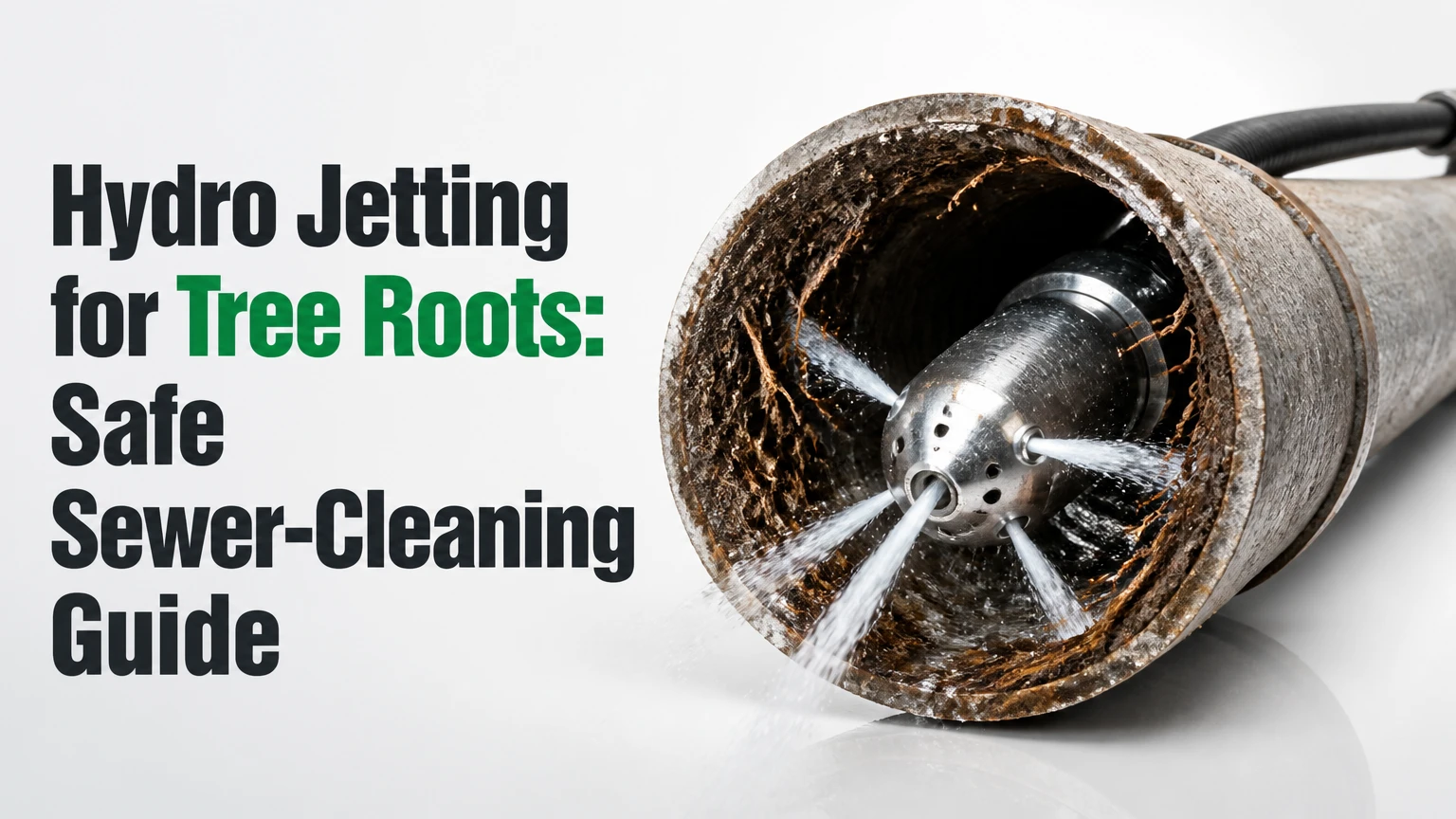
Hydro jetting for tree roots uses a high-pressure water jetter and a purpose-selected nozzle to cut, scour, and flush root growth from a sewer pipe. It can restore much of the pipe’s internal diameter, but it cannot repair cracked, displaced, or collapsed pipe sections where roots entered, so camera inspection must guide the service.
Key Facts at a Glance
Professional sewer jetting commonly uses roughly 1,500-4,000 PSI and 4-18 GPM, depending on the pipe, nozzle, and blockage.
A camera inspection should occur before jetting when the line is old, repeatedly blocked, inaccessible, or suspected to be damaged.
Hydro jetting removes existing roots but does not permanently prevent regrowth through an open joint or cracked pipe.
Typical residential root-clearing service costs about $350-$600, while difficult access, severe blockage, or emergency work can push the total above $1,000.
A sewer camera, cleanout access, controlled nozzle selection, and post-service verification are more important than choosing the highest available PSI.
A collapsed or badly displaced line requires repair or replacement, not repeated high-pressure cleaning.
What Is Hydro Jetting for Tree Roots?
Hydro jetting for tree roots is a sewer-cleaning procedure that sends pressurized water through a flexible hose into a private drain or sewer lateral. A nozzle directs water forward to cut the obstruction and backward to propel the hose while washing loosened roots toward an approved downstream access point.
Unlike a drain auger, which generally creates a passage through the center of a blockage, a correctly selected jetting nozzle cleans the pipe circumference. That distinction matters because fine roots often remain attached to joints after a cable machine opens only a small channel.
Hydro jetting is a cleaning treatment, not a structural repair. Roots usually enter through failed mortar joints, cracked clay, separated connections, corrosion holes, or defective transitions. Unless the entry point is lined, repaired, or replaced, new roots can eventually follow the same path.
The safest decision sequence is simple: identify the blockage, inspect the pipe, choose pressure and flow for the actual material, jet from a suitable access point, then verify the result. A contractor who proposes maximum pressure before examining the line is using the wrong selection criterion.
How Does the Root-Cutting Process Work?
A sewer jetter combines a water tank or supply connection, pump, pressure hose, control valve, and nozzle. The pump supplies both pressure and volume, while the nozzle converts that water into directed streams that cut roots and move debris through the line.
Pressure describes the force available at the pump or nozzle. Gallons per minute determine how effectively the system carries cut material away. A 4,000-PSI machine with insufficient flow may cut a channel but leave a heavy root mass inside the pipe, whereas adequate flow can transport loosened debris to the cleanout.
The operator normally works from a downstream cleanout toward the house or upstream blockage. Rear-facing jets pull the hose forward and scour the pipe wall; forward jets break apart the obstruction. The operator then retracts the hose gradually so the rear jets wash the circumference rather than merely making another narrow hole.
What happens during a professional service?
A competent root-clearing visit usually follows these stages:
- Confirm access and blockage location. The technician identifies the private sewer cleanout, checks fixture behavior, and determines whether sewage is backing up.
- Inspect with a camera. CCTV shows root density, pipe material, standing water, offsets, cracks, bellies, and collapse risk. If the camera cannot pass, the contractor should explain why before applying aggressive equipment.
- Select the nozzle. A rotating nozzle suits wall-scale residue and fine roots; a root saw or cutting nozzle may be needed for dense, woody growth.
- Set a controlled operating range. The technician matches pressure, flow, hose size, and nozzle to the pipe’s condition instead of copying a maximum machine rating.
- Jet in controlled passes. The hose advances and retracts slowly. Rapid withdrawal can leave root fibers attached to joints.
- Manage the debris. The contractor confirms that loosened material can travel downstream and does not create a second blockage.
- Inspect after cleaning. A second camera pass verifies the cleaned section and records defects that remain.
The Water Jetting Association’s safety guidance treats jetting as specialist work requiring operator training, protective equipment, exclusion zones, and control of the hose and nozzle. That principle applies directly to residential sewer lines because the nozzle can recoil violently if it exits the pipe or encounters a sudden obstruction.
Which Pressure and Flow Are Appropriate?
Typical residential sewer jetting falls between 1,500 and 4,000 PSI, with approximately 4-18 GPM, but the correct setting depends on pipe material, diameter, length, nozzle design, and structural condition. The machine’s advertised maximum is not a safe universal operating setting.
| Application | Typical pressure | Typical flow | Suitable use |
|---|---|---|---|
| Interior branch drain | 1,000-2,500 PSI | 2-5 GPM | Small lines, grease, light root hairs |
| Residential sewer lateral | 2,000-3,500 PSI | 6-12 GPM | Four- to six-inch private sewer lines |
| Dense root mass | 2,500-4,000 PSI | 8-18 GPM | Thick roots in sound pipe |
| Fragile or uncertain line | 1,000-2,500 PSI | 4-10 GPM | Controlled cleaning after inspection |
| Large commercial line | 3,000-4,000 PSI | 12-25+ GPM | Larger diameters and long transport distances |
These figures are typical field ranges, not engineering specifications. A nozzle may reduce pressure at the outlet, and a long hose can reduce effective performance. Pipe diameter also changes the result: a nozzle that cleans a six-inch lateral may be poorly suited to a two-inch branch.
A practical rule is to increase cleaning effectiveness through nozzle design and controlled passes before increasing pressure. High pressure can damage a defective line, while low flow can leave cut roots downstream.
What Equipment Removes Roots Most Effectively?
Root removal depends on the nozzle’s cutting pattern and the technician’s ability to control its movement. Nozzle choice should follow the root structure shown by the camera, not a standard attachment used on every call.
| Nozzle type | Primary action | Typical application | Main limitation |
|---|---|---|---|
| Rotating nozzle | Spins rear jets around the wall | Fine roots and general wall cleaning | May struggle with thick woody trunks |
| Root cutter or saw nozzle | Concentrates cutting streams | Dense, established root masses | Higher risk in damaged pipe |
| Penetrating nozzle | Uses forward jets to open a path | Initial access through soft blockage | Does not always scour the full wall |
| Flushing nozzle | Emphasizes rearward transport | Removing loose fragments and sediment | Poor choice for hardened root bundles |
| Chain flail attachment | Mechanically scrapes the interior | Select commercial or robust-pipe work | Can damage liners and weak pipe |
Rotating nozzles are often appropriate after a penetrating pass creates room for the hose. A saw-style attachment may be necessary when roots have formed a dense mat, but aggressive cutting tools should not be used across a camera-identified collapse, open void, or severely offset joint.
Can Hydro Jetting Damage a Sewer Line?
Hydro jetting can damage a sewer line that is already fractured, collapsed, badly offset, heavily corroded, or unsupported by surrounding soil. The water pressure is not usually the original cause of failure, but jetting can expose or worsen a defect that a camera inspection would have identified beforehand.
| Pipe condition | Jetting decision | Main risk | Preferred next action |
|---|---|---|---|
| Sound PVC with minor roots | Usually suitable | Limited joint or fitting damage | Controlled root cleaning |
| Intact vitrified clay | Possible after inspection | Joint erosion or displacement | Moderate setting and camera records |
| Corroded cast iron | Conditional | Flaking, perforation, leakage | Inspect wall thickness and repair options |
| Open joint with soil visible | Do not jet blindly | Soil washout and sinkhole formation | Repair or line the entry point |
| Collapsed or severely offset pipe | Do not jet as a solution | Hose entrapment and further collapse | Excavation or trenchless replacement |
A camera cannot reveal every weakness, particularly where standing water obscures the pipe crown or where deposits hide corrosion. The operator should stop when the hose repeatedly snags, the camera shows a missing section, or the line fails to carry water after a controlled cleaning attempt.
Which pipe materials require extra caution?
Clay tile commonly develops root entry at joints rather than through the pipe wall. Cast iron can tolerate professional cleaning in good condition, yet corrosion may leave a fragile shell that aggressive equipment punctures. PVC generally resists root intrusion except at joints, fittings, or damaged sections, but thin or poorly supported pipe still requires appropriate settings.
Septic laterals and older private lines deserve the same diagnostic process as municipal connections. A septic tank inlet or outlet baffle can be damaged by poorly directed cleaning, and loosened roots can overwhelm a small downstream component.
How Much Does Root Hydro Jetting Cost?
Typical residential root hydro jetting costs about $350-$600 for an accessible sewer cleanout and a standard private line. Severe root density, long lines, blocked access, emergency response, difficult debris removal, or a required camera inspection can raise the total to $950-$2,000 or more.
| Service situation | Typical price | Typical duration | Cost drivers |
|---|---|---|---|
| Camera inspection only | $150-$350 | 30-90 minutes | Access, recording, travel |
| Standard residential jetting | $350-$600 | 1-3 hours | Line length and root density |
| Jetting plus difficult access | $600-$1,000 | 2-4 hours | Excavated cleanout or limited parking |
| Emergency or severe blockage | $950-$2,000+ | 2-6 hours | Backup response and repeated passes |
| Repair after root discovery | $1,500-$15,000+ | 1 day to several weeks | Spot repair, lining, or replacement |
Prices vary substantially by region, labor rates, disposal rules, and whether the contractor charges separately for the camera. A low advertised price may cover only a short branch line, while a main-line service includes a larger machine, additional hose, traffic control, or cleanup.
Request an itemized estimate covering the inspection, jetting, access, after-camera, wastewater handling, and any chemical treatment. Root removal and pipe repair should appear as separate line items because one does not substitute for the other.
How Long Does a Root-Jetting Job Take?
A typical residential root-jetting job takes one to three hours, including setup, camera inspection, cleaning, and verification. The water-jetting portion may take less than an hour when the cleanout is accessible and roots are localized, while long or repeatedly blocked lines require more passes.
The largest time variables are cleanout location, pipe length, blockage density, water supply, and whether sewage is actively backing up. A buried or missing cleanout can add excavation time before cleaning starts. A blocked downstream path can also require separate access so loosened roots do not accumulate inside the lateral.
The service is not complete merely because fixtures drain again. A post-cleaning camera should show the cleaned section, remaining cracks or offsets, and the approximate distance from the access point. That record helps distinguish a successful cleaning from a temporary opening through an unresolved defect.
Will Hydro Jetting Prevent New Root Growth?
Hydro jetting does not permanently prevent new root growth because jetting removes roots inside the pipe but does not close the crack or joint that allowed them to enter. Recurrence may take months or years, depending on pipe defects, moisture, nearby vegetation, soil conditions, and root species.
Chemical root inhibitors can reduce regrowth in some sewer systems, but they are not a structural repair and require label compliance. Copper sulfate is not a universally safe DIY treatment: local sewer rules, septic conditions, downstream aquatic impacts, and discharge restrictions can make it inappropriate.
| Long-term option | What it changes | Typical durability | Best use |
|---|---|---|---|
| Repeat jetting | Removes current intrusions | 6-24 months, sometimes longer | Sound pipe with manageable recurrence |
| Labeled root-control treatment | Slows regrowth | Variable, often seasonal | Follow-up where legally permitted |
| Spot repair | Closes a localized defect | 10-50 years, material-dependent | One or two root-entry joints |
| CIPP lining | Creates a continuous inner liner | Often 30-50 years when properly installed | Structurally suitable, accessible pipe |
| Pipe replacement | Removes defective section | Often 50+ years, material-dependent | Collapse, severe offsets, widespread failure |
No fixed 18- or 24-month schedule fits every property. A homeowner with a documented root-entry defect may need annual monitoring, while a sound line cleaned once after construction debris may never need routine jetting.
Is Jetting Better Than Snaking?
Hydro jetting is usually better for dense roots, grease-coated walls, and recurring blockages in structurally sound pipe because it cleans more of the circumference. Snaking is often safer and less expensive for a fragile or uncertain line because a cable can restore flow without applying high-volume water pressure.
| Decision factor | Hydro jetting | Cable snaking | Chemical control |
|---|---|---|---|
| Typical residential price | $350-$600 | $150-$400 | $20-$150 plus application |
| Cleaning pattern | Wall and blockage circumference | Narrow passage | No immediate removal |
| Dense root mass | Strong performance | Variable penetration | Poor immediate performance |
| Pipe damage risk | Higher if defective | Lower in many fragile lines | Chemical and environmental risks |
| Root prevention | No, by itself | No, by itself | Temporary suppression only |
| Grease removal | Strong with proper nozzle | Limited | Variable degradation |
| Camera verification | Recommended | Recommended for recurrence | Needed to identify entry defect |
Snaking wins when the line is weak, the blockage is small, or immediate flow restoration matters more than wall cleaning. Jetting wins when camera evidence shows a sound line coated with roots and the operator can provide adequate downstream transport.
Is DIY Root Jetting Safe?
DIY root jetting is not a safe default for homeowners because a sewer jetter combines high-pressure water, contaminated wastewater, hose recoil, confined access, and hidden pipe defects. Rental machines can also flood fixtures or force sewage back through toilets when the operator misjudges the line.
A professional setup should include waterproof protective clothing, face and eye protection, non-slip footwear, hose control, backflow awareness, and an exclusion zone around the cleanout. The operator must know where the nozzle is, where the water will exit, and how to shut the pump down instantly.
Do not jet through a cleanout when the line condition is unknown, the hose cannot advance, sewage is rapidly rising indoors, or the access point lacks secure control. Do not use a pressure washer attachment intended for surface cleaning as a substitute for sewer-jetting equipment. The hose and nozzle are engineered as a system.
What Problems Can Happen During Jetting?
The most serious jetting problems are hose entrapment, indoor sewage backup, failure to transport loosened roots, and damage to a defective pipe. Each problem requires stopping the operation and diagnosing the cause rather than increasing pressure.
- The hose will not advance: Stop the pump, isolate the hose, and inspect with a camera. Pulling force can wedge a nozzle at an offset or broken joint.
- Water backs up indoors: Stop or reduce the operation and protect occupants from sewage exposure. The downstream path may be blocked by mobilized debris.
- The line still blocks after cleaning: Request an after-camera. A belly, collapse, severe offset, or downstream municipal blockage may remain.
- Roots return quickly: Compare before-and-after footage. Rapid recurrence usually indicates an open entry defect, not inadequate washing alone.
- The cleanout overflows: The line may lack downstream capacity or the access point may be upstream of the blockage. Stop until flow direction is confirmed.
- A chemical odor or unusual discharge appears: Stop chemical additions and verify the product, label, sewer authority requirements, and septic compatibility.
A practitioner rule of thumb is to treat repeated hose snagging as diagnostic evidence, not a challenge to overcome with more force. The stuck location often corresponds to the defect that explains the recurring root problem.
What Changes for Septic and Commercial Lines?
Septic systems require additional care because the private sewer line connects to a tank, inlet, outlet, baffles, and soil absorption system rather than directly to a municipal main. Jetting can clear the building sewer, but it cannot correct a full tank, failed baffle, saturated drainfield, or blocked effluent filter.
Commercial lines often need higher-flow trailer equipment, larger access points, grease-management coordination, and documented wastewater handling. Root intrusion may coexist with fats, oils, grease, sediment, or a municipal surcharge problem. A facility manager should coordinate jetting with the responsible sewer authority instead of discharging debris into an unauthorized location.
For either setting, confirm the pipe ownership boundary before work begins. A private lateral, shared line, utility-owned main, and septic component can involve different permissions, costs, and repair responsibilities.
How Should You Choose a Plumbing Contractor?
Choose a contractor who provides pre-service camera footage, explains the pipe material and defect risk, identifies the machine’s operating range, and includes post-service verification. The contractor should also explain where loosened roots and wastewater will go.
Ask these questions before authorizing work:
- Will the camera inspection occur before jetting, and will I receive the recording?
- What pipe material, diameter, length, and defect condition did you observe?
- What pressure and flow will you use, and why are those settings suitable?
- Which nozzle will you use for the documented root pattern?
- Is the after-camera included in the quoted price?
- What happens if the hose cannot pass or the line collapses?
- Are chemicals included, and are they legal for my sewer or septic system?
- Does the price include access excavation, cleanup, and emergency charges?
A credible contractor will not promise permanent root removal from a pipe that still has open joints. The most useful deliverable is a before-and-after record that lets you decide between repeat maintenance and structural repair.
FAQ
How often should a sewer line with tree roots be cleaned?
A sewer line with recurring roots may need cleaning every 6-24 months, but the correct interval comes from camera evidence and blockage history. Annual inspection is sensible after repeated backups, while a sound line with one isolated intrusion may require no fixed maintenance schedule after the entry defect is repaired.
Can tree roots grow through PVC sewer pipes?
Tree roots rarely penetrate intact PVC pipe walls, but they can enter through separated joints, damaged fittings, service connections, or poorly sealed transitions. Camera footage should identify the entry point. Repeated jetting without repairing that defect treats the symptom while leaving the access route open.
Does hydro jetting remove roots from a sewer cleanout?
A sewer cleanout provides access for the jetting hose, but the roots are normally located farther along the lateral. Hydro jetting removes them from the pipe, while the cleanout itself may still need replacement if its cap, riser, or connection leaks or is damaged.
Can hydro jetting clear a sewer belly?
Hydro jetting can remove roots and sediment from a sewer belly, but it cannot restore the pipe’s slope or eliminate the standing-water pocket. A belly that repeatedly collects debris may require spot repair, pipe replacement, or a trenchless solution after a qualified structural assessment.
Will homeowner’s insurance pay for root damage?
Many homeowner policies exclude gradual wear, maintenance problems, and damage caused by roots, although coverage varies for resulting water damage, service-line endorsements, and buried utility options. Review the policy language and obtain an insurer-approved inspection before assuming cleaning or replacement is covered.
What should I do during an active sewage backup?
Stop using toilets, showers, washing machines, and sinks connected to the affected line. Keep people and pets away from contaminated water, avoid electrical hazards, and call an emergency plumber or sewer utility when ownership is uncertain. Do not attempt DIY jetting while sewage is entering the building.
The Bottom Line
Hydro jetting for tree roots is an effective way to clean a structurally sound sewer line, especially when roots have narrowed the passage around the pipe wall. The method does not repair the crack or joint that caused the intrusion, and the safest result comes from camera diagnosis, controlled pressure and flow, suitable nozzle selection, debris management, and post-service verification. When the footage shows collapse, severe displacement, or soil loss, spend the money on repair rather than repeating cleanings.