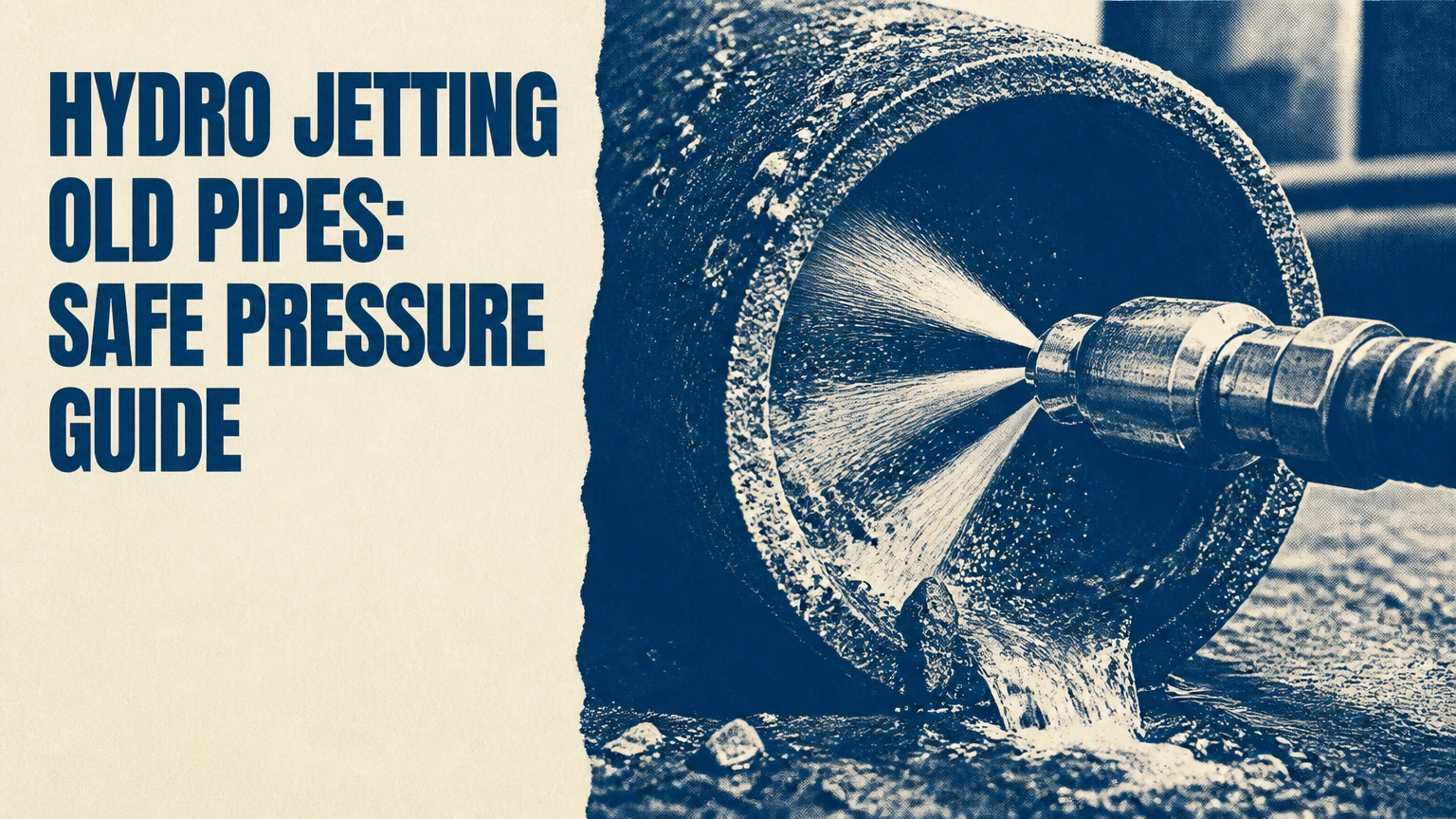
Hydro jetting old pipes uses pressurized water to remove grease, mineral scale, silt, and roots from the full interior of a drain or sewer line. The method can restore flow in sound cast iron, clay, galvanized steel, or PVC, but a camera inspection must identify cracks, collapse, severe corrosion, separated joints, and bellies before pressure is selected.
Key Facts at a Glance
Professional hydro jetting typically uses 1,500-4,000 PSI and approximately 4-18 GPM, depending on pipe size, blockage, access, and equipment.
No universal PSI limit applies to every old pipe; nozzle design, hose diameter, distance, flow, pipe condition, and discharge control all affect risk.
A CCTV inspection before cleaning is the most important safety control for cast-iron, clay, galvanized, and other aging sewer lines.
Hydro jetting cleans pipe walls more completely than cabling, while cabling is usually cheaper and safer for an unknown emergency blockage.
Typical residential mainline pricing is about $350-$600, with complex root, access, or commercial work often reaching $950-$1,600 or more.
Hydro jetting cannot repair a collapsed, badly offset, structurally unsound, or continuously leaking pipe.
What Is Hydro Jetting Old Pipes?
Hydro jetting old pipes is a professional drain-cleaning process that sends water through a flexible hose and engineered nozzle at high pressure and controlled volume. Forward-facing jets penetrate an obstruction, while rear-facing jets propel the hose and scour deposits from the pipe wall.
Unlike a drain cable, which generally creates a passage through a blockage, water jetting can remove a broad layer of grease, rust scale, sludge, and loose mineral deposits. The distinction matters in older sewer lines because a cable may restore drainage while leaving most of the restricted wall surface in place.
Hydro jetting is restoration of hydraulic capacity, not structural repair. A clean pipe with an open crack remains cracked, and a pipe with separated clay joints remains vulnerable to soil movement and root entry.
Why Pressure and Flow Both Matter
Pressure supplies cutting and impact force. Flow, measured in gallons per minute, carries the loosened material away and reduces the chance that sludge will settle downstream.
A small cart jetter may produce roughly 1,500-3,000 PSI at 2-4 GPM. A larger trailer or truck-mounted machine may deliver approximately 3,500-4,000 PSI at 6-18 GPM. Those machine ratings are not the same as the pressure actually appropriate at an old pipe wall.
The nozzle converts pump output into water velocity and directional force. A plumber should select the nozzle for the pipe diameter and obstruction rather than choosing the machine’s highest available setting.
Is Hydro Jetting Old Pipes Safe?
Hydro jetting old pipes is usually safe only when the pipe is structurally sound enough to contain the water and the technician adjusts the equipment to the inspection findings. Old age alone does not disqualify a line, but advanced corrosion, cracks, open joints, collapse, and severe wall loss can make jetting unsafe.
A cast-iron sewer from the 1960s may tolerate carefully controlled cleaning if its wall remains intact. Another cast-iron line of the same age may have a paper-thin bottom caused by corrosion and should not receive aggressive descaling.
Clay presents a different problem. The pipe body can remain strong while mortar joints have opened or roots have entered through them. High-pressure water can enlarge a defect that was previously allowing only slow infiltration.
Nozzle speed, stand-off distance, water volume, hose movement, and the technician’s ability to stop the pump all affect the result. “Under 2,000 PSI” is not a universal guarantee of safety, and “4,000 PSI” is not automatically destructive when used in a sound, properly sized line.
How Does the Procedure Work?
A professional hydro-jetting service for an older sewer typically follows six stages: diagnosis, access, equipment selection, controlled cleaning, downstream flushing, and verification. A straightforward residential job often takes 1.5-3 hours, although blocked access, long runs, roots, and repeated passes increase the time.
Step 1: Inspect the Line With CCTV
The technician runs a camera through a cleanout or another suitable access point. The inspection should identify pipe material, diameter, direction, blockage type, water level, joint condition, corrosion, cracks, offsets, bellies, and collapse.
Ask for a recorded video or still images. A verbal statement that the pipe is “old but fine” does not document whether the bottom has disappeared or whether a joint has separated.
Step 2: Establish Safe Access and Discharge
The preferred entry is usually an exterior sewer cleanout because it reduces indoor wastewater exposure and gives the operator a straighter route. Basement cleanouts, mainline openings, and certain roof vent arrangements may provide alternatives, but each creates different backflow and ventilation risks.
The downstream route must be able to receive the water and debris. A closed or poorly understood system can force wastewater into toilets, tubs, floor drains, or wall cavities.
Step 3: Match the Jetter to the Pipe
The technician chooses hose diameter, nozzle configuration, pressure, flow, and pass direction based on the camera report and pipe dimensions. A residential branch line may need a compact jetter, while a long six-inch sewer may require high-volume equipment and a larger access opening.
The operator should not confuse pump capacity with operating pressure. A machine capable of 4,000 PSI can be run below that rating when an older line requires less impact.
Step 4: Clean in Controlled Passes
The nozzle usually advances through the obstruction and then returns slowly, allowing the rear jets to wash the pipe wall. Operators may begin with a flushing or penetrating nozzle and switch to a rotary or descaling head after confirming that the line can contain the water.
A root-cutting nozzle can remove intruding roots, but it does not close the joint or repair the pipe opening that allowed roots to enter. Repeated root service without a structural repair is maintenance, not a permanent solution.
Step 5: Flush Debris to a Safe Outlet
The loosened material must move to an accessible downstream point. Heavy rust flakes, grease, sand, and root fragments can form a secondary blockage if the operator advances debris into a restricted section.
A sudden rise in upstream water, unexpected wastewater at fixtures, or inability to maintain discharge requires an immediate pause. Continuing to pump can convert a drainage problem into an indoor contamination event.
Step 6: Verify the Result With a Camera
The final camera pass confirms whether the obstruction is gone and whether the pipe wall, joints, and connections remain intact. The video can also reveal a previously hidden defect after grease or scale has been removed.
Post-cleaning inspection is especially valuable when the initial blockage concealed a crack, offset, root opening, or severe corrosion. It provides a baseline for future maintenance and for comparing relining or replacement quotes.
Which Pressure and Flow Settings Are Safe?
Safe hydro-jetting settings depend on pipe condition, not on a single published maximum. Typical residential work may use 1,500-2,500 PSI for vulnerable or moderately scaled lines and higher settings for sound, larger-diameter pipes, but the technician should prioritize controlled flow and nozzle selection over maximum pressure.
| Pipe condition or material | Typical working approach | Common risk | Required decision |
|---|---|---|---|
| Sound PVC, 4-inch sewer | 2,500-4,000 PSI, 6-12 GPM | Joint displacement from poor technique | Jet after camera confirmation |
| Sound cast iron, moderate scale | 1,500-2,500 PSI, 4-9 GPM | Flaking or wall perforation | Use controlled descaling |
| Thin or heavily corroded cast iron | Below standard jetting range or no jetting | Bottom-wall breach | Consider replacement or lining |
| Vitrified clay with intact joints | 1,500-2,000 PSI, controlled flow | Joint or connection damage | Use a suitable nozzle and camera |
| Clay with open joints and roots | Avoid aggressive cleaning | Soil washout and worsening infiltration | Repair, line, or replace |
| Galvanized steel with internal rust | Low-impact assessment first | Scale detachment and leaks | Inspect exposed sections before service |
These are typical field ranges, not engineering limits. Pipe diameter, hose size, nozzle orifice, distance from the wall, pump regulation, and the condition recorded on video can justify a different setting.
What Does a Technician Look for Before Jetting?
A technician should look for a continuous pipe profile, contained joints, usable diameter, no active collapse, and enough downstream capacity to carry water and debris. PACP terminology can help standardize sewer observations, but homeowners should receive a plain-language explanation rather than a grade alone.
A line with a structural defect equivalent to a severe condition may need lining or excavation before cleaning. A technician who cannot explain where the defect is, how large it is, and what the jetting plan changes should not proceed blindly.
What Can Hydro Jetting Remove?
Hydro jetting can remove grease, soap residue, mineral scale, sludge, loose rust, sediment, and many root intrusions when the pipe remains open and structurally contained. Hydro jetting cannot restore a missing pipe section, stabilize moving soil, close a separated joint, or reliably remove concrete that has hardened around a line.
| Obstruction | Jetting performance | Likely nozzle | Permanent limitation |
|---|---|---|---|
| Kitchen grease, 2-4 inches thick | High after emulsification | Rotary or grease nozzle | Recurrence if disposal habits remain |
| Loose rust and mineral scale | Moderate to high | Descaling or rotary nozzle | Wall loss may be exposed |
| Tree roots at a joint | High for removal | Root cutter or chain nozzle | Open joint still admits roots |
| Sand and silt deposits | High when outlet is open | Flushing nozzle | Belly continues collecting sediment |
| Collapsed pipe fragments | Low | None reliably | Structural repair required |
| Hardened concrete or grout | Variable and risky | Specialist tooling | Cutting can damage the host pipe |
Scale removal can make a line appear worse before it becomes better. The cleaning may reveal pinholes that deposits had temporarily sealed, which is why a leak after jetting does not necessarily mean the water created the original corrosion.
How Do Old Pipe Materials Respond?
Old pipe material predicts likely failure modes, but material alone does not determine whether jetting is appropriate. Condition, wall thickness, joint integrity, diameter, and previous repair history matter more than the installation year printed on a property record.
| Material | Typical service-era issue | Jetting concern | Better next step when defective |
|---|---|---|---|
| Cast iron | Internal corrosion and tuberculation | Thin bottom may perforate | Camera, spot repair, lining, or replacement |
| Vitrified clay | Open mortar joints and roots | Joint washout or displacement | Joint repair, lining, or replacement |
| Galvanized steel | Rust scale and restricted bore | Leaks after scale removal | Replace accessible sections |
| Orangeburg fiber pipe | Deformation and softening | Collapse or flattening | Replacement or approved trenchless repair |
| PVC | Displaced or damaged joints | Usually lower wall risk | Repair failed joints or sections |
| Concrete | Infiltration and cracking | Surface erosion or joint loss | Structural rehabilitation |
Orangeburg is an important edge case in older homes. The fiber-based pipe can deform under soil load, so cleaning a narrowed line does not restore its original shape or provide a lasting solution.
How Much Does Hydro Jetting Cost?
Typical residential mainline hydro jetting costs about $350-$600, while difficult root removal, long sewer runs, limited access, or commercial work commonly reaches $950-$1,600 or more. Camera inspection may add $150-$350, although many contractors bundle it into the quoted service.
| Job component | Typical price range | Typical duration | Main price driver |
|---|---|---|---|
| CCTV inspection | $150-$350 | 30-60 minutes | Access and line length |
| Residential branch jetting | $300-$600 | 1-2 hours | Pipe diameter and blockage |
| Residential mainline jetting | $350-$900 | 1.5-3 hours | Cleanout, roots, grease |
| Root-heavy or long sewer | $950-$1,600+ | 2-5 hours | Distance and repeated passes |
| Sewer cleanout installation | $800-$1,500 | 3-8 hours | Excavation and surface restoration |
| Emergency or after-hours service | Add $100-$250 | Variable | Staffing and response time |
A low quote may exclude the camera inspection, difficult access, disposal, additional passes, or emergency charges. Request a written scope that states the entry point, expected pressure range, flow rate, camera verification, cleanup responsibility, and what happens if the camera finds structural damage.
The lifespan of a cleaning is commonly described as two to five years for residential lines, but that range is a maintenance estimate rather than a promise. A restaurant grease line, a sewer with open root-entry joints, and a clean PVC line do not have the same recurrence pattern.
How Does Jetting Compare With Snaking?
Hydro jetting is generally the better cleaning method for recurring grease, heavy scale, and sediment in a structurally sound pipe, while snaking is usually the faster and less expensive first response for a single soft blockage or an unknown emergency line. Neither method repairs defective pipe.
| Criterion | Hydro jetting | Mechanical snaking | Chemical or enzymatic treatment |
|---|---|---|---|
| Typical residential price | $350-$900 | $150-$400 | $50-$300 |
| Wall coverage | Broad interior cleaning | Narrow passage | Uneven liquid contact |
| Grease removal | High with suitable nozzle | Low to moderate | Low for thick deposits |
| Root treatment | Cuts or washes roots | Cuts a central path | Preventive control only |
| Structural risk | Water can expose defects | Cable can snag or crack weak pipe | Acids can corrode old metal |
| Best use | Sound line with recurring buildup | One localized blockage | Maintenance after physical cleaning |
Snaking is not inferior in every situation. A cable may be the responsible choice when water cannot be discharged, a camera cannot pass, or the line has an uncertain defect that requires diagnosis before introducing a large volume of water.
Chemical drain cleaners are poor substitutes for sewer-line cleaning in old systems. Strong acids and caustics can damage metal, injure workers, and leave hazardous liquid in a backed-up line.
When Is Hydro Jetting the Wrong Choice?
Hydro jetting is the wrong choice when CCTV shows collapse, a large open crack, severe wall loss, major joint separation, an unstable belly, or a line that cannot safely discharge the cleaning water. Cleaning a structurally failed pipe can accelerate soil erosion and cause a larger excavation problem.
Relining may suit a pipe that retains a continuous route but has leaking joints, cracks, or moderate deterioration. Replacement becomes more likely when the line has repeated collapse, severe deformation, inaccessible defects, poor grade, or a material that cannot support a reliable liner.
A technician should also postpone jetting during an active backup when the downstream path is unknown. First protect occupants, isolate wastewater use, identify the blockage, and establish where water can go.
Is Hydro Jetting Appropriate for Root Intrusion?
Hydro jetting can remove roots from a sewer, but root cutting does not cure the entry point. Roots return when an open joint, crack, or failed connection remains exposed to soil moisture.
For recurring intrusion, combine cleaning with a structural solution such as a point repair, joint sealing, cured-in-place lining, or replacement. Root-inhibiting products have application limits and environmental concerns; copper sulfate and similar chemicals should not be treated as a substitute for repairing the pipe.
What About an Active Backup?
Stop using toilets, showers, washing machines, and sinks when wastewater is backing up. Do not run a jetter through an indoor fixture unless a qualified professional has established safe access, an open discharge route, and protection against backflow.
A plumber may cable the line first to create drainage, inspect it, and then schedule jetting after the system can receive water. If sewage has entered living space, electrical hazards, contamination control, and local wastewater procedures take priority over cosmetic drain cleaning.
What Warning Signs Require a Stop?
The operator should stop immediately for a sudden pressure drop, unexplained water loss, expanding void noise, wastewater appearing at an unexpected fixture, or a camera image showing a new defect. A pressure change can indicate a clogged nozzle, hose problem, open connection, or pipe rupture, so the pump should be shut down before diagnosis.
Common mistakes include:
- Skipping CCTV: Blind jetting can send water into soil through a crack or collapsed section. Inspect first.
- Using maximum machine pressure: Pump capacity is not a safe operating setting. Regulate pressure and select the correct nozzle.
- Ignoring downstream capacity: Dislodged grease or roots can block the next section. Confirm a route for discharge.
- Jetting from a fixture without backflow control: Wastewater can exit through toilets, tubs, or floor drains.
- Treating root removal as a repair: Roots return unless the failed joint or crack is addressed.
- Accepting a verbal result: Require a post-cleaning camera recording when the line is old or the quote is substantial.
One useful practitioner rule is to judge the pipe before judging the blockage. A severe grease plug in a sound line is often a cleaning problem; a small recurring stoppage in a collapsing line is a structural problem.
How Should You Choose a Contractor?
Choose a contractor who documents the pipe with CCTV, explains the operating plan, carries appropriate liability insurance, and provides a written price before cleaning begins. The contractor should identify the pipe material, access point, estimated flow, nozzle type, discharge route, and post-service verification.
Ask these questions before authorizing work:
- Will I receive the pre- and post-cleaning camera footage?
- What defect would make you refuse to jet the line?
- What pressure and GPM do you expect to use, and why?
- Where will the water and debris discharge?
- Is camera inspection included in the quote?
- What happens if jetting reveals a failed pipe?
- Does the price include a second pass or emergency surcharge?
- Who is responsible if the sewer is on municipal property?
Property owners should verify responsibility for the building sewer before paying for private work. Local ordinances, utility easements, and municipal cleanout locations can change who must authorize or fund a repair.
FAQ
Can hydro jetting damage cast-iron pipes?
Hydro jetting can damage cast iron that has severe corrosion, thin walls, cracks, or failed joints. The water may remove deposits that were masking a pinhole or breach a weakened section. A camera inspection, controlled pressure, appropriate nozzle, and post-cleaning verification reduce risk, but no contractor can guarantee an unsound pipe will tolerate cleaning.
How often should old sewer pipes be hydro-jetted?
A sound residential sewer may need jetting every two to five years when grease, scale, or sediment repeatedly restricts flow. Lines with mature-tree root intrusion may require cleaning every 6-12 months until the defective joint is repaired. Preventive frequency should follow camera findings and blockage history, not a fixed calendar alone.
Can hydro jetting remove limescale from galvanized pipes?
Hydro jetting may remove loose mineral scale from galvanized steel, but aggressive descaling can expose pinholes in pipe that has corroded internally. Because galvanized water-supply piping is pressurized and differs from a drain line, a plumber should inspect exposed sections and assess replacement before attempting high-pressure cleaning.
Does hydro jetting clear a sewer belly?
Hydro jetting can remove sediment from a sewer belly temporarily, but it cannot correct the low section that collects water and solids. A belly caused by settlement or poor grade usually requires excavation, spot correction, or a suitable trenchless rehabilitation method after the location and depth are confirmed.
Is pipe relining better than hydro jetting?
Pipe relining is better when a pipe has leaking joints, cracks, or moderate structural deterioration but retains a continuous shape. Hydro jetting is better for removing deposits from a sound line. Many rehabilitation projects use cleaning before lining, but jetting alone cannot create a watertight structural pipe.
What should I do if the drain backs up after jetting?
Stop all water use and contact the contractor immediately. The line may have a downstream debris blockage, an undiscovered collapse, or a damaged section. Request the post-cleaning camera footage and ask whether the technician verified the entire run, including the connection to the municipal sewer or septic tank.
The Bottom Line
Hydro jetting old pipes can restore substantial flow and remove deposits that cabling leaves behind, but the method is safe only when the pipe is diagnosed before water pressure is applied. Camera inspection, calibrated pressure, adequate GPM, controlled discharge, and final verification matter more than a headline PSI number.
Use hydro jetting for a structurally contained line with grease, scale, sediment, or roots. Choose snaking for an immediate, localized blockage when diagnosis or water control is incomplete, and choose relining or replacement when inspection shows collapse, severe corrosion, open joints, deformation, or recurring structural failure. The right question is not whether an old pipe can be jetted, but whether the inspected pipe can safely contain the planned cleaning process.