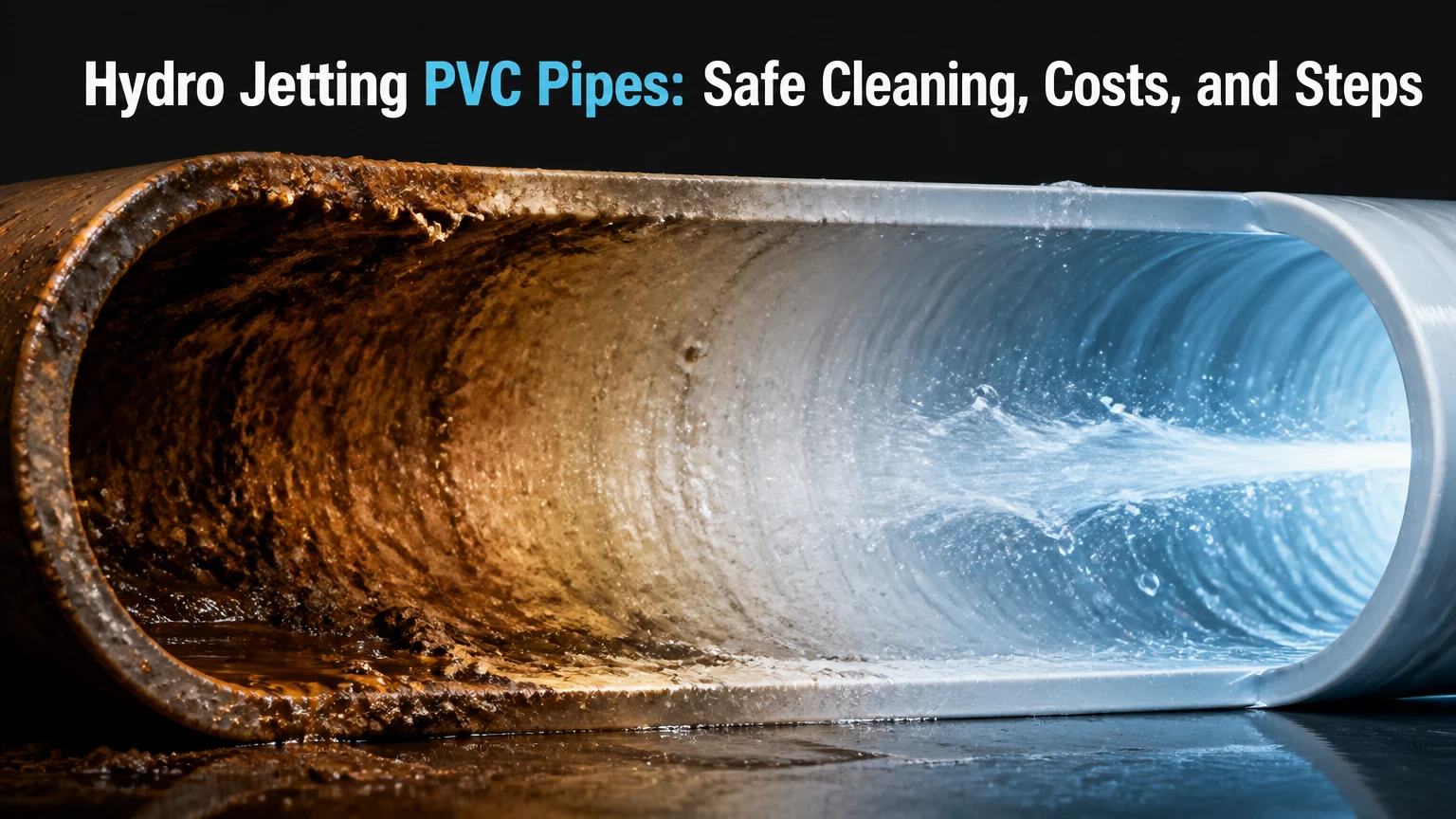
Hydro jetting PVC pipes uses a high-volume water jet to remove grease, sludge, mineral deposits, and some roots from the full interior of a drain line. The method is usually safe for sound PVC when a technician inspects the pipe first, selects the correct nozzle, and controls pressure, flow, hose speed, and jetting direction.
Key Facts at a Glance
Hydro jetting cleans the pipe wall and restores more internal diameter than a cable that merely opens a passage.
A universal “safe PSI” does not exist for PVC drains because nozzle impact, flow, pipe condition, and distance also determine risk.
Typical residential service costs $350-$600 and takes 1-3 hours when camera inspection and access are straightforward.
A pre-jetting camera should identify cracks, separated joints, severe offsets, bellies, and collapse before water pressure is applied.
Root cutting removes intruding roots but does not eliminate the tree or permanently repair the joint where roots entered.
Hydro jetting removes deposits. It does not rebuild a collapsed, badly cracked, or unsupported pipe.
What Is Hydro Jetting PVC Pipes?
Hydro jetting PVC pipes is a drain-cleaning process that sends pressurized water through a flexible hose and specialized nozzle. Rear-facing jets pull the hose forward and carry loosened debris toward the access point, while forward-facing jets help penetrate dense obstructions.
The cleaning effect differs from cable snaking. A cable usually creates a narrow channel through a blockage, whereas water jets can scour grease and soft deposits from a much larger portion of the pipe circumference. That distinction matters in kitchen waste lines, restaurant laterals, and sewer pipes where residue quickly narrows the effective diameter again.
PVC is smooth, corrosion-resistant, and unaffected by many conditions that damage metal drainpipe. PVC is not indestructible, however. A jet can expose a weak glued fitting, enlarge an existing crack, disturb a poorly supported section, or force water into a separated joint.
How does a water jetter clean a PVC drain?
A water jetter combines pump pressure, water volume, nozzle geometry, and controlled hose movement. The pump supplies energy, but the nozzle converts that energy into directional streams that cut, lift, dissolve, or transport different deposits.
The technician normally works from a downstream cleanout toward the upstream branch or building fixture. That direction gives wastewater and loosened material a more natural route out of the line, although access, slope, blockage location, and the risk of flooding can change the setup.
A hose that moves too quickly may leave grease on the crown of the pipe. A hose that remains stationary can concentrate water on one area and increase the chance of disturbing a defective joint. Professional jetting is therefore a controlled cleaning operation, not simply a matter of turning a pressure dial higher.
Is Hydro Jetting PVC Pipes Safe?
Hydro jetting PVC pipes is generally safe for intact, properly installed drain lines when the operator uses a camera, appropriate equipment, and a nozzle matched to the deposit. Jetting becomes unsafe when a line has collapse, severe cracking, an open joint, a major offset, or inadequate support.
The commonly repeated 1,500-4,000 PSI range should not be treated as a guaranteed PVC safety limit. The pressure shown at a pump gauge is not the same as the impact delivered at the pipe wall. A small orifice can produce a sharper stream, while a larger nozzle can deliver more flushing volume at a lower displayed pressure.
PVC drainpipe also differs by nominal diameter, wall thickness, material formulation, age, joint design, burial condition, and installation quality. A technician should record the pipe material and diameter, inspect the route, and choose a conservative operating setting that removes the deposit without attacking the pipe structure.
Which PVC defects make jetting unsafe?
A camera inspection should identify structural defects before the pump runs. Hydro jetting is a cleaning method, not a substitute for structural repair.
| Camera finding | Jetting risk | Preferred response |
|---|---|---|
| Fully collapsed PVC section | Hose obstruction and flooding | Excavate, reline, or replace the section |
| Separated solvent-welded joint | Water and hose can exit the line | Repair or replace the joint |
| Long longitudinal crack | Crack enlargement and soil intrusion | Repair after locating the defect |
| Severe offset at a fitting | Nozzle snagging and joint stress | Use inspection and repair planning |
| Minor grease film | Low structural risk | Low-impact flushing or jetting |
| Localized root intrusion | Possible root and joint disturbance | Root-capable nozzle followed by repair planning |
A particularly important rule is that pressure rating and drain-cleaning suitability are different concepts. A pipe’s pressure rating describes how it handles sustained internal pressure under specified conditions. It does not automatically define the safe impact of a moving cleaning nozzle.
What Pressure and Flow Should Be Used?
Typical residential jetting equipment may operate around 1,500-4,000 PSI and 3-8 gallons per minute, but those figures describe common service equipment rather than universal limits for every PVC line. The technician should prioritize nozzle impact, water volume, line diameter, pipe condition, and the distance between the nozzle and pipe wall.
Smaller indoor branch lines often need a compact machine and smaller hose. A large building sewer may require substantially more flow to transport loosened grease and sediment. Excess pressure with insufficient flow can cut into a defect while failing to carry debris away.
| Line or application | Typical equipment range | Main operating concern |
|---|---|---|
| 1.5-2 inch sink branch | 1,500-2,500 PSI, 2-4 GPM | Protect traps, bends, and small fittings |
| 2-3 inch residential branch | 2,000-3,000 PSI, 3-6 GPM | Remove grease without flooding fixtures |
| 3-4 inch building sewer | 2,500-4,000 PSI, 5-8 GPM | Carry debris through the full line |
| Commercial grease lateral | 2,500-4,000 PSI, 6-12 GPM | Match flow to heavy grease loading |
| Root-affected line | 2,000-3,500 PSI, 4-8 GPM | Avoid aggressive cutting at defective joints |
These ranges are typical practitioner settings, not engineering approvals. A responsible operator may begin below the upper range, confirm nozzle performance, and increase only when the inspection and cleaning response justify it.
Why is GPM as important as PSI?
GPM determines how effectively the water transports loosened material after the nozzle breaks it apart. PSI contributes cutting and penetration force, while GPM supplies the carrying capacity that moves grease, sediment, and root fragments toward the outlet.
A high-pressure, low-flow machine may open a small channel without washing the pipe clean. A lower-pressure, higher-flow setup can produce better flushing in a larger sewer, provided the nozzle has enough impact to remove the deposit. The correct specification is a pressure-flow-nozzle combination.
Which Nozzle Fits the Blockage?
The nozzle should match the obstruction, pipe diameter, access route, and structural condition. Penetrating nozzles suit compact soft blockages, rotary nozzles remove broad grease films, flushing nozzles transport loose debris, and root-cutting heads address intrusions only when the pipe can tolerate the operation.
| Nozzle type | Typical target | Suitable use | Important limitation |
|---|---|---|---|
| Penetrator nozzle | Soft blockage, paper, sludge | Initial passage through a plugged line | May tunnel without cleaning walls |
| Flushing nozzle | Loose sediment and debris | Final transport and rinse | Weak against hardened grease |
| Rotary nozzle | Grease, slime, broad residue | Commercial and kitchen lines | Needs controlled retrieval speed |
| Root-cutting nozzle | Fine or moderate root intrusion | Select PVC sewer repairs | Does not repair the entry joint |
| Chain flail | Heavy roots and deposits | Large, accessible sewer lines | Higher risk at cracks and offsets |
Nozzle angle also changes performance. Rear jets commonly sit around 30-45 degrees to propel the hose and wash debris backward, while forward jets can help pierce a blockage. A nozzle with too much forward thrust may stall the hose in a bend or drive debris farther into the system.
What should a technician do if the hose stops?
The operator should stop advancing, reduce pump output, and determine whether the hose has reached a bend, obstruction, offset, or defect. A controlled pulsing function may help release a hose in a sound line, but repeated high-pressure attempts can wedge the nozzle more tightly.
Pressure loss can result from a clogged nozzle or damaged hose. The operator should shut down the pump before inspecting equipment, clear blocked orifices, check fittings, and verify that the water supply provides adequate volume. Pulling aggressively on a trapped hose can damage a fitting or leave the hose inside the drain.
How Is a PVC Drain Jetting Service Performed?
A professional PVC drain jetting service normally follows six stages: inspection, access planning, equipment selection, controlled cleaning, flushing, and post-cleaning verification. A straightforward residential visit often takes 1-3 hours, while difficult access, extensive roots, or commercial grease can extend the appointment.
Step 1: Inspect the pipe with a camera
The technician inserts a CCTV drain camera through a cleanout or suitable access point. The inspection records blockage location, pipe diameter, material, standing water, roots, offsets, cracks, and the condition of joints.
A camera cannot always see beyond a complete blockage, so the first pass may require limited cable work or cautious low-impact jetting. The technician should document the reason for any cleaning performed before full visualization.
Success checkpoint: The route and major structural defects are understood before high-pressure cleaning begins.
Common mistake: Treating a recurring stoppage as a simple clog without locating the underlying defect.
Step 2: Select access and protect the property
The operator chooses a downstream cleanout when possible, confirms that the cleanout is secure, and protects fixtures from splashback. Indoor work may require caps, towels, drain covers, and a plan for controlling wastewater.
Working through a roof vent or fixture opening can be necessary, but those access points may create more risk than a dedicated cleanout. The operator should not assume that every cleanout can withstand force from a pressurized hose.
Success checkpoint: The hose can enter and exit without stressing the cleanout or flooding the building.
Common mistake: Removing a brittle or poorly supported cleanout cap without preparing for discharge.
Step 3: Calibrate pressure, flow, and nozzle
The technician selects hose diameter, nozzle type, jet angle, pressure, and flow for the pipe and deposit. The starting setting should be conservative, especially in older PVC, shallow-buried pipe, thin-wall pipe, or lines with visible joint movement.
The machine must have enough water supply to maintain stable output. A restricted supply can cause pump cavitation, inconsistent cleaning, and misleading pressure readings.
Success checkpoint: The pump maintains the planned flow and the nozzle advances without snagging.
Common mistake: Choosing the largest available nozzle because the blockage appears severe.
Step 4: Advance the hose and break down deposits
The operator advances the nozzle toward the blockage without forcing it. Forward jets penetrate compact material, and rear jets pull the hose through the line while washing loosened residue back toward the access point.
The hose should move at a controlled speed suited to the deposit. Hardened grease needs slower passes, while a final flushing pass may use a steady retrieval speed to carry debris out.
Success checkpoint: Flow improves, pressure behavior stabilizes, and the camera shows a wider, cleaner passage.
Common mistake: Retrieving the hose too quickly and leaving a grease layer on the upper pipe wall.
Step 5: Flush and remove debris
The operator continues controlled water flow long enough to transport suspended material through the downstream section. A blockage can return if fragments collect at a low point, fitting, or downstream restriction.
Water usage depends on equipment and duration. A 3-8 GPM machine running for 30 minutes uses approximately 90-240 gallons, so the operator must account for discharge capacity and local wastewater controls.
Success checkpoint: The line drains continuously without backup while debris exits the system.
Common mistake: Stopping immediately after the first opening instead of completing the flushing pass.
Step 6: Verify the result with a camera
A post-cleaning camera inspection confirms whether the deposit was removed around the pipe circumference and whether joints, bends, and previously hidden defects remain intact. The recording should identify remaining roots, corrosion-like deposits, sags, cracks, and areas that still restrict flow.
“100% cleaning” should not be promised without visual evidence. Heavy scale, irregular pipe geometry, standing water, or a defect can prevent a complete view.
Success checkpoint: The camera reaches the intended endpoint and documents an open, structurally acceptable line.
Common mistake: Declaring success based only on a temporarily restored sink or toilet.
How Much Does PVC Drain Jetting Cost?
Residential PVC drain jetting typically costs $350-$600 for a standard accessible line with inspection, although total prices can range from about $100 to more than $2,000. Commercial grease removal commonly costs $950-$2,500 because larger equipment, longer runs, access requirements, and disposal needs increase labor and water use.
| Service situation | Typical price | Typical duration | Main price driver |
|---|---|---|---|
| Accessible residential branch | $350-$600 | 1-2 hours | Camera and standard jetting |
| Emergency residential blockage | $500-$1,200 | 1-3 hours | After-hours labor and difficult access |
| Root-affected building sewer | $600-$2,000+ | 2-5 hours | Root cutting and repeat passes |
| Commercial grease lateral | $950-$2,500 | 2-6 hours | Flow volume, grease load, and access |
| Long or buried sewer run | $1,000-$3,000+ | 3-8 hours | Multiple access points and locating |
Published consumer cost guides from Angi and HomeAdvisor commonly place ordinary hydro jetting near the mid-hundreds, but local labor rates and access conditions produce wide variation. A quote should state whether it includes camera inspection, cleanup, additional access, emergency fees, and post-jetting video.
What makes the price increase?
The main cost increases come from missing cleanouts, long pipe runs, severe roots, commercial grease, standing water, difficult equipment placement, and the need to expose or repair a defective section. Jetting cannot reduce repair costs when a camera shows collapse or a separated joint.
A low quote may omit the inspection that determines whether jetting is appropriate. Ask for the line diameter, expected pressure-flow range, nozzle type, camera inclusion, and the price if the technician finds structural damage.
How Does Jetting Compare With Other Drain Methods?
Hydro jetting is usually the strongest choice for recurring grease, sludge, and sediment because it cleans more of the pipe wall. Snaking is often better for a single soft blockage, limited access, or a line whose structural condition is unknown and needs a less aggressive first response.
| Method | Typical result | Typical cost | Best use | Main limitation |
|---|---|---|---|---|
| Hydro jetting | Full-wall cleaning and flushing | $350-$2,500 | Grease, sludge, roots, sediment | Can expose or worsen defects |
| Cable snaking | Narrow opening through blockage | $150-$500 | Single soft stoppage | Leaves wall deposits behind |
| Enzyme treatment | Gradual organic maintenance | $20-$80 per treatment | Light recurring organic residue | Does not clear roots or hard grease |
| Chemical opener | Fast chemical dissolution | $10-$40 | Limited household use | Can injure people and damage some materials |
| Pipe repair or replacement | Structural restoration | $500-$10,000+ | Collapse, cracks, open joints | Higher cost and site disruption |
Chemical drain openers are not equivalent to hydro jetting. Caustic products may react with standing water, injure workers, harm finishes, and fail against roots or structural defects. PVC itself may tolerate some products, but the entire drainage assembly includes seals, fittings, traps, and downstream materials.
A cable can be the safer first tool when the camera cannot pass and the operator needs to establish a small opening. Jetting is the better follow-up when the line is structurally sound and recurring residue is the cause.
What Can Hydro Jetting Not Fix?
Hydro jetting cannot repair a collapsed pipe, restore a missing section, reseal a separated joint, correct a severe belly, or eliminate the tree that produced a root intrusion. Cleaning may improve flow temporarily while leaving the structural cause untouched.
A pipe belly holds water and debris after every cleaning cycle. Jetting can remove the debris from the low section, but gravity will refill the depression with sediment and organic material. Replacement, spot repair, or trenchless rehabilitation may be required.
Roots require careful interpretation. A root-cutting nozzle can clear the passage, but roots typically entered through a joint or crack. If the entry point remains open, recurrence may occur in months rather than years.
When should jetting be refused?
A technician should postpone or refuse full-pressure jetting when a camera shows collapse, a large open joint, a severely displaced connection, exposed bedding, or a line that cannot safely contain wastewater. The correct next step may be excavation, pipe lining, spot repair, or a controlled inspection procedure.
Older PVC deserves extra caution even though PVC does not rust. Ultraviolet exposure, thermal cycling, poor bedding, chemical attack, and brittle fittings can create weakness that is invisible from the outside.
How Long Does the Cleaning Result Last?
A residential jetting result may last two to five years when the pipe is structurally sound and the original cause is controlled. Commercial kitchens often need six- to twelve-month maintenance because fats, oils, grease, food solids, and high discharge volumes rebuild deposits faster.
A fixed interval cannot predict every line. A home with mature trees and a defective sewer joint may need root management or repair, while a lightly used, properly sloped PVC line may remain open much longer.
| Line condition | Reasonable maintenance approach | Expected recurrence pattern |
|---|---|---|
| Sound residential PVC, low debris | Inspect when symptoms recur | Often multiple years |
| Kitchen line with recurring grease | Jet and review usage every 12-24 months | Seasonal or use-related buildup |
| Commercial food-service lateral | Inspect and clean every 6-12 months | Frequent grease accumulation |
| Root intrusion at open joint | Clean as a temporary measure, then repair | Possible recurrence within months |
| Pipe belly or collapse | Repair rather than schedule cleaning | Persistent recurrence after cleaning |
A useful maintenance plan tracks symptoms, camera findings, cleaning date, nozzle used, and the location of recurring deposits. That record turns repeated emergency calls into a condition-based decision.
What Mistakes Cause PVC Jetting Problems?
The most damaging mistakes are skipping the camera inspection, using an unsuitable nozzle, confusing pump PSI with safe pipe-wall impact, advancing or retracting too quickly, and continuing after the hose encounters resistance.
Four practitioner rules prevent many failures:
- Do not use pressure to compensate for the wrong nozzle. A rotary grease nozzle at an unsuitable angle can outperform a higher-pressure penetrator.
- Treat a sudden pressure change as diagnostic information. A pressure drop can indicate a clogged orifice, open joint, burst hose, or disconnected fitting.
- Never pull a trapped hose with vehicle-like force. Hose retrieval should follow controlled pulsing, reduced pressure, and inspection of the route.
- A clean camera view is more valuable than a dramatic pressure number. The finished condition of the line determines whether the service worked.
If wastewater backs up during jetting, stop the pump, secure the access point, and prevent contaminated water from reaching occupied areas. The operator should identify whether the blockage is downstream, whether the receiving drain can accept the flow, and whether a second restriction is present.
Can Homeowners Rent a Hydro Jetter?
Homeowners can rent small electric jetters, but professional service is safer for most PVC sewer lines because equipment selection, hose retrieval, wastewater control, and camera interpretation require experience. Rental machines may lack the flow, nozzle range, access adapters, and recovery procedures needed for a difficult blockage.
A homeowner should not jet through an uncertain cleanout, roof vent, or visibly damaged pipe without inspection. Pressurized wastewater can exit through an open fixture, and a hose can become trapped at a fitting or bend.
Rental use is most defensible for a known, accessible, structurally sound outdoor line when local rules permit discharge and the operator has received equipment-specific instruction. Indoor branch lines and shared building sewers generally justify professional service.
Which Situations Need Different Advice?
New PVC with a recurring blockage needs diagnosis rather than repeated cleaning. A construction defect, incorrect slope, glue failure, or foreign material may be responsible, and repeated jetting can delay the warranty or repair decision.
Tree-root problems require a camera, location data, and a plan for the affected joint. Root cutting is useful for restoring flow, but the lasting solution may involve spot repair, lining, replacement, or approved root-management treatment.
Commercial kitchens need grease-control practices alongside jetting. Trap maintenance, proper solids management, and cleaning frequency affect recurrence more than increasing pump pressure.
Storm drains and agricultural PVC systems can require different nozzles, outlet controls, and environmental precautions than sanitary plumbing. Sediment discharge, wildlife protection, and local water regulations may govern the work.
FAQ
Can high-pressure water crack PVC drainpipe?
High-pressure water can worsen a pipe that already has a crack, separated joint, brittle fitting, or inadequate support. Sound PVC usually tolerates professional drain jetting, but safety depends on the complete pressure-flow-nozzle setup and the pipe’s actual condition, not on a single PSI number printed on a machine gauge.
Is hydro jetting safe for glued PVC joints?
Hydro jetting is generally safe for intact solvent-welded PVC joints when the nozzle passes smoothly and the operator uses appropriate settings. A poorly bonded, displaced, or cracked joint can fail during cleaning because the jet exposes an existing weakness rather than creating a defect in otherwise sound material.
Should I snake or hydro jet a PVC sewer line?
Choose snaking for an isolated soft blockage, limited access, or an initial opening when the pipe condition is unknown. Choose hydro jetting for recurring grease, sludge, sediment, or root residue after inspection confirms structural integrity. A cable restores passage; hydro jetting provides broader wall cleaning.
Does hydro jetting remove tree roots permanently?
Hydro jetting removes or cuts many roots inside the pipe, but it does not permanently eliminate the tree or repair the joint where roots entered. Recurrence depends on the root species, joint condition, soil, and season. Camera inspection and structural repair planning are necessary for a durable result.
How much water does a hydro jetter use?
A 3-8 GPM machine uses approximately 90-240 gallons during 30 minutes of active pumping. A longer commercial service can use several hundred gallons. The operator must confirm that the downstream system can accept the discharge and that contaminated water will not flood the property.
Can hydro jetting clear a collapsed PVC pipe?
Hydro jetting cannot restore a collapsed PVC pipe. The nozzle may stop, become trapped, or push debris into the collapse. A camera inspection should identify the affected section, after which excavation, spot replacement, trenchless lining, or another structural repair can address the failure.
The Bottom Line
Hydro jetting PVC pipes is an effective way to remove full-wall deposits from sound drain lines, especially grease, sludge, sediment, and selected root intrusions. The safe method is inspection-led: identify structural defects, match the nozzle to the deposit, control pressure and flow, flush debris, and verify the result with a post-cleaning camera.
The 1,500-4,000 PSI and 3-8 GPM figures are typical service ranges, not universal PVC limits. Expect approximately $350-$600 and 1-3 hours for many residential jobs, with higher costs for roots, commercial grease, difficult access, or repairs. For a recurring problem, hydro jetting PVC pipes should be paired with a camera diagnosis and a plan for the underlying cause.