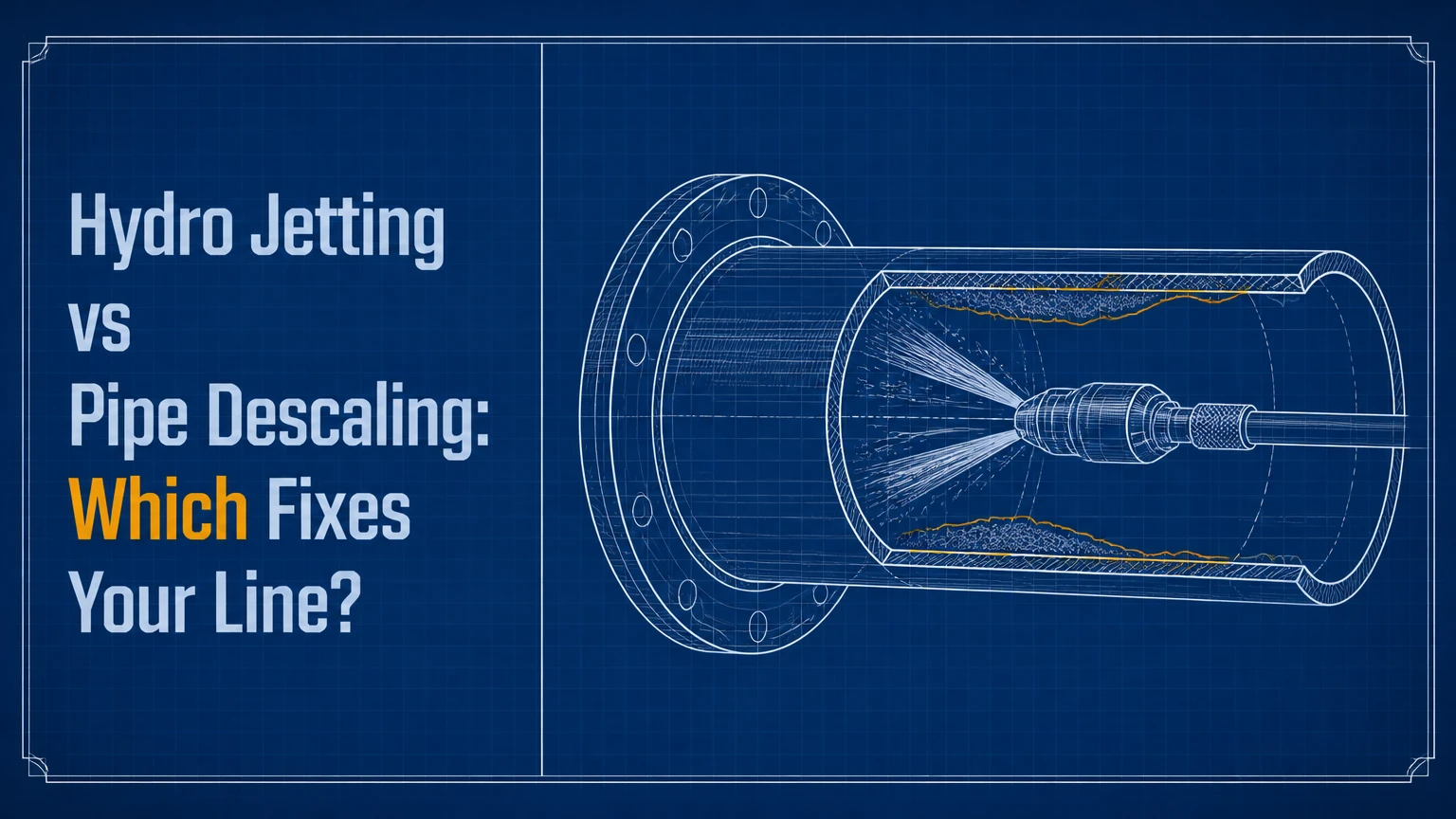
Hydro jetting removes flow-blocking debris with high-pressure water, while pipe descaling mechanically removes hardened deposits bonded to pipe walls. Hydro jetting is usually the better choice for grease, sludge, wipes, and roots; descaling is better for rust tuberculation and mineral scale in aging metal lines. A camera inspection determines whether either method is safe.
Key Facts at a Glance
- Hydro jetting cleans a pipe with pressurized water, commonly using 1,500-4,000 PSI and approximately 5-25 gallons per minute, depending on equipment and line size.
- Pipe descaling uses rotating chains, abrasive heads, or specialized tools to remove rust, tuberculation, and mineral deposits from the pipe wall.
- Hydro jetting targets loose or semi-adherent material; descaling targets hard deposits that reduce the pipe’s internal diameter.
- Neither method repairs a collapsed, badly cracked, separated, bellied, or structurally failed sewer line.
- A pre-treatment CCTV inspection is the safest way to identify pipe material, wall condition, blockage type, and treatment limits.
- A combined sequence, descaling followed by controlled flushing and then lining, can restore flow and protect severely scaled cast-iron pipe.
Hydro Jetting vs Pipe Descaling: What Is the Difference?
Hydro jetting is a hydraulic cleaning process, whereas pipe descaling is a deposit-removal process. Hydro jetting directs water through a selected nozzle to cut, scour, and transport debris; pipe descaling uses mechanical abrasion or, in limited applications, chemical action to detach hardened scale from the pipe wall.
The difference matters because a pipe can be open while remaining severely restricted. A cable machine may punch a small passage through grease, and a water jet may move loose sludge, but neither approach necessarily removes a thick layer of iron oxide bonded around a cast-iron sewer. Conversely, a rotating descaling head is poorly suited to a grease-filled line because the tool can become fouled before reaching the affected section.
“Pipe descaling” also describes more than one technique. Drain contractors may use carbide chain knockers, abrasive brushes, flexible-shaft equipment, water-jet lances, or chemical products selected for a particular deposit and pipe material. Chemical descaling is not interchangeable with mechanical cast-iron descaling, and aggressive acids can damage metal, seals, concrete, or downstream treatment systems.
Master comparison
| Decision criterion | Hydro jetting | Pipe descaling |
|---|---|---|
| Main action | 1,500-4,000 PSI water impact and flushing | Rotating chains, brushes, or abrasive heads |
| Best target | Grease, sludge, roots, wipes, soft deposits | Rust, tuberculation, calcium, mineral crust |
| Typical duration | 1-3 hours for a residential lateral | 3-6 hours for a scaled residential line |
| Typical residential price | $350-$1,000 | $600-$2,000 |
| Common pipe materials | PVC, ABS, clay, concrete, sound cast iron | Cast iron, steel, galvanized iron, selected copper |
| Primary risk | Erosion, joint damage, or wall failure in defective pipe | Perforating thin, corroded pipe walls |
| Final requirement | CCTV confirmation and debris removal | CCTV confirmation, flushing, and often lining evaluation |
How Does Each Method Work?
Hydro jetting converts pump pressure and water flow into a cutting and flushing action, while descaling transfers motor torque through a flexible shaft to an abrasive head. The technician must match the tool to the deposit, internal diameter, access point, and structural condition rather than selecting equipment from pressure alone.
Hydro jetting process
A professional hydro jetting visit normally follows these steps:
- Inspect the line with CCTV. The camera identifies roots, grease, offsets, cracks, bellies, collapsed sections, and the approximate deposit thickness.
- Choose a safe access point. An exterior cleanout is preferable when available because it reduces indoor contamination and provides a straighter hose path.
- Select the nozzle. A forward-cutting nozzle may penetrate a blockage, while rear-facing jets provide propulsion and wall scouring. Rotary nozzles improve circumferential cleaning, and root-cutting heads address fibrous intrusion.
- Set pressure and flow. The operator adjusts equipment for pipe diameter, material, deposit type, and wall condition. A 4,000-PSI machine does not mean 4,000 PSI reaches the pipe wall at every moment.
- Advance and retrieve the hose. The hose is commonly worked upstream against the normal drainage direction, then retrieved slowly so the rear jets wash loosened debris downstream.
- Flush and reinspect. The line is flushed until the discharge clears, and a second CCTV run verifies the result.
A high pressure number without a gallons-per-minute figure gives an incomplete picture. Nozzle orifice size, pump output, hose length, nozzle angle, and distance from the pipe wall all influence actual cleaning performance.
Pipe descaling process
Pipe descaling begins with the same diagnostic discipline but uses a different cutting action:
- Map the scale with CCTV. The technician records the affected length, remaining opening, fittings, joints, and visible wall defects.
- Remove loose material. A low-pressure flush or carefully controlled jetting pass may clear sludge before the abrasive tool enters.
- Size the descaling head. Chains or brushes must contact the deposit without binding against a fragile pipe wall or sharp bend.
- Make controlled passes. The rotating head breaks rust tubercles and mineral crust into smaller fragments. Several slower passes are safer than forcing one oversized tool.
- Flush the fragments. Water carries powdered or loosened scale out of the line, preventing the debris from creating a downstream blockage.
- Inspect the exposed surface. The final camera run may reveal holes, open joints, or paper-thin sections that the scale had concealed.
Descaling restores internal space; it does not rebuild lost metal. If the exposed pipe wall is structurally unsound, lining, spot repair, or replacement becomes the next decision.
Which Debris Does Each Method Remove?
Hydro jetting is the stronger choice for grease, sludge, roots, and soft organic blockages; pipe descaling is the stronger choice for hardened rust and mineral deposits. The dividing line is deposit adhesion: water is efficient against material that can be cut or transported, while bonded scale often requires direct mechanical contact.
| Problem observed by CCTV | Hydro jetting result | Descaling result | Preferred first method |
|---|---|---|---|
| Kitchen grease layer, 1-10 mm | Cuts and flushes grease from the circumference | Tool can clog with soft grease | Hydro jetting |
| Tree-root intrusion, 10-50 mm | Root nozzle cuts and clears fibers | Abrasive head is unsuitable for active roots | Hydro jetting, then repair entry |
| Rust tuberculation, 5-20 mm | May remove loose flakes, not bonded peaks | Breaks and shaves attached tubercles | Pipe descaling |
| Calcium carbonate crust, 3-12 mm | Limited effect unless friable | Abrasive or chemical treatment can remove deposit | Pipe descaling |
| Flushable wipes and paper accumulation | Breaks and transports the mass | No efficiency advantage | Hydro jetting |
| Collapsed or displaced pipe | Cannot restore shape | Cannot restore shape | Repair or replacement |
Hydro jetting can remove some loose rust and scale, particularly from a sound line where deposits are friable. It should not be sold as a guaranteed substitute for mechanical descaling when a CCTV image shows a narrow opening surrounded by hard, mineralized buildup.
Pipe descaling also has limits. It does not reliably remove roots growing through a joint, correct a low spot that holds water, or remove a failed section of pipe. A clean-looking interior cannot compensate for a structural defect outside the camera’s immediate view.
How Do Specifications Compare?
Hydro jetting has measurable pressure and flow settings; mechanical descaling has measurable head size, shaft speed, pass count, and removed deposit thickness. Pressure, gallons per minute, pipe diameter, and material must be considered together because a low-flow machine and a high-flow municipal jetter can produce very different results at the same PSI.
| Specification | Residential hydro jetting | Residential mechanical descaling | Practical meaning |
|---|---|---|---|
| Operating force | 1,500-4,000 PSI at pump | 500-2,000 RPM tool rotation, equipment-dependent | Water impact versus abrasive torque |
| Water demand | 5-25 GPM, typical service range | 1-5 GPM flushing flow, typical | Jetting transports more debris |
| Working diameter | 2-8 inch drains and laterals | 3-8 inch drains and laterals | Tool must fit the internal opening |
| Common nozzle or head | Rotary, penetrating, root-cutting nozzle | Carbide chain, brush, abrasive head | Selection follows deposit type |
| Typical effective pass | 10-30 feet per hose retrieval segment | 10-50 feet per controlled tool pass | Long runs require repeated verification |
| Main measurement after work | Open circumference and clear flow | Removed thickness and remaining wall integrity | CCTV provides the evidence |
PVC and ABS generally tolerate professional jetting when joints and fittings are sound, although excessive force or a poorly chosen nozzle can still damage a defect. Clay pipe can withstand some cleaning methods but may have brittle joints or displaced sections. Cast iron may tolerate controlled jetting when structurally healthy, yet deep corrosion changes the risk calculation.
What should happen before treatment?
A technician should perform CCTV inspection, identify pipe material and defects, confirm access, and explain the treatment limit before applying pressure or abrasion. A camera cannot measure wall thickness with laboratory precision, but it can expose corrosion patterns, holes, offsets, roots, and collapsed geometry that make aggressive cleaning unsafe.
The inspection should answer four practical questions:
- Is the pipe open enough for the proposed nozzle or descaling head?
- Does the line have cracks, open joints, a belly, or a collapse?
- Is the deposit loose, greasy, fibrous, or bonded to the wall?
- Will loosened debris have a clear route to an accessible downstream point?
A camera-first rule prevents a common false economy. Jetting a collapsed sewer does not reopen its shape, and descaling a heavily perforated cast-iron pipe can remove the material that was temporarily bridging a hole.
Which Method Is Safer?
Neither method is automatically safe for every pipe. Hydro jetting presents more hydraulic risk to defective lines, while descaling presents more abrasion risk to thin-walled metal; the safer method is the least aggressive process that addresses the diagnosed deposit without exceeding the pipe’s condition.
Hydro jetting safety limits
Hydro jetting should be reconsidered when CCTV shows a collapsed section, severe channeling, large voids, an open joint, or soil visible through a defect. Water can enlarge a failure, move surrounding soil, or send debris toward a weak downstream connection. Operators should also control splashback, isolate fixtures where appropriate, and protect occupants from contaminated wastewater.
The common claim that hydro jetting “cleans every pipe safely” is too broad. Sound PVC is a different engineering situation from a 70-year-old cast-iron lateral with active corrosion. Equipment pressure must be reduced or the method changed when the inspection shows limited wall strength.
Descaling safety limits
Descaling is risky when scale thickness is masking corrosion. An oversized chain can bind at a fitting, damage a joint, or remove the remaining wall of a corroded pipe. A tool that is too small may polish a narrow track while leaving ridges that catch paper and regenerate the blockage.
An experienced contractor should explain what happens if the pipe fails during cleaning. The contract may need to distinguish cleaning from repair, especially when the inspection already shows open joints, extensive rust, or a service line near the end of its expected life.
How Much Does Each Method Cost?
Typical residential hydro jetting costs $350-$1,000 and takes 1-3 hours, while pipe descaling commonly costs $600-$2,000 and takes 3-6 hours. Actual pricing changes with line length, diameter, access, location, camera inspection, disposal, after-hours labor, and whether lining or repair follows the cleaning.
| Service scenario | Hydro jetting typical price | Descaling typical price | Typical duration |
|---|---|---|---|
| Single residential branch, 2-3 inch | $350-$650 | $600-$1,000 | 1-3 hours |
| Main building lateral, 4-6 inch | $500-$1,000 | $900-$2,000 | 2-6 hours |
| Commercial kitchen grease line | $600-$1,500 | $800-$2,500 | 2-8 hours |
| Long multifamily or commercial run | $1,000-$3,000 | $1,500-$4,000 | 4-10 hours |
| Descale plus epoxy lining evaluation | $600-$2,000 cleaning | $3,000-$10,000 total project | 1-3 days |
These are typical planning ranges, not universal rate cards. A low quote may exclude CCTV, a second flush, difficult cleanout access, disposal, or the repair required after descaling reveals a defect.
Hydro jetting is often cheaper for recurring grease maintenance because one visit can clean the entire circumference. Descaling may carry a higher initial cost but can be financially rational when it restores enough diameter to avoid excavation or premature replacement.
Which Method Lasts Longer?
The cleaning method does not determine service life by itself; the underlying cause determines how quickly the line reaccumulates debris. Hydro jetting can provide months to several years of relief from grease when food-service practices improve, while descaling may provide only temporary flow improvement if raw corroded cast iron remains unlined.
Restaurant lines illustrate the difference. Quarterly or semiannual jetting may be appropriate for a high-FOG kitchen, but the schedule should follow grease production, interceptor maintenance, and inspection history rather than a fixed promise. A descaled cast-iron line exposed to moisture and oxygen can continue corroding, so lining or replacement may be needed after the deposit is removed.
Expert insight: cleaning can reveal a larger problem
A recurring blockage after successful hydro jetting often indicates a belly, root re-entry, or structural offset rather than ineffective cleaning. When the pipe is open immediately after service and clogs again within days or weeks, another cleaning pass treats the symptom while leaving the storage point intact.
Expert insight: scale may be hiding leaks
A cast-iron pipe can appear more watertight before descaling because rust and debris bridge a defect. After the deposit is removed, sewer odor, moisture, or a visible perforation may appear. That outcome does not prove the descaling caused the original failure; it may have exposed pre-existing deterioration.
When Is a Combined Treatment Better?
Descaling followed by controlled flushing is appropriate when hard scale and loose debris coexist, particularly in an older cast-iron main that has lost substantial internal diameter. The sequence should end with CCTV and a structural decision, because removing scale without protecting the exposed pipe can produce a short-lived result.
A common rehabilitation sequence is:
- Camera-inspect and document the line.
- Use a suitable descaling head to remove tubercles.
- Flush fragments without sending a heavy debris load into a restricted downstream section.
- Perform a second camera inspection.
- Evaluate epoxy lining, localized repair, or replacement.
- Reinspect after the rehabilitation work.
Lining is not suitable for every pipe. Severe collapse, large missing sections, active groundwater intrusion, or inadequate access may require excavation or sectional replacement. Lining also reduces internal diameter by a small amount, so the pipe must have enough restored opening before installation.
When Is Neither Method Appropriate?
Neither hydro jetting nor pipe descaling is the correct primary solution for a collapsed, badly offset, structurally separated, or inaccessible sewer line. A cable machine may be better for a single acute clog, spot repair may address one failed joint, and replacement may be more economical than repeated cleaning when defects occupy much of the run.
| Diagnosed condition | More suitable alternative | Reason |
|---|---|---|
| Single soft clog near a fixture | 25-75 foot drain cable | Lower setup cost for a localized obstruction |
| Collapsed 4-6 inch sewer | Open-cut or trenchless replacement | Cleaning cannot restore missing geometry |
| One defective joint | Spot excavation or sectional liner | Treats the actual leak location |
| Long sound line needing rehabilitation | Cured-in-place pipe liner | Seals defects after cleaning and drying |
| Root entry through a failed connection | Root removal plus joint repair | Jetting alone does not close the entry path |
| Septic tank outlet restriction | Tank, baffle, or outlet inspection | The blockage may be outside the building sewer |
Chemical drain openers are a poor preparation step before professional jetting. Residual chemicals can create splash and exposure hazards, and the products rarely solve a thick grease mat, root intrusion, or structural defect.
Which Should You Choose?
Choose hydro jetting for grease, sludge, roots, wipes, and soft buildup in a structurally sound line; choose pipe descaling for bonded rust or mineral scale that has narrowed an aging metal pipe. Choose repair or replacement instead when CCTV shows structural failure, and choose a combined descaling and lining plan when scale removal exposes a rehabilitatable cast-iron line.
Newer home with PVC or ABS
Hydro jetting is usually the better option for a newer plastic drainage system with recurring kitchen grease or laundry buildup. PVC and ABS do not normally develop the same iron tuberculation found in cast iron, although mineral deposits can still occur in hard-water or unusual wastewater environments.
Ask for nozzle selection based on pipe diameter and a post-cleaning camera image if the blockage has recurred. Hydro jetting does not correct an installation defect such as inadequate slope or a poorly glued fitting.
Older home with cast iron
Pipe descaling is usually the better diagnostic treatment when CCTV shows rust tubercles and a reduced central opening in cast iron. The technician should inspect for cracks, holes, severe channeling, and thin sections before selecting a chain or abrasive head.
Do not assume that a pre-1980 construction date proves the presence of cast iron or proves that descaling is needed. Confirm the material and deposit visually, because homes may contain galvanized steel, copper, PVC replacements, or mixed materials.
Restaurant or commercial kitchen
Hydro jetting is usually the correct recurring maintenance method for commercial FOG accumulation. A typical program may use quarterly or semiannual cleaning, but the interval should reflect line diameter, cooking volume, interceptor performance, and documented backup history.
Descaling becomes relevant when a commercial building has older metal drainage and CCTV shows mineral or rust restriction beneath the grease layer. Jetting removes the grease first; descaling may follow only after the line’s structural condition is known.
Clay or concrete sewer
Hydro jetting may be suitable for sound clay or concrete, but displaced joints and cracks require a lower-risk plan. Root cutting can clear the immediate obstruction, yet the root entry will recur unless the defective joint is repaired or the affected segment is renewed.
Multifamily building
A multifamily main requires attention to debris transport and downstream capacity. A line that accepts several apartments’ wastewater may need staged flushing, multiple access points, and a camera inspection beyond the original blockage so loosened material does not form a second obstruction.
How Should You Maintain the Line?
Maintenance should address the deposit source, not only the resulting blockage. Commercial kitchens need grease-control procedures, households should avoid wipes and cooking oil, and all properties with recurring sewer problems should track CCTV findings, cleaning dates, pipe material, and failure intervals.
Use these practical controls:
- Collect cooking oil in a container instead of pouring it into a sink.
- Keep wipes, paper towels, and hygiene products out of toilets, even when packaging labels them flushable.
- Maintain grease interceptors according to local requirements and measured accumulation.
- Schedule a camera inspection when a blockage returns within 30-90 days.
- Request a written record of the nozzle or descaling head, pressure, flow, affected length, and post-service findings.
- Reconsider cleaning-only maintenance when the same section fails after two documented treatments.
A clean pipe is not necessarily a healthy pipe. Flow restoration, watertightness, wall integrity, and correct grade are separate conditions that require separate verification.
Frequently Asked Questions
Can hydro jetting remove rust from cast-iron pipes?
Hydro jetting can remove loose rust flakes and some friable deposits, but it is less reliable against thick tuberculation bonded to cast iron. Mechanical descaling is more appropriate for hard rust buildup. CCTV inspection must come first because jetting can expose or enlarge defects in severely corroded pipe walls.
Does pipe descaling remove tree roots?
Pipe descaling is not designed for active tree-root intrusion. A root-cutting hydro jet nozzle or mechanical root cutter can clear the fibers, but recurring roots usually indicate a failed joint or crack. The durable solution is joint sealing, spot repair, lining, or replacement of the affected section.
Is hydro jetting safe for a 50-year-old sewer line?
Age alone does not determine safety. A 50-year-old PVC line may tolerate controlled jetting well, while a younger cast-iron line with deep corrosion may not. The technician should review CCTV evidence for cracks, open joints, wall loss, collapse, and soil intrusion before setting pressure and flow.
How often should a cast-iron pipe be descaled?
There is no universal descaling interval because scale formation depends on pipe age, wastewater chemistry, flow, and corrosion. A cast-iron line that re-restricts within one to three years may need lining or replacement rather than repeated scraping. Post-treatment CCTV and documented recurrence provide a better schedule than a calendar alone.
Can homeowners perform hydro jetting or descaling?
Homeowners can rent drain equipment, but professional hydro jetting and descaling require equipment matching, contamination controls, and structural judgment. A mistaken pressure setting or oversized chain can damage a concealed pipe. Chemical descalers also create exposure and disposal concerns, particularly in occupied homes.
Is pipe descaling better than replacing cast-iron pipe?
Descaling can cost less than replacement when the cast-iron line remains structurally continuous and has enough wall thickness for lining or continued service. Replacement is better when CCTV shows collapse, extensive perforation, repeated leaks, or a large failed section. Descaling restores diameter; replacement restores the pipe itself.
The Bottom Line
Hydro jetting vs pipe descaling is a debris-and-condition decision, not a contest between two universally superior services. Use hydro jetting for grease, sludge, roots, and soft blockages in sound pipe; use pipe descaling for bonded rust or mineral scale in aging metal; and choose repair, lining, or replacement when inspection shows structural failure. The correct sequence begins and ends with CCTV.