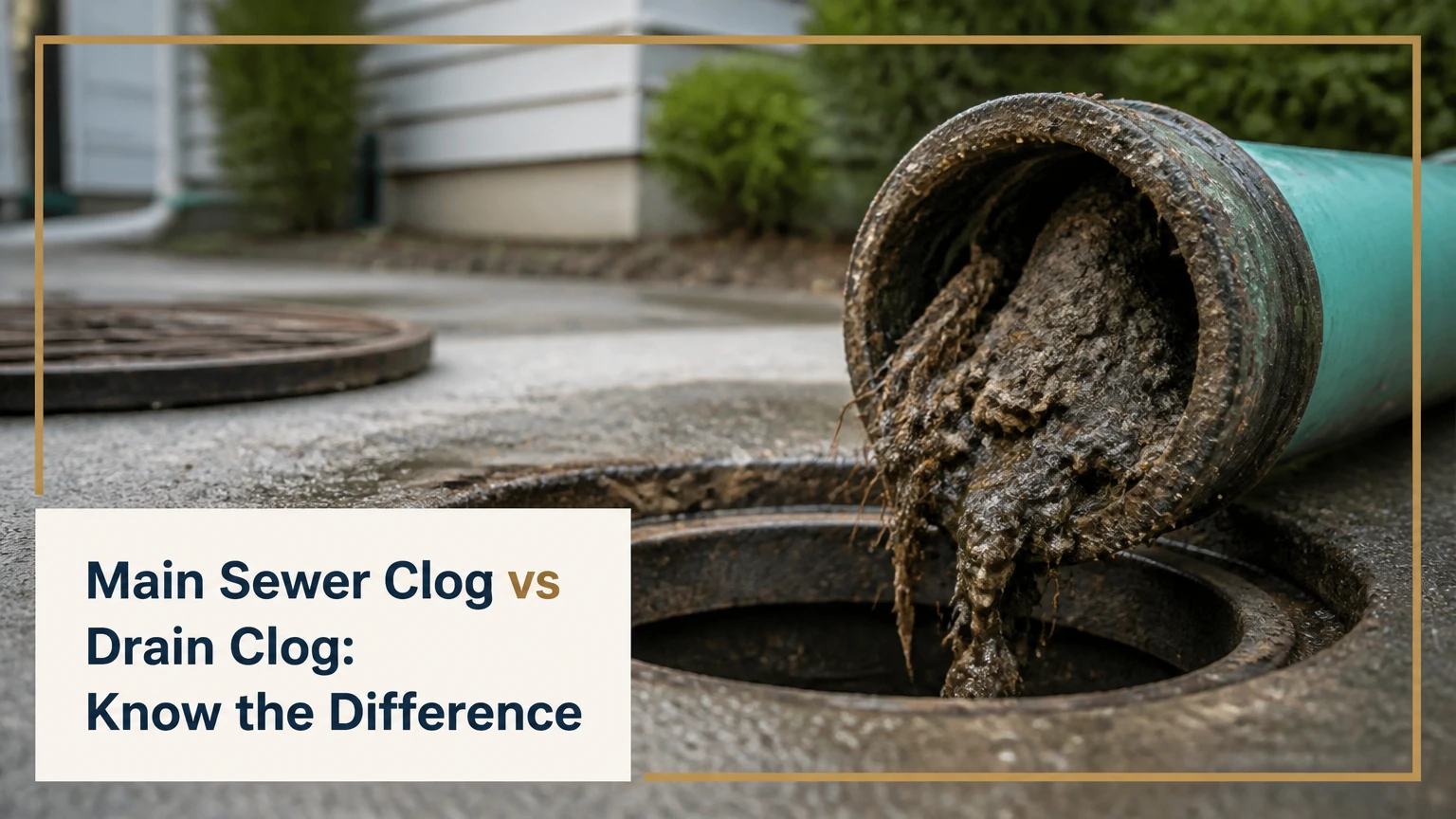
A drain clog affects one fixture or one branch pipe, while a main sewer clog blocks the shared line carrying wastewater from several fixtures toward a municipal sewer or septic tank. A single slow sink usually indicates a local obstruction; simultaneous backups, toilet-to-tub bubbling, or sewage at a floor drain indicate a main-line problem requiring urgent professional attention.
Key Facts at a Glance
- A local drain clog normally affects one sink, shower, bathtub, or toilet.
- A main sewer clog can make several fixtures drain slowly or overflow together.
- The lowest drain in a home often overflows first because wastewater follows gravity.
- Hair and soap commonly block fixture drains; roots, grease, damaged pipe sections, and wipes commonly affect sewer laterals.
- Typical local drain clearing costs $150-$350, while main-line clearing often costs $350-$900.
- Chemical drain cleaner is a poor choice for a fully blocked main sewer line because the product can remain in standing wastewater.
What Is a Drain Clog?
A drain clog is a localized obstruction in a fixture trap, drain fitting, or branch line serving one plumbing fixture. Common examples include hair in a shower drain, food residue in a kitchen sink P-trap, or an object lodged in a toilet trapway.
Most household fixtures connect to a small branch pipe after the P-trap. That pipe joins a larger branch or stack farther downstream, but a blockage close to the fixture usually affects only that fixture. A bathroom sink can therefore drain slowly while the toilet and shower operate normally.
The obstruction may be physical or chemical. Hair binds with soap residue, cooking grease coats pipe walls, and foreign objects reduce the opening available for water. A toilet auger, trap cleaning, or a short hand auger can often resolve a local blockage without accessing the underground sewer lateral.
A local clog is not automatically harmless. A kitchen blockage that recurs every few weeks may indicate a deeper branch-line restriction, poor pipe slope, or grease extending beyond the trap. Repeated clearing is evidence that the cause has not been removed.
What Is a Main Sewer Clog?
A main sewer clog is a blockage in the shared building sewer, also called a sewer lateral or house sewer, between the property plumbing system and the municipal sewer or private septic tank. Because several fixtures discharge through this line, a blockage can affect bathrooms, kitchens, laundry equipment, and floor drains at the same time.
Residential main sewer lines commonly measure 4 inches in diameter, although older or larger homes may use different sizes. The line may run beneath a slab, basement floor, yard, driveway, or public easement before reaching the street connection or septic tank.
The main line can be inside the building near the building drain or outside the foundation in the private lateral. That distinction affects responsibility. A homeowner may own the private lateral, while the municipality usually controls the public sewer main, but local ordinances and service agreements determine the actual boundary.
A septic tank problem can mimic a main sewer clog. A full tank, failed pump, blocked effluent filter, or saturated drain field can produce whole-house backups even when the building sewer is open.
Main Sewer Clog vs Drain Clog: Which Is More Likely?
The fastest distinction is the number and position of affected fixtures. One isolated fixture points toward a drain clog, while several connected fixtures backing up together point toward a main sewer clog or a whole-house septic problem.
| Diagnostic feature | Local drain clog | Main sewer clog | Likely interpretation |
|---|---|---|---|
| Affected fixtures | 1 sink, shower, tub, or toilet | 2 or more fixtures | Shared downstream restriction |
| Water level response | No change in nearby fixtures | Toilet flushing raises tub or floor-drain water | Main-line blockage likely |
| First overflow location | Affected fixture | Lowest drain, shower, or basement toilet | Gravity-driven backup |
| Typical sound | Local gurgle at one trap | Gurgling across bathroom or laundry fixtures | Air displaced around obstruction |
| Cleanout condition | Usually dry | Water or sewage present | Blockage downstream of cleanout |
| Typical first tool | Plunger or hand auger | Main-line cable and camera | Professional access often needed |
| Typical clearing cost | $150-$350 | $350-$900 | Scope and access determine price |
Which Symptoms Point to a Main Line?
Multiple slow drains, wastewater appearing in a bathtub when a toilet flushes, and sewage rising from a basement floor drain are strong indicators of a main sewer clog. A sewer odor alone is weaker evidence because a dry P-trap, damaged vent, or loose toilet seal can also cause odor.
The fixture sequence provides useful location information. If an upstairs toilet affects a nearby shower, the restriction may be in that bathroom branch. If the washing machine causes a basement drain to overflow, the restriction is usually farther downstream in the building drain or sewer lateral.
A cleanout test can add evidence, but opening a pressurized cleanout is hazardous. If a professional opens the cap and wastewater immediately fills the cleanout, the blockage is commonly downstream of that access point. If the cleanout is empty while interior fixtures back up, the obstruction may be upstream or in a branch line.
How Does a Main Sewer Clog Develop?
A main sewer clog usually develops through progressive narrowing rather than one sudden solid plug. Roots, grease, settled solids, or a damaged pipe section reduce the opening, slow flow, and create a surface where paper and waste can accumulate.
The typical sequence is:
- A restriction forms. Tree roots enter joints, grease coats the pipe, or a belly holds standing water.
- Solids catch on the restriction. Paper, wipes, and waste collect around roots or hardened deposits.
- Flow slows. Reduced velocity allows more sediment and organic material to settle.
- The opening becomes inadequate. Normal fixture discharge cannot pass the narrowed section.
- Backpressure rises. New wastewater pushes toward the lowest available fixture or cleanout.
The obstruction does not need to fill the entire pipe before symptoms appear. A partial blockage can cause intermittent gurgling and slow drainage for weeks, then become a complete backup after a laundry cycle or heavy rainfall.
A municipal sewer surcharge is different from a private-line clog. During intense rain or a public sewer obstruction, wastewater can move backward from the city system toward homes. A backwater valve may reduce that risk, but it cannot clear a private blockage or guarantee protection during every surcharge event.
What Causes Each Type of Blockage?
Cause and location matter more than the material alone. Grease can block a kitchen branch, but extensive grease can also obstruct a 4-inch sewer lateral; roots typically indicate a pipe-joint or structural issue rather than a simple disposable clog.
| Cause | More common location | Distinctive clue | Recurrence risk |
|---|---|---|---|
| Hair and soap | Shower or bathroom sink branch | Slow water with visible hair near strainer | High without stopper cleaning |
| Food and grease | Kitchen trap or branch | Drain slows after dishwashing | High if grease enters regularly |
| Foreign object | Toilet trapway or fixture branch | Sudden stoppage after an object is dropped | Medium to high |
| Tree roots | Underground sewer lateral | Repeated backups, often seasonal | High until roots and pipe defect are addressed |
| Wet wipes and hygiene products | Toilet branch or main line | Toilet blockage after repeated flushing | Medium to high |
| Pipe belly | Underground horizontal line | Recurring backup despite cleaning | High until slope is corrected |
| Crushed or offset pipe | Building sewer or lateral | Camera shows deformation or soil intrusion | Very high |
| Full septic tank | Septic system | Whole-house backup with tank-service history | High if maintenance is overdue |
Can Tree Roots Cause a Main Sewer Backup?
Tree roots can cause a main sewer backup when they enter cracked joints or separated pipe sections and form a dense obstruction. Roots do not usually grow through an intact modern PVC pipe wall; their presence often signals a defective connection, joint, or older pipe material.
Cutting roots with a sewer cable may restore flow temporarily, but cable cutting does not repair the opening that allowed roots to enter. Hydro jetting can remove more root fibers and deposits, although the line still requires monitoring or structural repair.
Root treatment products may slow regrowth in some systems, but they are not a substitute for correcting a broken or offset pipe. A camera inspection is the practical way to determine whether roots are the primary issue or merely collecting at another defect.
How Should You Diagnose the Problem?
Start by stopping water use, then identify how many fixtures are affected and whether one fixture changes another fixture’s water level. The most reliable professional diagnosis combines fixture testing, a cleanout assessment, and a sewer camera inspection when the blockage is deep, recurrent, or associated with structural concerns.
Use this sequence:
- Stop discharge. Do not run a washing machine, dishwasher, shower, or bathtub while a main-line backup is possible.
- Test fixture scope. Note which fixtures are slow, overflowing, or making noise.
- Check the lowest level. Inspect basement floor drains, showers, and ground-floor toilets.
- Look for a cleanout. Do not force open a cap if wastewater may be under pressure.
- Call the water authority when appropriate. Ask whether nearby properties have a public sewer outage or surcharge.
- Request camera evidence. A locating camera can identify roots, grease, collapse, offsets, and pipe belly conditions.
A camera is diagnostic, not automatically necessary for every isolated sink clog. It becomes especially valuable when the same sewer line backs up repeatedly, when a cable stops at a fixed distance, or when a home has older clay, cast-iron, or Orangeburg piping.
What Can You Safely Do Yourself?
A homeowner can usually address a simple fixture clog with a properly sized plunger, trap cleaning, or a hand auger. A suspected main sewer clog is different because motorized cables carry enough torque to cause severe injury and can become trapped in collapsed pipe.
For a sink or tub:
- Remove and clean the stopper or strainer.
- Add enough water to cover the plunger cup.
- Seal the overflow opening with a damp cloth.
- Plunge with 15-20 firm strokes.
- Remove and rinse the P-trap if the fixture design allows safe access.
- Use a hand auger designed for the fixture, not a large sewer machine.
Avoid mixing drain chemicals. Sodium hydroxide products, acidic cleaners, and bleach can create heat or dangerous fumes, especially when different products meet in standing water. Enzyme products work slowly on limited organic buildup and are preventive aids, not reliable solutions for a blocked main line.
Stop DIY work when multiple fixtures back up, sewage reaches a living area, a cable meets hard resistance, or the blockage returns after clearing. Those conditions increase the chance of a deeper obstruction or pipe defect.
Which Clearing Method Fits the Blockage?
A local drain clog generally needs a plunger, trap cleaning, or small auger, while a main sewer clog may need a larger cable machine, hydro jetting, or structural repair. The correct method depends on the obstruction and pipe condition, not on the highest advertised pressure.
| Method | Best target | Typical cost | Typical time | Main limitation |
|---|---|---|---|---|
| Plunger | Sink, tub, or toilet opening | $10-$40 DIY | 5-15 minutes | Cannot reach deep defects |
| Hand or closet auger | Fixture trapway or short branch | $25-$200 | 15-30 minutes | Limited reach and cutting power |
| Motorized sewer cable | Roots, solids, and hard obstructions | $150-$900 | 45-180 minutes | May leave grease or damaged pipe |
| Hydro jetting | Grease, sludge, and root fibers | $400-$1,200 | 1-4 hours | Unsafe for severely deteriorated pipe |
| Camera inspection | Unknown or recurring blockage | $200-$600 | 30-90 minutes | Diagnoses but does not clear |
| Pipe lining | Cracked but suitable lateral | $4,000-$12,000+ | 1-3 days | Requires adequate pipe shape |
| Open excavation | Collapse, belly, or severe offset | $5,000-$20,000+ | 2-7 days | Surface and landscape disruption |
A sewer cable is often the first professional response because it can restore an emergency flow path at lower cost. Hydro jetting cleans more of the pipe wall, but a competent contractor should assess pipe material and structural condition before applying high-pressure water.
Hydro jetting is not a universal upgrade. A deteriorated Orangeburg line, badly cracked clay pipe, or collapsed section may fail under aggressive cleaning. The prudent sequence is camera inspection, targeted clearing, and structural evaluation when the video identifies damage.
How Much Do Clearing and Repair Usually Cost?
Typical U.S. residential pricing is $150-$350 for a local drain clog, $350-$900 for main-line clearing, and $4,000-$20,000 or more for major sewer replacement. Local labor rates, emergency timing, access, pipe depth, permits, and restoration can move the final invoice substantially.
| Service scope | Typical residential range | Typical duration | What changes the price |
|---|---|---|---|
| Fixture drain clearing | $150-$350 | 30-60 minutes | Access, urgency, travel |
| Main-line cable clearing | $350-$900 | 1-3 hours | Cleanout access and obstruction |
| Camera and locating | $200-$600 | 30-90 minutes | Line length and reporting |
| Hydro jetting | $400-$1,200 | 1-4 hours | Pipe size, deposits, water access |
| Trenchless lining | $4,000-$12,000+ | 1-3 days | Diameter, length, preparation |
| Open sewer replacement | $5,000-$20,000+ | 2-7 days | Depth, pavement, landscaping, permits |
A quote for “sewer cleaning” may cover only temporary flow restoration. Ask whether the price includes a camera inspection, locating, root cutting, hydro jetting, cleanup, after-hours labor, and a written video report.
Homeowners should also ask who owns the affected section. Insurance commonly excludes gradual wear, roots, and maintenance, although some policies cover resulting water damage or offer sewer-line endorsements. Municipal responsibility varies by jurisdiction and may begin at the property line, curb, or a defined public connection.
When Is Sewer Repair Better Than Repeated Cleaning?
Structural repair is usually better than repeated cleaning when a camera shows collapse, a severe offset, a persistent belly, extensive cracking, or soil entering the pipe. Cleaning removes the immediate obstruction, but it cannot restore pipe slope or close a gap around a broken joint.
| Structural condition | Cleaning outcome | Usually appropriate repair |
|---|---|---|
| Small root intrusion at intact joint | Temporary to medium-term flow | Monitor, root control, or spot repair |
| Heavy grease with sound pipe | Often effective | Hydro jetting and grease control |
| Cracked pipe with stable alignment | May recur | Cured-in-place pipe lining |
| Collapsed section | Cable may not pass | Excavation or pipe replacement |
| Persistent belly | Solids settle again | Excavation and grade correction |
| Separated joints with soil intrusion | Repeated root and sediment entry | Spot repair, lining, or replacement |
| Severely deteriorated Orangeburg | Cleaning may cause failure | Replacement after inspection |
Trenchless cured-in-place pipe lining creates a resin pipe inside a host pipe when the existing route remains reasonably aligned and open. Pipe bursting can replace a line with a new polyethylene pipe, but it needs suitable access and may not solve every depth, utility, or easement constraint.
Open excavation remains the dependable option for a collapsed, back-pitched, or inaccessible line. The surface restoration cost can be substantial when the pipe runs beneath a driveway, retaining wall, mature landscaping, or finished floor.
What Should You Do During a Main-Line Backup?
Stop using all water and keep people away from contaminated wastewater during a suspected main sewer backup. Raw sewage can contain pathogens, and additional discharge from a toilet, washing machine, or sink can force more contaminated water into the building.
Follow these immediate actions:
- Stop toilets, showers, sinks, appliances, and irrigation connected to the home.
- Keep children and pets away from flooded floors and floor drains.
- Avoid electrical equipment in wet areas until an electrician or emergency professional confirms safety.
- Do not pour chemical cleaner into a backed-up fixture.
- Photograph the affected area before cleanup if insurance may apply.
- Call a licensed drain or sewer professional.
- Contact the municipality if neighboring properties report similar backups.
- Arrange professional sanitation for sewage-contaminated porous materials.
A backwater valve can reduce reverse flow from a public sewer, but the valve must be correctly installed, accessible, and maintained. A sump pump handles groundwater or stormwater, not a blocked sanitary sewer line.
How Can You Prevent Future Sewer and Drain Clogs?
Prevention depends on the failure mechanism. Use hair strainers, keep grease out of sink drains, flush only toilet paper and human waste, maintain septic systems on a service schedule, and investigate every recurring backup instead of repeatedly resetting the symptom.
Practical controls include:
- Wipe cooking grease into a container and discard it with solid waste.
- Remove shower hair weekly.
- Never flush wipes, paper towels, diapers, cotton products, or hygiene products.
- Keep large trees away from known sewer alignments when planning landscaping.
- Have a recurring root problem camera-inspected after clearing.
- Maintain a septic tank according to tank size, occupancy, and local requirements.
- Consider a sewer lateral camera inspection when buying an older home.
- Ask commercial kitchens about grease interceptors and documented pumping intervals.
A buyer’s standard home inspection may not include underground sewer video. A separate lateral inspection can identify roots, pipe material, bellies, offsets, and collapse before closing, when repair negotiation remains possible.
FAQ
Can One Clogged Toilet Mean a Main Sewer Problem?
One clogged toilet usually indicates a toilet trapway or nearby branch blockage, especially when sinks and showers drain normally. A main sewer problem becomes more likely when the toilet gurgles, the bathtub level changes after flushing, or another fixture backs up at the same time.
Why Does the Basement Drain Overflow First?
A basement floor drain often overflows first because it is the lowest open connection to the building drain. Wastewater blocked downstream follows gravity toward that drain, although a sealed or absent floor drain may cause a shower or ground-floor toilet to overflow instead.
Should I Use Drano for a Sewer Clog?
Do not use Drano or another caustic chemical cleaner for a suspected sewer clog. The chemical may sit in standing wastewater, fail to reach the obstruction, damage vulnerable piping, and expose the technician to a concentrated product during cable or jetting work.
Is a City Sewer Backup the Same as a Main Sewer Clog?
A city sewer backup and a private main sewer clog produce similar symptoms but occur in different locations. A public main obstruction or storm surcharge pushes wastewater toward connected properties, while a private clog blocks the lateral serving one building. Municipal confirmation and professional testing help separate them.
How Often Should a Sewer Line Be Cleaned?
A sewer line should be cleaned when inspection or symptoms identify a real restriction, not on an automatic schedule for every home. Commercial kitchens and properties with recurring roots may need maintenance every 12-24 months, while a sound residential lateral may need no routine jetting.
The Bottom Line
Main sewer clog vs drain clog diagnosis starts with scope: one affected fixture usually means a local drain blockage, while several slow or overflowing fixtures usually indicate the main sewer lateral, a septic-system failure, or a public sewer problem. Stop water use when backups spread, avoid chemical cleaners, and use camera evidence before approving hydro jetting or structural repair.