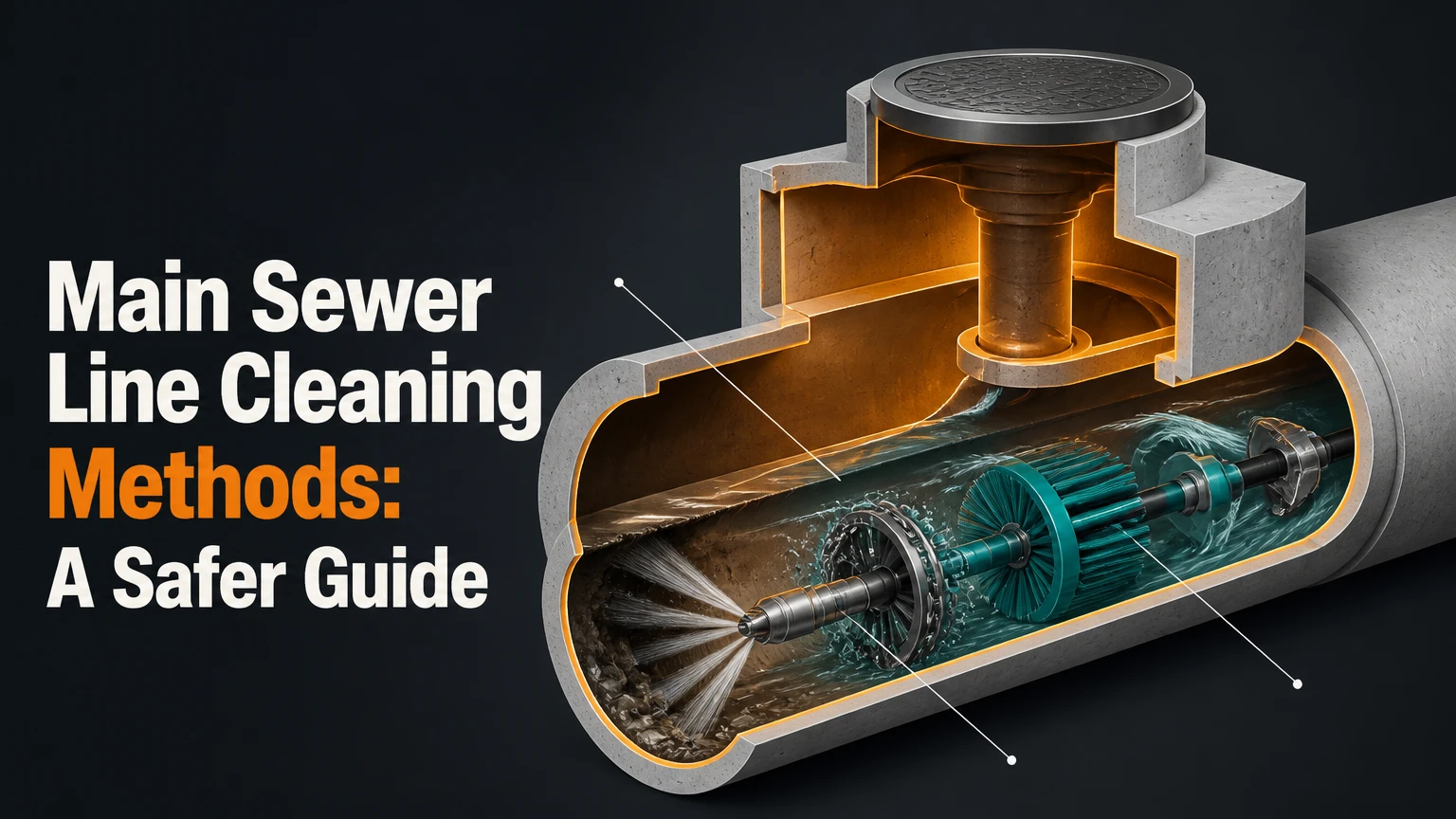
Main sewer line cleaning methods include mechanical augering, hydro jetting, descaling, and carefully selected chemical root treatments. Mechanical cables usually restore flow through a localized obstruction, while hydro jetting cleans broader deposits from sound pipe walls. A CCTV inspection should guide the method whenever roots, recurring backups, old pipe, or structural damage is possible.
Key Facts at a Glance
- A main sewer line commonly measures 4-6 inches inside residential properties and carries wastewater from branch drains toward a municipal sewer or septic system.
- Mechanical snaking removes or penetrates a blockage, but it often leaves grease, scale, or root fragments on the pipe wall.
- Hydro jetting uses high-volume water and cleans more of the pipe circumference, but it should follow a condition assessment on older or damaged lines.
- Root-killing products suppress regrowth; they do not repair cracked joints, replace missing pipe, or remove a complete obstruction.
- Multiple fixtures backing up together usually indicate a blockage in the building sewer or main drain, not a single sink trap.
- Typical United States service pricing ranges from $150-$400 for cable cleaning and $350-$900 for hydro jetting, before unusual access or repair costs.
What Does Main Sewer Line Cleaning Include?
Main sewer line cleaning removes an obstruction or deposit from the private sewer pipe connecting a building to the public sewer or a private septic tank. The work may involve a cleanout, cable machine, high-pressure water jetter, inspection camera, root treatment, or pipe descaling equipment.
The term “main line” can describe different segments. Inside a building, the main drain receives wastewater from toilets, sinks, showers, and laundry branches. Outside, the building sewer or sewer lateral runs through the yard toward the municipal connection. The public sewer main usually belongs to the utility and requires a separate response.
A residential line is often 4 inches in diameter, although 5-inch and 6-inch lines occur in larger homes, commercial properties, and some older installations. A septic system changes the destination, not the need for a clear building sewer. Wastewater still must travel from the house to the tank without obstruction.
How Is a Main-Line Clog Different From a Branch Clog?
A main-line blockage affects several fixtures at once, while a branch blockage normally affects one fixture or one nearby group of fixtures. Toilet bubbling during washing-machine discharge, sewage rising in a basement floor drain, and simultaneous slow drains are strong main-line indicators.
The cleanout test provides useful location evidence. If an exterior cleanout is full of standing sewage, the obstruction is often between that cleanout and the street or septic tank. If the exterior cleanout is empty while interior fixtures back up, the restriction may lie between the house and the cleanout, although cleanout layout and pipe elevation can complicate the diagnosis.
Do not remove a cleanout cap casually when the line may be full. Relieving the cap can release pressurized wastewater across the work area.
Which Main Sewer Line Cleaning Methods Fit Each Problem?
The best cleaning method depends on blockage composition, pipe condition, access, and the required durability of the result. Cable augering is the usual first response for a localized hard blockage, hydro jetting is better for wall deposits in an intact line, and chemical treatment is supplemental rather than a universal unclogging method.
Master Comparison of Cleaning Options
| Method | Best target | Typical equipment or specification | Typical cost | Typical duration |
|---|---|---|---|---|
| Mechanical cable | Paper mass, localized roots, soft blockage | 11/16-inch or 3/4-inch cable; 75-150-foot reach | $150-$400 | 45 minutes-2 hours |
| Hydro jetting | Grease, sludge, scale, widespread root residue | 3,000-4,000 psi; 8-18 gallons per minute | $350-$900 | 1.5-3.5 hours |
| Foaming root treatment | Fine root regrowth at joints | Product-specific foam applicator; label-directed dose | $200-$400 professional | 30 minutes plus dwell time |
| Mechanical descaling | Mineral or rust scale in cast iron | Chain knocker or rotary descaler; camera-guided | $300-$1,000 | 1-4 hours |
| Excavation or trenchless repair | Collapse, severe offset, repeated structural failure | Excavator or cured-in-place pipe system | $3,000-$15,000+ | 1-5 days typical |
Pricing varies by region, emergency timing, cleanout access, distance, disposal, and whether camera inspection is included. The ranges are typical residential United States figures, not guaranteed quotes.
How Does Mechanical Snaking Work?
Mechanical snaking, also called cable cleaning or drain augering, rotates a steel cable through the sewer line to break, pierce, cut, or retrieve an obstruction. A professional selects a cutter such as an auger head, C-cutter, spade blade, or root saw according to the pipe diameter and blockage.
The operator normally starts through a main cleanout rather than a toilet because the cleanout provides a straighter, larger access point and reduces fixture damage. A heavy-duty machine may use an 11/16-inch or 3/4-inch cable and reach approximately 75-150 feet, although actual reach depends on bends and pipe configuration.
The cable usually creates a passage through the obstruction rather than restoring every inch of the original bore. That distinction explains why a line can drain after snaking yet clog again soon when grease, scale, or roots remain attached to the wall.
Mechanical Snaking Procedure
- Confirm the affected line. Stop dishwashers, washing machines, showers, and toilet flushing before opening access.
- Locate and protect the cleanout. Use a downstream exterior cleanout when available, place absorbent materials around the opening, and keep people away from splash exposure.
- Inspect when risk is elevated. Camera inspection is appropriate for recurring backups, root symptoms, unknown pipe material, or a cable that meets an immovable obstruction.
- Choose a starter cutter. Begin with a smaller head when the blockage location is uncertain, then use a full-size cutter only when the pipe condition and diameter support it.
- Feed with controlled rotation. Keep hands away from the rotating cable, prevent cable loops, and never force a stalled machine against a suspected collapse.
- Withdraw and clean the cable. Retrieve debris in stages rather than dragging a heavily loaded cable through every bend.
- Flush and test. Run controlled volumes of water while watching the cleanout and fixtures for renewed backup.
A successful cable cleaning produces sustained flow under a realistic discharge test. A brief improvement followed by slow drainage indicates incomplete cleaning, a pipe defect, or a downstream restriction.
When Is Hydro Jetting the Better Choice?
Hydro jetting is usually the better choice when grease, sludge, mineral deposits, or widespread root residue coats a structurally sound sewer pipe. A pump sends water through a nozzle with rear-facing jets that propel the hose and scour the pipe wall, while a forward jet can penetrate the obstruction.
Pressure alone does not determine cleaning power. Gallons per minute control how much material the system carries away, while nozzle design, hose size, pipe diameter, and operator technique determine coverage. Typical residential equipment may operate around 3,000-4,000 psi at 8-18 gallons per minute, but the pressure at the pipe wall can differ from the pump gauge reading.
Hydro jetting should not be used to compensate for a collapsed, badly cracked, severely offset, or unsupported pipe. A camera inspection before jetting is especially important for Orangeburg, brittle clay, heavily corroded cast iron, and lines with a history of sudden failures.
Hydro Jetting Procedure and Verification
A technician inserts the nozzle through a cleanout, advances it downstream, and performs most wall cleaning while slowly retracting the hose. Rear jets wash loosened grease and sediment toward the outlet, so the downstream connection must be able to receive the wastewater load.
A professional process generally includes:
- Pre-cleaning CCTV inspection when pipe condition is uncertain.
- Nozzle selection for roots, grease, scale, or a combination of deposits.
- Controlled forward advancement without allowing the hose to snag at a joint.
- Slow retrieval passes, sometimes repeated in different directions.
- Post-cleaning camera verification.
- Documentation of remaining cracks, bellies, offsets, or root entry points.
The pipe is not “restored to original condition” if its wall is broken or its slope is defective. Jetting cleans a pipe; it does not correct structural geometry.
Can Chemicals Clean Roots and Sewer Deposits?
Chemical treatments can suppress fine root regrowth or soften selected organic deposits, but they rarely remove a complete main-line blockage. Foaming root products work by contacting roots at joints and perforations, while caustic drain chemicals may react with grease near the fixture but are poorly suited to a large, water-filled sewer line.
Root-control products must be used according to the current product label and local wastewater rules. Copper sulfate and herbicides can create environmental, septic, municipal, or permitting concerns, and some jurisdictions restrict discharge into certain systems. Product names, mixing instructions, dwell times, and application routes should never be improvised.
Chemical treatment cannot repair an open joint, sagging pipe, collapsed section, or missing pipe wall. It also cannot safely dissolve a solid object such as a toy, construction debris, or a broken fitting.
Chemical Treatment Limits
| Condition | Chemical result | Better action | Typical timing |
|---|---|---|---|
| Fine roots at a sound joint | Suppresses regrowth | Cable cleaning, then labeled root control | 4-24 hours dwell |
| Heavy root mat | Limited surface penetration | Mechanical cutting or jetting after inspection | Same day |
| Grease coating | May soften a thin deposit | Hydro jetting and FOG control | 1-3 hours service |
| Complete standing-water blockage | Little reliable contact | Cable or jetting by a professional | Immediate |
| Cracked or collapsed pipe | No structural benefit | Repair, lining, or replacement | 1-5 days typical |
Avoid liquid drain cleaners containing strong acids or caustics in a main sewer line. Standing wastewater dilutes the product, while residual chemical can injure a technician, damage vulnerable materials, or complicate camera and cleaning work.
What Should You Inspect Before Cleaning?
CCTV inspection identifies the cause and location of a sewer problem before a high-force cleaning method is chosen. The camera can reveal roots, grease, scale, offset joints, cracks, bellies, intruding connections, construction debris, and a complete collapse.
A camera inspection does not always need to precede a simple first-time paper blockage in a newer PVC line. It becomes much more valuable when a property has cast iron or clay piping, repeated stoppages, unexplained sewer odors, a low-priced cleaning proposal, or a proposed hydro-jetting service.
The camera should be advanced far enough to identify the municipal connection or septic tank inlet when access permits. A useful report records clock positions, distance, pipe material, defect type, and a surface reference for locating the repair area.
Pipe Material Changes the Risk
| Pipe material | Common issue | Cleaning concern | Evidence for repair |
|---|---|---|---|
| PVC, installed after 1970 | Roots at joints, grease | Generally tolerates routine cable work when sound | Cracks, separations, severe belly |
| Cast iron | Rust scale, narrowed bore | Aggressive descaling can expose thin walls | Perforation, heavy graphitic corrosion |
| Clay tile | Root intrusion, offset joints | Jetting requires condition screening | Multiple offsets, fractures, soil entry |
| Orangeburg | Flattening, softening, deformation | Cable and jetting can worsen fragile sections | Oval bore, collapse, repeated failure |
| ABS | Joint failure, grease | Avoid excessive force at damaged fittings | Split pipe, separated joint |
An older line may appear open on camera yet remain structurally weak. Cleaning success and pipe health are separate findings.
How Much Does Main Sewer Cleaning Cost?
Typical residential main sewer cleaning costs $150-$400 for mechanical cabling and $350-$900 for hydro jetting. A camera inspection commonly adds $100-$500, while difficult access, emergency hours, long lateral distance, or follow-up locating can increase the invoice.
Chemical root treatment typically costs $200-$400 when applied professionally, excluding the initial blockage removal. Descaling, repair, trenchless lining, and excavation cost substantially more because they address pipe condition rather than flow alone.
Typical Cost and Time Comparison
| Service | Labor or equipment scope | Typical price | Typical service time |
|---|---|---|---|
| Main-line cable cleaning | One cleanout, localized blockage | $150-$400 | 45 minutes-2 hours |
| CCTV sewer inspection | Camera travel and recording | $100-$500 | 45 minutes-2 hours |
| Residential hydro jetting | Pump, hose, nozzle, cleanup | $350-$900 | 1.5-3.5 hours |
| Root-control application | Product and professional dosing | $200-$400 | 30 minutes plus 4-24 hours |
| Sewer lateral repair | Excavation or trenchless access | $3,000-$15,000+ | 1-5 days |
Ask whether the quote includes camera footage, cleanup, travel, after-hours fees, a second cleaning pass, and a warranty. A low cable-cleaning price may be reasonable for a straightforward blockage but misleading when the service excludes diagnosis or downstream access.
Which Method Is Safest for Different Situations?
Mechanical cable cleaning is usually the least expensive first intervention for a new, localized blockage in a sound line. Hydro jetting is preferable for recurring grease or broad deposits after inspection confirms adequate structural integrity. Root treatment is maintenance after root removal, not a substitute for opening a blocked pipe.
Older Home With Clay or Cast Iron
Request a camera inspection and identify the pipe material before authorizing high-pressure cleaning. A cable may restore flow through roots, but repeated roots, soil visible through a joint, or heavy cast-iron corrosion indicates a repair conversation.
Restaurant or Commercial Kitchen
Hydro jetting generally provides better deposit removal than repeated snaking because fat, oil, and grease adhere around the pipe circumference. The National Restaurant Association recommends proper grease-management practices, but service frequency must follow the actual FOG load, interceptor performance, and local rules.
A restaurant may need cleaning every 3-12 months, while a low-use commercial line may need less frequent service. The maintenance record should track stoppages, jetting dates, camera findings, and grease-discharge conditions.
Homeowner Considering DIY
Limit DIY work to accessible, low-risk mechanical cleaning with the correct machine, protective equipment, and a clear exit plan. Do not use a pressure-washer sewer hose as a substitute for a commercial jetter, because an uncontrolled hose can become lodged, whip at the cleanout, or expose the operator to contaminated water.
Stop immediately when a cable repeatedly binds, returns damaged, or meets a rigid obstruction. A professional is warranted when sewage is present, the cleanout is inaccessible, the line contains roots, or the pipe material and condition are unknown.
What Problems Can Cleaning Fail to Fix?
Cleaning fails when the obstruction is a symptom of structural or hydraulic failure rather than removable debris. A pipe belly can collect sediment again after every cleaning, while a collapse can trap soil and cause an immediate recurrence.
Common failure patterns include:
- The cable passes, but drainage remains slow. The cutter may have made a narrow channel through grease or roots without clearing the wall.
- The backup returns within hours. A belly, collapse, downstream blockage, or heavy remaining deposit may be present.
- The line clears, then roots return quickly. Root entry usually reflects a joint defect, crack, or deteriorated pipe.
- Water backs up only during heavy rain. Surface-water infiltration, a combined sewer issue, or an overwhelmed public system may be involved.
- The cleanout is dry but indoor fixtures overflow. The restriction may lie upstream of that cleanout or in the building drain.
- The camera cannot pass. A severe offset, collapsed section, blockage, or inaccessible cleanout requires a different access strategy.
A digital sonde can help locate a camera head underground, but locating equipment does not prove the repair scope. Excavation should follow documented defect distance and depth, not guesswork.
When Is Repair Better Than Cleaning?
Repair is better than repeated cleaning when a camera shows collapse, severe deformation, open joints with soil intrusion, a major belly, or pipe material that cannot retain its shape. Cleaning restores passage; repair restores containment, alignment, slope, or structural capacity.
Trenchless cured-in-place pipe lining may rehabilitate a suitable continuous host pipe with limited excavation. It is not appropriate for every offset, collapsed, badly contaminated, or incorrectly sized line. Spot repair can address a localized defect, while full replacement may be more economical when failures occur at multiple locations.
A practical decision rule is simple: one successful cleaning may solve a blockage, two closely spaced recurrences justify inspection, and repeated recurrence at the same camera location justifies a repair estimate.
How Can You Prevent Future Main-Line Blockages?
Prevention combines correct disposal, root management, inspection, and maintenance matched to the property’s risk. No additive can compensate for a broken sewer lateral or a persistent pipe belly.
Use these controls:
- Keep fats, oils, and grease out of household drains; let cooking oil cool and place it in household waste where local rules permit.
- Flush only toilet paper and human waste, unless the local utility gives different instructions.
- Install or maintain a cleanout that remains accessible and properly capped.
- Plant large trees away from the sewer route, considering mature root spread rather than the current trunk size.
- Schedule a camera inspection before buying an older property or after repeated backups.
- Use root-control products only when the label and local regulations allow them.
- Keep records of cleaning dates, blockage locations, pipe material, and camera findings.
A yearly cleaning schedule is not automatically beneficial for every residence. Preventive hydro jetting is more defensible for commercial FOG exposure or documented recurring deposits than for a clean, modern residential PVC line.
FAQ
Does boiling water unclog a main sewer line?
Boiling water is not a reliable main sewer line treatment because the line is large, buried, and often filled with cool wastewater. Hot water may soften a small grease deposit near a fixture, but it cannot cut roots, remove scale, or correct a structural defect.
Can tree roots be permanently removed without replacing the pipe?
Root cutting can restore flow, and labeled foaming treatments can slow regrowth, but roots usually return if the cracked joint or separated pipe remains. Permanent resolution requires repairing or replacing the defective section, although treatment intervals can extend the time before repair.
Should I use a sewer bladder to clear the line?
A sewer bladder can create pressure that dislodges some soft blockages, but it provides poor control in a main line and can force wastewater into unintended branches. A cable machine or professional jetter offers better control, while CCTV inspection is safer when the pipe condition is unknown.
Who is responsible for a blocked sewer lateral?
Responsibility depends on the property boundary, local utility rules, easements, and the location of the defect. Owners commonly maintain the private lateral from the building to the public connection, while the municipality usually maintains the public main, but local ordinances control the final answer.
How often should a residential sewer line be cleaned?
A sound residential line does not require cleaning on a fixed calendar. Inspection or cleaning becomes reasonable after repeated backups, documented roots, heavy scale, or a high-risk older pipe; commercial kitchens may require service every 3-12 months based on FOG loading.
The Bottom Line
The safest main sewer line cleaning methods begin with diagnosis rather than equipment selection. Use mechanical snaking for a localized blockage, hydro jetting for deposits in a structurally sound line, and chemical root treatment only as labeled maintenance after roots are removed. If backups recur, CCTV findings should determine whether cleaning, lining, spot repair, or replacement is the correct next step.