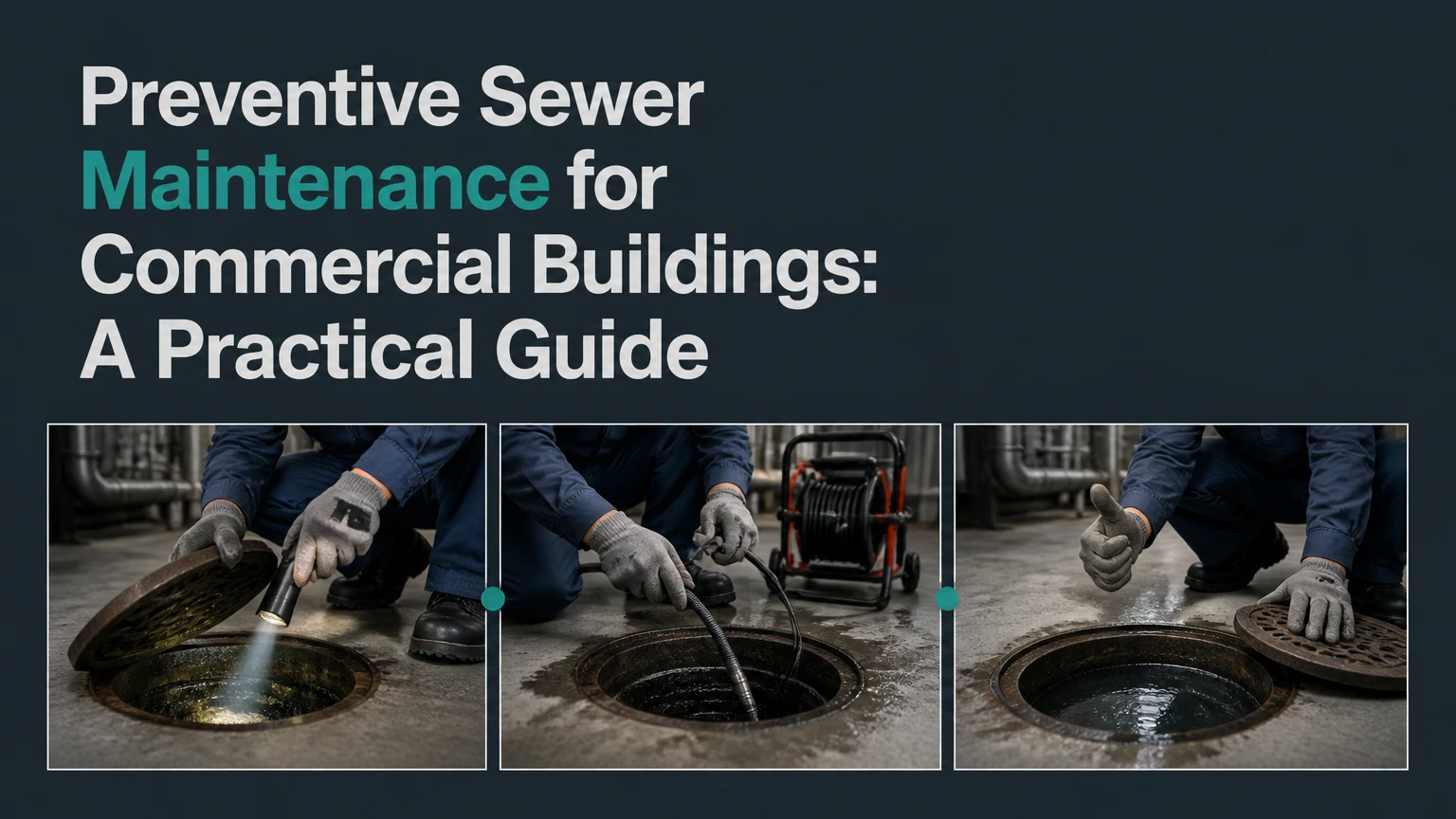
Preventive sewer maintenance for commercial buildings is a scheduled program of inspecting, cleaning, monitoring, and repairing wastewater assets before blockages or failures interrupt operations. The program combines CCTV inspection, targeted jetting or mechanical cleaning, grease-control practices, structural assessment, and documented follow-up. Its success depends on matching service frequency and cleaning method to building use, pipe condition, and consequence of failure.
Key Facts at a Glance
Commercial sewer maintenance programs typically combine CCTV inspection, cleaning, structural assessment, and documented scheduling.
Typical commercial CCTV inspections cost $300-$1,000 and take 1-3 hours, excluding difficult access or confined-space work.
Typical main-line hydro jetting costs $500-$1,500 per run and takes 2-5 hours under normal access conditions.
Hydro jetting removes more wall-bound grease than snaking, while mechanical equipment is better for roots and solid objects.
A cleanout that flows normally does not prove that the downstream pipe is structurally sound or free of deposits.
OSHA 29 CFR 1910.146 applies when sewer access meets the definition of a permit-required confined space; local regulations also govern wastewater discharge and waste disposal.
What Is Preventive Sewer Maintenance for Commercial Buildings?
Preventive sewer maintenance for commercial buildings is a planned asset-management process for sanitary building drains, stacks, collectors, grease interceptors, cleanouts, manholes, and private sewer laterals. Technicians inspect known risk points, remove deposits before hydraulic capacity falls, identify structural defects, and record conditions so future work is based on evidence rather than emergency symptoms.
Commercial wastewater systems face different loading patterns from residential systems. Restaurants discharge fats, oils, and grease (FOG); apartments send wipes and sanitary products into vertical stacks; warehouses contribute sediment and packaging debris; offices produce intense but predictable morning and evening flow peaks.
The business case is operational, not cosmetic. A main-line backup can close food service areas, contaminate occupied space, damage inventory, trigger tenant claims, and require after-hours restoration. Preventive work cannot eliminate every failure, especially when a municipal sewer surcharges or a buried pipe collapses, but it reduces avoidable accumulation and gives managers warning of structural decline.
Which assets belong in the program?
A useful sewer asset register identifies each asset by location, diameter, material, access point, served area, inspection date, condition, and consequence of failure. Include the following:
- Building sanitary branches and horizontal drains.
- Vertical soil and waste stacks.
- Basement collectors and ejector discharge lines.
- Grease traps, grease interceptors, and sampling points.
- Exterior cleanouts, manholes, and private laterals.
- Backwater valves, lift stations, pumps, vents, and floor drains.
- Connections between the building drain and municipal connection.
The highest priority is not necessarily the largest pipe. A six-inch line serving a restaurant kitchen may create more risk than a larger office collector because FOG accumulates quickly and the affected operation may have no practical alternate route.
How Does a Commercial Sewer Maintenance Program Work?
A commercial sewer maintenance program starts with a verified system map, establishes a condition baseline, performs targeted cleaning, and confirms the result with inspection and records. The program then uses recurrence, deposit depth, flow demand, and defect severity to set the next service date rather than applying one interval to every line.
Step 1: Build the sewer asset map
Locate cleanouts, manholes, building traps, grease interceptors, pump basins, stack bases, and known low points. Trace flow direction and note which tenants, kitchens, restrooms, or production zones discharge to each segment.
A basic map should show upstream and downstream access. Without both points, a contractor may push debris farther into the system or fail to verify whether a blockage was actually removed.
Step 2: Inspect before selecting a tool
A CCTV camera records deposits, roots, cracks, open joints, offsets, corrosion, belly sections, intruding laterals, and abandoned connections. Push cameras commonly cover approximately 200-300 feet from an access point; crawler systems can inspect longer, larger-diameter runs when access and pipe geometry permit.
CCTV is not a substitute for cleaning. Heavy grease can hide defects, and a camera may pass through a small opening while the pipe remains hydraulically restricted. For high-risk lines, inspect before cleaning, clean, then perform a post-cleaning scan.
Step 3: Classify the condition
Separate operational defects from structural defects. A grease deposit is an accumulation problem; a fractured clay pipe, displaced joint, or collapsed cast-iron section is a structural problem. The distinction determines whether cleaning solves the risk or only restores flow temporarily.
Use consistent descriptions such as light, moderate, or heavy deposits only when the contractor defines those terms. Better reports include video time, distance from access, clock position, defect type, estimated severity, and recommended action.
Step 4: Clean the identified restriction
Hydro jetting uses water pressure and flow to scour the pipe wall. Mechanical rodding uses rotating cable and cutting or retrieval heads. Biological products may reduce organic loading between physical cleanings, but they cannot repair a crack or remove a rag bundle.
The technician should select nozzle, pressure, flow, cable head, and access direction from the inspection findings. More pressure is not automatically safer or more effective.
Step 5: Verify the result
A completed job should identify the cleaned segment, equipment used, waste removed, access points, before-and-after condition, and next recommended service date. Post-cleaning CCTV is especially valuable when the line had recurring backups, roots, heavy scale, or suspected corrosion.
Step 6: Adjust the interval
A line that remains clean after two six-month services may move to an annual inspection and condition-based cleaning. A restaurant line that reaches heavy FOG accumulation after eight weeks needs a shorter interval, better interceptor practices, or both.
Which Cleaning Method Fits the Failure?
Hydro jetting is usually the best method for wall-bound grease and broad sediment deposits, while mechanical rodding is usually better for roots, rags, and discrete solid objects. Biological treatment can support a grease-control program, but it is an adjunct rather than a replacement for inspection and physical cleaning.
| Method | Typical operating range or capability | Best target | Main limitation |
|---|---|---|---|
| Hydro jetting | 2,000-4,000 psi, 15-25 gpm | FOG, sludge, scale, broad deposits | Can damage fragile or severely deteriorated pipe |
| Mechanical rodding | 3/4-inch or 1-1/4-inch commercial cable | Roots, wipes, objects, localized blockage | Often leaves wall deposits behind |
| Biological dosing | $100-$300 monthly supply, typical | Organic FOG between cleanings | Does not remove roots, rags, cracks, or scale |
| CIPP lining | $150-$300 per linear foot, typical | Cracks, leaking joints, root pathways | Requires suitable geometry, isolation, and curing |
| Epoxy coating | Project-specific, usually spot or full-segment work | Pinhole corrosion and surface defects | Cannot restore collapsed or badly deformed pipe |
When is hydro jetting appropriate?
Hydro jetting is appropriate when CCTV shows grease, sludge, mineral scale, or soft sediment distributed along the pipe wall. Rear-facing jets propel the hose and scour the circumference, while specialized rotating or descaling nozzles increase wall contact.
Jetting should not begin with a fixed pressure assumption. Pipe material, age, defect severity, diameter, nozzle design, hose length, and downstream discharge controls affect the safe operating setup. Old vitrified clay, thin cast iron, cracked concrete, and compromised plastic transitions require condition-based pressure selection.
A vacuum truck or downstream capture point may be needed when large deposits are dislodged. Sending loosened grease into a smaller downstream section can convert one building blockage into a municipal-side restriction.
When is mechanical rodding better?
Mechanical rodding is better for roots, towels, wipes, toys, metal fragments, and other objects that a water jet may not retrieve. A cutter can open a passage quickly, but opening a passage is not the same as cleaning the entire pipe circumference.
Repeated snaking through a corroded cast-iron bottom can expose weak metal or catch on a deteriorated section. If the same segment requires multiple interventions, request CCTV and a structural opinion instead of authorizing unlimited cable work.
What Schedule Should a Commercial Building Use?
Most commercial buildings need a risk-based schedule rather than a universal annual cleaning. Annual CCTV is a reasonable starting point for many main lines, while high-FOG restaurants may need jetting every 3-6 months and root-prone laterals may require semiannual monitoring.
| Building type | Primary sewer risk | Starting inspection interval | Starting cleaning interval |
|---|---|---|---|
| Restaurant or food hall | FOG, food solids, interceptor overload | 3-6 months | Hydro jetting every 3-6 months |
| Office building | Peak occupancy, aging stacks | 12 months | Condition-based, often 12 months |
| Apartment high-rise | Wipes, sanitary products, stack loading | 6-12 months | 6-12 months on collector lines |
| Warehouse or distribution center | Sediment, packaging debris, low-use branches | 6-12 months | 12-24 months if condition remains stable |
| School or campus | Seasonal occupancy, foreign objects | 6 months | Before and after major occupancy periods |
| Healthcare facility | Continuous use, hygiene and contamination controls | 3-6 months | Risk-based, with strict isolation planning |
A schedule should also respond to events. Inspect after a major backup, renovation, tenant change, grease-interceptor failure, flood, root recurrence, or discovery of unknown pipe material. A new restaurant tenant can change the loading profile within weeks.
What should a maintenance record contain?
A defensible record connects the recommendation to observed evidence. Require:
- Asset identifier and exact access points.
- Pipe diameter, material, direction, and inspected length.
- CCTV video with distance counter and date.
- Defect descriptions with timestamps.
- Cleaning method, nozzle or cutter, pressure, flow, and duration.
- Waste volume and disposal destination when applicable.
- Post-cleaning verification.
- Photographs of access conditions and damage.
- Recommended interval, repair priority, and operating restrictions.
How Much Does Commercial Sewer Maintenance Cost?
Typical commercial sewer maintenance costs range from $300-$1,000 for CCTV inspection, $500-$1,500 for hydro jetting a main-line run, and $250-$600 for heavy mechanical rodding. Actual pricing changes with linear footage, access, traffic control, night work, bypass pumping, confined-space requirements, waste disposal, and regional labor rates.
| Service | Typical price | Typical duration | Common trigger |
|---|---|---|---|
| CCTV inspection | $300-$1,000 | 1-3 hours | Annual baseline or recurring symptoms |
| Main-line hydro jetting | $500-$1,500 per run | 2-5 hours | FOG, sludge, or scale deposits |
| Heavy mechanical rodding | $250-$600 | 1-3 hours | Roots or solid obstruction |
| Grease-interceptor service | $300-$1,200 | 1-3 hours | Pumping interval or capacity limit |
| Bypass pumping | $1,000-$5,000+ | 4-24 hours | Flow must continue during isolation |
| CIPP or epoxy rehabilitation | $150-$300 per linear foot | 1-3 days | Recurring structural defects |
These are typical planning ranges, not bids. A 100-foot accessible office line may cost far less than a 300-foot restaurant main requiring traffic control and vacuum capture. Ask contractors to separate inspection, cleaning, disposal, access, emergency labor, and repair allowances.
The correct financial comparison is expected disruption cost, not service price alone. A $900 planned cleaning may be economical when a failed line could close a commercial kitchen for two days and damage finished flooring.
Can Commercial Sewer Pipes Be Repaired Without Excavation?
Commercial sewer pipes can often be rehabilitated without open excavation when the pipe retains a usable pathway and the defect is compatible with lining or coating. Cured-in-place pipe (CIPP) inserts resin-saturated material into the host pipe and cures it, while epoxy coating places a protective resin layer over the interior surface.
| Structural condition | Likely response | Excavation avoidance | Key limitation |
|---|---|---|---|
| Isolated pinhole corrosion | Epoxy coating or spot repair | Usually possible | Surface must be clean and stable |
| Open joint with root intrusion | CIPP or localized repair | Often possible | Lateral connections need reinstatement |
| Long crack with usable bore | CIPP lining | Often possible | Reduces internal diameter slightly |
| Severe ovality or collapsed section | Excavation or replacement | Usually not possible | Liner cannot recreate missing passage |
| Major belly from settlement | Regrade, replacement, or engineered repair | Case-specific | Lining does not correct slope |
| Unknown abandoned lateral | Investigation before lining | Case-specific | Unaddressed connections may remain active |
Trenchless repair is not a universal preventive treatment. A liner may conceal a defect without correcting poor slope, eliminate some access to laterals, or fail when the host pipe cannot support installation. CCTV, cleaning, measurements, and an engineering review should precede a capital decision.
What Safety and Environmental Controls Are Required?
Commercial sewer maintenance requires worker protection, building protection, public controls, and lawful wastewater handling. OSHA 29 CFR 1910.146 governs permit-required confined spaces in covered workplaces, and entry into manholes or sewer structures should never be treated as routine access.
A competent contractor should establish atmospheric testing, ventilation, retrieval, communication, traffic protection, isolation, and rescue procedures before confined-space entry. Hydrogen sulfide and methane are serious hazards, and odor alone cannot establish safe conditions because olfactory fatigue can occur.
Building operations also need controls. Protect floors and walls from hoses, isolate affected fixtures, post wet-floor warnings, coordinate tenant access, and schedule high-noise work outside trading or occupancy hours. Bypass pumping requires capacity calculations, standby equipment, alarm response, and a plan for power loss.
Waste from grease, sludge, and captured debris must go to an authorized disposal route. Local sewer authorities may restrict discharge from jetting or require solids capture. Biological products should not be presented as permission to discharge FOG or chemicals into a municipal system.
Which Problems Require Escalation?
Recurring symptoms across multiple fixtures usually indicate a shared downstream restriction, structural defect, or venting problem rather than several unrelated fixture failures. Escalate from drain clearing to CCTV, flow testing, smoke testing, or structural assessment when symptoms recur after cleaning.
| Symptom | Likely cause | First diagnostic action | Preventive response |
|---|---|---|---|
| Slow drains on several floors | Main collector restriction or sag | Check downstream cleanout and run CCTV | Jet deposits or repair structural defect |
| Gurgling at floor fixtures | Main restriction or vent problem | Check cleanout pressure and roof vents | Clear line, test vents, inspect stack |
| Sewer odor in corridors | Dry trap, failed primer, cracked pipe | Smoke test and inspect traps | Restore trap seal or repair defect |
| Backup after every heavy storm | Infiltration, surcharge, or backwater | Inspect lateral and backwater valve | Seal defects or install engineered protection |
| Same blockage within 30 days | Root intrusion, severe FOG, or collapse | Compare post-service CCTV | Change loading controls or rehabilitate pipe |
| Cleanout overflows during use | Downstream blockage or undersized line | Isolate flows and inspect downstream | Clean, repair, or redesign capacity |
A camera should reach beyond the point where the blockage was removed. A short pass that confirms an opening near the cleanout cannot rule out a downstream belly or displaced joint.
How Should Building Owners Choose a Contractor?
A commercial sewer contractor should provide evidence of diagnosis, safe execution, waste handling, and verification rather than quoting only a cleaning method. The lowest hourly rate is not the lowest operational risk when the contractor cannot map the line or document the result.
Request these items before approval:
- Proof of commercial insurance, licensing, and relevant local credentials.
- A written scope identifying access points, pipe sizes, expected footage, and work hours.
- CCTV deliverables with timestamps, distance markers, and downloadable video.
- Equipment details, including jetting flow, pressure range, nozzle type, and vacuum capture.
- Confined-space, traffic-control, bypass, and emergency procedures.
- Waste-manifest or disposal documentation when solids or grease are removed.
- Separate prices for inspection, cleaning, repair, restoration, and after-hours work.
- Acceptance criteria stating what counts as a completed and verified service.
Avoid contracts that promise a fixed cleaning interval without reviewing service history. A competent program changes when the building use, pipe condition, or failure consequence changes.
What Are the Most Common Maintenance Mistakes?
The most damaging maintenance mistakes are waiting for backups, using aggressive tools without condition data, and failing to capture loosened debris downstream. Each mistake either increases failure probability or turns a manageable restriction into a larger structural or hydraulic problem.
Mistake 1: Treating normal flow as proof of health
A partially blocked pipe can pass ordinary overnight flow and fail during lunch, shift change, or a major discharge event. Flow testing during peak periods and CCTV provide stronger evidence than fixture appearance.
Mistake 2: Snaking without investigating recurrence
A cable can restore flow while leaving grease, roots, or a damaged joint behind. Recurrence within 30-90 days should trigger inspection rather than another identical dispatch.
Mistake 3: Using caustic chemicals as a maintenance plan
Caustic or acid drain cleaners create heat and chemical exposure, may damage unsuitable materials, and rarely remove a large downstream FOG mass. Commercial systems need source control, interceptor maintenance, and physical cleaning.
Mistake 4: Jetting an unstable pipe
Hydro jetting can expose weak sections in brittle clay, severely corroded cast iron, or cracked concrete. The operator should review CCTV and adjust pressure, flow, nozzle, and direction before cleaning.
Mistake 5: Ignoring tenant and kitchen behavior
A maintenance contractor cannot compensate for wipes, cooking grease, paper towels, or solids entering the system every day. Install strainers, train tenants, verify interceptor practices, and track the source of recurring loads.
Mistake 6: Accepting no post-work evidence
A paid service without video, measurements, or a written condition update creates no useful baseline. Require documentation that allows the next technician to compare conditions over time.
What Is a Practical 12-Month Program?
A practical first-year program begins with a full asset map and baseline inspection, then uses targeted cleaning and quarterly review of failures, deposits, and tenant practices. The program should prioritize lines whose failure would stop food service, affect multiple floors, or release sewage into occupied areas.
| Month or interval | Activity | Deliverable | Decision point |
|---|---|---|---|
| Month 1 | Asset mapping and baseline CCTV | Map, videos, condition register | Rank assets by consequence and defect |
| Month 2 | Targeted cleaning and interceptor review | Cleaning logs and waste records | Confirm deposits and operational controls |
| Month 3 | Review work orders and tenant reports | Recurrence dashboard | Shorten intervals for repeat failures |
| Month 6 | High-risk line inspection | Updated videos and measurements | Repair, jet, rod, or continue monitoring |
| Month 9 | Kitchen, stack, or low-point audit | Source-control checklist | Correct loading and access problems |
| Month 12 | Annual condition review | Budget and next-year schedule | Set risk-based interval and capital plan |
For restaurants, inspect interceptor performance and FOG loading alongside the sewer line. For office buildings, focus on aging cast-iron stacks, basement collectors, and low-use branches that can lose trap seals. For apartments, combine stack inspection with resident education and rapid reporting of wipes or sanitary-product incidents.
Two practitioner rules improve results. First, clean from the downstream side when the system allows it, because gravity and capture reduce the chance of relocating deposits. Second, compare the same segment at the same access points, because inconsistent camera starting locations make deterioration appear better or worse than it is.
FAQ
Should commercial sewer lines be cleaned every year?
Annual cleaning is a reasonable starting interval for many office and mixed-use buildings, but it is not a universal rule. Restaurants with heavy FOG may need service every 3-6 months, while stable low-loading lines may need annual CCTV and condition-based cleaning. Recurring failures justify a shorter interval or structural investigation.
Is hydro jetting safe for cast-iron sewer pipes?
Hydro jetting can be safe for sound cast iron when the operator selects pressure, flow, nozzle, and direction from CCTV evidence. Severely corroded or thin-walled cast iron may fail during cleaning, so repeated jetting without structural assessment is inappropriate. A post-cleaning scan should confirm the pipe remains intact.
Does enzyme treatment prevent commercial sewer backups?
Enzyme or bacterial treatment may reduce organic FOG accumulation between physical cleanings when dosing, temperature, retention time, and loading are suitable. It does not remove roots, rags, mineral scale, collapsed sections, or displaced joints. Interceptor pumping and source control remain necessary.
How long does a commercial CCTV sewer inspection take?
A typical accessible inspection takes 1-3 hours, although long runs, restricted cleanouts, active flow, large-diameter pipe, and confined-space controls can extend the work. Push cameras commonly inspect 200-300 feet from one access point, while crawler systems can cover longer runs under suitable conditions.
Can a commercial sewer maintenance plan cover tenant spaces?
A building-wide plan can cover tenant branches, shared collectors, grease equipment, stacks, and private laterals if the lease, access rules, and cost responsibilities are defined. Managers should record which tenant discharges into each segment because loading differs substantially between an office, restaurant, salon, and residential unit.
When should a building owner replace rather than clean a sewer line?
Replacement or trenchless rehabilitation should be evaluated when CCTV shows collapse, repeated structural cracks, severe corrosion, persistent root intrusion, major joint displacement, or a settled belly that cleaning cannot correct. Cleaning is appropriate for deposits; it is not a structural repair. Compare repair life, access, downtime, and future maintenance cost.
Conclusion
Preventive sewer maintenance for commercial buildings works best as a documented, risk-based system rather than a recurring emergency cleaning purchase. Start with asset mapping and CCTV, match hydro jetting or mechanical rodding to the actual obstruction, control FOG and foreign objects at the source, verify every service, and escalate recurring defects to trenchless rehabilitation or replacement. A schedule based on building use, pipe condition, and failure consequence protects operations more effectively than an arbitrary annual promise.