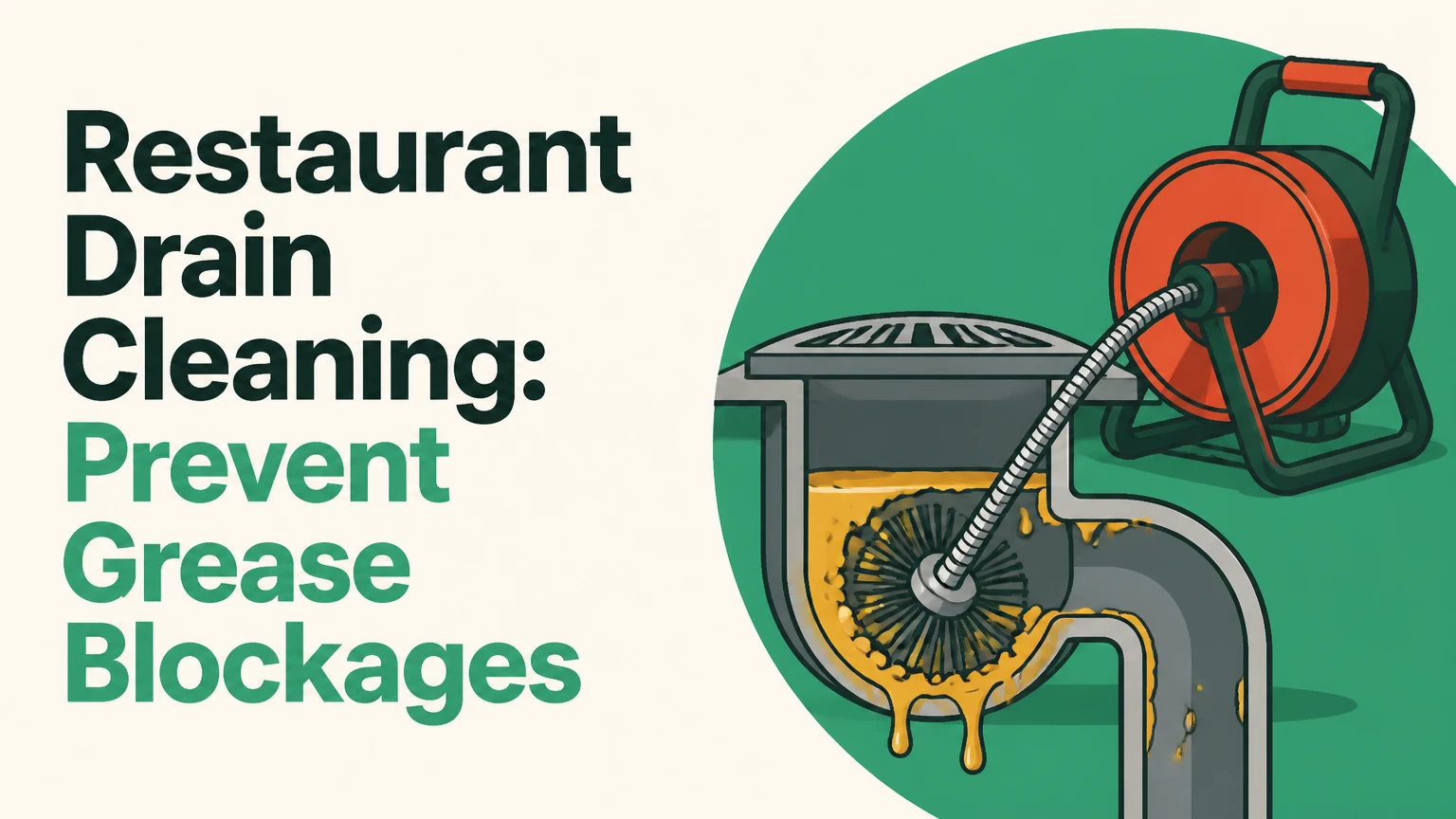
Restaurant drain cleaning is the professional removal of fats, oils, grease, food solids, mineral scale, and other buildup from commercial kitchen drainage. The correct service combines diagnosis, mechanical clearing, and pipe-wall cleaning, while prevention depends on grease-interceptor maintenance, staff practices, and a schedule matched to the kitchen’s wastewater volume.
Key Facts at a Glance
- Commercial kitchen drains commonly carry FOG, food particles, starch, detergent residue, and mineral scale through branch lines and grease-control devices.
- Hydro jetting cleans more of the pipe circumference than snaking, but excessive pressure can damage deteriorated cast iron, Orangeburg, or fragile clay pipe.
- A grease trap or interceptor captures floating grease and settled solids; it does not clean downstream drain lines.
- Typical commercial hydro jetting costs $350-$700 for routine service, while emergency main-line clearing commonly costs $400-$950 or more.
- A recurring blockage after cleaning can indicate a collapsed pipe, poor slope, root intrusion, undersized grease control, or an interceptor that is overdue for pumping.
- Local plumbing, wastewater, and health authorities determine pumping intervals, discharge rules, and acceptable cleaning chemicals.
What Is Restaurant Drain Cleaning?
Restaurant drain cleaning is the inspection and removal of accumulated material from commercial kitchen drain pipes, floor sinks, branch lines, building sewers, and related access points. Unlike a household kitchen line, a restaurant system receives wastewater from dish machines, pot sinks, prep sinks, mop sinks, floor drains, and cooking equipment throughout the operating day.
The material is usually a mixture rather than pure grease. FOG combines with breadcrumbs, rice, flour, meat particles, detergent residue, paper, and mineral deposits. The resulting layer can narrow the pipe without producing an immediate total blockage.
Commercial service differs from grease-trap pumping. Pumping removes contents from the trap or interceptor tank; drain cleaning removes deposits inside the connected piping. A restaurant can have a freshly pumped interceptor and still suffer a blocked downstream main.
The United States Environmental Protection Agency advises food-service operators to prevent FOG from entering drains and summarizes the operational rule as, “Never pour fats, oils, or grease down the drain.” That rule reduces loading, but it cannot remove buildup already bonded to pipe walls.
How Does a Commercial Kitchen Drain System Work?
A commercial kitchen drain system carries wastewater by gravity from fixtures into branch lines, larger building drains, a grease-control device, and eventually the municipal sewer. Air admittance or vent piping helps maintain flow and trap seals, while cleanouts give technicians access for cables and jetting hoses.
A typical flow path is:
- A sink, dishwasher, or floor drain receives wastewater.
- A basket strainer or solids interceptor captures larger particles.
- Branch piping carries liquid toward a grease trap or interceptor.
- The grease-control device slows flow and separates floating FOG from settled solids.
- The partially clarified liquid continues into the building sewer.
- The building sewer connects to the public sewer or a private treatment system.
Grease-control devices work through retention time, not filtration alone. FOG floats, dense food solids settle, and the middle liquid layer exits. When the grease and solids layers become too deep, effective capacity falls and material passes through the outlet.
Grease Traps and Interceptors
A grease trap is generally a smaller indoor device installed near fixtures, while a grease interceptor is usually a larger outdoor tank with greater capacity and longer retention time. Terminology varies by jurisdiction, so the installation drawing and local authority classification matter more than the name used by a contractor.
| Device | Typical capacity | Common location | Primary service |
|---|---|---|---|
| Under-sink grease trap | 20-50 gallons | Beneath a pot or prep sink | Frequent inspection and cleaning |
| Small indoor interceptor | 50-100 gallons | Kitchen utility area | Pumping and solids removal |
| Outdoor gravity interceptor | 1,000-5,000 gallons | Underground service area | Scheduled vacuum pumping |
| Automatic grease recovery device | 5-50 gallons per hour of rated recovery | Dishwashing or process line | Skimming and component cleaning |
A trap cannot compensate for poor scraping practices, excessive flow, incorrect baffles, or an undersized design. The 25% grease-and-solids trigger cited by many wastewater programs is a useful operating benchmark, but local rules may require a fixed schedule, inspection frequency, or earlier pumping.
Why Do Restaurant Drains Keep Clogging?
Restaurant drains keep clogging when warm, dispersed FOG leaves the interceptor, cools inside downstream piping, and bonds with food solids or scale. The deposit forms a grease shelf along the pipe wall, reducing the usable diameter until normal wastewater flow can no longer pass.
Hot wastewater often makes the problem harder to see. Liquid grease may travel beyond the trap during a busy shift, then solidify in a cooler crawlspace, slab, exterior line, or building sewer. A cable can reopen a narrow channel through the deposit while leaving the surrounding shelf intact.
Recurring blockages have additional causes:
- An interceptor is too small for the fixture load.
- Baffles are damaged, missing, or installed incorrectly.
- The building drain has insufficient slope or a low section, known as a belly.
- Tree roots enter joints in an exterior sewer.
- Cast iron has internal corrosion and rough scale.
- A pipe is cracked, offset, crushed, or partially collapsed.
- A floor drain receives mop water containing sediment and debris.
- Staff rinse fryer residue, sauces, coffee grounds, or food scraps into sinks.
A blockage returning within days or weeks deserves camera inspection rather than repeated chemical or cable treatment. Repetition is diagnostic evidence.
Which Cleaning Method Fits the Blockage?
Hydro jetting is usually the best choice for grease-coated commercial drain lines, while mechanical augering is better for a localized obstruction or an emergency opening. Enzyme treatments support prevention but cannot reliably remove an active blockage, and pipe condition determines whether high-pressure water is safe.
| Method | Typical operating range | Best application | Main limitation |
|---|---|---|---|
| Hydro jetting | 1,500-4,000 PSI; 4-12 GPM | FOG shelves, sludge, soft food buildup | Can damage weak or fractured pipe |
| Mechanical augering | 3/8-3/4-inch cable; 50-200 feet | Utensils, hard objects, immediate openings | Often leaves wall coating behind |
| Vacuum extraction | 1,000-3,000 CFM typical truck capacity | Standing wastewater and tank contents | Does not scour pipe walls |
| Enzyme or microbial dosing | Daily or several-times-weekly application | Residual film and odor control | Cannot repair or open structural failures |
| Hot-water jetting | Approximately 140-160°F where equipment and rules allow | Softened grease in compatible lines | Heat can spread liquefied FOG downstream |
Hydro Jetting
Hydro jetting uses a pump, hose, and nozzle that directs water forward and backward through the pipe. The forward jets penetrate the obstruction, while rear jets move the hose and wash deposits from the circumference.
A technician should select pressure, flow, hose size, and nozzle design for the pipe diameter and material. Higher PSI is not automatically better. Water volume, nozzle angle, access distance, and the ability to drain removed material often determine the result.
Hydro jetting is a poor first choice when a camera shows a fractured line, severe corrosion, Orangeburg pipe deformation, or a completely collapsed section. In those cases, cleaning may expose the defect without restoring reliable service.
Snaking and Mechanical Augering
A sectional cable or drum machine rotates a cutting head through the obstruction. Augering works quickly on a single branch line and can retrieve objects such as utensils, cloths, plastic packaging, or compacted food debris.
The limitation is geometric. A cable commonly creates a passage through the center of grease instead of removing the deposit from the wall. Use augering for access, retrieval, or a rapid emergency opening, then assess whether jetting or repair is needed.
Enzyme and Microbial Treatments
Biological drain treatments can reduce residual organic film when the line is already open and the product is compatible with the facility’s wastewater requirements. Microorganisms metabolize some organic compounds, but performance depends on contact time, temperature, pH, dosage, and continued grease loading.
Biological products do not dissolve utensils, remove roots, correct pipe slope, or clear a dense fatberg. They also do not replace interceptor pumping. A dosing system is a maintenance aid, not an emergency drain cleaner.
Hot Water and Chemical Cleaners
Hot water can temporarily liquefy FOG and move the blockage deeper into a colder section of pipe. It does not remove the grease mass from the drainage system.
Caustic and acidic drain openers create additional hazards. They can generate heat, damage seals or pipe materials, injure staff, and leave corrosive liquid inside a backed-up line where technicians later need to work. Commercial kitchens should follow the product label, sewer authority rules, and the plumbing contractor’s written recommendation instead of pouring retail chemicals into a blocked system.
What Is the Professional Cleaning Process?
Professional restaurant drain cleaning normally follows six stages: site assessment, isolation and protection, inspection, obstruction removal, pipe-wall cleaning, and verification. The exact sequence changes when a camera identifies structural damage or unsafe access.
1. Assess the System and Protect the Kitchen
The technician identifies affected fixtures, cleanouts, pipe diameter, access points, grease-control equipment, and discharge locations. The crew protects food-contact surfaces, isolates the work area, wears gloves, eye protection, waterproof clothing, and respiratory protection where conditions require it.
The operator should stop water use in the affected zone. Continued discharge can overflow floor sinks, spread contaminated wastewater, and obscure the original failure point.
2. Inspect With a Camera
A sewer camera helps locate the blockage and distinguishes grease from a foreign object, root intrusion, broken pipe, offset joint, or low section. Camera footage is especially valuable when the same line has required multiple visits.
Inspection has limits. Heavy grease can obscure the lens, small branch lines may not accept a camera, and standing wastewater can reduce visibility. A competent contractor records the accessible findings rather than promising that a camera can see every inch.
3. Open the Line Mechanically When Necessary
An auger, retrieval head, or water vacuum may create initial access through a solid obstruction. This stage reduces pressure on the jetting equipment and prevents a large object from being pushed farther into the system.
Technicians should not force a cable through a line suspected of collapse. Resistance, cable damage, or an inability to reach a known cleanout can indicate a structural defect.
4. Hydro-Jet the Pipe
The technician chooses a nozzle matched to the line. A penetrating nozzle may open dense material, while a rotary or flushing nozzle can improve wall coverage after the central blockage is cleared.
Typical branch-line work uses approximately 1,500-2,500 PSI. Larger building sewers may use 3,000-4,000 PSI and 4-12 GPM, but those figures are operating ranges, not universal prescriptions. Pipe material, age, wall thickness, and camera findings control the safe setting.
5. Verify Flow and Inspect Again
After cleaning, the crew runs a controlled volume of water through the fixtures and checks downstream flow. A second camera pass can confirm whether grease shelves, roots, cracks, or offsets remain.
A service report should identify the line cleaned, access point, approximate length, nozzle type, pressure and flow used, observed defects, and recommended next interval. Camera footage is stronger evidence than a statement that the drain is “fully clear.”
6. Clean the Interceptor and Document Disposal
Tank pumping, lid cleaning, inlet and outlet inspection, and baffle checks belong in the same maintenance program but may be performed by a different licensed provider. The operator should retain invoices, service dates, waste manifests where required, and photographs of the tank condition.
How Much Does Restaurant Drain Cleaning Cost?
Typical restaurant drain cleaning costs range from $175-$450 for a small grease-trap service, $350-$700 for routine hydro jetting, and $400-$950 or more for emergency main-line clearing. Location, access, pipe length, after-hours labor, disposal requirements, and structural findings can change the total substantially.
| Service | Typical price range | Typical duration | Main price driver |
|---|---|---|---|
| Indoor trap cleaning | $175-$450 | 30-90 minutes | Tank size and access |
| Single branch augering | $200-$500 | 1-2 hours | Depth and obstruction type |
| Routine hydro jetting | $350-$700 | 2-4 hours | Line diameter and buildup |
| Main-line emergency clearing | $400-$950+ | 2-5 hours | Time of service and access |
| Camera inspection with report | $150-$400 | 30-90 minutes | Line length and recording detail |
These are typical commercial-service ranges, not regulated prices. A quote should state whether setup, water, wastewater recovery, disposal, camera inspection, after-hours labor, and return travel are included.
The cheapest opening service may cost more over time if it only punches through the blockage. Compare the expected interval until recurrence, the inspection evidence, and the proposed prevention plan rather than the dispatch price alone.
How Often Should a Restaurant Schedule Cleaning?
A high-volume fryer or full-service kitchen often benefits from quarterly drain-line cleaning, while a small cafe may need annual mechanical cleaning if daily scraping and interceptor maintenance are effective. The correct interval comes from blockage history, grease loading, pipe configuration, and local requirements.
| Kitchen profile | Typical drain-line interval | Grease-control interval | Operating emphasis |
|---|---|---|---|
| Coffee bar or bakery | 6-12 months | Every 30-90 days | Milk fats, flour, coffee solids |
| Small deli | 3-6 months | Every 30-60 days | Sinks, slicers, sauces |
| Fast-casual fryer kitchen | 60-90 days | Every 30-60 days | Fryer and dishwashing FOG |
| High-volume full-service kitchen | 30-90 days | Every 30-60 days | Multiple branches and heavy cooking |
| Institutional kitchen | Based on inspection data | Local authority schedule | Large meal volumes and fixed menus |
Use the shortest interval that prevents recurrence without unnecessary service. If a line blocks twice during one interval, shorten the interval only after checking for structural or design defects.
What Should You Do During an Active Backup?
Stop water use immediately, isolate contaminated areas, and call a commercial drain contractor when multiple fixtures overflow or wastewater reaches food-preparation spaces. Do not add chemical opener, boiling water, or a second appliance discharge to a line that is already backing up.
| Symptom | Likely location | Immediate response |
|---|---|---|
| One sink drains slowly | Local branch line | Stop use, remove visible solids, arrange branch inspection |
| Several fixtures back up together | Shared downstream line | Shut off water use in the kitchen |
| Floor drains bubble when dishwasher runs | Main or interceptor outlet | Stop dishwashing and check accessible cleanouts |
| Sewer odor without backup | Trap seal, interceptor, or vent | Add water to unused traps and schedule inspection |
| Grease appears at an exterior cleanout | Building sewer or interceptor outlet | Keep staff away and arrange containment |
Treat wastewater as potentially contaminated. Keep food, utensils, and packaging away from splash zones, follow the facility’s food-safety response plan, and contact the local health authority if sewage enters food-contact or food-storage areas.
Which Pipe Problems Need Repair Instead of Cleaning?
A collapsed, badly offset, root-filled, or severely corroded pipe needs repair or replacement rather than repeated cleaning. Cleaning can restore flow temporarily, but it cannot correct poor slope, missing pipe sections, failed joints, or a line that has lost structural integrity.
Common findings and likely responses include:
- Grease coating with intact walls: hydro jetting and prevention.
- Localized root intrusion: root cutting followed by joint repair or liner evaluation.
- Low spot with standing water: pipe regrading or replacement.
- Cracked cast iron: targeted replacement or rehabilitation after inspection.
- Orangeburg deformation: replacement is generally more reliable than aggressive jetting.
- Repeated offset joints: excavation, spot repair, or a qualified trenchless option.
- No accessible cleanout: install a code-compliant access point during repair work.
Camera evidence should identify clock-position, distance from the access point, pipe material, and defect type. A contractor who recommends replacement without showing the defect has not provided enough information for a high-cost decision.
How Can Staff Prevent Grease Clogs?
Restaurant staff prevent grease clogs by scraping solids into waste containers, collecting fryer oil separately, using correctly sized strainers, and keeping grease-control devices maintained. Prevention begins before wastewater reaches the sink, because no downstream cleaning method can permanently offset continuous FOG discharge.
Use this operating checklist:
- Scrape plates, pans, and prep equipment into a lined solids container.
- Collect fryer oil for approved recycling or disposal.
- Keep sink baskets installed and empty them during each shift.
- Do not send coffee grounds, flour, rice, bones, or fibrous scraps through drains.
- Dry-wipe oily cookware before washing.
- Clean indoor traps according to the manufacturer and local authority schedule.
- Record interceptor pumping, drain cleaning, odors, backups, and repeat symptoms.
- Train new staff with a sink-side visual instruction sheet.
- Never mix drain chemicals, bleach, acids, or biological products.
- Schedule service during a closed period with enough time for verification.
Very fine strainers are not automatically better. A screen that is too restrictive can clog, overflow, or encourage staff to remove it, so the opening size should match the fixture, solids load, and local plumbing specification.
How Should You Choose a Restaurant Drain Contractor?
Choose a contractor who diagnoses the line, explains the method, protects the kitchen, and documents the result. A responsible quote identifies access points, cleaning scope, pressure and flow plan, disposal method, emergency charges, and conditions that would require repair.
Ask these questions before authorizing work:
- Will the technician perform a camera inspection before or after clearing?
- Does the price include setup, water recovery, disposal, and cleanup?
- What pipe material and diameter can the equipment safely service?
- Will the contractor provide before-and-after footage?
- Is the grease trap pumping included, excluded, or subcontracted?
- What local wastewater or health-code records must the restaurant retain?
- What recurrence interval does the contractor recommend, and what evidence supports it?
- What happens if the line is collapsed or inaccessible?
The best service is not always the highest-pressure service. It is the lowest-risk method that removes the actual obstruction and produces evidence about the remaining condition of the system.
Frequently Asked Questions
Can I use a commercial drain opener in a restaurant?
Chemical drain openers are usually a poor response to a restaurant grease blockage. Caustic products can injure staff, damage plumbing components, react with other chemicals, and remain in standing wastewater. Mechanical clearing and inspection provide safer control, while local rules may restrict chemical discharge into the wastewater system.
Does a grease trap stop all restaurant drain clogs?
A grease trap reduces FOG entering downstream piping, but it does not stop every clog. Food solids, detergent residue, mineral scale, excessive flow, damaged baffles, and grease that passes through with hot wastewater can still accumulate in branch lines and building sewers.
Is hydro jetting safe for cast-iron restaurant pipes?
Hydro jetting can be safe for sound cast iron when a trained technician selects suitable pressure, flow, nozzle, and access. Severely corroded, cracked, or thin-walled cast iron may be damaged by aggressive cleaning, so camera inspection should precede high-pressure work.
How long can a restaurant operate after a drain is cleared?
A properly cleaned and structurally sound line may operate for several months, but recurrence depends on FOG loading, staff practices, interceptor performance, and pipe condition. A drain that blocks again within 30-60 days needs diagnosis rather than repeated emergency opening.
Does enzyme dosing replace grease-trap pumping?
Enzyme dosing does not replace grease-trap pumping, interceptor inspection, or mechanical drain cleaning. Biological products may reduce residual organic film under controlled conditions, but trapped grease and settled solids still require physical removal according to local requirements.
What records should a restaurant keep after cleaning?
Keep the invoice, date, line or tank serviced, access point, method, camera report, before-and-after photographs, disposal documentation, and recommended interval. These records help demonstrate maintenance, reveal recurring failure patterns, and support conversations with plumbing, wastewater, and health authorities.
Conclusion: Build a Maintenance System, Not a Reaction
Restaurant drain cleaning works best as a documented maintenance system that combines staff controls, grease-trap service, camera-based diagnosis, and correctly selected mechanical cleaning. Hydro jetting usually provides the most complete FOG removal, but augering, vacuum recovery, biological treatment, repair, or replacement may be more appropriate for specific conditions.
Use the first blockage to establish a baseline. Record the line, pipe material, cleaning method, recurrence interval, and interceptor condition, then adjust the schedule from evidence. Restaurant drain cleaning becomes predictable when the kitchen prevents solids, the interceptor receives timely service, and the drain contractor verifies both flow and pipe condition.