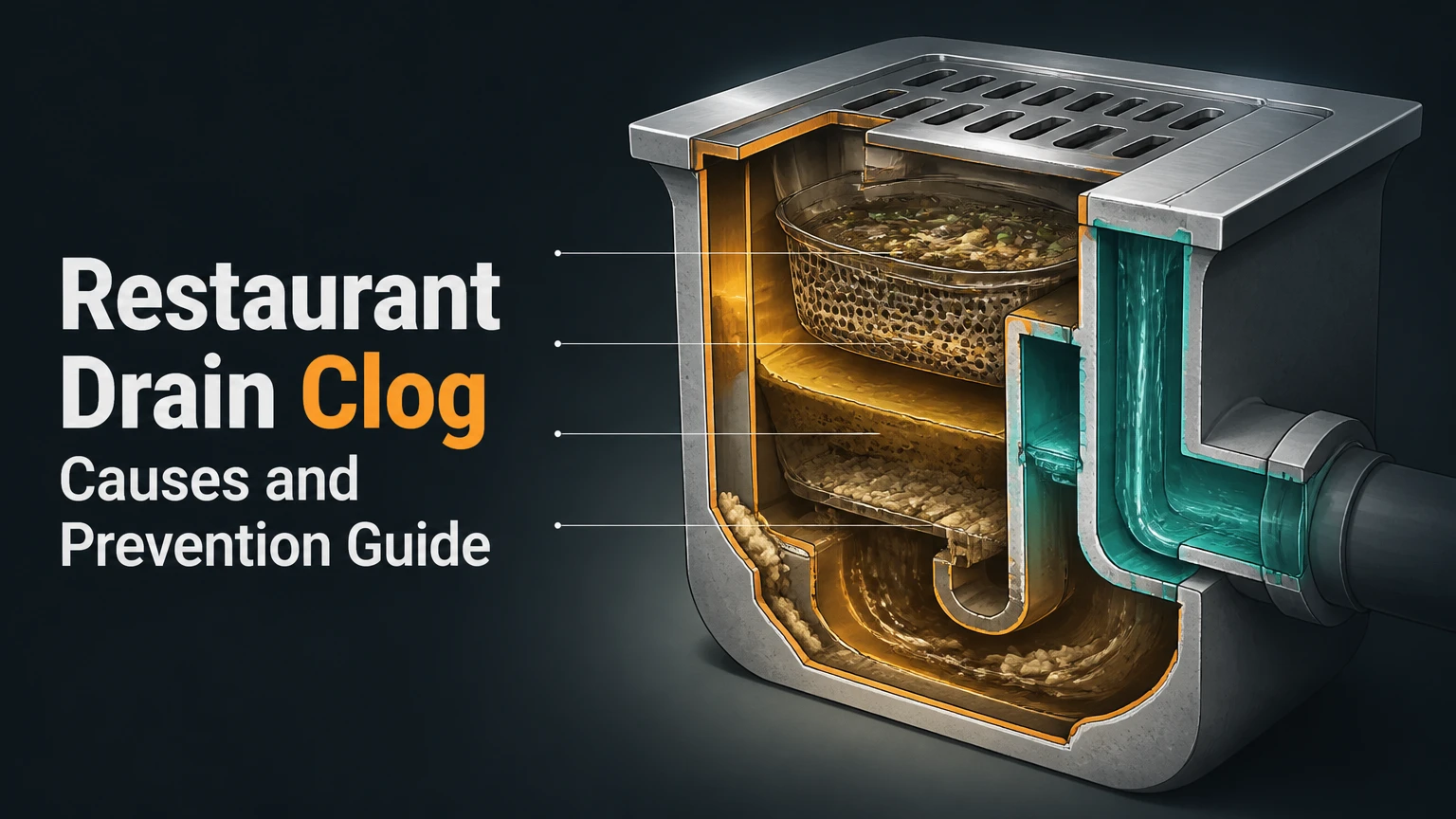
Restaurant drain clog causes usually combine fats, oils, grease, food solids, foreign objects, and defective pipe conditions. FOG cools and coats the line, while starches, fibers, scale, and debris attach to that rough surface until wastewater cannot pass. Commercial kitchens clog faster than homes because high-volume sinks, dishwashers, floor drains, and grease interceptors discharge repeatedly every day.
Key Facts at a Glance
- Fats, oils, and grease are the leading material cause of commercial kitchen drain backups.
- Hot water can move liquid grease farther down a pipe, where cooler conditions allow it to harden.
- A single slow sink usually indicates a local trap or branch-line problem; several overflowing fixtures usually indicate a downstream blockage.
- Rice, pasta, flour, coffee grounds, eggshells, bones, and fibrous vegetables should enter waste containers, not drains.
- A grease interceptor removes FOG only when its capacity, baffles, cleaning schedule, and flow conditions remain suitable.
- Chemical drain openers are a poor commercial-kitchen solution because they create exposure hazards and may damage pipework or equipment.
What Causes Restaurant Drains to Clog?
The main restaurant drain clog causes are FOG accumulation, wet food waste, starch and dough residues, mineral scale, pipe defects, roots, and foreign objects. The highest-risk locations are pot sinks, pre-rinse sinks, dishwasher branches, floor sinks, bar drains, and the main kitchen line.
A restaurant drain rarely fails because of one spoonful of grease. The usual pattern is repeated small discharges. A thin grease film reduces the effective pipe diameter, food particles adhere to it, and each subsequent discharge adds another layer. A 50 mm branch pipe can lose substantial flow capacity even when the obstruction does not yet form a solid plug.
Drain design also matters. Undersized branches, long horizontal runs, poor slope, insufficient cleanouts, and incorrectly installed strainers allow solids to settle before they reach the grease interceptor. High discharge from a commercial dishwasher can then push accumulated material into a restriction and produce an apparently sudden backup.
| Cause | Typical source | Common location | Primary effect |
|---|---|---|---|
| FOG | Frying oil, butter, meat fat, dairy | Pot sink, pre-rinse sink | Sticky wall coating |
| Starch | Rice, pasta, flour, sauces | Prep sink, bakery line | Swelling paste |
| Abrasive solids | Coffee grounds, eggshells, sand | Bar sink, floor drain | Sediment accumulation |
| Fibers | Celery, corn husks, wipes | Prep sink, disposal | Snagging and wrapping |
| Foreign objects | Caps, gloves, wrappers, towels | Floor sink, bar well | Mechanical obstruction |
| Pipe defects | Belly, corrosion, scale, roots | Main or underground line | Permanent restriction |
How Does a Restaurant Drain Clog Form?
A commercial drain clog forms through four connected stages: deposition, cooling, adhesion, and restriction. Liquid FOG leaves kitchen equipment warm, cools inside the branch or building sewer, coats the pipe, and captures solids that would otherwise pass through.
1. FOG cools and thickens
Cooking grease may flow as a liquid near equipment, but underground drainage lines are often much cooler. The United States Environmental Protection Agency identifies fats, oils, and grease as a major contributor to sanitary sewer blockages because FOG accumulates inside sewer pipes and restricts flow.
The exact solidification temperature varies by fat type, water content, and pipe conditions. Beef fat, butter, and some shortening become firm sooner than many vegetable oils. Mixed grease can remain soft while still producing a high-friction coating.
2. Mineral deposits harden the layer
Grease can interact with calcium and magnesium in wastewater and with alkaline mineral surfaces, producing deposits that resemble soap or cement. The chemical process is not identical in every pipe, and the word “saponification” is sometimes used too broadly, but mineral binding and hardening are real reasons old grease deposits resist simple flushing.
Concrete pipe, hard-water scale, and corroded cast iron provide rough surfaces where deposits remain attached. Smooth, correctly sloped PVC reduces mechanical retention but does not prevent a large FOG load from accumulating.
3. Food particles attach to the coating
Rice and pasta absorb water and become cohesive. Flour, batter, and gelatinous sauces form viscous masses that adhere to a greasy wall. Coffee grounds and eggshell fragments behave differently: they are dense granular solids that settle in traps, bellies, and low-flow sections.
4. Flow becomes turbulent or stops
As the opening narrows, wastewater moves less efficiently and solids settle more readily. A dishwasher discharge may expose the restriction by sending a large volume through the branch in a short period. Odor, bubbling, slow drainage, and recurring backups often appear before complete blockage.
Which Materials Create the Worst Commercial Clogs?
FOG creates the most persistent pipe-wall buildup, while starch, fibers, sediment, and foreign objects determine how quickly a partial restriction becomes a total blockage. Material type matters because a cable may pierce a soft food plug but leave the underlying grease layer intact.
| Material | Why it causes trouble | High-risk station | Best control |
|---|---|---|---|
| Frying oil and lard | Cools into deposits and coats walls | Fryer and pot-wash area | Collect in sealed waste containers |
| Meat fat and butter | Solidifies readily and binds debris | Grill, butcher, prep sink | Dry-scrape pans before washing |
| Rice and pasta | Absorb water and swell | Prep and dish areas | Scrape into food-waste bins |
| Flour, batter, dough | Forms adhesive paste | Bakery and pizza stations | Dry-scrape, then wipe |
| Coffee grounds | Dense particles settle like sediment | Coffee and bar sinks | Use grounds collection bins |
| Eggshells | Abrasive, slow to break down | Prep sink or disposal | Place in organics or trash |
| Celery and corn husks | Fibers wrap around strainers | Salad and prep sinks | Use a solids container |
| Wipes, gloves, wrappers | Do not disperse in water | Floor sinks and wash areas | Keep waste away from drains |
Why are coffee grounds and eggshells especially troublesome?
Coffee grounds and eggshells create dense sediment that settles in traps and low spots rather than dissolving. Ground coffee can combine with grease into a thick sludge, while eggshell fragments add abrasive mineral particles that remain after organic material has moved onward.
A disposal does not make these materials harmless. Grinding changes particle size, but it does not remove the solids from the drainage system. Commercial disposals need adequate water flow, correctly sized separators where required, and a waste stream designed for the equipment.
How Do Grease Traps and Interceptors Fail?
Grease traps and grease interceptors fail when FOG loading exceeds their retention capacity, cleaning is delayed, baffles are damaged, or high flow carries grease through the unit. A trap is a control point, not permission to discharge unlimited oil into the plumbing.
An under-sink trap may be suitable for a small café, but a fry-heavy restaurant often requires a larger hydromechanical interceptor or gravity grease interceptor sized by local plumbing requirements. A professional should verify fixture load, flow rate, retention volume, access, and local authority rules rather than selecting capacity from kitchen square footage alone.
Common failure modes include:
- Grease layers become thick enough to reduce the liquid volume.
- Solids settle on the bottom and shorten effective retention time.
- Inlet or outlet baffles break, shift, or become obstructed.
- Staff rinse pans directly into a trap without dry scraping.
- Dishwasher flow exceeds the unit’s rated or practical throughput.
- The interceptor is pumped but the inlet and outlet piping remain coated.
- Odor-control additives mask a full trap instead of removing contents.
A practical inspection should measure both the floating grease layer and settled solids. The often-used two-inch threshold is a maintenance warning, not a universal legal limit. Local regulations, manufacturer instructions, and the authority having jurisdiction control the required servicing interval.
What does a full grease interceptor look like?
A full interceptor usually has a thick floating grease layer, visible settled solids, strong odor, reduced liquid capacity, or grease continuing through the outlet. A full unit may also coincide with slow sinks and downstream backups, but a clean-looking lid does not prove that the outlet line is open.
Can Poor Plumbing Cause a Restaurant Drain Backup?
Poor plumbing can cause repeated restaurant backups even when staff disposal practices are acceptable. Sagging pipe sections, inadequate slope, corrosion, hard-water scale, root intrusion, undersized lines, and missing cleanouts create locations where grease and solids remain.
A pipe belly is a low section that holds wastewater and sediment. Cleaning may restore flow temporarily, but the same section can refill because gravity cannot carry solids through the depression. Camera inspection is the most useful way to distinguish a deposit from a structural defect.
| Structural issue | Camera or site clue | Typical remedy | Cleaning outlook |
|---|---|---|---|
| Pipe belly | Standing water in a low section | Regrade or replace section | Recurs after cleaning |
| Cast-iron corrosion | Flaking, rough internal wall | Descale, line, or replace | Variable |
| Hard-water scale | White or brown rigid narrowing | Mechanical descaling or jetting | Often serviceable |
| Root intrusion | Fine or large roots at joints | Root cutting and repair | Requires monitoring |
| Undersized branch | Frequent restriction at peak flow | Redesign or replacement | Cleaning is temporary |
| Broken joint | Offset, soil intrusion, leakage | Excavation or trenchless repair | Cleaning is insufficient |
Why Does One Restaurant Drain Keep Clogging?
A repeatedly clogged restaurant drain usually has an unresolved source, an undersized or defective branch, an interceptor problem, or incomplete cleaning. If the same sink slows every few weeks, repeated cabling may be removing the symptom while leaving grease on the pipe walls.
Track the fixture, discharge event, interval, and overflow point for at least four weeks. A backup after fryer oil disposal suggests FOG loading; one after a dishwasher cycle suggests branch capacity or a downstream restriction. A clog that returns after professional cleaning deserves a camera inspection, flow assessment, or pipe repair recommendation.
Practitioner rule: if a cable restores flow but the line becomes slow again within 30-60 days, treat recurrence as diagnostic evidence, not bad luck. Grease removal, interceptor correction, or structural investigation is usually more valuable than another identical cable pass.
How Can You Tell Where the Blockage Is?
The number and location of affected fixtures provide the fastest initial diagnosis. One sink points toward a local strainer, trap, or branch restriction; several fixtures, bubbling floor drains, or wastewater rising at a lower drain indicate a downstream or main-line blockage.
| Symptom | Likely location | Immediate action | Escalation |
|---|---|---|---|
| One prep sink drains slowly | Strainer, trap, branch | Stop solids, clean strainer | Plumber if plunging fails |
| Sink and nearby floor sink back up | Shared branch | Stop discharge to both fixtures | Cable or camera |
| Dishwasher makes floor drain rise | Downstream kitchen line | Stop dishwasher and water use | Emergency service |
| Several floor drains overflow | Main kitchen line | Isolate affected area | Hydro jet or inspection |
| Foul odor without backup | Trap or interceptor | Inspect water seal and grease | Maintenance service |
| Backup appears outside building | Building sewer or municipal line | Stop all discharge | Licensed diagnosis |
Bubbling does not always prove a grease clog. A blocked vent, damaged trap, or air-pressure problem can produce gurgling, although simultaneous wastewater rise at multiple low fixtures strongly favors a downstream restriction.
Which Drain-Clearing Method Should a Restaurant Use?
Hydro jetting is generally the strongest choice for substantial grease and sludge attached to commercial pipe walls, while cabling suits a localized mechanical obstruction. Bio-enzymatic products support maintenance but do not replace physical clearing, and chemical openers should not be the default commercial response.
| Method | Best target | Typical duration | Typical North American cost | Main limitation |
|---|---|---|---|---|
| Hand auger or plunger | Local soft trap blockage | 10-30 minutes | $0-$250 | Limited reach and cleaning |
| Mechanical cable | Rags, caps, localized plug | 1-2 hours | $250-$800 | May leave grease coating |
| Hydro jetting | FOG, sludge, scale | 2-4 hours | $600-$2,000 | Needs access and trained operator |
| Camera inspection | Recurring or structural clog | 45-90 minutes | $200-$600 | Diagnoses, does not clear |
| Bio-enzymatic treatment | Organic film prevention | Overnight dosing | $50-$300 monthly | Too slow for active blockage |
| Chemical opener | Rarely appropriate commercially | Minutes to hours | $20-$150 | Exposure, damage, disposal risk |
Prices are typical planning ranges, not universal rates. Labor market, access, after-hours work, pipe diameter, disposal requirements, camera recording, and local currency can change the invoice substantially.
When is hydro jetting better than snaking?
Hydro jetting is better than snaking when grease coats a long section of pipe or when a cable repeatedly opens only a narrow channel. High-pressure water can wash deposits from the wall, but an operator must confirm pipe condition and control discharge so the jet does not damage fragile, cracked, or poorly supported lines.
Snaking is preferable for a trapped foreign object, a short branch blockage, or a situation where jetting access is unavailable. A camera inspection before aggressive jetting is prudent for old cast iron, suspected breaks, exposed joints, or unknown pipe material.
Should restaurants use chemical drain cleaner?
Restaurants should not use caustic or acidic drain openers as routine maintenance. Chemical products may create corrosive liquid in the line, damage seals or metals, generate heat, and expose staff or plumbers to hazardous residues that remain after the drain appears open.
Do not mix products, add chemicals to a standing wastewater backup, or send a plumber into a line without disclosing what was poured. Use strainers, dry scraping, scheduled interceptor service, mechanical cleaning, and approved biological maintenance instead.
What Does Commercial Drain Cleaning Cost?
Typical commercial drain cleaning costs range from $250-$800 for localized cabling, $600-$2,000 for hydro jetting, and $200-$600 for camera inspection in North America. Emergency night work, difficult access, excavation, disposal, and structural repairs can exceed those ranges.
| Service scenario | Typical service time | Typical cost | Result expectation |
|---|---|---|---|
| Single sink cable | 1-2 hours | $250-$800 | Immediate local flow |
| Main-line hydro jet | 2-4 hours | $600-$2,000 | Wall cleaning when pipe is sound |
| Camera inspection | 45-90 minutes | $200-$600 | Location and condition evidence |
| Grease interceptor pump-out | 1-3 hours | $300-$1,200 | Restored interceptor capacity |
| Pipe repair | 1-3 days | $1,500-$15,000+ | Addresses structural cause |
| Preventive service plan | Monthly or quarterly | $150-$1,500 monthly | Depends on fixtures and volume |
A low-cost cable call can become expensive if it delays diagnosis of a belly or collapsed line. Request the service scope in writing: access point, equipment, footage or photographs, disposal, after-hours fees, and whether the quoted work includes cleaning the full affected run.
How Should Staff Prevent Restaurant Drain Clogs?
The most effective prevention system combines dry scraping, correctly sized strainers, interceptor maintenance, staff training, and a documented response threshold. Prevention works at the source because no downstream treatment can reliably compensate for pouring concentrated oil and food solids into the drainage network.
Use this operating sequence:
- Scrape first. Remove oil, sauce, dough, rice, and solids into the appropriate waste container before rinsing.
- Collect FOG separately. Store used fryer oil in a labeled, leak-resistant container for approved recycling or disposal.
- Keep strainers installed. Empty baskets before they overflow, and never sweep debris through a removed grate.
- Protect the interceptor. Follow the manufacturer and local authority schedule, recording pump-outs and defects.
- Control dishwasher discharge. Do not send pans loaded with grease or flour directly into the pre-rinse stream.
- Inspect slow drains early. A slow branch is cheaper to clean than an overflowing main line.
- Use biological maintenance only as support. Apply an approved product at the correct dose and timing, never as a substitute for pumping or jetting.
- Train by station. Bakery, bar, fryer, and dish staff need different disposal rules.
| Restaurant type | Highest-risk waste | Recommended control | Typical review interval |
|---|---|---|---|
| Fried-food kitchen | Fryer oil and meat fat | Dry scrape plus high-capacity interceptor | Weekly checks |
| Café or bar | Coffee grounds and dairy | Dedicated grounds bin and sink strainers | Daily checks |
| Bakery or pizzeria | Flour, dough, batter | Dry bench scraping and solids basket | Each shift |
| Full-service dining | Mixed plate waste and FOG | Plate scraping, pre-rinse strainer | Each shift |
| High-volume cafeteria | Large solids and peak flow | Solids separator and flow review | Monthly review |
A restaurant that changes its menu should reassess drainage demand. Adding a fryer, bakery operation, or high-volume dishwasher can invalidate a maintenance schedule that worked for the previous concept.
What Should Managers Do During a Backup?
Managers should stop water discharge, isolate the affected area, protect food and electrical equipment, and determine whether one fixture or the main line is involved. Staff should not keep running sinks or dishwashers to test a drain that is already rising.
Follow these steps:
- Stop the dishwasher, sinks, ice machine discharge, and floor washing near the affected line.
- Restrict access and use gloves, eye protection, and appropriate contaminated-water procedures.
- Photograph the overflow point and note the last fixture that discharged successfully.
- Remove only accessible strainer debris; do not push objects deeper into the pipe.
- Inspect the grease interceptor without entering it or placing hands into wastewater.
- Use a plunger only on a single fixture with a known local blockage.
- Call a licensed commercial drain professional when multiple fixtures are affected, sewage is present, or the obstruction returns.
- Record the cause, service method, camera findings, and corrective action.
Never enter a grease interceptor. Confined-space hazards include toxic gases, oxygen deficiency, engulfment, and sudden inflow.
What Are the Most Common Prevention Mistakes?
The most expensive mistakes are moving grease instead of collecting it, treating a disposal as a trash system, and accepting repeated cable clearing without diagnosis. Each action can preserve normal flow briefly while increasing the amount of material deposited farther downstream.
Mistake 1: Using hot water to flush oil
Hot water may keep some grease mobile for a short distance, but it does not remove the FOG load. The mixture can cool in the building sewer or municipal connection, creating a deeper restriction.
Mistake 2: Removing drain baskets
A missing basket converts a floor drain into a direct route for caps, wrappers, gloves, towels, and food debris. Locking or secured strainers reduce this predictable human error.
Mistake 3: Pumping the trap without cleaning the line
A serviced interceptor cannot clear grease already deposited in the outgoing pipe. Recurring backups after pump-outs may require jetting and a camera inspection.
Mistake 4: Treating odors as the first warning
Odors often indicate trapped organic material, a dry trap seal, or a full interceptor. Waiting for wastewater to rise turns a maintenance signal into an operational interruption.
Mistake 5: Applying enzymes to a solid blockage
Bio-enzymatic products act gradually on accessible organic material. They cannot retrieve a towel, dissolve a plastic cap, correct a pipe belly, or restore a collapsed line.
Frequently Asked Questions
Do restaurant floor drains clog more often than sink drains?
Restaurant floor drains often clog from foreign objects and sediment, while sink drains more commonly accumulate FOG and food waste. Floor drains are vulnerable because staff may sweep debris toward them, remove baskets, or spill solids during cleaning. A floor drain that overflows during dishwasher discharge usually shares a blocked downstream line.
How often should a restaurant grease trap be cleaned?
Cleaning frequency depends on grease loading, trap size, fixture flow, local rules, and manufacturer instructions. Many restaurants need service every 1-4 weeks, while lower-volume operations may use a longer interval. Measure floating grease and settled solids, maintain service records, and shorten the interval when the outlet begins carrying grease.
Can a garbage disposal prevent commercial drain clogs?
A garbage disposal can reduce large plate solids only when the equipment, water flow, separator, and interceptor are correctly designed. It cannot make oil, coffee grounds, eggshells, dough, bones, or fibrous waste safe for unrestricted discharge. Source separation and dry scraping remain more reliable controls.
Why does a drain back up when the dishwasher runs?
A dishwasher releases a large volume of water quickly, exposing a partially blocked branch or main line. The discharge may also carry grease and starch loosened from racks and pans. If a floor drain rises during the cycle, stop the dishwasher and treat the event as a downstream restriction until inspection proves otherwise.
Is a recurring clog evidence that the pipe needs replacement?
A recurring clog does not automatically require replacement, but recurrence after proper wall cleaning indicates a possible structural or capacity problem. Camera evidence of a belly, severe corrosion, root intrusion, broken joint, or undersized pipe supports repair or redesign. A clean, intact line usually needs source-control changes instead.
What is the fastest safe response to a restaurant drain clog?
The fastest safe response is to stop all connected water use, contain the affected area, remove visible strainer debris, and identify the number of affected fixtures. A plunger may help a single local sink blockage. Multiple backups, wastewater contamination, or rapid recurrence requires commercial drain service rather than chemical opener.
The Bottom Line
Restaurant drain clog causes usually begin with preventable FOG and food solids, then become severe because of grease interceptors, pipe scale, poor slope, or incomplete cleaning. Dry scraping, waste separation, secure strainers, scheduled interceptor service, and early diagnosis prevent most operational backups. When several fixtures rise together, stop discharge and investigate the main line. Hydro jetting suits wall-coated grease in sound pipes, while cabling suits localized mechanical obstructions. A camera inspection becomes the better investment when the same restaurant drain clog causes return within weeks.