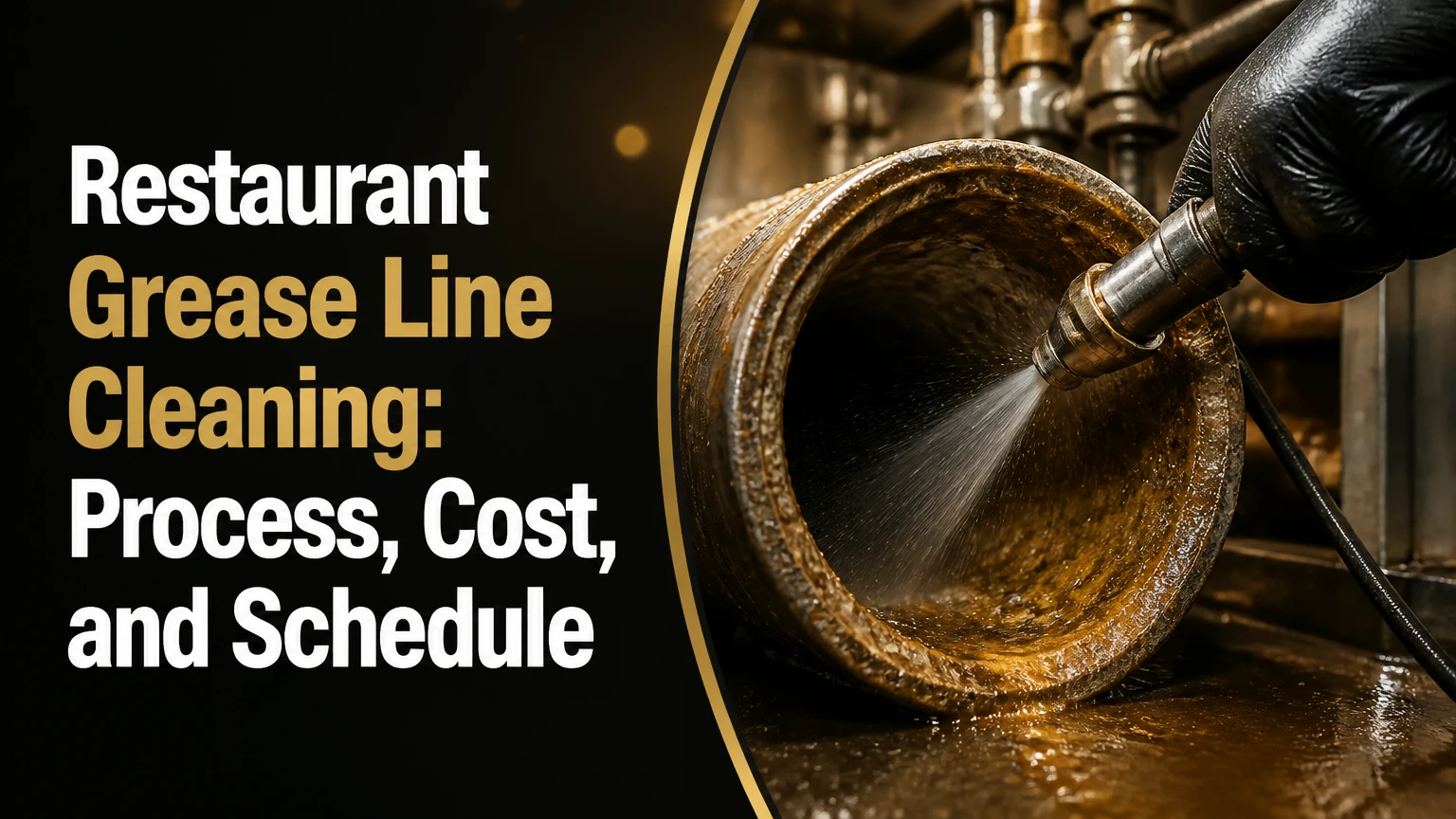
Restaurant grease line cleaning removes accumulated fats, oils, grease, food solids, and scale from the wastewater piping between kitchen fixtures and a grease trap or interceptor. Professional service usually combines inspection, controlled access, mechanical or high-pressure cleaning, waste containment, and flow verification. The correct method depends on pipe condition, blockage severity, line length, and local discharge requirements.
Key Facts at a Glance
A restaurant grease line carries wastewater from FOG-producing fixtures to a grease trap or interceptor.
Hydro-jetting cleans pipe walls more completely than cable snaking, but a camera inspection should precede high-pressure work on older or damaged piping.
Typical commercial service costs about $600-$1,500 for scheduled jetting and $1,500-$3,300 or more for after-hours emergencies.
A grease interceptor’s 25% maintenance rule is common in some programs, but local authorities determine the enforceable threshold.
High-volume kitchens often need cleaning every 1-3 months; lower-volume facilities may need service every 4-6 months.
Enzyme or bacterial products can support prevention, but they cannot repair a collapsed pipe or reliably clear a solid blockage.
What Is a Restaurant Grease Line?
A restaurant grease line is the dedicated wastewater piping that receives discharge from commercial kitchen fixtures and routes it through a grease control device. Typical connected fixtures include three-compartment sinks, pot sinks, pre-rinse stations, floor sinks, floor drains, wok stations, tilt skillets, and some dishwashing equipment.
The line normally ends at an indoor grease trap or an outdoor grease interceptor. The sanitary sewer line is a separate downstream system that usually receives treated effluent from the grease device, while restroom fixtures typically connect through a different branch.
Why restaurant lines clog
FOG enters as a liquid when hot water carries it away from cookware and dishes. As the wastewater cools inside the pipe, grease adheres to rough surfaces and combines with starch, food particles, detergent residue, and mineral scale. A pipe can retain flow while losing much of its usable diameter, so a sudden backup may represent months of hidden accumulation rather than one isolated event.
Pipe material changes the risk. Rough cast iron, poorly aligned joints, low-slope sections, and long horizontal runs hold more material than smooth, correctly sloped piping. A grease trap that is full, poorly sized, or bypassed can also move excessive FOG into the line beyond the trap.
How Does FOG Build Up Inside the Plumbing?
FOG buildup begins when hot, contaminated wastewater loses heat faster than the grease can remain suspended. The resulting coating narrows the pipe, traps solids, increases friction, and eventually creates a restriction that affects multiple fixtures.
Kitchen practices determine how much material enters the line. Dry scraping plates into a waste container removes a large share of grease before washing, while grinders and unrestricted sink discharge reduce solids into small particles that attach readily to pipe walls.
A useful diagnostic distinction is location. A single slow sink often indicates a local branch restriction; several slow fixtures or rising floor drains usually indicate a shared branch, interceptor problem, or downstream sewer issue.
What a line cleaning actually removes
Professional cleaning targets accumulated material on the pipe interior, not merely the water standing behind a clog. The technician should identify whether the obstruction is grease, food solids, scale, roots, a foreign object, displaced pipe, or structural failure.
Cleaning cannot restore a pipe that is crushed, separated, badly sagged, or incorrectly installed. It can temporarily restore flow through a structurally defective section, but recurring failure requires repair or replacement rather than repeated jetting.
What Happens During Professional Grease Line Cleaning?
Commercial grease line cleaning normally follows five stages: diagnosis, preparation, cleaning, waste handling, and verification. A typical internal line up to 150 feet requires 1-3 hours of active work, although access, blockage density, pipe condition, and disposal arrangements can extend the visit.
Step 1: Inspect the line and locate access
The technician identifies the nearest cleanout, confirms the affected fixtures, and uses a drain camera when access and line diameter permit. Camera inspection can reveal grease depth, cracks, offsets, root intrusion, corrosion, standing water, and the direction of the line.
A camera cannot travel through every blocked or sharply offset pipe. If the lens cannot pass, the technician should document the limitation instead of presenting an incomplete inspection as a full condition report.
Step 2: Shut down fixtures and protect the work area
Staff should stop using connected sinks, dishwashers, floor drains, and other fixtures before the cleanout is opened. Technicians typically use absorbent mats, splash containment, protective coverings, and controlled access around the work zone.
Food, utensils, and sanitized surfaces must remain separated from wastewater equipment. The restaurant should schedule service during a low-use period and assign one manager to confirm when fixtures may return to service.
Step 3: Select the nozzle, hose, and cleaning method
Hydro-jetting uses a pump, hose, and nozzle that directs water forward and backward. Rear-facing jets propel the hose and wash loosened material toward a collection point, while rotating or specialized grease nozzles improve wall contact in larger lines.
Pressure alone does not determine performance. A technician must match pressure, flow, nozzle geometry, hose diameter, pipe size, and pipe condition. Typical commercial jetting may use roughly 3,000-4,000 pounds per square inch and 4-12 gallons per minute, but those figures are operating ranges, not universal requirements.
Step 4: Clean from the appropriate access point
The hose is advanced through a cleanout, floor drain, or other approved access point. The operator works through the restriction gradually, avoiding uncontrolled force that could damage fragile joints or push debris into a difficult downstream location.
The objective is a continuous, open passage with substantially reduced wall buildup. “100% clean” is not a verifiable promise unless the contractor defines the inspection method, pipe condition, and acceptance standard.
Step 5: Capture waste and verify flow
Loosened grease and solids should move to the grease control device or a contained recovery point, not into an unprotected municipal line. Where the interceptor is already full, pumping may be necessary before or during line cleaning.
A final camera inspection is the strongest verification when the line is accessible. The restaurant should receive before-and-after images, the cleaned footage location, observed defects, waste quantity or disposal record when available, and recommendations for the next service interval.
Which Cleaning Method Is Best?
Hydro-jetting is usually the best choice for recurring grease accumulation because it contacts more of the pipe wall than a cable. Snaking remains useful for a localized emergency, foreign object, or line where high-pressure water is unsafe, while biological products fit prevention rather than blockage removal.
| Method | Typical equipment or specification | Best use | Main limitation |
|---|---|---|---|
| Hydro-jetting | 3,000-4,000 PSI; 4-12 GPM; grease nozzle | Wall buildup and recurring restrictions | Can expose weak pipe defects |
| Mechanical snaking | 50-150 foot cable; cutting or retrieval head | Local blockage or foreign object | Often leaves grease coating behind |
| Enzyme treatment | Metered dosing; product-specific temperature range | Preventive organic-load reduction | Cannot repair or reliably open a hard clog |
| Bacterial treatment | Live microbial formulation; scheduled dosing | Odor and FOG support between visits | Sanitizers and hot discharge can reduce performance |
| Chemical opener | Caustic or acidic drain chemical | Generally unsuitable for restaurant grease lines | Exposure, corrosion, and downstream resolidification risks |
When is snaking the better first move?
Snaking is preferable when the line contains a suspected utensil, rag, plastic item, or other discrete obstruction, or when inspection shows an older pipe that cannot safely tolerate jetting. A cable can restore immediate drainage at lower typical cost, often $150-$400, but it may cut a narrow channel through grease instead of removing the annular coating.
A recurring clog within 30-90 days after snaking is evidence that the underlying buildup remains. The correct next action is usually camera inspection followed by full wall cleaning or structural repair.
Do enzymes replace professional cleaning?
Enzymes and bacterial products do not replace professional cleaning. They may reduce odor and slow organic deposits when used as a measured maintenance supplement, but they cannot dissolve a collapsed section, retrieve foreign objects, remove mineral scale, or guarantee removal of hardened grease.
Do not combine biological products casually with disinfectants, caustic chemicals, or very hot discharge. Product labels, local wastewater rules, and the grease-control equipment manufacturer determine whether dosing is permitted.
How Much Does Restaurant Grease Line Cleaning Cost?
Typical scheduled hydro-jetting costs $600-$1,500, while an after-hours emergency commonly costs $1,500-$3,300 or more. Price changes with line length, access, blockage severity, camera inspection, pumping, disposal, travel, pipe diameter, and whether the contractor must open or restore flooring.
| Service component | Typical price range | Typical duration | Main price driver |
|---|---|---|---|
| Camera inspection | $275-$500 | 30-90 minutes | Access and blockage condition |
| Scheduled hydro-jetting | $600-$1,500 | 1-3 hours | Length, diameter, and buildup |
| Emergency unclogging | $1,500-$3,300+ | 2-5 hours | After-hours labor and flooding risk |
| Small indoor trap pumping | $150-$500 | 30-90 minutes | Capacity and access |
| Outdoor interceptor pumping | $325-$950 | 1-3 hours | Capacity, hose distance, and disposal |
These are typical planning ranges, not regulated prices. A written estimate should state whether camera work, water, pumping, disposal, emergency labor, travel, and return visits are included.
How Long Will the Kitchen Be Down?
Most restaurant line-cleaning visits create about 2-4 hours of kitchen disruption, including setup, cleaning, testing, and cleanup. A simple branch restriction may take less than two hours, while a long line, full interceptor, inaccessible cleanout, or structural defect can require most of a service window.
The restaurant should reserve extra time for water testing after cleaning. A line that drains during the technician’s test can still fail when multiple sinks, a dishwasher, and floor drains discharge simultaneously.
What determines the service window?
| Condition | Typical impact on downtime | Scheduling response |
|---|---|---|
| Accessible cleanout and moderate grease | 2-3 hours | Book after closing |
| 100-150 foot internal line | 3-4 hours | Add a full off-peak window |
| Full outdoor interceptor | 3-5 hours | Coordinate pumping truck access |
| Collapsed or offset pipe | 4 hours or more | Plan inspection and repair separately |
| Active flooding or sewage exposure | Variable | Stop water use and use emergency response |
How Often Should a Restaurant Schedule Cleaning?
High-volume kitchens commonly schedule grease line cleaning every 1-3 months, standard restaurants every 3-4 months, and low-volume cafes every 4-6 months. The correct interval is the shortest period that prevents measurable restriction, odor, or overflow under normal operating load.
A fixed quarterly contract is a starting point, not proof of adequate maintenance. Track the date, symptoms, trap condition, line findings, and days until the next restriction; then shorten or lengthen the interval based on observed recurrence and the authority having jurisdiction.
| Kitchen profile | Typical starting interval | Examples | Adjustment trigger |
|---|---|---|---|
| Very high FOG load | 4-8 weeks | BBQ, fried chicken, commissary | Slow drains before the next visit |
| High-volume restaurant | 6-12 weeks | Busy full-service kitchen | Heavy trap solids or repeated odors |
| Standard restaurant | 90 days | Casual dining, mixed menu | Multiple fixtures draining slowly |
| Low-volume operation | 4-6 months | Cafe, juice bar, sandwich shop | Milk, avocado, or oil discharge |
| Seasonal facility | Before and during peak season | Resort, stadium concession | Event volume exceeds normal records |
The often-cited 25% rule normally refers to the combined FOG and solids layer in a grease trap or interceptor, not a universal measurement for grease inside every line. Some municipalities or sewer authorities require pumping at that point, while others specify monthly, quarterly, or performance-based intervals. Check the local pretreatment program.
What Should You Do During an Active Backup?
During an active backup, stop all connected water use, isolate the affected area, and call a commercial plumber or drain contractor. Do not keep running a dishwasher, flush nearby fixtures, pour chemicals into the drain, or open a full trap without appropriate protective equipment.
If wastewater has contacted food-contact surfaces, close the affected preparation area and follow the restaurant’s food-safety and local health-department procedure. A backup across several fixtures can originate beyond the grease interceptor, so checking only the nearest sink may misdiagnose the failure.
| Symptom | Likely location | Immediate action | Required follow-up |
|---|---|---|---|
| One sink drains slowly | Local branch | Stop using that fixture | Branch inspection or cable cleaning |
| Several sinks slow together | Shared grease line | Stop kitchen discharge | Camera inspection and likely jetting |
| Floor sink overflows | Downstream branch or interceptor | Isolate water and contain spill | Commercial emergency service |
| Trap is full or overflowing | Grease control device | Stop discharge to the device | Pumping, baffle inspection, and records |
| Cleanout backs up when fixtures run | Downstream restriction | Keep all fixtures off | Line inspection beyond cleanout |
| Odor without slow drainage | Trap seal, sludge, or vent issue | Check trap condition | Trap service and vent evaluation |
When Is Hydro-Jetting Unsafe?
Hydro-jetting is unsafe when inspection indicates severely corroded, cracked, separated, crushed, or otherwise fragile piping that cannot contain the selected pressure and flow. Orangeburg, thin-wall deteriorated cast iron, exposed joints, and undocumented alterations deserve particular caution.
The correct response is not to avoid inspection. It is to lower risk through camera evaluation, controlled pressure, an appropriate nozzle, and a repair plan if the pipe fails testing. A contractor who promises maximum pressure before seeing the line is using a poor decision process.
What are the hardest recurring failure cases?
Recurring blockages after cleaning usually point to a cause that jetting alone cannot correct. Common examples include an undersized interceptor, missing baffle, negative pipe slope, belly holding water, root intrusion, a cross-connection, or kitchen staff continuing to discharge bulk grease.
A grease line can also appear clean while the municipal lateral remains restricted. If the restaurant experiences backups after the interceptor and internal line pass inspection, the plumber should test the downstream building sewer rather than repeating the same internal cleaning.
How Can Staff Prevent Grease Line Blockages?
Staff prevention begins before wastewater reaches the drain. Dry-wipe pans and plates into waste containers, use sink strainers, collect fryer oil for authorized recycling, keep solids out of floor drains, and record every trap and line service.
The US Environmental Protection Agency’s public guidance uses a direct instruction: “Never pour fats, oils, or grease down the drain.” That rule applies even when hot water or detergent appears to carry the material away, because the grease can cool later in the building sewer or public sewer.
Daily operating controls
- Scrape plates and cookware before washing.
- Keep stainless-steel strainers in three-compartment sinks and pre-rinse basins.
- Empty strainers into lined waste containers at defined intervals.
- Do not use a garbage disposal as a substitute for solids control.
- Keep fryer oil in a labeled collection container.
- Prevent mop water, cooking oil, and food solids from entering floor drains.
- Record unusual odors, gurgling, slow drainage, and overflow dates.
- Confirm that trap lids, baffles, and access covers remain correctly installed.
Practitioner insight: Hot water can improve short-term sink drainage while worsening a downstream grease problem. Heat changes grease from a visible deposit into a mobile load, so the absence of an immediate sink blockage does not prove that the line is clean.
What Records and Compliance Evidence Should You Keep?
A restaurant should retain pumping receipts, cleaning invoices, camera reports, disposal documentation, trap measurements, observed defects, and the next scheduled service date. Local sewer authorities may require specific manifests, licensed haulers, minimum pumping intervals, or access to inspection records.
A useful service log includes the fixture group cleaned, line access point, line length, method, pressure and flow used, waste destination, before-and-after findings, and any recommended repair. These details help an operator defend maintenance decisions and adjust frequency using evidence rather than guesswork.
Do not assume a private contractor’s biological treatment, chemical product, or automatic dosing system is allowed by the local pretreatment authority. Some programs prohibit additives that emulsify grease because emulsified FOG can pass through the trap and burden the public sewer.
The Bottom Line
Restaurant grease line cleaning removes accumulated FOG and solids from kitchen wastewater piping, but the best result requires diagnosis, safe method selection, controlled waste handling, and post-service verification. Schedule typical high-volume kitchens every 1-3 months, treat the 25% trap threshold as jurisdiction-specific, and use hydro-jetting when pipe condition and access support it. Effective restaurant grease line cleaning is a documented operating program, not a one-time reaction to flooding.
Frequently Asked Questions
Can I clean a restaurant grease line myself?
A restaurant employee can remove accessible sink strainers and maintain daily solids controls, but internal commercial line cleaning is usually contractor work. High-pressure equipment, contaminated wastewater, confined access, disposal obligations, and hidden pipe defects create safety and liability risks. Staff should not open pressurized equipment or use caustic drain chemicals as a substitute for diagnosis.
Should the grease trap be pumped before line jetting?
The grease trap should be pumped before or during jetting when its FOG and solids layer is near the local maintenance limit or when the line discharges directly into a full device. Jetting against a full interceptor can push loosened material into the kitchen branch or downstream sewer, reducing the value of the cleaning.
Why does a restaurant drain smell after cleaning?
A post-cleaning odor can come from a dirty trap lid, depleted trap seal, residual sludge, venting defects, floor-drain biofilm, or decomposing material outside the cleaned section. Warm soapy water may remove surface residue, but persistent odor requires inspection of the trap, vent, downstream line, and nearby drains.
Can boiling water prevent grease clogs?
Boiling water does not reliably prevent grease clogs. Boiling water can liquefy grease temporarily and carry it farther into a cooler pipe, where the material can adhere again. Dry scraping, strainers, proper oil collection, routine pumping, and evidence-based line cleaning provide more reliable control.
Does a restaurant dishwasher need a separate grease line?
A dishwasher does not automatically require a separate grease line. Connection requirements depend on local plumbing codes, fixture type, discharge temperature, grease-control design, and the approved plumbing layout. The installer or authority having jurisdiction should confirm whether dishwasher discharge must pass through the interceptor and whether a separate indirect connection is required.
What should I ask a grease line cleaning contractor?
Ask whether the quote includes camera inspection, containment, hydro-jetting or snaking, pumping, disposal, final testing, and a written report. Confirm the technician’s proposed pressure and flow, pipe-condition safeguards, cleanout access, emergency surcharge, warranty terms, and compliance with the local sewer authority’s grease-control requirements.