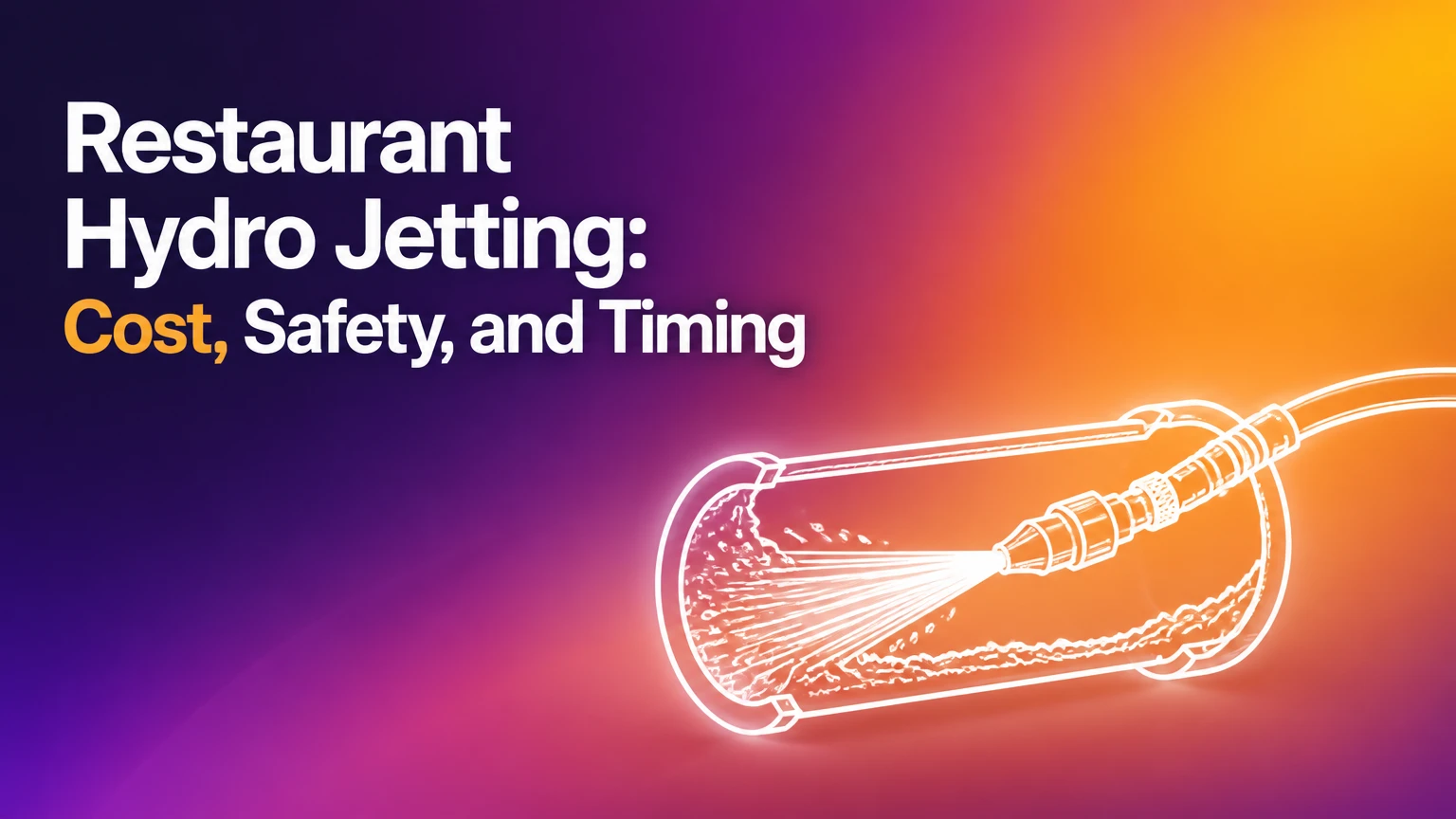
Restaurant hydro jetting is professional drain-line cleaning that sends high-volume, high-pressure water through commercial kitchen plumbing to remove grease, food solids, sludge, and mineral buildup from pipe walls. Unlike an auger, which usually creates a narrow passage through a clog, a properly selected jetting nozzle cleans a larger portion of the pipe’s internal surface and flushes loosened material downstream.
Key Facts at a Glance
- Commercial restaurant jetting commonly uses approximately 2,000-4,000 PSI and 4-12 gallons per minute, but the correct setting depends on pipe condition, diameter, and access.
- CCTV inspection should precede high-pressure cleaning when pipe condition, blockage location, or line routing is uncertain.
- Hydro jetting cleans a drain line; it does not replace grease-interceptor pumping, structural repair, or correction of poor kitchen waste practices.
- Typical service pricing is approximately $600-$1,500 per line, with complex or after-hours work reaching $950-$2,500 or more.
- Preventive intervals commonly range from quarterly to annually, while six-month service is a practical starting point for many full-service restaurants.
- The best result requires both adequate water volume to carry debris away and controlled pressure that does not damage the line.
What Is Restaurant Hydro Jetting?
Restaurant hydro jetting is a corrective and preventive plumbing service for kitchen branch drains, floor-sink lines, building drains, and sewer laterals affected by fats, oils, grease, food particles, detergent residue, sludge, or scale. A motorized pump drives water through a flexible hose and purpose-built nozzle, while the operator controls pressure, flow, direction, and retrieval speed.
The service is different from grease-trap cleaning. A grease interceptor or trap holds separated fats and solids and must be pumped according to local rules and measured accumulation. Jetting cleans the connecting pipes. Pumping an interceptor without cleaning a heavily coated line can leave the upstream restriction intact.
Hydro jetting also has a defined limit. Water can remove deposits from a structurally sound pipe, but it cannot restore a collapsed section, replace missing pipe, correct inadequate slope, or permanently solve grease entering the system at an excessive rate.
Why Do Restaurant Drains Need More Than Snaking?
Restaurant drains accumulate wall coatings because warm FOG cools inside downstream piping, where it combines with food particles and detergent residue. An auger may open a channel through that material, but a remaining annular coating can reduce effective diameter and collect new debris quickly.
The practical distinction is surface coverage. A rotating or multi-directional jetting nozzle can wash deposits from substantially more of the circumference than a single cable path, although no nozzle guarantees removal from every section of an irregular, damaged, or inaccessible line.
How Does the Jetting Mechanism Work?
A commercial jetter combines a pump, water supply, pressure regulator, hose, and nozzle. Rear-facing jets create thrust and push loosened material toward the access point, while forward-facing or angled jets attack the obstruction and scour the pipe as the technician retrieves the hose.
Pressure supplies impact force, but flow rate determines how much loosened grease and sediment the system can transport. A high-PSI machine with insufficient GPM can cut a hole through a blockage and leave the resulting debris downstream. That is why experienced operators select pressure and flow together rather than treating PSI as the only performance measure.
The technician generally advances the hose with the pump disengaged or at controlled output, activates water near the working area, and retrieves the hose slowly. Retrieval speed controls dwell time. Pulling too quickly can leave a coating behind; holding too long in one location can stress a weak section or overwork a fitting.
What Happens to Grease During Jetting?
Water pressure breaks cohesive grease deposits into smaller pieces and suspends some material in the wastewater stream. The pipe gradient, downstream capacity, water volume, and interceptor condition determine whether those pieces leave the building successfully.
Hydro jetting does not magically dissolve all FOG into harmless water. Large deposits can relocate and form a downstream obstruction if the contractor does not monitor flow or flush far enough toward the interceptor or municipal connection. A post-service camera and sustained downstream flow provide stronger evidence than a temporarily open fixture.
What Happens During a Professional Service?
A professional restaurant hydro jetting service normally follows six stages: inspection, access, equipment selection, controlled cleaning, flow verification, and documentation. A straightforward line may take 1.5-4 hours, while multiple branches, poor access, severe deposits, or a long sewer lateral can extend the appointment.
Step 1: Inspect the Line With CCTV
The technician uses a drain camera to identify the blockage, estimate deposit thickness, locate offsets, and check for fractures, root intrusion, corrosion, collapse, or separated joints. High-pressure cleaning should not begin blindly when the line is old, repeatedly failing, or structurally uncertain.
A camera cannot always see through a completely filled line, so an initial auger opening may be necessary before inspection. The contractor should record the location and condition rather than merely reporting that the line is “blocked.”
Step 2: Establish a Suitable Access Point
The preferred access is a properly sized cleanout that allows the hose to enter without sharp bends. Common points include a building drain cleanout, exterior sewer cleanout, floor-sink connection, or accessible branch cleanout.
Removing a fixture is sometimes possible, but it increases labor and introduces a reassembly risk. A contractor should identify where wastewater will discharge before starting, especially in kitchens with multiple interconnected floor sinks.
Step 3: Match Pressure, Flow, and Nozzle
The technician selects a nozzle according to pipe diameter, blockage composition, line length, and available access. Typical commercial kitchen work uses approximately 2,000-4,000 PSI and 4-12 GPM, but those figures are operating ranges, not universal prescriptions.
The often-repeated statement that PVC has a single “safe maximum” or cast iron has one fixed limit is misleading. The actual risk depends on pipe condition, wall thickness, fittings, joints, hose position, nozzle design, and pressure at the nozzle. Manufacturer instructions and technician assessment should control.
Step 4: Clean From the Farther Point Toward Access
The hose is advanced beyond the main deposit when possible, then retrieved gradually while the jets scour the line. Cleaning from the farther section toward the access point helps avoid pushing a large grease mass into an unverified downstream bottleneck.
The operator watches pressure behavior and downstream fixtures during the pass. Rising pressure, unexpected backflow, or water appearing at another floor drain can indicate that the line cannot accept the discharge rate.
Step 5: Flush and Monitor the Discharge
A high-volume flush carries loosened deposits toward the grease interceptor or sewer connection. The contractor should verify that the receiving system has capacity and that the interceptor is not already overloaded with solids or FOG.
Wastewater may contain grease chunks, sediment, and contaminated material. Food-preparation surfaces require protection, and the work area should be cleaned and disinfected under the restaurant’s food-safety procedures before reopening.
Step 6: Verify the Result
A final camera inspection is the strongest routine check for remaining deposits, damaged pipe, displaced debris, or an unaddressed downstream restriction. The operator should also run representative fixtures and observe floor drains during sustained flow.
A successful service record includes before-and-after images, line location, pipe observations, nozzle and pressure details when available, and recommendations for the next maintenance interval.
Which Equipment and Nozzles Are Used?
Restaurant jetting equipment ranges from compact electric machines for short indoor branches to trailer-mounted units for large exterior laterals. Equipment selection should follow the line’s internal diameter and access constraints, not the largest pressure number printed on the machine.
| Equipment type | Typical output | Best application | Main limitation |
|---|---|---|---|
| Portable electric jetter | 1,500-2,200 PSI; 2-5 GPM | Bar sinks, short branches, indoor access | Limited flushing distance and solids transport |
| Cart-mounted gas jetter | 2,500-4,000 PSI; 4-12 GPM | Kitchen mains and grease-trap branches | Requires ventilation and reliable water supply |
| Trailer-mounted jetter | 4,000-8,000 PSI; 10-30 GPM | Long laterals and large external lines | Excessive for small indoor pipes and difficult to position |
| Vacuum-assisted combination unit | 2,000-4,000 PSI; variable GPM | Lines requiring controlled recovery of wastewater | Higher mobilization cost and access requirements |
Nozzle choice also changes the result. Penetrating nozzles open dense restrictions, rotating nozzles improve wall coverage, and specialized scale or root-cutting heads address harder deposits. Chain flails require particular caution because mechanical impact can damage weakened pipe and joints.
| Nozzle style | Typical target | Advantage | Avoid when |
|---|---|---|---|
| Penetrator nozzle | Rock-hard grease and compacted sludge | Creates an initial passage | The line has unknown structural damage |
| Rotating nozzle | Broad grease film and organic residue | Improves circumferential coverage | The pipe is too small for the nozzle’s rotation |
| Flush nozzle | Routine deposits and final rinsing | Provides strong downstream transport | The receiving line is already restricted |
| Scale-cutting nozzle | Mineral scale and rust | Breaks hard inorganic deposits | Thin, corroded cast iron is present |
| Root-cutting nozzle | Root intrusion in sewer laterals | Removes soft root growth | Roots indicate a repair or replacement issue |
What Pressure and Flow Are Appropriate?
Typical restaurant hydro jetting operates around 2,000-4,000 PSI and 4-12 GPM, but a safe setting must be chosen for the specific line. Older cast iron, vitrified clay, cracked PVC, fragile fittings, and poorly supported joints require more conservative operation than newer, sound commercial piping.
A useful practitioner rule is to prioritize enough GPM to transport debris after the deposit breaks apart. Pressure without volume often produces the familiar failure pattern of a temporarily open drain followed by gurgling or a second blockage downstream.
| Pipe and condition | Typical operating approach | Inspection priority | Reason |
|---|---|---|---|
| Newer PVC, sound joints | 2,500-4,000 PSI; 6-12 GPM | Moderate | Handles routine grease cleaning when fittings are sound |
| Aging cast iron | 1,500-3,000 PSI; 4-10 GPM | High | Corrosion and thin walls increase damage risk |
| Vitrified clay lateral | 1,500-3,000 PSI; 6-12 GPM | High | Offset or cracked joints can fail under force |
| Small branch drain | 1,500-2,500 PSI; 2-6 GPM | Moderate | Oversized equipment can overwhelm traps and fittings |
| Large sewer lateral | 3,000-6,000 PSI; 10-20 GPM | High | Long runs need volume and downstream capacity |
Is Hydro Jetting Safe for Older Plumbing?
Hydro jetting can be safe for older plumbing when inspection finds sound walls, stable joints, and an appropriate nozzle and pressure. It is unsafe to treat jetting as a structural test or to use a generic high-pressure setting on a line with severe corrosion, fractures, collapse, or displaced joints.
The limitation matters financially. If a line is already failing, jetting may expose the failure by removing the deposit that was temporarily bridging it, but blaming the cleaning process without reviewing the camera footage is poor diagnosis. A responsible contractor explains that possibility before work begins.
How Much Does It Cost and How Often Is It Needed?
Typical commercial restaurant hydro jetting costs approximately $600-$1,500 for one service line and $950-$2,500 or more for complicated layouts, long laterals, multiple branches, difficult access, or after-hours emergencies. A routine appointment usually takes 1.5-4 hours.
| Service situation | Typical price | Typical duration | Main cost driver |
|---|---|---|---|
| Short branch line | $400-$800 | 1-2 hours | Indoor access and setup |
| Standard kitchen main | $600-$1,500 | 1.5-4 hours | Grease load and line length |
| Multiple branches | $1,200-$2,500 | 3-6 hours | Number of access points |
| Emergency overnight call | $950-$2,500+ | 2-6 hours | Premium labor and urgent mobilization |
| Large exterior lateral | $1,500-$4,000+ | 4-8 hours | Equipment, traffic control, and disposal |
These are typical planning ranges, not regulated prices. Local labor rates, wastewater handling, camera inspection, access work, pipe diameter, and whether the price includes a final flush can materially change the invoice.
Frequency should follow performance data rather than a universal calendar. Quarterly service often suits fryer-heavy, barbecue, wok, and high-volume fast-food kitchens; six-month service fits many full-service restaurants; annual review may suit cafés, bakeries, and low-grease bars.
Is Hydro Jetting Better Than Snaking?
Hydro jetting is usually better for recurring grease-coated restaurant lines, while snaking is often the faster first response when a single fixture is blocked and the pipe condition is unknown. Chemical drain cleaners are generally a poor choice for commercial kitchen FOG because they add handling hazards and rarely remove the underlying wall coating.
| Method | Typical action | Best use | Typical result |
|---|---|---|---|
| Hydro jetting | 2,000-4,000 PSI; 4-12 GPM water cleaning | Recurring FOG and sludge in sound lines | Broad deposit removal and downstream flushing |
| Cable auger | Mechanical cable penetration | Localized blockage and urgent opening | Narrow passage through obstruction |
| Enzyme treatment | Biological digestion over hours or days | Between-service residue control | Slow maintenance support, not emergency clearing |
| Chemical cleaner | Caustic or acidic reaction | Limited residential applications | Temporary effect with safety and corrosion risks |
Snaking should precede jetting when the technician cannot pass a camera or when a narrow obstruction must be opened safely. Jetting should follow inspection when recurring grease, scale, or sludge is coating a known-sound line.
Neither method repairs bad slope, inadequate pipe diameter, broken joints, or a grease interceptor that is undersized for the kitchen’s discharge.
What Can Go Wrong During or After Jetting?
The most common failures are poor downstream flushing, skipped inspection, excessive pressure, incorrect access direction, inadequate water supply, and loss of trap seal. Each failure has a different remedy, so repeating the same cleaning pass may waste time and compound the blockage.
Debris Moves Into a Downstream Restriction
Gurgling or slow drainage immediately after service can indicate that loosened grease settled beyond the cleaned section. The operator should stop sending additional fixtures into the line and request a camera inspection plus a high-volume downstream flush.
A Weak Pipe Fails
A crack, collapse, severe corrosion, or separated joint can worsen under pressure. The appropriate recovery is to document the condition, isolate the affected line, and obtain a repair estimate. Repeated jetting is not a substitute for replacing failed piping.
Water Backs Up Into the Kitchen
Backflow can occur when the technician exceeds the receiving line’s capacity or works in the wrong direction. Floor sinks and drains should be monitored continuously, and food-contact equipment should be protected before water is engaged.
Floor Drains Smell After Service
A jetting pass can disturb or empty P-trap water seals, allowing sewer gas into the kitchen. Restore each trap with clean water, then inspect for siphoning, evaporation, missing trap primers, or damaged venting if the odor returns.
The Jetter Pump Cavitates
Insufficient incoming water can cause pump cavitation, which damages valves and seals. The contractor should verify supply flow, use an appropriate buffer tank when required, and never compensate for inadequate water with unsafe operating changes.
How Should Kitchens Prevent Recurring Clogs?
A restaurant prevents recurring drain blockages by controlling FOG at the source, maintaining the interceptor, installing effective strainers, and scheduling line cleaning from measured performance. Hydro jetting cannot compensate for fryer oil, meat scraps, coffee grounds, or batter entering drains every day.
Use a written drain-management plan with these controls:
- Scrape plates into solid-waste containers before washing.
- Collect fryer oil for an approved recycling or disposal service.
- Keep food particles out of floor sinks and mop basins.
- Clean removable strainers at least once per shift.
- Record slow drains, backups, odors, and service dates.
- Pump the grease interceptor according to local requirements and measured accumulation.
- Verify that dishwashers and pre-rinse stations discharge through correctly sized drainage.
- Use biological products only as supplementary maintenance, never as a replacement for pumping or jetting.
The commonly cited “25% rule” requires careful interpretation. Many jurisdictions use a 25% accumulation threshold for grease interceptor servicing, but the exact measurement method, interval, and enforcement standard vary by local authority. The threshold does not mean that every restaurant drain line requires hydro jetting at exactly 25% interceptor capacity.
Which Maintenance Interval Fits Each Kitchen?
Cuisine, covers served, fryer count, pipe layout, and prior blockage history determine the correct interval. A restaurant that records two backups between annual services needs a shorter interval, regardless of cuisine category.
| Kitchen profile | Starting interval | Trigger for more frequent service | Operational control |
|---|---|---|---|
| Fryer-heavy fast food | Every 3 months | Backup before 90 days | Oil recovery and shift-based scraping |
| Wok or barbecue kitchen | Every 3-4 months | Grease film returns within 8 weeks | Hot-water wash control and strainers |
| Full-service restaurant | Every 6 months | Slow drains before 6 months | Interceptor records and line log |
| Café or bakery | Every 6-12 months | Dairy, flour, or grounds accumulation | Dedicated solids collection |
| Low-volume bar | Every 12 months | Odor or recurring sink restriction | Trap-primer and drain inspection |
How Should an Operator Choose a Contractor?
Choose a contractor that inspects the line, explains the pressure and flow plan, protects food-preparation areas, and provides before-and-after evidence. A low quote that excludes CCTV, wastewater recovery, access work, or cleanup may not represent a lower total cost.
Ask these questions before approving the work:
- Will the technician perform a pre-jetting camera inspection?
- What pipe material, diameter, and condition were identified?
- What nozzle, pressure, and flow rate are proposed?
- Where will loosened grease and wastewater discharge?
- Is a final camera inspection included?
- Will the report identify remaining defects and the next service date?
- Does the company carry commercial liability insurance?
- Does the quoted price include after-hours labor, access work, and cleanup?
- How will the crew protect food-contact surfaces and reopen the kitchen safely?
- Which local grease-interceptor and wastewater rules apply?
A contractor should not promise that every pipe will be restored to “original” capacity. The defensible promise is narrower: remove accessible deposits from a structurally suitable line, flush the material downstream, and document the condition afterward.
Frequently Asked Questions
Can hydro jetting clear a grease trap?
Hydro jetting can clean the inlet and outlet piping connected to a grease trap, but it does not replace pumping the trap itself. A grease interceptor contains settled solids and separated FOG that require approved removal and disposal. The contractor must coordinate line jetting with interceptor capacity to prevent a downstream overflow.
Can restaurant staff perform hydro jetting?
Restaurant staff should not operate commercial high-pressure jetting equipment without specialized training, protective equipment, and a controlled wastewater plan. Pressurized hoses can cause injection injuries, splash contaminated water, damage plumbing, and spread pathogens into food areas. Staff should handle source control and report symptoms, while qualified plumbers perform jetting.
Do enzymes replace commercial drain cleaning?
Enzyme treatments do not replace hydro jetting, snaking, or grease-interceptor pumping. Biological products may help reduce light residue between professional services when used according to the label and local wastewater rules, but they work gradually and cannot remove a compacted grease mass or repair a defective line.
Why does a restaurant drain clog only during busy service?
A partially restricted line may handle low daytime flow but fail when dishwashers, sinks, and floor drains discharge simultaneously. Peak service exposes inadequate pipe capacity, downstream grease accumulation, poor slope, or a full interceptor. A camera inspection during planned maintenance can identify the restriction before the next operational backup.
Should a restaurant jet every drain at once?
A restaurant should jet interconnected lines together only after mapping the drainage system and confirming that the interceptor and downstream sewer can accept the flow. Cleaning one branch may be sufficient for a localized coating, while a shared main requires a coordinated pass. The service plan should follow the plumbing layout, not a fixed package.
The Bottom Line
Restaurant hydro jetting is the most effective routine method for removing substantial grease, sludge, food residue, and scale from structurally sound commercial drain lines, but it is not a substitute for pipe repair, interceptor pumping, or source control. Start with CCTV when the line is old or repeatedly blocked, select pressure and flow for the actual pipe, verify downstream flushing, and schedule the next service from recorded performance. A properly planned restaurant hydro jetting program reduces backups without treating a damaged plumbing system as a cleaning problem.