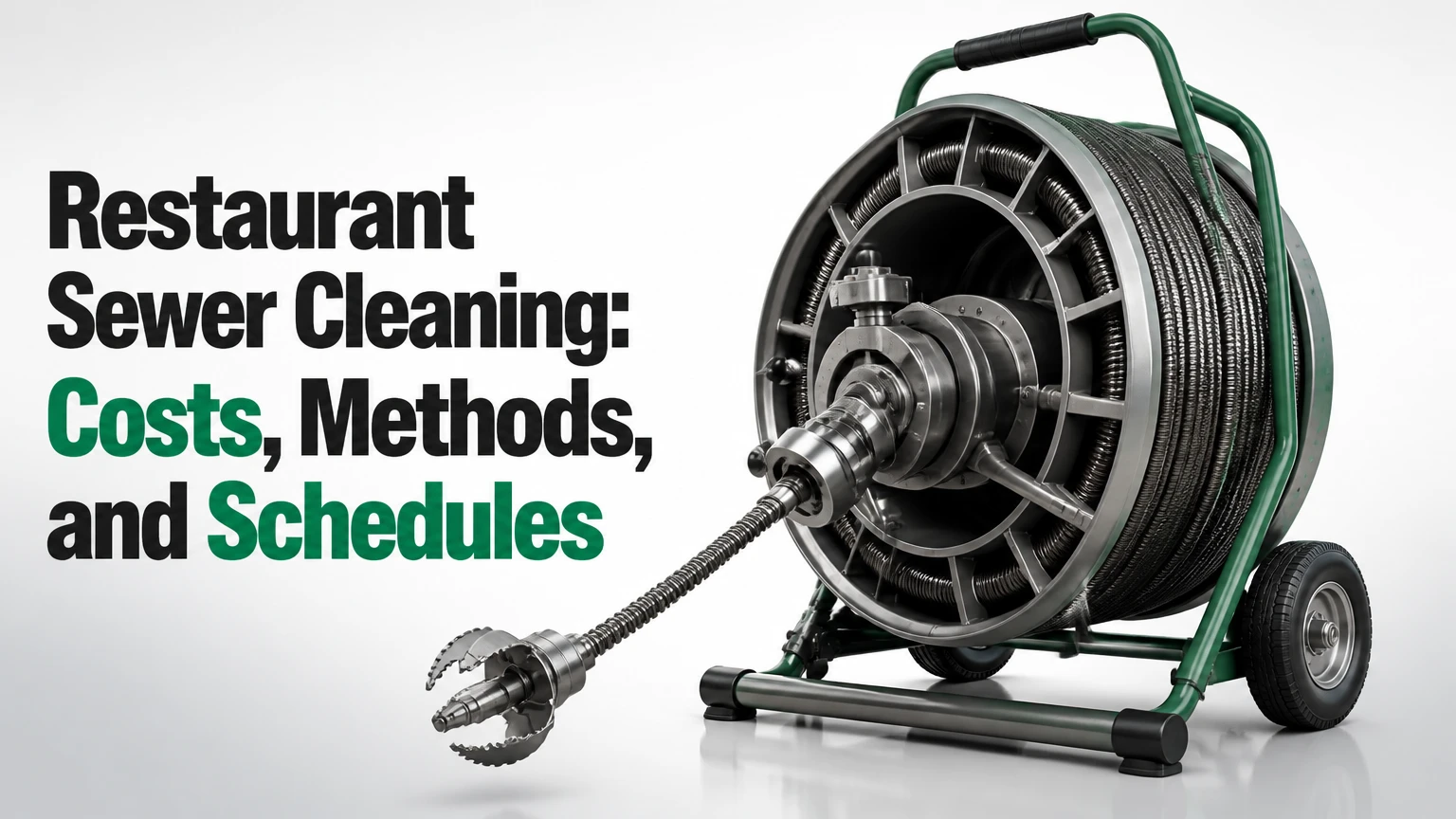
Restaurant sewer cleaning is the professional removal of fats, oils, grease, food solids, sludge, scale, roots, and foreign objects from commercial kitchen wastewater lines. The service combines diagnosis, mechanical cleaning, wastewater containment, and verification to restore flow and reduce backups, odors, pest activity, equipment downtime, and regulatory problems.
Key Facts at a Glance
- Hydro jetting cleans pipe walls with pressurized water, while snaking usually creates a passage through the obstruction.
- Typical commercial hydro jetting costs $500-$1,200 for one accessible line up to 100 feet.
- Grease-trap pumping and sewer-line cleaning are separate services with different equipment and disposal requirements.
- A camera inspection can identify roots, cracks, bellies, corrosion, and collapse that cleaning cannot repair.
- Caustic drain openers and boiling water can relocate or chemically harden grease inside downstream plumbing.
- Cleaning frequency should follow cuisine, covers, grease output, pipe condition, and documented recurrence rather than a fixed calendar alone.
What Does Restaurant Sewer Cleaning Include?
Restaurant sewer cleaning is the cleaning and inspection of wastewater piping that carries discharge from sinks, dishwashers, floor drains, prep areas, and other food-service fixtures. The work may involve a branch drain under the kitchen, a grease line, the building sewer, or a private lateral leading toward the municipal connection.
The service is broader than clearing a single sink. A restaurant can have a localized trap blockage, a grease-coated branch line, a full building sewer, an overflowing exterior interceptor, or a defect beneath the parking lot. Each location requires a different access point and cleaning strategy.
How FOG Creates Commercial Blockages
FOG means fats, oils, and grease. Hot cooking oil may flow through a fixture briefly, but the oil loses heat as it enters cooler piping, adheres to the pipe wall, and traps starch, meat scraps, flour, detergent residue, and sediment.
Over time, the deposit narrows the effective pipe diameter. The remaining opening may still pass water during slow periods, then fail when a dishwasher, pot sink, and floor drain discharge together. Large hardened accumulations are often called greasebergs, although the term describes a condition rather than a specific engineering classification.
San José Environmental Services Department guidance gives the basic rule plainly: “Never pour grease, fats or oils down the drain.” Dry scraping and containerized disposal prevent more FOG from entering the wastewater system than downstream treatment can remove.
Which Parts of the System Need Cleaning?
| System component | Typical location | Main contaminant | Separate service needed |
|---|---|---|---|
| Fixture trap | Beneath sink or basin | Food particles, grease, solids | Yes, fixture clearing |
| Branch drain | Kitchen floor or wall | FOG, sludge, detergent | Often, line cleaning |
| Grease trap | Indoors near fixtures | Separated FOG and solids | Yes, pump-out |
| Grease interceptor | Exterior underground tank | High-volume FOG and sediment | Yes, vacuum pumping |
| Building sewer | Property-wide underground line | Grease, roots, scale, debris | Yes, sewer cleaning |
How Is Commercial Kitchen Drain Cleaning Performed?
A professional crew typically inspects the line, contains the work area, clears the obstruction, manages the receiving end, flushes the system, and documents the result. The sequence changes when access is limited, the interceptor is full, wastewater is entering the building, or the camera identifies structural damage.
Step 1: Diagnose From a Cleanout
Technicians begin at an accessible cleanout, floor sink, interceptor opening, or other approved access point. A camera inspection is useful when the line is passable, but a completely blocked or submerged pipe may require an initial opening with an auger before video can travel.
The inspection should record pipe diameter, material, direction, distance to the restriction, and evidence of roots, cracks, offsets, corrosion, or standing water. A locator sonde can estimate position and depth above ground, although accuracy depends on soil, signal interference, and technician technique.
Step 2: Protect the Kitchen and Control Wastewater
Containment includes floor protection, absorbent materials, splash control, access covers, and a plan for contaminated water. Food-contact surfaces must be isolated from wastewater and cleaned according to the restaurant’s food-safety procedure before reopening.
A contractor should confirm where removed grease and solids will go. Wastewater must not be discharged onto a floor, storm drain, landscaped area, or neighboring property.
Step 3: Choose Jetting or Augering
Hydro jetting is usually selected for grease-coated lines because the nozzle’s water streams scour deposits from the pipe circumference. Reverse-facing jets propel the hose, while forward-facing or rotating jets help cut and wash heavy buildup.
An auger is more appropriate for an immediate opening through a hard obstruction, foreign object, root intrusion, or a line that cannot safely receive high-pressure water until its condition is known. A cable can restore flow without removing the grease film.
Step 4: Clean Toward a Safe Receiving Point
When access permits, technicians often work from a downstream cleanout toward the kitchen. That direction gives loosened material a route away from occupied fixtures, but the correct setup depends on pipe slope, blockage location, access, and the capacity of the interceptor or collection equipment.
A full grease interceptor changes the plan. If the receiving tank cannot accept additional liquid and solids, the tank may need pumping before line cleaning continues.
Step 5: Flush, Inspect, and Record
The crew should flush the line with an appropriate volume of water, confirm that fixtures drain, and inspect the cleaned section when camera access remains possible. “100% clean” is an overly absolute promise because small films, blind branches, and inaccessible sections may remain; a video showing open flow and visible wall condition is more useful.
The final record should include video or still images, line length, nozzle or cable used, access points, observed defects, removed material, disposal destination, and recommendations.
Step 6: Restore Prevention Controls
Prevention includes interceptor service, fixture strainers, dry scraping, staff training, and any approved biological dosing program. Biological products may reduce thin organic films between physical cleanings, but they cannot remove a solid blockage or correct a collapsed pipe.
Which Restaurant Sewer Cleaning Method Is Best?
Hydro jetting is generally the best method for widespread grease coating and recurring FOG buildup, while snaking is the faster first response for a hard blockage or foreign object. Camera inspection is the diagnostic and verification tool, not a substitute for either cleaning method.
| Method | Typical operating detail | Best application | Main limitation |
|---|---|---|---|
| Hydro jetting | 2,000-4,000 PSI; 4-18 GPM | Grease, sludge, soft scale, wall deposits | Unsafe for damaged pipe without assessment |
| Motorized auger | 1/2-11/16-inch cable; 100-200 feet | Hard clog, roots, object, emergency opening | Usually leaves grease on pipe walls |
| CCTV inspection | Push camera; locating sonde often 512 Hz | Blockage location and pipe-condition evidence | Cannot see through severe obstruction |
| Biological dosing | Daily or weekly measured dose | Preventive film reduction | Cannot remove an active solid blockage |
| Chemical opener | Product-specific caustic or acidic formula | Generally unsuitable for food-service sewer lines | Safety, pipe, disposal, and saponification risks |
Why Hydro Jetting Does Not Always Come First
Hydro jetting sends substantial force into the pipe and can expose weaknesses hidden by grease. Old cast iron with severe corrosion, cracked clay, offset joints, thin PVC, or a broken line may require lower pressure, controlled flow, or repair instead.
Pressure alone is not the cleaning specification. Flow rate moves the debris, nozzle design determines coverage, hose size affects reach, and the operator must match the setup to pipe diameter and condition.
What Does Snaking Actually Fix?
Snaking cuts or punctures a route through an obstruction. The method is valuable when a restaurant is losing service during a busy shift, but a narrow opening through grease can close again rapidly because the remaining shelves continue collecting solids.
A practical rule is simple: use an auger to regain access or remove a discrete obstruction, then schedule camera inspection and jetting when the line has enough flow for safe cleaning.
How Much Does Restaurant Sewer Cleaning Cost?
Typical restaurant sewer cleaning costs range from $250-$600 for emergency augering, $500-$1,200 for hydro jetting one line up to 100 feet, and $200-$500 for a standalone camera inspection. Actual pricing changes with access, pipe diameter, distance, after-hours labor, vacuum recovery, traffic control, and disposal.
| Service | Typical price | Typical duration | Common scope |
|---|---|---|---|
| Emergency augering | $250-$600 | 1-2 hours | One accessible blockage |
| CCTV inspection | $200-$500 | 45-90 minutes | One line with camera access |
| Hydro jetting | $500-$1,200 | 2-4 hours | One line up to 100 feet |
| Interceptor pumping | $300-$1,000 | 1-3 hours | Tank volume and disposal vary |
| After-hours response | 1.5-2 times standard rate | Same visit | Nights, weekends, holidays |
A quarterly maintenance visit may cost approximately $300-$800 when the scope includes routine line cleaning, inspection, or biological treatment. Those figures are typical planning ranges, not a binding market rate.
Ask whether the estimate includes travel, setup, cleanout access, camera footage, water, vacuum recovery, taxes, disposal, and emergency surcharges. The lowest hourly price can become the highest invoice when cleanup and waste handling are excluded.
How Long Does the Work Take?
A camera inspection commonly takes 45-90 minutes, emergency snaking takes 1-2 hours, and hydro jetting takes 2-4 hours for a straightforward line up to 100 feet. A blocked interceptor, multiple branches, structural defects, or restricted access can extend the outage substantially.
Schedule the work after closing when possible, but do not delay a backup that is reaching food-preparation areas or neighboring property. Ask the contractor for an isolation plan covering dishwashing, handwashing, restrooms, and floor drains.
What Should a Restaurant Do During a Sewer Backup?
Stop using fixtures connected to the affected line, isolate contaminated areas, and call a licensed commercial drain contractor. Do not add chemicals, send more water through the system, or wash sewage into a floor drain or storm inlet.
Use this response sequence:
- Stop dishwashers, prep sinks, pot sinks, and affected floor drains.
- Keep employees and customers away from wastewater.
- Photograph the condition for the facility and insurance records.
- Locate the nearest cleanout without opening it unless trained personnel can control discharge.
- Call the building owner, contractor, and sewer authority when public infrastructure may be involved.
- Clean and disinfect according to the local health department’s reopening requirements.
- Record the cause, response time, affected equipment, and corrective work.
A backup at one sink may be local. Simultaneous slowdown at multiple sinks and floor drains points toward a branch or building sewer restriction.
How Often Should a Restaurant Sewer Be Cleaned?
High-FOG restaurants often begin with quarterly line cleaning, moderate-FOG operations with six-month intervals, and low-FOG businesses with annual inspection or cleaning. The correct interval is the shortest schedule that prevents recurrence, established from service records rather than copied from another restaurant.
| Restaurant profile | Typical starting interval | Highest-risk discharge | Prevention priority |
|---|---|---|---|
| Fast food and fryer-heavy | Every 3 months | Fryer oil, meat fat, starch | Dry scraping and automated dosing |
| BBQ or full-service dining | Every 3-6 months | Rendered fat, sauces, dishwater | Interceptor inspection and staff control |
| Cafe and casual dining | Every 6 months | Dairy, oils, food solids | Sink strainers and plate scraping |
| Bakery | Every 6-12 months | Flour, dough, batter | Fine-mesh solids capture |
| Smoothie or sandwich shop | Every 12 months | Seeds, pulp, dairy residue | Fixture screens and flow monitoring |
Reduce the interval after two preventable backups in six months, repeated slow drainage, visible interceptor overloading, or heavy grease shelves on camera. Extend it only after documented clean inspections and stable drainage across several service cycles.
How Can Restaurants Prevent Grease-Line Blockages?
Restaurants prevent grease-line blockages by keeping bulk FOG and solids out of fixtures, maintaining traps and interceptors, and measuring recurrence. Cleaning the sewer without changing kitchen behavior removes the symptom while the same waste stream rebuilds the deposit.
Use the following controls:
- Scrape plates, pans, and fryer equipment into a waste container before washing.
- Collect used cooking oil through a licensed recycling or disposal service.
- Install and clean strainers in prep sinks, floor sinks, and three-compartment sinks.
- Keep interceptor lids accessible and inspect baffles during scheduled pumping.
- Follow local rules for grease-trap pumping frequency and waste manifests.
- Train dish staff to avoid directing food scraps into floor drains.
- Record backup dates, affected fixtures, cleaning method, footage, and grease depth.
- Review the record monthly against covers, menu changes, and fryer volume.
Municipal wastewater programs commonly emphasize source control because treatment plants cannot reliably remove all grease that enters a private sewer. Local sewer authorities may impose specific interceptor sizing, sampling, pumping, and discharge requirements.
Are Enzymes Better Than Physical Cleaning?
Enzyme or bacterial treatments can support preventive maintenance between cleanings, but they are not a replacement for hydro jetting, augering, grease-trap pumping, or pipe repair. Product performance depends on dose, contact time, temperature, flow, microbial conditions, and whether detergents or sanitizers kill the organisms.
Do not use biological dosing to justify pouring grease into sinks. A restaurant still needs dry-waste controls and required interceptor service, and some jurisdictions restrict chemical or biological additives because they can move FOG farther downstream.
What Problems Cannot Be Fixed by Cleaning?
Cleaning cannot permanently fix a collapsed sewer, severe corrosion, a separated joint, root-damaged pipe, an undersized line, or a persistent belly that holds wastewater. Jetting may temporarily reopen such a line, but recurring failure requires repair, lining, replacement, or correction of the drainage design.
| Camera finding | Cleaning result | Likely next action | Operational risk |
|---|---|---|---|
| Grease shelf, open pipe | Usually removable | Jetting and prevention | Recurring blockage |
| Tree-root intrusion | Temporary opening possible | Root treatment or repair | Rapid regrowth |
| Offset joint | Partial flow improvement | Spot repair or replacement | Solids catch at joint |
| Standing-water belly | Deposit removal only | Engineering assessment | Recurrent sludge |
| Collapsed or crushed pipe | No lasting cleaning result | Excavation or trenchless repair | Complete stoppage |
A camera report should distinguish a deposit from a defect. Operators should not approve repeated cleaning visits when the same structural finding appears after each service.
What Mistakes Cause Repeat Restaurant Backups?
The most expensive mistakes are treating a recurring grease problem as a one-time clog, using chemicals, and accepting no evidence of completed work. Each mistake either leaves the deposit in place or creates additional risk downstream.
Repeated Snaking Without Jetting
A cable can punch through a grease mass while leaving shelves attached to the wall. If flow returns but the line slows again within days or weeks, request a camera review and full wall cleaning.
Pouring Caustic Chemicals Into the Line
Caustic drain openers can burn workers, damage fittings, create hazardous splash during jetting, and react with grease to form hardened soap-like deposits. Tell the contractor what product entered the pipe before work begins.
Using Boiling Water as a Grease Strategy
Boiling water can liquefy surface grease temporarily, then carry it into cooler downstream pipe where it re-solidifies. Hot water is not a substitute for dry scraping, interceptor service, or physical line cleaning.
Skipping Interceptor Pumping
A clean kitchen branch line can still back up when the interceptor is full. Tank pumping removes accumulated FOG and solids from the containment point; it does not scour grease from every upstream pipe.
Accepting a Verbal Completion Claim
Request before-and-after camera evidence when the line is accessible. A written report protects the operator during landlord disputes, insurance claims, recurring service calls, and health department inspections.
How Do You Choose a Commercial Cleaning Contractor?
Choose a contractor that can diagnose, clean, contain, and document the complete wastewater system rather than simply insert a cable. Verify commercial experience, licensing where required, insurance, disposal practices, equipment capacity, and emergency response terms.
Ask these questions before approval:
- Will the estimate include CCTV before or after cleaning?
- What pressure, flow, nozzle, and hose size will be used?
- How will the crew protect food-contact surfaces?
- Where will removed grease and wastewater be transported?
- Does the price include interceptor pumping or only line cleaning?
- What happens if the camera finds a broken or collapsed pipe?
- Will the contractor provide footage, measurements, and a written report?
- Which local sewer authority and health department rules apply?
A responsible contractor should explain why a method fits the pipe condition. A contractor who promises that one pressure setting works for every material, diameter, and age is offering a sales shortcut rather than a technical assessment.
Expert Rules for Lower-Risk Maintenance
First, measure recurrence at the fixture level. A monthly backup at the pot sink and a quarterly floor-drain slowdown may require different branch cleaning, even when both appear to be “the restaurant sewer.”
Second, prioritize flow over pressure. High PSI can cut a deposit, but insufficient flow leaves loosened grease in the line. Nozzle design and downstream receiving capacity determine whether removed material actually exits the system.
Third, treat the interceptor as a capacity calculation. A tank that is pumped on schedule can still overload when covers increase, fryer production rises, or solids enter with wash water. Compare grease depth, pumping records, and business volume.
Frequently Asked Questions
Can a restaurant clean its own sewer line?
Restaurant staff can prevent buildup, clean accessible strainers, and follow grease-handling procedures, but professional sewer cleaning is safer for blocked or contaminated lines. Commercial equipment can injure workers and damage compromised pipes, while wastewater disposal may require licensed handling and local documentation.
Does a grease trap need cleaning after hydro jetting?
A grease trap may need pumping before or after hydro jetting, depending on its fill level and receiving capacity. Hydro jetting removes deposits from piping, whereas pumping removes accumulated FOG and solids from the trap or interceptor. One service does not replace the other.
Can a blocked restaurant sewer cause drain flies?
A blocked or heavily coated restaurant sewer can support drain flies by creating wet organic slime on pipe walls. Drain flies are a warning sign, not proof of the blockage location; inspect floor drains, traps, branch lines, and interceptor areas before choosing treatment.
Is hydro jetting safe for cast-iron restaurant pipes?
Hydro jetting can be safe for cast-iron pipes when the pipe is structurally sound and the technician matches pressure, flow, nozzle, and distance to its condition. Severely corroded or cracked cast iron may require controlled cleaning, camera inspection, lining, spot repair, or replacement.
Should restaurant sewer cleaning happen before a health inspection?
Preventive cleaning should occur before a scheduled inspection when records show buildup, odor, slow drainage, or interceptor risk, but cleaning alone does not satisfy every health or sewer-authority requirement. Maintain pumping receipts, waste manifests, inspection footage, staff procedures, and required maintenance logs.
When should a restaurant contact the municipality?
Contact the sewer authority when wastewater backs up from a public manhole, neighboring properties experience similar problems, or a private line appears open but the municipal connection remains blocked. The property owner generally controls private piping, while the utility controls infrastructure according to local boundaries.
The Bottom Line
Restaurant sewer cleaning removes FOG, solids, sludge, scale, roots, and foreign objects from commercial wastewater piping, but the best method depends on the obstruction and pipe condition. Hydro jetting usually provides the most complete grease removal, snaking provides rapid access through hard blockages, and CCTV supplies the evidence needed to distinguish deposits from structural failure.
Restaurant operators should combine scheduled line cleaning with grease-trap pumping, dry scraping, strainers, documented inspections, and staff training. Use the restaurant’s cuisine, covers, wastewater volume, pipe condition, and backup history to set the interval. Effective restaurant sewer cleaning prevents the next emergency instead of merely reopening the line today.