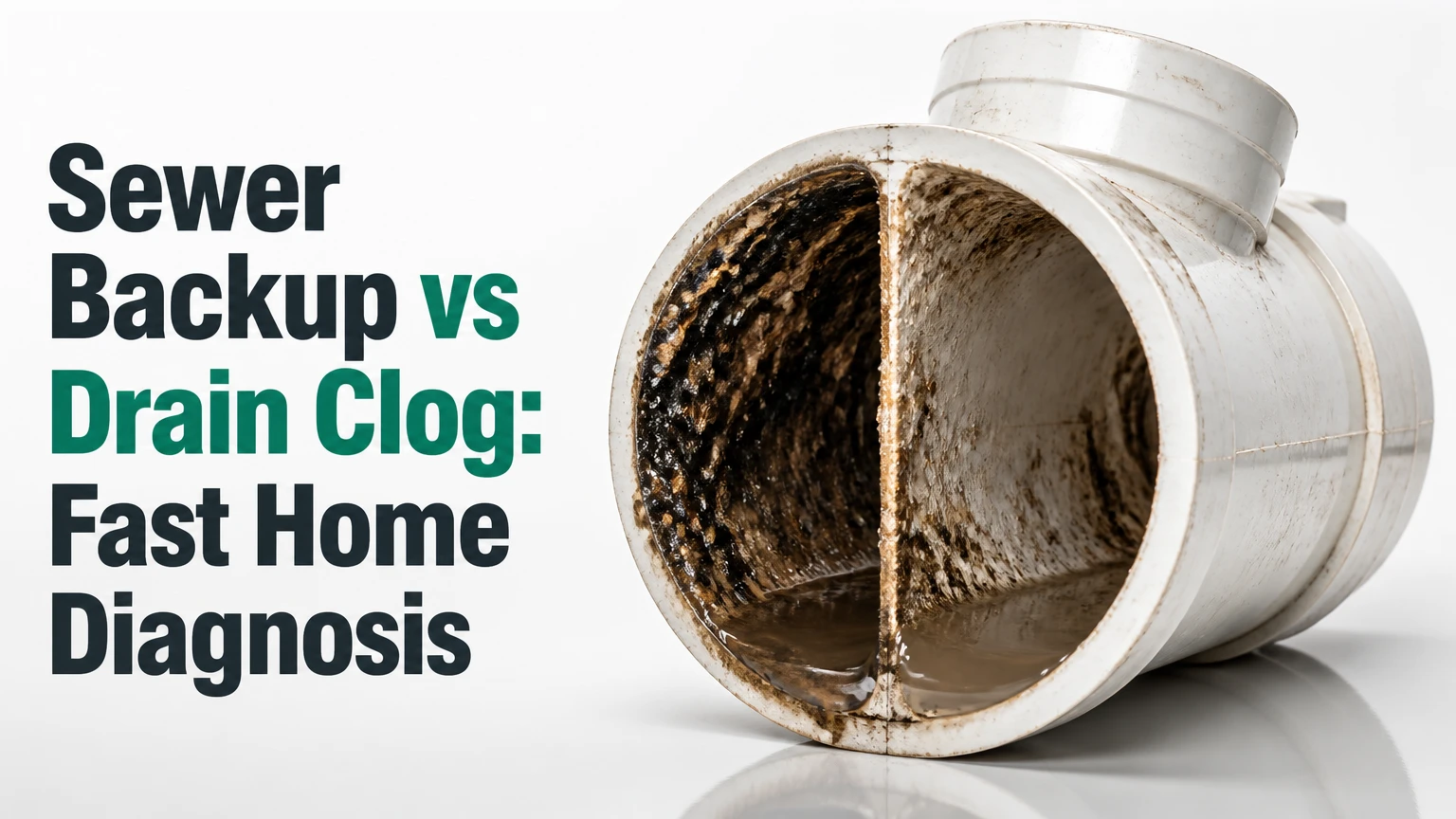
A drain clog is usually a localized blockage affecting one fixture or branch pipe, while a sewer backup is a restriction or failure in the building’s main sewer lateral, municipal sewer, or septic outlet. One slow sink suggests a branch clog; sewage rising from a basement drain or several fixtures backing up indicates a main-line emergency.
Key Facts at a Glance
A drain clog normally affects one fixture, such as one sink, shower, or toilet.
A sewer backup commonly affects multiple fixtures, especially those below the blockage.
Stop using water immediately when toilets gurgle, floor drains rise, or several drains fail together.
Sewer-contaminated water is a biological hazard and requires professional cleanup when it enters living areas.
A plunger or small hand auger may clear a fixture clog, but neither tool diagnoses a damaged sewer lateral.
Typical professional costs range from $150-$400 for fixture drain clearing and $200-$500 for a sewer camera inspection.
What Is the Difference Between a Sewer Backup and a Drain Clog?
The primary difference is location and scope. A drain clog sits in a fixture trap, fixture drain, or branch line; a sewer backup occurs farther downstream in the building drain, private sewer lateral, municipal main, or septic discharge route.
Residential drainage follows a connected path. Water leaves a sink or toilet, passes through a trap and branch drain, joins the larger building drain, then exits through the sewer lateral. A blockage near the fixture can isolate one room. A blockage after several branches join can affect the entire home.
The distinction is important because the same symptom, standing water, can have different causes. A shower that drains slowly after hair accumulates needs a local clearing method. A shower that fills with wastewater when the washing machine drains may be receiving backup from a restricted main line.
Comparison table
| Diagnostic factor | Local drain clog | Sewer backup |
|---|---|---|
| Affected area | One sink, tub, shower, or toilet | Two or more connected fixtures |
| Typical blockage location | P-trap, fixture drain, branch line | Building drain, sewer lateral, municipal main, or septic outlet |
| Water appearance | Usually clear or gray wastewater | Often graywater, sewage, solids, or foul-smelling blackwater |
| Trigger pattern | Fixture use causes local overflow | Any significant water use raises another drain |
| Lowest drain involvement | Uncommon | Common, especially basement floor drains |
| Immediate response | Limited water use and local clearing | Stop all water use and arrange urgent diagnosis |
| Typical first tool | Cup plunger or hand auger | Professional cable, camera, or hydro-jetting equipment |
| Main long-term concern | Recurring local obstruction | Roots, pipe damage, lateral failure, or municipal surcharge |
How Does Each Problem Work Inside the Plumbing?
A local drain clog traps water upstream of a restriction, whereas a sewer backup traps wastewater from several fixtures in the shared downstream pipe. Gravity then pushes the accumulating wastewater toward the lowest available opening.
A typical fixture clog develops when hair, grease, food, mineral scale, or an object narrows the pipe. The restriction may allow a small amount of flow at first, producing slow drainage. Once debris bridges the remaining opening, the fixture holds standing water.
A main-line restriction behaves differently. Someone flushes a toilet or runs a washing machine, and that wastewater travels into the blocked shared line. The water cannot leave the property normally, so it rises through connected piping and may emerge at a floor drain, shower, toilet, or cleanout.
Air movement also matters. A partial main-line obstruction can produce bubbling or gurgling because wastewater compresses trapped air and displaces it through nearby traps. A blocked plumbing vent can create similar noises, so sound alone does not prove a sewer backup.
The failure sequence
- Local clog: debris accumulates at a trap or branch restriction.
- Reduced flow: the fixture drains slowly or intermittently.
- Complete obstruction: water remains in that fixture.
- Main-line backup: wastewater reaches a downstream blockage after multiple branches connect.
- Rising column: continued water use fills the building drain.
- Lowest-point overflow: wastewater exits through the lowest open fixture or drain.
How Can Symptoms Reveal the Blockage Location?
The number and relationship of affected fixtures provide the strongest initial clue. One isolated fixture usually indicates a local clog, while simultaneous failure of toilets, tubs, sinks, or floor drains points toward a shared drain or sewer-line restriction.
Use a controlled test only when no sewage is already overflowing. Run a small amount of water in the suspected fixture, then observe nearby fixtures. If the kitchen sink alone holds water, the obstruction is probably in its trap or branch. If flushing a toilet makes a shower pan rise, the restriction lies downstream of both fixtures.
| Symptom | More likely location | What the symptom means | Recommended response |
|---|---|---|---|
| One bathroom sink drains slowly | Sink trap or branch drain | Local flow restriction | Remove stopper, clean trap, or use a plunger |
| One toilet clogs after an object is flushed | Toilet trap or closet bend | Object-specific obstruction | Use a flange plunger; escalate if unsuccessful |
| Toilet bubbles when laundry drains | Building drain or sewer lateral | Shared downstream restriction | Stop water use and call a plumber |
| Basement floor drain overflows | Main drain, lateral, or municipal main | Lowest opening receives trapped wastewater | Avoid contact and arrange emergency service |
| Several toilets clog together | Building drain or sewer lateral | Multiple branches cannot discharge | Stop flushing and isolate water use |
| All drains are slow without overflow | Partial main restriction or vent issue | System-wide reduced capacity | Schedule prompt diagnosis |
| Backup occurs only during storms | Municipal surcharge, inflow, or lateral defect | Rainwater may overwhelm or enter the system | Contact utility and plumber; document timing |
A single fixture can still have a deeper problem. For example, a bathroom group may share a branch line, so a sink, tub, and toilet in one room can fail together without the private sewer lateral being blocked.
When is gurgling a sewer warning?
Gurgling becomes a sewer warning when it occurs in one fixture while another fixture discharges water. A toilet that bubbles during washing-machine discharge is more concerning than a sink that gurgles only as its own water drains.
Vent obstructions, inadequate venting, and partial branch clogs can also cause gurgling. A plumber can separate those causes by testing flow, checking cleanouts, and using a camera when the pattern suggests a downstream restriction.
What Causes a Drain Clog or Sewer Backup?
Drain clogs usually come from material introduced during ordinary use, while sewer backups more often involve roots, structural defects, accumulated solids, or capacity problems outside the fixture. Cause matters because clearing debris will not permanently correct a collapsed or sagging pipe.
| Cause | Common location | Typical clue | Permanent remedy |
|---|---|---|---|
| Hair and soap residue | Shower or bathtub drain | Slow drainage after months of buildup | Remove hair, clean trap, improve screening |
| Cooking grease and food | Kitchen branch drain | Backup after dishwashing or greasy cooking | Mechanical cleaning and grease-control habits |
| Wipes or hygiene products | Toilet trap or building drain | Sudden blockage after flushing | Mechanical removal; change disposal practice |
| Mineral scale | Older metal or hard-water piping | Repeated small clogs and reduced opening | Descaling, replacement, or pipe rehabilitation |
| Tree roots | Clay, cast-iron, or separated sewer joints | Recurring blockage despite cleaning | Root cutting plus repair or lining when defective |
| Pipe belly or sag | Buried private lateral | Solids repeatedly settle in one section | Excavation or suitable trenchless correction |
| Offset or collapsed pipe | Aging buried sewer line | Cable encounters resistance; recurring backups | Structural repair or replacement |
| Municipal surcharge | Public sewer or shared system | Backup coincides with heavy rainfall | Utility response, backwater protection, lateral correction |
| Full septic tank or failed outlet | Septic property | Slow drains, odors, tank-area issues | Septic pumping or system repair |
Tree roots do not usually enter an intact sewer pipe through solid pipe walls. They exploit joints, cracks, or failed connections, then expand in a moist pathway and catch paper and solids.
A sewer snake may restore flow without removing the underlying defect. That distinction is a practitioner rule: a line that blocks again within weeks deserves camera inspection, not repeated blind cleaning.
What Should You Do First?
Stop adding water when multiple fixtures fail or wastewater appears at a low drain. Protect people and pets from contact, keep electrical equipment away from wet areas, and document the event before cleanup or repair.
Safe immediate actions
- Stop water use. Do not flush toilets, run laundry, use showers, or operate a dishwasher.
- Keep people away. Sewage can contain bacteria, viruses, parasites, and chemical contaminants.
- Avoid electrical hazards. Do not enter standing water near outlets, appliances, furnaces, or electrical panels.
- Close the toilet supply valve if one toilet is overflowing.
- Call the relevant parties. Contact a licensed plumber, municipal sewer utility, landlord, or septic provider according to the suspected source.
- Photograph the condition. Record affected rooms, water level, fixture locations, and the time symptoms began.
- Notify the insurer. Ask specifically about water-backup coverage before discarding damaged materials.
What can you safely do for one fixture?
For one isolated fixture, a plunger, stopper cleaning, or trap inspection is reasonable if no chemical cleaner has been added. Use a cup plunger for sinks and tubs, a flange plunger for toilets, and short controlled strokes that preserve the trap seal.
A hand auger can address a nearby branch obstruction, but cable length and pipe geometry limit its reach. Do not force a small household auger into a suspected 4-inch main line. The cable can kink, damage fragile piping, or give a false impression that the blockage is cleared.
Chemical drain cleaners are a poor choice for recurring or complete blockages. They may sit in the pipe, create a caustic exposure for the next person opening the trap, and damage some older metal or plastic components. Tell the plumber if any chemical product was used.
When Should You Call a Plumber?
Call a plumber immediately for sewage overflow, multiple failing fixtures, a backed-up floor drain, or a blockage that returns after clearing. A professional diagnosis is also appropriate when a property has mature trees, aging sewer materials, repeated stoppages, or a suspected buried-pipe defect.
A useful diagnostic package may include a main-line cleanout assessment, mechanical clearing, and a sewer camera inspection. A camera can identify roots, offsets, cracks, bellies, grease, and collapse, although it may not show every defect when standing water, heavy deposits, or a fully blocked section obscures the lens.
Opening a cleanout can provide evidence, but it is not risk-free. A cap may release pressurized wastewater, and cleanouts can be difficult to identify or may be located inside a wall, basement, crawlspace, or near the property line. Have a professional open a flooded or visibly pressurized cleanout.
| Service | Typical cost | Typical duration | What it can establish |
|---|---|---|---|
| Fixture drain clearing | $150-$400 | 1-2 hours | Local obstruction and restored flow |
| Main-line cabling | $250-$700 | 1-3 hours | Passage through soft or fibrous blockage |
| Sewer camera inspection | $200-$500 | 45-90 minutes | Roots, offsets, cracks, bellies, collapse |
| Hydro-jetting | $450-$900 | 2-4 hours | Grease and deposits along accessible pipe |
| Trenchless lining or bursting | $4,000-$12,000 | 1-2 days | Structural rehabilitation with limited excavation |
| Excavated sewer replacement | $3,500-$15,000 or more | 2-5 days | Full removal and replacement of buried pipe |
These are typical United States residential ranges, not guaranteed quotes. Depth, access, regional labor rates, concrete removal, landscaping, emergency timing, pipe diameter, and permit requirements can change the total substantially.
How Much Damage Can Each Problem Cause?
A fixture clog usually creates limited water damage near the affected sink, tub, or toilet, while a sewer backup can contaminate flooring, drywall, insulation, stored belongings, and mechanical rooms with sewage. The health and remediation difference is larger than the plumbing difference.
Clean water from a supply leak is categorized differently from wastewater. Sewer overflow commonly requires contaminated-material removal, disinfection, drying, odor control, and sometimes professional contents handling. Porous materials that absorb sewage may need disposal rather than surface cleaning.
The National Association of Sewer Service Companies uses the phrase “sanitary sewer overflows” for events in which untreated sewage is released before reaching treatment. That terminology matters because wastewater in a home may contain pathogens even when it looks like ordinary gray water.
Do not use a household fan to spread air across contaminated materials. Keep children and pets out, avoid direct contact, and follow local public-health or restoration guidance.
Does Insurance Cover a Sewer Backup?
Standard homeowners insurance often does not automatically cover water entering through a sewer, drain, or sump system; coverage commonly requires a water-backup or sewer-backup endorsement. Policy language controls, and coverage limits, deductibles, exclusions, and source definitions vary.
Insurance may distinguish sudden accidental damage from long-term seepage, maintenance neglect, groundwater, floodwater, or a failed sump pump. A municipal sewer surcharge, private lateral failure, and basement seepage may therefore receive different treatment under one policy.
| Scenario | Common coverage question | Documentation to keep |
|---|---|---|
| Sewer backup through floor drain | Is water-backup endorsement active? | Photos, plumber report, itemized invoice |
| Broken private lateral | Is buried-service or sewer-line coverage included? | Camera video, repair estimate, pipe location |
| Heavy-rain basement flooding | Is the event flood, surcharge, or backup? | Rain timing, utility communication, water path |
| Failed sump discharge | Does endorsement include sump overflow? | Pump condition, maintenance records, receipts |
| Renter’s contaminated belongings | Does renter’s policy cover contents? | Inventory, purchase records, remediation report |
Call the insurer before major disposal when conditions are safe. Keep damaged materials available for inspection unless a public-health professional directs immediate removal.
Which Problem Is More Expensive to Fix?
A local drain clog typically costs less because technicians can access the obstruction through a nearby trap or branch cleanout. A sewer backup becomes expensive when the cause is structural, inaccessible, contaminated, or located under concrete, landscaping, or a public right-of-way.
The lowest-cost sewer response is often professional clearing, not replacement. However, repeated clearing without a camera can create a false economy when roots or a pipe belly causes the recurrence.
Cost by likely outcome
| Outcome | Typical price range | Typical time | Main cost driver |
|---|---|---|---|
| Plunge or trap cleaning | $0-$150 | 15-60 minutes | DIY versus service call |
| Fixture snaking | $150-$400 | 1-2 hours | Access and obstruction depth |
| Main-line cable clearing | $250-$700 | 1-3 hours | Emergency rate and cleanout access |
| Camera after clearing | $200-$500 | 45-90 minutes | Pipe length and accessibility |
| Root cutting or jetting | $450-$900 | 2-4 hours | Root density and pipe condition |
| Local sewer repair | $1,500-$6,000 | 1-3 days | Excavation depth and surface restoration |
| Full lateral replacement | $3,500-$15,000 or more | 2-5 days | Length, depth, concrete, permits |
Professional quotes should state whether they include locating the defect, restoring service, disposal, permits, excavation, surface repair, and post-repair verification.
What Situations Mislead Homeowners?
Some symptoms resemble sewer backups but originate elsewhere. A full septic tank, blocked vent, laundry standpipe, failed backwater valve, or municipal surcharge can produce overlapping signs, so the timing and fixture pattern matter.
Rain-related backup
Heavy rain can overwhelm a municipal sanitary system, force water through defects in a private lateral, or saturate a combined sewer network. A backup that begins during storms and stops after the system recovers may still require lateral inspection, because a cracked or offset pipe can admit groundwater.
Septic-system failure
On a septic property, slow drains and sewage surfacing outdoors may indicate a full tank, blocked outlet, saturated drain field, or failed pump rather than a municipal sewer backup. A septic professional should inspect the tank and effluent route.
Blocked plumbing vent
A blocked roof vent can cause gurgling, slow drainage, trap siphoning, and sewer odors. Vent problems usually do not cause sewage to rise from the lowest floor drain, so visible wastewater at a low point shifts concern back toward the building drain or lateral.
Laundry-specific overflow
A washing-machine standpipe or branch drain may be undersized, improperly trapped, or locally obstructed. If only the laundry standpipe overflows while toilets and other fixtures work normally, investigate that branch before assuming a main sewer failure.
How Can You Prevent Recurring Problems?
Prevent local clogs with strainers, grease control, and appropriate flushing habits; prevent sewer backups with inspections, lateral maintenance, backwater protection, and timely repair of structural defects. No preventive device can compensate for a collapsed private sewer line.
Use a mesh hair catcher in showers, scrape food into the trash or compost stream, and never pour cooking grease into a drain. “Flushable” labeling does not mean a wipe behaves like toilet paper in a sewer system; wipes can accumulate at bends, pumps, roots, and rough pipe joints.
For older properties with mature trees, a camera inspection provides a useful baseline before repeated symptoms become an emergency. Hydro-jetting can clean deposits from a sound pipe, but it is not automatically suitable for brittle, cracked, heavily offset, or collapsed piping.
Backwater valves can reduce reverse flow through protected drains when correctly sized, installed, maintained, and accessible. They do not clear a blockage, protect every fixture automatically, or prevent wastewater from emerging through an unprotected opening.
Practitioner rules that prevent expensive mistakes
- A recurrence interval is diagnostic evidence. A backup returning every few months strongly suggests roots, a belly, scale, or a damaged joint rather than bad luck.
- The lowest fixture is a location clue, not always the cause. Wastewater exits at the lowest opening because of elevation, even when the blockage is outside the foundation.
- Clearing and repairing are different services. A cable may create a temporary channel through roots while leaving the cracked pipe and root pathway intact.
- Water pressure is not a universal solution. Hydro-jetting can damage compromised piping or push debris into another restriction when the operator has not confirmed pipe condition.
What Is the Bottom Line for Sewer Backup vs Drain Clog?
A single slow or blocked fixture is usually a drain clog that may respond to safe local clearing. Multiple failing fixtures, toilet bubbling during discharge, sewage odors with low-drain overflow, or wastewater emerging from a basement drain indicates a likely sewer backup and requires immediate water shutoff and professional diagnosis.
The correct response to sewer backup vs drain clog depends on scope, contamination, recurrence, and pipe condition. Clear a simple fixture obstruction cautiously, but treat system-wide symptoms as an emergency rather than repeatedly plunging individual fixtures.
Frequently Asked Questions
Can one clogged toilet indicate a sewer-line problem?
One clogged toilet usually indicates an obstruction in the toilet trap or nearby branch. It may indicate a sewer-line problem when another toilet, tub, floor drain, or sink also reacts, or when flushing causes wastewater to rise elsewhere. A single toilet that repeatedly clogs deserves inspection for a downstream restriction or pipe defect.
Why does sewage back up into the bathtub first?
Sewage often enters a bathtub because the tub drain sits lower than nearby fixtures and has no elevated overflow path. When the building drain or sewer lateral is blocked, wastewater rises until it reaches that low opening. A tub backup after toilet flushing is more concerning than a tub that drains slowly by itself.
Is a blocked sewer line the landlord’s responsibility?
Responsibility depends on the lease, local law, and blockage location. Landlords commonly handle building systems and buried laterals, while tenants may be responsible for damage caused by improper disposal. Tenants should report symptoms promptly, avoid further water use, and retain written records rather than arranging major repairs without authorization.
How long can a partial sewer blockage remain before failure?
A partial sewer blockage can persist for days, weeks, or months before becoming complete, but no reliable safe period exists. Roots, grease, paper, and solids can narrow the remaining opening during ordinary use. Repeated gurgling, slow drainage across fixtures, or intermittent low-point backup warrants diagnosis before a full overflow occurs.
Should I use a drain snake or hydro-jetting?
Use a small hand auger only for an isolated fixture when the pipe is accessible and no chemical cleaner is present. Hydro-jetting is better for confirmed grease or deposit buildup in a structurally sound line, but a camera inspection should guide treatment when roots, cracks, offsets, or older pipe materials are possible.
Can a sewer backup be prevented completely?
A sewer backup cannot be prevented completely because municipal surcharges, extreme rainfall, and unexpected pipe failures remain possible. Homeowners can reduce risk with proper disposal, lateral inspections, root management, backwater protection, sump maintenance, and prompt attention to recurring slow drains or gurgling.