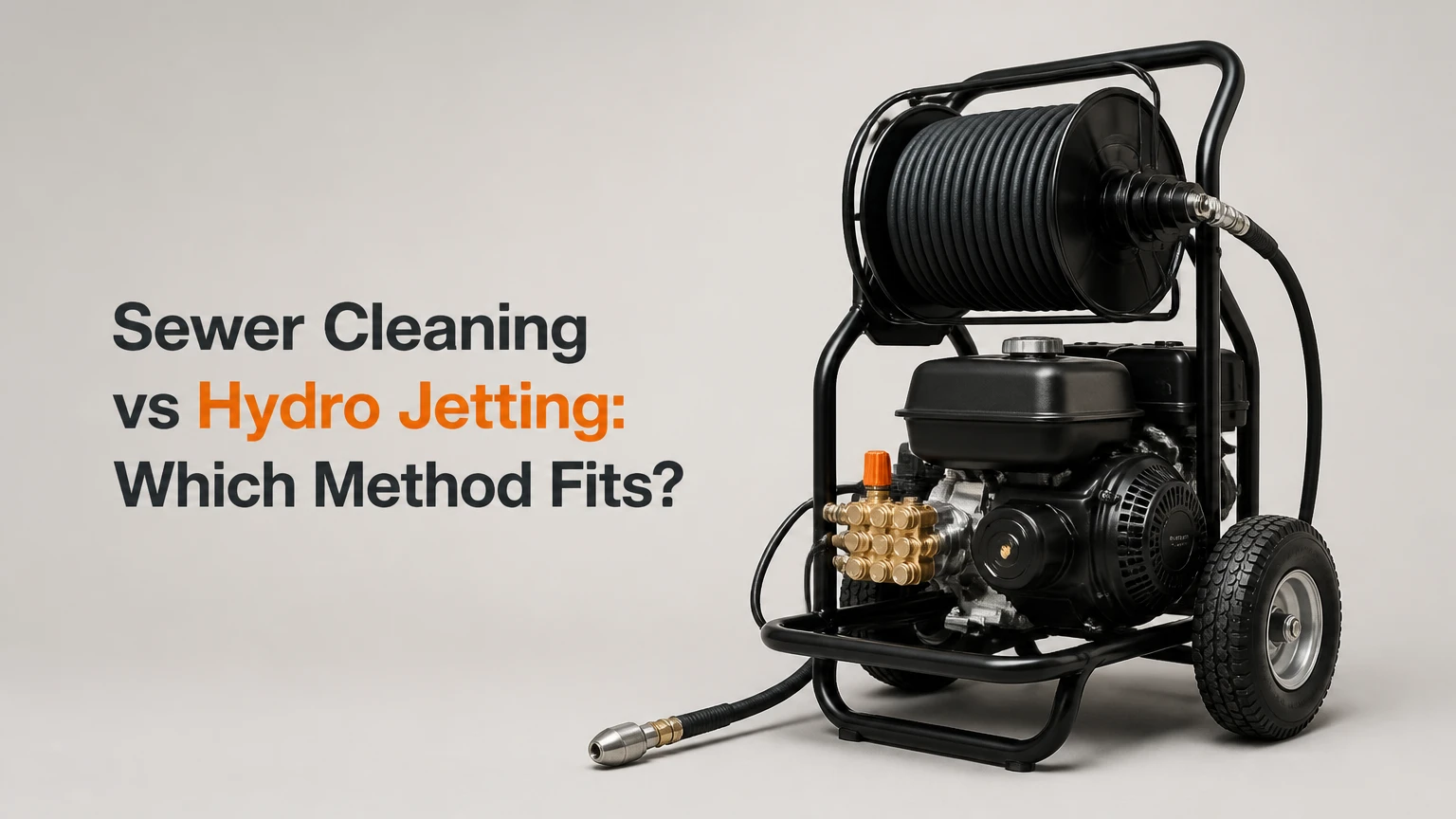
Sewer cleaning usually means mechanical cable cleaning that opens a passage through a blockage, while hydro jetting uses pressurized water to scour deposits from the pipe wall. Mechanical cleaning is generally cheaper and safer for uncertain, fragile lines; hydro jetting is usually more thorough for recurring grease, sludge, and scale when a camera confirms the pipe can withstand the work.
Key Facts at a Glance
- A sewer snake removes or penetrates an obstruction, but it commonly leaves attached grease, scale, and biofilm behind.
- Hydro jetting combines water pressure and flow, with typical professional equipment ranging from about 1,500-5,000 PSI and 6-18 gallons per minute.
- A camera inspection should precede hydro jetting when the pipe is old, damaged, inaccessible, or affected by repeated backups.
- Hydro jetting cleans more of the pipe circumference, but it cannot repair a collapsed, offset, bellied, or severely cracked sewer.
- Typical residential cable cleaning costs about $150-$500, while residential hydro jetting commonly costs about $350-$1,100.
- Tree-root cutting is temporary unless the root-entry defect is repaired or the affected pipe is replaced.
What Are the Two Methods?
Sewer cleaning is a broad service category, while snaking is one mechanical technique within that category. A plumber feeds a rotating cable, auger, or sectional rod into a drain or sewer and uses a cutting head to pierce, break, retrieve, or compress the obstruction.
Hydro jetting is a water-based cleaning process that sends a controlled stream through a specialized nozzle. Rear-facing jets propel the hose and wash pipe walls, while nozzle geometry determines whether the equipment penetrates a clog, scours deposits, or cuts roots.
The practical difference is the cleaning objective. A cable is designed primarily to restore flow through a blockage. A jetter is designed to remove more of the material attached to the interior circumference. Neither method is a structural repair.
How Does Each Method Work?
Mechanical sewer cleaning begins at a cleanout, floor drain, toilet opening, or other accessible point. The technician selects a cable diameter and cutting head, feeds the cable until it meets resistance, rotates it through the obstruction, and retracts it for inspection and cleanup.
A hydro-jetting job should begin with access and diagnosis, not maximum pressure. The technician normally identifies pipe size and material, uses a camera when structural condition is uncertain, selects a nozzle, regulates pressure and flow, advances the hose at a controlled speed, and verifies the result when the blockage or deposit warrants confirmation.
The often-repeated claim that hydro jetting always uses 1,500-5,000 PSI needs qualification. Professional jetters have a broad operating range, and pressure at the pump is not identical to effective pressure at the pipe wall. Flow rate, hose diameter, nozzle orifice, distance, and nozzle condition all affect cleaning power.
A second correction concerns nozzle direction. A technician may work upstream or downstream depending on access, blockage location, line layout, and the need to manage debris. The correct sequence is a controlled sequence, not a universal insertion direction.
What Equipment Fits the Job?
| Equipment | Typical reach or output | Best application | Main limitation |
|---|---|---|---|
| Hand auger | 3-25 feet | Sink, lavatory, and toilet-trap blockages | Cannot clean long sewer runs |
| Electric drum machine | 50-100 feet | Residential branch and building sewer lines | Leaves wall deposits behind |
| Sectional cable machine | 100-150 feet per setup | Long commercial or institutional lines | Heavy, labor-intensive, splash risk |
| Electric jetter | 1,500-2,000 PSI; 2-8 GPM | Interior drains and light residential lines | Limited flow for large mains |
| Trailer or truck jetter | 3,500-5,000 PSI; 8-18 GPM | Main sewers, grease, sludge, and scale | Requires trained operation and suitable access |
| Root-cutting nozzle | Equipment-specific | Fibrous root intrusion | Does not seal the root-entry defect |
Equipment selection should match the pipe, not the technician’s favorite machine. A small sink clog may need a hand auger, whereas a restaurant’s grease-coated building sewer may need high flow, hot water, and scheduled jetting. Oversized equipment can create unnecessary risk and mess.
Sewer Cleaning vs Hydro Jetting: Which Cleans Better?
Hydro jetting usually provides the more complete cleaning because water can wash deposits from a larger portion of the pipe circumference. Mechanical sewer cleaning usually provides the faster, lower-cost emergency opening when the immediate objective is to restore flow and the line’s structural condition is uncertain.
A cable head may pass through paper, hair, soft roots, wipes, or a compacted mass while leaving a ridge of grease or mineral scale on the remaining wall. That ridge reduces the effective diameter and gives future debris a rough surface to catch. Hydro jetting can remove that accumulation when the deposit is compatible with water cleaning and the pipe remains structurally sound.
“Better” therefore means better for a defined outcome. For emergency drainage in an old line, the safer choice may be mechanical cleaning first. For repeated kitchen-line blockages in a sound PVC sewer, hydro jetting can reduce the deposit that causes the recurrence.
| Decision criterion | Mechanical cable cleaning | Hydro jetting |
|---|---|---|
| Primary result | Opens a passage through a blockage | Removes deposits across the pipe wall |
| Typical residential price | $150-$500 | $350-$1,100 |
| Typical service time | 45-90 minutes | 90 minutes-3 hours |
| Main operating action | Rotational cutting or retrieval | Pressurized water scouring |
| Best recurring cause | Isolated soft blockage | Grease, sludge, scale, and buildup |
| Structural risk | Lower when the line is uncertain | Higher if damaged pipe is misdiagnosed |
| Root outcome | Cuts roots to restore flow | Cuts or flushes roots, depending on nozzle |
| Verification | Flow test, sometimes camera | Camera strongly recommended for complex lines |
How Long Does Each Method Last?
No cleaning method has a guaranteed service life because the underlying cause controls recurrence. A cable opening may last days, months, or years; hydro jetting may last longer when grease or scale caused the blockage, but it cannot prevent roots from returning through an unrepaired joint.
Typical practitioner estimates place repeat cable service at roughly 3-12 months in heavily depositing lines, although a one-time paper blockage may never recur. Hydro-jetting intervals for sound residential lines commonly range from 1-4 years, while restaurants may schedule grease-line jetting every 3-12 months.
These are planning ranges, not warranties. A pipe with a belly retains solids after either service. A cracked clay joint can admit roots after either service. A failed backwater valve can cause backups even when the sewer is clean.
Which Method Fits Each Blockage?
Mechanical cleaning is usually the first choice for a single localized blockage, an emergency backup with unknown pipe condition, or a line containing a removable object. Hydro jetting is usually the stronger choice for recurring grease, heavy sludge, mineral scale, and broad wall deposits in a structurally sound pipe.
| Blockage or condition | First-choice service | Why | Follow-up requirement |
|---|---|---|---|
| Toilet trap clog | Closet auger | Reaches the porcelain trap without long-line equipment | Investigate if multiple fixtures back up |
| Hair or soap in a branch drain | Small cable or auger | Matches the short, localized obstruction | Clean trap and screen if recurrence continues |
| Wet wipes in a building sewer | Cable machine | Mechanical head can open and retrieve compacted material | Confirm disposal habits and line condition |
| Restaurant FOG buildup | Hydro jetting | High flow can wash grease from the wall | Establish a scheduled maintenance interval |
| Mineral scale in cast iron | Camera, then cautious descaling | Scale may conceal corrosion or wall loss | Inspect after cleaning |
| Tree roots at a joint | Cable or root-cutting nozzle | Restores flow temporarily | Repair or replace the entry point |
| Collapsed or offset pipe | Repair or replacement | Cleaning cannot restore missing structure | Confirm location and depth with inspection |
| Bellied sewer line | Repair or replacement | Standing water will continue collecting solids | Correct the grade or replace the section |
Are Tree Roots Better Removed by Snaking or Jetting?
Both methods can restore a root-intruded line, but neither method permanently solves root intrusion. A cable cutter may cut a clear channel quickly, while a root-cutting water nozzle can flush smaller root fragments and some attached debris from the wall.
The root returns because roots enter through a cracked pipe, separated joint, deteriorated connection, or service opening. Chemical root control products may slow regrowth in some systems, but they do not close the defect, and local rules may restrict their use.
A recurring root problem deserves a camera inspection that documents the entry location. The durable solution may be spot repair, cured-in-place lining, pipe bursting, or excavation, depending on pipe material, access, grade, and local code requirements.
Is Hydro Jetting Better for Grease and Scale?
Hydro jetting is generally better for grease, sludge, and removable mineral deposits because the water stream contacts more of the pipe wall than a single cable cutter. A cable can bore through a grease plug while leaving a narrowed, sticky passage that clogs again.
Hydro jetting does not remove every form of scale safely. Thick corrosion in old cast iron can detach in large pieces, and severe rust may have become part of the remaining pipe wall. The technician should determine whether the apparent scale is deposit, corrosion product, or evidence of structural deterioration.
Restaurants face a distinct maintenance pattern. Hot-water jetting can remove fats, oils, and grease more effectively than cold water, but grease interceptors, waste practices, trap maintenance, and line design still determine the long-term result.
What Do Sewer Cleaning and Hydro Jetting Cost?
Typical United States residential cable cleaning costs about $150-$500, while hydro jetting commonly costs about $350-$1,100. Emergency access, long sewer distances, camera inspection, root cutting, difficult cleanouts, commercial equipment, and after-hours labor can push either service above those ranges.
| Service situation | Cable cleaning typical cost | Hydro jetting typical cost | Typical duration |
|---|---|---|---|
| Single fixture or short branch | $100-$300 | $300-$700 | 30-90 minutes |
| Residential main sewer | $150-$500 | $350-$1,100 | 1-3 hours |
| Root-intruded line | $250-$800 | $600-$1,500 | 1.5-4 hours |
| Emergency after-hours visit | $300-$800 | $750-$2,000+ | 1-4 hours |
| Restaurant or commercial line | $300-$1,000 | $600-$3,000+ | 2-6 hours |
Local labor rates can change the quote substantially. A city with high service-truck costs may exceed these figures, while a rural market may quote less but charge separately for travel. Ask whether the price includes camera inspection, cleanout access, water disposal, traffic control, and a return visit.
A low initial price is not always the low-cost decision. Three cable visits for a grease-coated line can exceed one properly diagnosed jetting service, while jetting a damaged line can turn a cleaning problem into a repair emergency.
What Are the Risks of Hydro Jetting?
Hydro jetting can damage a compromised sewer when high flow or pressure acts on a cracked, severely corroded, offset, or unsupported pipe. Mechanical cable cleaning has lower hydraulic risk, but a rotating cutter can also snag, damage weak material, or become trapped in a deteriorated line.
Pipe material alone does not determine safety. A modern PVC line may tolerate jetting well, but poor joints, a collapsed section, or an incorrectly selected nozzle can still create problems. Old cast iron may be sound enough for controlled cleaning or too thin for aggressive descaling.
The technician should inspect when the property is older, the blockage recurs, roots are suspected, the line has unknown material, or prior work suggests structural defects. A camera cannot always see every defect through standing water or heavy deposits, so diagnosis may require cleaning followed by a second inspection.
What Can Hydro Jetting Not Fix?
Hydro jetting cannot repair a collapsed sewer, correct a belly, realign an offset joint, replace missing pipe, or stop groundwater from entering through a structural defect. Cleaning removes an obstruction; repair restores the pipe’s shape, grade, continuity, or watertightness.
A useful diagnostic distinction is flow versus structure. If water drains after cleaning but the camera shows a sag, open joint, fracture, or crushed wall, the apparent success is temporary. The pipe may remain one heavy storm or large discharge away from another backup.
Hydro jetting also cannot guarantee a permanently root-free line. Root fibers can return through the same opening, and a jetter may leave hidden fragments in an inaccessible lateral. A written report should identify the cleaned distance, observed defects, and recommended repair.
How Does a Professional Service Proceed?
A responsible sewer-cleaning visit starts by locating the affected line and identifying whether one fixture or multiple fixtures share the problem. The technician then chooses access, equipment, and verification based on symptoms rather than selling the most powerful procedure.
- Confirm the symptom pattern. One slow sink suggests a branch-line issue; several fixtures backing up together suggests a building sewer or main-line restriction.
- Locate a suitable access point. The cleanout should provide a straight, usable path without forcing equipment through a fixture unnecessarily.
- Inspect when risk is material. Use a camera before jetting when the pipe is old, repeatedly blocked, root-intruded, or structurally uncertain.
- Match the tool to the obstruction. Select a closet auger, cable head, root cutter, penetrator nozzle, or rotary nozzle according to the blockage.
- Control the operation. Feed a cable gradually or advance a jetter at a controlled speed; excessive force can worsen a trapped cable or overload a weak line.
- Test and document. Run sufficient water, observe downstream flow, and use a post-cleaning camera when deposits, roots, or structural concerns were involved.
The strongest success checkpoint is not merely a draining fixture. A line is better documented when the technician records the cleaned section, remaining defects, camera distance, and whether the pipe’s usable diameter appears restored.
What Are the Alternatives?
Mechanical cleaning and hydro jetting are cleaning methods, not universal sewer remedies. A localized branch clog may respond to trap cleaning, a defective section may need spot repair, and a long damaged run may require lining, pipe bursting, or excavation.
| Alternative | Appropriate condition | Typical result | Limitation |
|---|---|---|---|
| Trap or fixture cleaning | Blockage inside a sink or toilet trap | Removes localized obstruction | Does not reach the building sewer |
| Enzyme maintenance | Light organic buildup | May slow accumulation | Cannot clear a solid blockage quickly |
| Spot repair | One cracked or separated joint | Repairs a defined defect | Does not address defects elsewhere |
| Cured-in-place lining | Structurally continuous but leaking pipe | Creates an internal liner | Requires suitable diameter and access |
| Pipe bursting | Replaceable underground run | Installs new pipe with limited excavation | Needs adequate path and launch access |
| Excavation and replacement | Collapse, severe belly, or inaccessible defect | Replaces failed section | Highest surface disruption |
Chemical drain openers are a poor substitute for professional sewer cleaning in a backed-up main line. They may fail to reach the blockage, create splash hazards, damage some materials, and expose the technician to caustic residue during cable or camera work.
Which Should You Choose?
The correct choice depends on blockage material, recurrence, pipe condition, access, and the cost of failure. Use the following decision paths rather than treating hydro jetting as an automatic upgrade.
Choose Mechanical Cleaning When
Mechanical cable cleaning is the practical first step for a new emergency blockage, an unknown older line, a single fixture restriction, or a suspected object that must be opened or retrieved. It also makes sense when the immediate priority is restoring sanitation while a camera inspection is arranged.
A cable is not automatically an inferior service. For a sound line with one compact obstruction, it may solve the actual problem at lower cost and with less water handling.
Choose Hydro Jetting When
Hydro jetting fits a structurally sound line with recurring grease, sludge, scale, or broad root residue. It is especially useful when a cable has restored flow repeatedly but the same section continues to collect material.
Request the operating pressure, flow rate, nozzle type, camera findings, and post-service verification. A professional should explain why the chosen settings suit the pipe instead of presenting PSI as a quality score.
Choose Inspection and Repair First When
Inspection and repair should precede aggressive cleaning when the line has collapsed, severe corrosion, a pronounced belly, open joints, repeated ground movement, or a history of unexplained backups. Cleaning a structurally failed pipe may delay the necessary repair and complicate the failure.
For a home built before the widespread use of modern plastic drainage, ask about clay, cast iron, Orangeburg, vitrified clay, and previous replacement sections. Mixed-material systems are common and may require different cleaning approaches along one sewer route.
Common Mistakes That Increase Cost
- Requesting hydro jetting without diagnosis: A jetter cannot correct a collapsed line, and aggressive cleaning can expose a weakness.
- Treating a cable opening as a complete cleaning: Restored flow does not prove that grease, scale, or roots are gone.
- Using pressure as the only specification: Flow rate and nozzle design can matter as much as pump pressure.
- Ignoring the cleanout location: A poor access point can increase labor, debris handling, and the chance of incomplete cleaning.
- Accepting a root-cutting result as permanent: Root entry requires repair, lining, or scheduled maintenance.
- Renting commercial equipment without training: A high-pressure hose can cause serious laceration injuries, and uncontrolled water can flood interior spaces.
- Failing to ask what the quote includes: Camera work, difficult access, after-hours charges, and disposal may be separate line items.
One practitioner rule is especially valuable: do not judge a sewer by the first minute after it drains. A partially opened channel can handle a brief flow test while remaining too narrow for normal household discharge.
FAQ
Can a plumber snake a sewer line without a camera?
Yes, a plumber can snake many sewer lines without a camera, especially when a clear emergency blockage requires immediate flow restoration. A camera becomes more valuable when the line repeatedly backs up, roots are suspected, the property is old, or the owner needs to distinguish deposits from structural damage before choosing hydro jetting or repair.
Does hydro jetting use more water than normal plumbing?
Yes, hydro jetting uses substantially more water than cable cleaning because the jetter relies on both pressure and flow. Typical equipment may deliver 6-18 gallons per minute, although actual use depends on job duration, nozzle size, and operating settings. The technician must manage downstream discharge so water does not back up into fixtures.
Is hydro jetting safe for cast-iron sewer pipes?
Hydro jetting can be safe for sound cast iron when a trained technician selects suitable pressure, flow, and nozzle settings. Severely corroded cast iron is different: deposits may be supporting weakened areas, and aggressive cleaning can reveal holes or detach fragile material. Camera evidence and pipe-wall condition should guide the decision.
How often should a residential sewer line be cleaned?
A residential sewer line should be cleaned when symptoms, inspection findings, or a known recurring cause justify it, rather than on a universal calendar. Homes with sound PVC and no history may need no routine service. Properties with roots or recurring grease may require annual or multi-year maintenance, followed by periodic camera review.
Can I hydro jet my own sewer line?
Most homeowners should not operate commercial hydro-jetting equipment themselves. Equipment commonly combines high pressure, high flow, rotating nozzles, and hoses that can injure skin or flood a building when control is lost. Professional service also includes nozzle selection, pipe-risk assessment, safe access, and management of wastewater and dislodged debris.
Will sewer cleaning remove a sewer odor?
Sewer cleaning may reduce odor when decomposing organic deposits or stagnant wastewater caused the smell, but odor can also come from a dry trap, damaged vent, defective cleanout cap, or sewer-gas leak. If odor remains after the line flows normally, inspect traps, vents, cleanouts, and concealed pipe connections instead of repeating cleaning.
The Bottom Line
Sewer cleaning vs hydro jetting is a choice between targeted blockage opening and broader pipe-wall cleaning. Choose mechanical cleaning for an isolated obstruction or uncertain fragile line; choose hydro jetting for recurring grease, sludge, and scale after confirming structural integrity. If inspection reveals a collapse, belly, offset, or failed joint, stop comparing cleaning methods and plan the appropriate sewer repair.