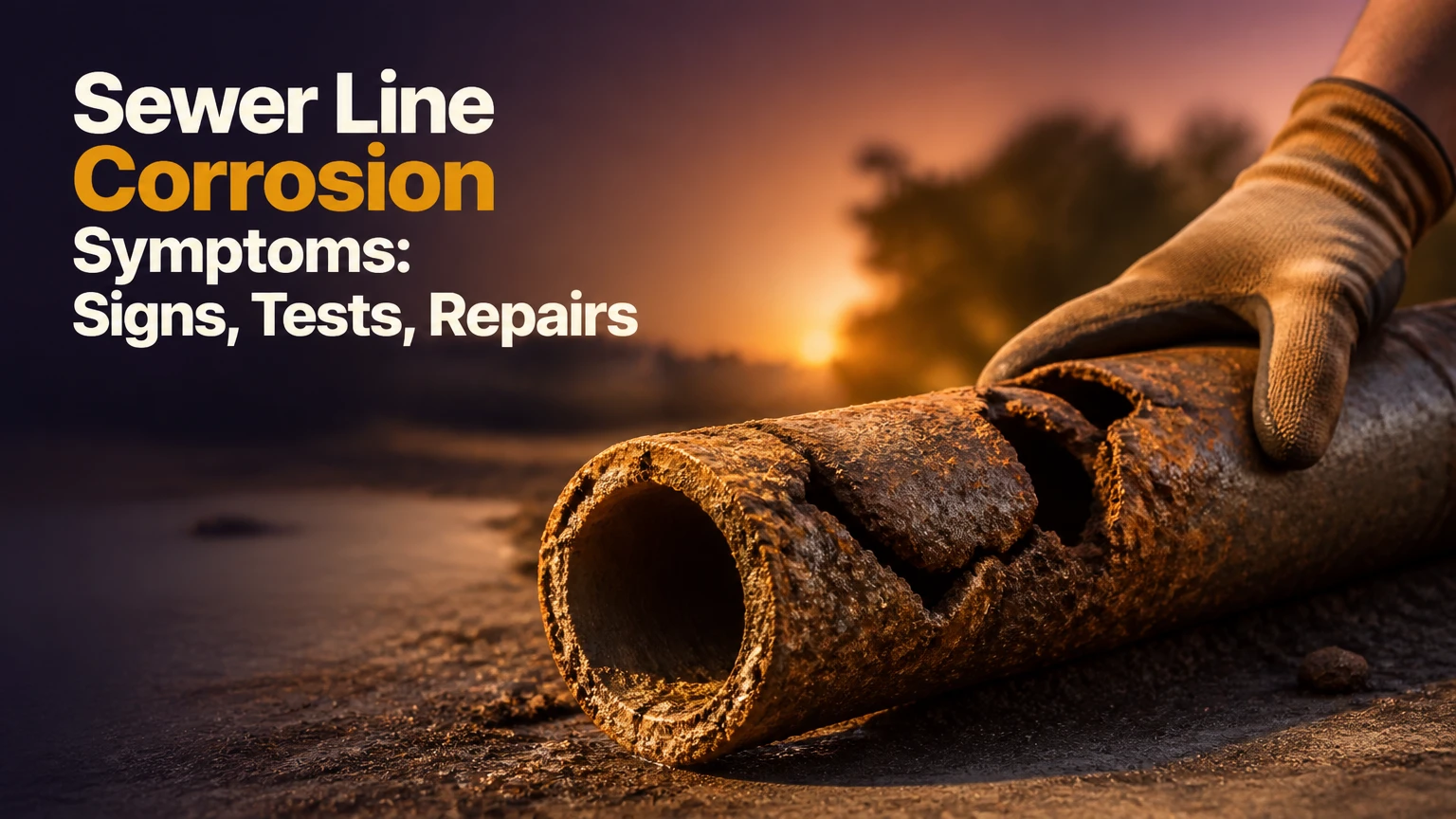
Sewer line corrosion symptoms include recurring multi-fixture slow drainage, gurgling, sewer odors, backups, and wet or unusually green soil above the buried line. These signs are not diagnostic by themselves. A CCTV inspection must confirm corrosion by showing wall loss, tuberculation, channeling, crown erosion, pinholes, or structural failure.
Key Facts at a Glance
- Sewer line corrosion permanently removes or weakens pipe material; a routine clog only obstructs flow.
- Hydrogen sulfide can contribute to crown corrosion when bacteria convert it into sulfuric acid on moist pipe surfaces.
- Cast iron commonly develops internal scale and bottom channeling, while concrete commonly suffers crown erosion.
- PVC and ABS do not undergo ordinary metal or microbiologically influenced corrosion, but they can crack, deform, or fail at joints.
- A sewer camera is the primary diagnostic tool; a drain snake or hydrojet only changes flow and cannot prove structural condition.
- Raw sewage indoors, a collapsing yard, or repeated whole-house backups requires prompt professional assessment.
What Are Sewer Line Corrosion Symptoms?
The most useful sewer line corrosion symptoms are recurring problems affecting several fixtures, especially when a camera later reveals rough scale, missing pipe material, or perforation. Gurgling, slow drains, odor, sewage backups, and lawn changes can also result from roots, grease, a sagging pipe, poor venting, or a simple obstruction.
Corrosion becomes more likely when symptoms occur in an older cast iron, steel, concrete, or ductile iron system and return soon after cleaning. A single bathroom sink that drains slowly usually indicates a local trap or branch blockage, not a corroded building sewer.
How Reliable Is Each Symptom?
| Symptom or finding | Corrosion likelihood | More common alternatives | Best confirmation |
|---|---|---|---|
| One slow sink or shower | Low | Hair, soap, local trap clog | Branch-line cleaning |
| Gurgling across several fixtures | Moderate | Main blockage, poor venting, air movement | CCTV and vent evaluation |
| Repeated whole-house backup | Moderate to high | Roots, collapse, severe clog, belly | CCTV inspection |
| Sewer odor near one drain | Low to moderate | Dry trap, failed seal, vent defect | Trap test and smoke or dye testing |
| Rust scale or missing pipe floor | High | None that mimic wall loss | CCTV video review |
| Bright grass above a sewer route | Moderate | Irrigation leak, fertilizer, natural drainage | Camera and moisture investigation |
| Sunken ground over the line | High for leakage or collapse | Soil settlement, utility trench | CCTV, locating, excavation if needed |
The practical rule is simple: symptoms identify a problem category, but the pipe interior identifies corrosion. A contractor should provide the recorded video, location measurements, and a written description of every defect rather than offering only a verbal diagnosis.
How Does Sewer Pipe Corrosion Happen?
Sewer pipe corrosion usually develops through biological acid production inside the pipe or electrochemical reactions outside it. In a partially full sewer, anaerobic bacteria can produce hydrogen sulfide, which moves into the humid crown area; sulfur-oxidizing bacteria may then convert it into sulfuric acid that attacks concrete and metal surfaces.
What Is Crown Corrosion?
Crown corrosion attacks the upper interior surface of a sewer pipe. The process is especially damaging in concrete sewer systems because sulfuric acid dissolves cementitious components, exposes aggregate, and can reduce the crown until sections collapse.
The process requires several conditions: organic wastewater, low-oxygen zones, hydrogen sulfide production, moisture on the crown, and oxygen available at the pipe surface. Flat or poorly ventilated lines can encourage the conditions, but no universal slope value proves that corrosion will occur. Flow, temperature, diameter, retention time, loading, and ventilation all matter.
How Does External Corrosion Differ?
External corrosion occurs when buried metal encounters conductive, chemically aggressive, or persistently wet soil. Low soil resistivity, chlorides, sulfates, acidic drainage, damaged coatings, dissimilar metals, and stray direct current can create localized pits or broad wall thinning.
External corrosion may produce few indoor symptoms until a leak develops. A pipe can remain open and drain normally while its exterior wall loses strength, which is why normal flow does not establish structural safety.
Which Pipe Materials Show Corrosion?
Cast iron, steel, ductile iron, and concrete have the clearest corrosion failure patterns. Clay is chemically durable but often fails at joints, while PVC and ABS generally avoid corrosion but remain vulnerable to deformation, cracking, installation defects, and aggressive chemicals.
| Pipe material | Typical failure mechanism | Camera findings | Common repair direction |
|---|---|---|---|
| Cast iron | Rust tuberculation, pitting, bottom channeling | Rough scale, flakes, narrowed bore, missing invert | Descaling plus lining, spot replacement, or full replacement |
| Galvanized steel | Zinc loss, rust-through, threaded-joint failure | Internal rust, pits, pinholes, separated joints | Replacement with approved plastic or metal pipe |
| Concrete | Sulfuric-acid crown erosion, spalling | Exposed aggregate, rough crown, roof loss | Protective liner, structural liner, or replacement |
| Ductile iron | Pitting, graphitization, external soil corrosion | Pits, wall thinning, fractures, joint leakage | Replacement, coating, or engineered rehabilitation |
| Vitrified clay | Joint displacement, root entry, fractures | Offset joints, cracks, root masses | Joint repair, lining, or replacement |
| Orangeburg | Binder deterioration and flattening | Oval shape, folds, delamination, collapse | Replacement or approved bursting solution |
| PVC or ABS | Deformation, cracks, solvent attack, joint failure | Bellies, splits, separated fittings | Spot repair or replacement, not corrosion treatment |
Cast iron deserves special attention because a clean-looking surface can conceal a compromised pipe floor. A cutter or jetter may remove deposits while leaving a paper-thin wall, and aggressive cleaning can turn an operating line into a collapsed line.
PVC is not automatically problem-free. Plastic sewer lines can develop bellies from poor bedding, crack under movement, separate at joints, or deform under load. Calling every older sewer defect “corrosion” can lead to the wrong repair.
How Can You Tell Corrosion From a Clog?
Corrosion is more likely when a line repeatedly loses capacity after cleaning or when CCTV shows fixed wall damage. A clog is more likely when one branch suddenly stops draining and normal flow returns after localized removal of hair, grease, paper, or roots.
| Diagnostic clue | Clog or obstruction | Corrosion or structural damage |
|---|---|---|
| Fixture pattern | One fixture or one branch | Several fixtures or the entire building |
| Onset | Often sudden | Often progressive or recurring |
| Cleaning result | Flow stays restored | Flow declines again within days or weeks |
| Camera view | Grease, roots, paper, foreign object | Scale, pits, missing floor, crown loss, holes |
| Pipe diameter | Normal behind obstruction | Permanently narrowed or irregular |
| Water test | Holds when obstruction is cleared | May lose level through a leak |
| Repair need | Cleaning or root management | Rehabilitation or pipe replacement |
A drain auger cannot inspect wall thickness. Hydrojetting can expose the pipe interior, but it also carries risk in brittle cast iron, Orangeburg, and severely eroded concrete. Camera inspection before high-pressure cleaning is the safer sequence when structural failure is plausible.
What Other Signs Suggest Advanced Sewer Damage?
Advanced sewer damage may cause cross-fixture backups, sewage seepage, wet soil, subsidence, pest access, or persistent odors near the lateral. These findings indicate leakage, obstruction, or collapse, but they do not identify corrosion without visual or physical testing.
Watch for the following patterns:
- Cross-fixture backup: A toilet flush sends wastewater into a tub, shower, or basement floor drain because the main line cannot pass the incoming volume.
- Localized wetness: Soil remains damp without recent rain or irrigation, often near a joint, hole, or failed connection.
- Unusually vigorous grass: A narrow green strip can result from wastewater nutrients, but a leaking water service, irrigation line, or fertilizer pattern can look identical.
- Settlement: A depression over the sewer route may indicate soil migration from leakage or a void created by collapse.
- Foundation-area symptoms: Cracked finishes, uneven slabs, or sticking doors require broader structural evaluation; sewer leakage alone does not prove foundation movement.
- Pests: Rodents and insects can use damaged infrastructure, but pest presence is not a dependable corrosion indicator.
When Is the Problem an Emergency?
Stop using unnecessary plumbing and call for urgent service when sewage enters the building, the ground opens or rapidly sinks, wastewater reaches an electrical area, or multiple fixtures back up repeatedly. Keep people and pets away from contaminated water, avoid chemical cleaners, and do not enter a sewer vault or confined space.
Hydrogen sulfide is toxic at elevated concentrations, and odor is an unreliable safety meter because smell fatigue can occur. Ventilate only without spreading contamination, and let trained personnel perform gas monitoring where exposure is possible.
How Is Sewer Line Corrosion Diagnosed?
A professional diagnosis combines fixture mapping, access-point inspection, CCTV video, pipe locating, and targeted leak or structural testing. The camera report should identify material, defect type, clock position, distance from the access point, severity, and whether the line remains structurally serviceable.
A Practical Inspection Sequence
- Map the symptoms. Record which fixtures drain slowly, when backups occur, and whether cleaning restored flow.
- Identify access. Locate the building cleanout, basement access, roof vent constraints, and municipal connection.
- Run CCTV. Inspect the line before and after cleaning when scale or roots hide the wall surface.
- Classify defects. Separate corrosion from roots, offset joints, bellies, cracks, grease, and collapse.
- Locate the defect. Use the camera sonde to mark depth and surface position before excavation.
- Verify leakage if needed. A controlled water or hydrostatic test can support leak detection, but qualified technicians must isolate fixtures and interpret level changes.
- Choose repair scope. Compare spot repair, lining, bursting, and open replacement against the pipe’s remaining structure.
The National Association of Sewer Service Companies, or NASSCO, uses standardized PACP coding to describe defects such as roots, fractures, deposits, and holes. A report using recognized defect terminology is easier to compare between contractors than a report that says only “bad pipe.”
What Should a Camera Report Include?
| Report item | Specific detail to request | Why it matters |
|---|---|---|
| Access point | Cleanout, toilet pull, or manhole location | Establishes inspection direction |
| Distance | Feet or metres to each defect | Supports repair pricing and excavation |
| Clock position | For example, 12 o’clock crown loss | Identifies crown corrosion versus invert wear |
| Material | Cast iron, clay, concrete, PVC, or Orangeburg | Determines repair eligibility |
| Structural grade | PACP grade or equivalent description | Separates maintenance from replacement |
| Video record | Full continuous recording with audio or notes | Prevents selective evidence |
| Post-repair view | Liner, joints, laterals, and endpoints | Confirms usable capacity and workmanship |
Which Technical Conditions Increase Corrosion Risk?
Low flow, long wastewater retention, hydrogen sulfide production, persistent moisture, aggressive soil, and damaged protective coatings increase corrosion risk. Thresholds such as pH below 5.5, slope below 0.25 inches per foot, or hydrogen sulfide above 10-20 parts per million are screening figures, not universal failure limits.
A sewer engineer or utility operator should interpret pH and hydrogen sulfide readings with temperature, exposure duration, pipe material, ventilation, and flow data. Residential drain symptoms cannot establish those values.
Pipe age also needs context. A 40-60-year cast iron service may deserve inspection, but installation quality, soil, wastewater chemistry, maintenance, and prior repairs can produce very different outcomes. Age is a reason to investigate, not proof of corrosion.
What Repairs Work for Corroded Sewer Lines?
Repair selection depends on remaining wall strength, defect length, pipe diameter, alignment, access, connections, and whether the line is collapsed. CIPP lining can rehabilitate a structurally suitable host pipe, while severe collapse, major grade problems, or inaccessible connections may require replacement.
| Repair method | Typical residential cost | Typical duration | Best fit | Main limitation |
|---|---|---|---|---|
| Open-trench replacement | $5,000-$15,000 or more | 3-7 days | Fully collapsed or badly misaligned lines | Landscape and hardscape restoration |
| CIPP lining | $4,000-$12,000 | 1-2 days | Continuous pipe with adequate shape and access | Cannot restore a fully collapsed host |
| Pipe bursting | $3,500-$20,000 | 1-2 days | Replacement along a suitable straight route | Needs compatible alignment and launch pits |
| Epoxy coating or spin casting | $3,000-$8,000 | About 1 day | Selected localized wall-loss cases | Requires careful preparation and structural review |
| Under-slab tunneling | $8,000-$25,000 or more | 5-10 days | Lines beneath buildings with suitable soil | Access, engineering, and restoration complexity |
These are typical planning ranges, not 2026 price guarantees. Local labor, depth, permits, traffic control, pipe diameter, access, soil, restoration, and municipal requirements can change the total substantially.
Is Trenchless Repair Always Better?
Trenchless repair reduces surface disruption, but it is not automatically the superior technical option. CIPP needs a host pipe that can accept and support the liner, and bursting needs enough surrounding clearance to expand the replacement path without damaging nearby utilities.
A liner also reduces internal diameter by the liner thickness, although the smoother surface can improve hydraulic performance in a scaled pipe. A contractor should explain the finished diameter, lateral reconnection method, resin or liner specification, curing method, warranty, and post-installation camera result.
Open replacement remains the better choice when the pipe has collapsed, has severe grade defects, requires relocation, or has multiple failed branches that trenchless access cannot address. A complete replacement also makes bedding and slope visible for correction.
Which Repair Option Fits Each Situation?
| Situation | Usually reasonable first option | Why | Required verification |
|---|---|---|---|
| Localized cast iron scale with sound shape | Descaling followed by lining or spot repair | Preserves usable host pipe | CCTV wall condition after cleaning |
| Long cast iron run with repeated wall loss | CIPP or replacement | Addresses more than one weak point | Structural CCTV and diameter measurement |
| Fully collapsed section | Open replacement or bursting | A liner cannot pass a closed void | Excavation or pre-repair locating |
| Clay roots at stable joints | Root control, joint repair, or lining | Targets entry points and leakage | Camera review of every joint |
| Orangeburg flattening | Replacement or approved bursting | Shape loss limits liners | Diameter and route assessment |
| Pipe beneath a sound slab | Tunneling or suitable lining | Avoids unnecessary slab demolition | Depth, soil, and structural review |
| PVC belly with normal wall | Spot excavation and regrade | Corrosion treatment is irrelevant | Laser or camera grade assessment |
A practitioner rule is to repair the failure mechanism, not the symptom. Lining a pipe with a bad slope may preserve a standing-water problem, while replacing a short intact section may leave adjacent corroded pipe ready to fail.
How Much Maintenance Is Safe?
Maintenance should remove deposits without damaging the remaining pipe wall. A contractor should select jetting pressure and nozzle type after reviewing material and condition; a fixed recommendation such as 3,500-4,000 PSI is unsafe for every sewer.
Avoid acid or caustic drain cleaners in old metal, Orangeburg, or damaged lines. Chemicals can worsen wall loss, create hazardous mixtures, and leave a weakened pipe that still requires mechanical repair.
Hydrojetting is useful for grease and some deposits, but roots can return because cutting removes growth without repairing the joint or crack that allowed entry. Descaling cast iron may improve flow while revealing perforations, so the operator should have a camera and repair plan available.
Common Mistakes That Increase Damage
- High-pressure cleaning without inspection: Brittle pipe can break under jetting or mechanical force. Review CCTV first.
- Treating recurring backups as ordinary clogs: Repeated symptoms after cleaning justify structural inspection.
- Accepting a one-location patch for widespread corrosion: Compare the full inspected length and remaining wall condition.
- Skipping lateral reconnection after lining: A closed branch connection can create a new backup.
- Ignoring ownership boundaries: The homeowner, utility, or municipality may own different portions of the lateral.
- Relying on odor alone: A dry trap and a corroded pipe can produce similar smells, but they require different repairs.
What Should Homeowners, Buyers, and Managers Do?
Homeowners with several affected fixtures should arrange a recorded sewer camera inspection, especially in a property with cast iron, galvanized steel, Orangeburg, concrete, or a history of recurring backups. Buyers should make the inspection a sale condition when the property has an older private lateral, mature trees, under-slab piping, or no accessible cleanout.
Property managers should track backup dates, cleaning results, camera findings, and repair locations. A maintenance log exposes recurring defects earlier than isolated service invoices, while grease control and scheduled inspection can reduce avoidable obstructions without pretending to prevent all corrosion.
Ask the contractor these questions:
- What pipe material and diameter did the camera confirm?
- Is the defect corrosion, root intrusion, a belly, a crack, or collapse?
- What is the exact distance and depth?
- How much structurally sound pipe remains?
- Can the proposed liner pass bends and reconnect every lateral?
- What permits, restoration, and utility approvals are included?
- Will a post-repair CCTV recording be supplied?
Insurance policies often exclude gradual deterioration and deferred maintenance, although sudden resulting damage may receive different treatment. Review the policy and obtain the insurer’s position before assuming sewer corrosion is covered.
Frequently Asked Questions
Can a sewer line smell without being corroded?
Yes. Sewer odor commonly comes from a dry P-trap, a failed toilet seal, a blocked plumbing vent, an uncapped cleanout, or a cracked drain connection. Corrosion becomes more plausible when odor accompanies recurring whole-house drainage problems or camera evidence of pinholes and wall loss. Odor alone cannot identify the pipe condition.
Can tree roots cause sewer corrosion?
Tree roots do not chemically corrode pipe walls, but roots exploit cracks, failed joints, and small holes. Root growth then enlarges the opening and can retain moisture and deposits that accelerate deterioration around the defect. Root cutting restores flow temporarily; durable repair requires sealing or replacing the damaged section.
How often should an older sewer line be inspected?
A baseline camera inspection is sensible when purchasing an older property or when the line has cast iron, Orangeburg, clay joints, or recurring service calls. A universal three-to-five-year schedule is not appropriate for every home. Inspection frequency should follow material condition, tree exposure, prior defects, and local utility requirements.
Does sewer line corrosion affect drinking water?
A buried sanitary sewer defect does not normally contaminate a pressurized drinking-water line directly. Cross-connections, nearby water-main breaks, floodwater, or loss of pressure can create a separate public-health risk. Do not use visibly contaminated water, and contact the water utility or health department when sewage contacts a private well or water system.
Can corrosion be prevented in a residential sewer?
Prevention focuses on reducing obstructions and detecting damage early, not eliminating every corrosion mechanism. Keep grease, solvents, wipes, and caustic cleaners out of the line, maintain accessible cleanouts, correct drainage defects, and inspect older metal or concrete pipe before aggressive cleaning. Pipe replacement with suitable PVC can remove material-specific corrosion risk, but poor bedding and joint failure remain possible.
Should a homeowner repair or replace the entire sewer line?
A homeowner should replace the entire run when CCTV shows widespread wall loss, multiple perforations, collapse, severe grade defects, or a material such as flattened Orangeburg. A localized defect in otherwise sound pipe may justify spot repair or lining. The decision should follow the inspected condition of the complete accessible run, not a single symptom or isolated hole.
The Bottom Line
Sewer line corrosion symptoms are warning signals, not a diagnosis. Multiple slow drains, gurgling, recurring backups, odors, wet ground, and settlement justify inspection, while camera evidence determines whether the cause is corrosion, roots, a clog, a belly, joint failure, or collapse.
The safest sequence is to limit water use during a backup, avoid chemical cleaners, obtain recorded CCTV with defect locations, and compare repair methods against the pipe’s actual structural condition. Use the exact sewer line corrosion symptoms and the inspection findings together, because symptom-based guesses can produce expensive repairs that leave the original failure mechanism untouched.