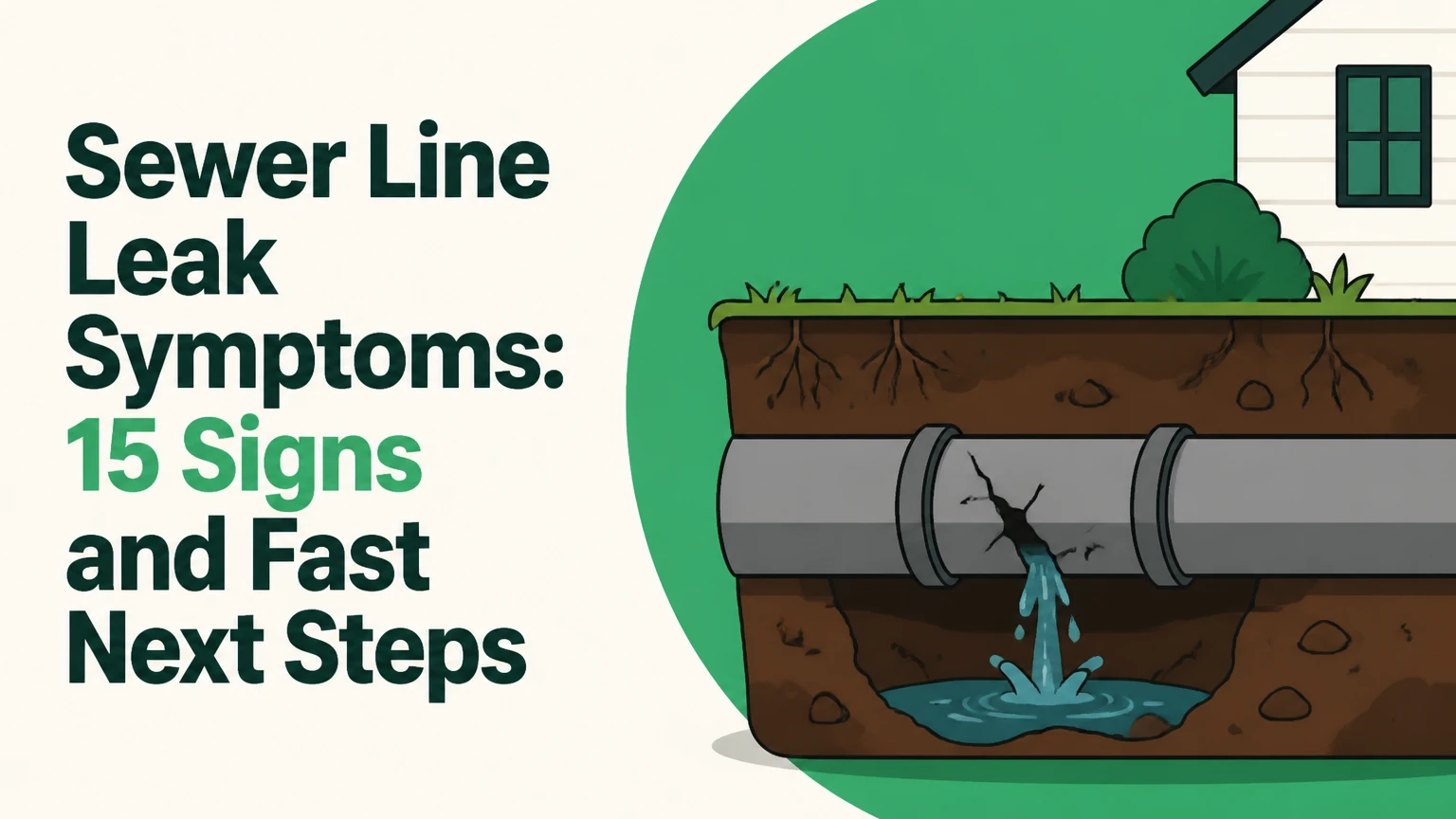
Sewer line leak symptoms include persistent sewage odor, several slow drains, gurgling toilets, wastewater backing up into low fixtures, unexplained indoor dampness, and unusually green or soggy ground above the buried pipe. These signs indicate a damaged, blocked, or leaking building sewer, but a camera inspection is usually needed to distinguish a structural leak from a clog or vent problem.
Key Facts at a Glance
A single slow drain usually indicates a local fixture clog; several affected fixtures suggest a main sewer restriction or damaged line.
Rotten-egg odor can come from a cracked sewer pipe, a dry P-trap, a blocked vent, or a failed septic component.
Green grass above a sewer route is suggestive, not conclusive, because irrigation, fertilizer, and natural drainage create the same pattern.
Wastewater backing up into a shower or floor drain after toilet flushing is a main-line warning sign that requires prompt professional attention.
A sewer camera shows the defect, while electronic locating identifies its surface position; neither test alone proves who owns the damaged section.
Do not excavate until underground utilities have been located and the repair route has been confirmed.
What Is a Sewer Line Leak?
A sewer line leak occurs when the buried pipe carrying wastewater from a building to a public sewer main or septic tank loses its watertight integrity. Cracks, separated joints, root intrusion, corrosion, punctures, and collapsed sections can allow sewage to escape or groundwater and soil to enter.
A sewer leak is different from a sewer backup. A backup is wastewater unable to move through the pipe, while a leak is wastewater escaping through a defect. The same defect can cause both conditions when roots, soil, or a collapsed wall restrict flow.
How does household wastewater reach the sewer?
Household wastewater flows from fixtures through branch drains into a larger building drain, then through the building sewer toward the municipal main or septic tank. Gravity normally provides the driving force, while vent piping admits air and helps maintain balanced pressure.
The pipe must maintain sufficient fall for water to carry solids. A commonly used residential reference is approximately 1/4 inch per foot, or about 2%, although required slope varies with pipe diameter, local plumbing code, fixture design, and site conditions. The AI Overview’s 0.6-centimeter drop per 30 centimeters equals about 2%, not a universal minimum for every sewer line.
What Are the Indoor Sewer Line Leak Symptoms?
The strongest indoor evidence is a combination of sewage odor and multi-fixture drainage trouble. A single odor or one slow sink is rarely enough to identify a buried leak because dry traps, blocked vents, and ordinary fixture clogs can produce similar symptoms.
Persistent sewage or rotten-egg odor
A persistent sewage smell near a basement, crawl space, slab, cleanout, or floor drain can indicate escaping sewer gas from a cracked pipe or failed connection. Hydrogen sulfide is one component of sewer gas and is associated with the characteristic rotten-egg odor.
Odor alone does not prove an underground pipe leak. A dry P-trap in an unused sink, shower, or floor drain can allow sewer gas into a room. A damaged toilet seal, loose cleanout plug, blocked vent, or septic tank problem can also be responsible.
Practical test: Pour approximately 1-2 liters of water into an unused drain. If the odor disappears and does not return, a dry trap was likely. If the smell returns during fixture use or remains near the floor or foundation, arrange a plumbing inspection.
Several slow drains at the same time
Simultaneously slow sinks, tubs, showers, and toilets point toward a restriction in the building sewer or a problem farther downstream. A local sink clog affects one fixture, while a main-line obstruction changes drainage behavior across multiple fixtures.
Recurring slow flow after snaking is particularly informative. Mechanical clearing can open a passage through roots or sludge without repairing the cracked pipe that allowed the roots to enter. A camera inspection becomes more useful when the same symptoms return weeks or months after cleaning.
Gurgling toilets and bubbling drains
Gurgling occurs when trapped air moves through water because wastewater cannot pass freely or the vent system cannot equalize pressure. Toilets may bubble when a washing machine discharges, and shower drains may make a sucking sound when another fixture flushes.
A blocked roof vent can create similar noises, especially when all drainage problems occur inside the home without outdoor wetness. The symptom becomes more concerning for a main-line issue when gurgling accompanies slow drains, sewage odor, or backup into a low fixture.
Wastewater backing up into low fixtures
Wastewater rising in a basement floor drain, shower, bathtub, or laundry standpipe is a high-priority warning sign. Water from an upstairs toilet or washing machine can force contaminated water toward the lowest available opening when the main sewer path is blocked or collapsed.
Stop using toilets, showers, sinks, dishwashers, and washing machines until the cause is identified. Keep children and pets away from sewage, avoid contact with bare skin, and disinfect affected surfaces according to local public-health guidance.
Unexplained dampness, mold, or humidity
A damaged sewer beneath a slab or inside a wall can contribute to persistent moisture, musty odor, mold growth, or elevated humidity. These signs are stronger when they appear near the sewer route and have no plumbing fixture, rainwater, condensation, or groundwater explanation.
Mold is not a sewer-specific indicator. Foundation seepage, poor grading, condensation, and leaking supply pipes are more common alternatives in some properties. Moisture mapping, a plumbing pressure check, and camera inspection can separate those causes.
Toilets that change water level
A toilet bowl that rises, falls, or ripples when another fixture operates can indicate a partially obstructed main line or vent. A damaged sewer pipe may produce the same effect if soil or roots have entered the flow path.
Observe whether the change occurs only in one bathroom or throughout the property. Localized behavior favors a branch drain or toilet issue; whole-house behavior favors the building sewer or shared vent system.
Indoor symptom comparison
| Symptom | More likely local cause | More likely sewer-line cause | Immediate response |
|---|---|---|---|
| One slow sink | Hair, grease, trap blockage | Branch-pipe defect near fixture | Clean trap, then reassess |
| Several slow fixtures | Rarely one fixture clog | Main-line restriction or collapse | Limit water use |
| Sewer odor in unused bathroom | Dry P-trap | Cracked pipe, failed seal, cleanout leak | Refill trap and monitor |
| Backup in shower after flushing | Toilet or branch clog | Building sewer blockage | Stop all wastewater use |
| Gurgling during laundry discharge | Local trap or vent issue | Main-line restriction | Schedule diagnosis promptly |
| Basement dampness | Groundwater, condensation | Sewer leak beneath slab | Check moisture source professionally |
What Are the Outdoor Signs of a Leaking Sewer?
Outdoor sewer leak signs usually appear as a localized change along the buried pipe route. Bright grass, wet soil, settling, or sewage odor can support a leak diagnosis, but irrigation lines, stormwater, fertilizer, and natural groundwater must be ruled out before excavation.
Unusually green or fast-growing grass
A narrow, unusually green strip above the sewer route may result from moisture and nutrients escaping from a damaged pipe. The pattern is more persuasive when it persists during dry weather and follows the approximate line from the house to the street or septic tank.
Green grass is not proof of sewage. Broken irrigation, fertilizer spread, a low area in the yard, and roof drainage can create the same appearance. Compare the suspected area with nearby grass after several dry days and check irrigation coverage before calling for excavation.
Soggy soil or foul-smelling mud
Soft, wet ground over a sewer route during otherwise dry weather can indicate wastewater escaping underground. A sewage odor, surface sheen, or repeated wetness near a cleanout makes the finding more significant.
Do not walk barefoot through suspected sewage-contaminated soil. Keep runoff away from vegetable gardens, play areas, wells, and surface water, and report substantial contamination to the relevant local authority when required.
Depressions, settling, or sinkholes
A sewer leak can wash fine soil into the pipe or surrounding voids, causing pavers, soil, patios, or sections of a driveway to settle. A sudden depression directly above the sewer route may also indicate a collapsed pipe or an improperly compacted previous excavation.
A depression is structurally important even when no sewage is visible. Heavy rain, poor subgrade, erosion, and abandoned utility trenches can produce similar settlement, so a professional should identify the void before anyone fills it.
Foundation or slab movement
Persistent leakage beside a foundation can saturate soil and contribute to settlement or lateral movement. Possible signs include new cracks, uneven floors, sticking doors, or recurring dampness near the foundation.
A sewer leak is only one possible cause. Foundation drainage, expansive clay, groundwater, and structural settlement require different specialists and repairs. Never assume that every foundation crack originated from a sewer pipe.
Flies, rodents, or unusual pest activity
Sewer flies near drains or openings may increase when organic material accumulates in a damaged or blocked line. Rodents can enter some sewer systems through defects, although outdoor pest activity more commonly reflects food, shelter, or nearby public infrastructure.
Pests are supporting evidence, not a standalone diagnosis. A drain cleaning, trap inspection, pest survey, and sewer camera provide more reliable confirmation.
Is It a Sewer Leak, a Clog, or a Vent Problem?
A sewer leak is more likely when symptoms include sewage odor, outdoor wetness, settlement, or repeated backups after temporary clearing. A clog is more likely when flow stops suddenly without outdoor changes, while a vent problem more often causes gurgling and odor without wastewater accumulation.
| Observation | Likely explanation | Why it matters | Best next check |
|---|---|---|---|
| One fixture fails | Local drain clog | Problem is upstream of that fixture | Trap inspection or local auger |
| Whole house drains slowly | Main-line obstruction | Restriction affects shared pipe | Building-sewer camera |
| Odor after unused drain | Dry trap | Water seal has evaporated | Refill and monitor |
| Odor near slab | Pipe, seal, or cleanout defect | Gas may be escaping from structure | Smoke or camera evaluation |
| Green lawn only after irrigation | Broken sprinkler | Moisture source is independent | Irrigation pressure test |
| Backup after washing machine use | Main-line restriction | High discharge exposes limited capacity | Stop use and inspect cleanout |
A hydrostatic test can confirm leakage in an isolated section, but it does not necessarily identify the defect’s location or distinguish every source of water loss. A camera inspection shows cracks, roots, offsets, bellies, corrosion, and collapse, but a camera may miss a tiny leak that has no visible structural opening.
How Can a Homeowner Check for Sewer Trouble Safely?
Homeowners can perform observation-based checks, but they should not open a pressurized cleanout, enter a sewer, apply chemicals to a suspected failure, or dig without utility locating. The safest checks establish whether the problem is localized, whole-house, intermittent, or associated with a visible outdoor change.
- Stop wastewater use if sewage is backing up. Do not flush toilets or run appliances that discharge large volumes.
- Record affected fixtures. Note which drains are slow, when gurgling occurs, and whether one fixture triggers another.
- Refill unused traps. Add water to floor drains, showers, and sinks, then monitor whether odor returns.
- Inspect the cleanout visually. Do not force a stuck cap. If an accessible cap is already loose, standing wastewater may indicate a downstream restriction.
- Check outdoor conditions. Photograph wet soil, green strips, settlement, and odors, then compare them with irrigation and rain patterns.
- Request a sewer camera report. Ask for the video, distance from the access point, defect description, pipe depth if located, and recommended repair length.
When is a sewer line leak an emergency?
A sewer problem is urgent when sewage enters living areas, contamination threatens a private well or waterway, the yard is collapsing, or the building has no usable drainage. A small odor without backup may permit a scheduled inspection, but delaying a recurring symptom can turn a spot repair into a larger excavation.
Contact the municipal sewer department when the blockage may be in the public main or when neighboring properties have the same problem. Responsibility varies by jurisdiction, easement, and local ordinance, so the homeowner should not assume the entire route belongs to the property owner.
How Do Professionals Confirm a Sewer Leak?
Professionals usually combine symptom history, visual inspection, flow testing, and a sewer camera. Hydrostatic testing can confirm that an isolated section does not hold water, while electronic locating maps the camera head’s position at the surface.
Typical diagnostic sequence
- Visual and odor inspection: The technician checks fixtures, cleanouts, basement areas, crawl spaces, and the yard.
- Flow evaluation: The technician observes how fixtures discharge and whether water reaches the cleanout.
- Hydrostatic or air testing: The isolated pipe is tested according to local practice and safety requirements.
- Camera inspection: A waterproof camera travels through the cleanout to document structural and flow defects.
- Electronic locating: A sonde in the camera head identifies horizontal position and approximate depth.
- Written recommendation: The report distinguishes cleaning, spot repair, lining, bursting, or replacement.
What should a camera inspection report include?
A useful report identifies the access point, pipe material, camera distance, defect type, clock position, severity, and recommended remedy. It should also show whether roots, cracks, offsets, standing water, corrosion, or collapse affect the full line or one segment.
Ask whether the camera reached the municipal connection or septic tank. A short inspection ending at a blockage may not show downstream defects, and a clean video after jetting can conceal the original structural problem unless pre-cleaning footage exists.
Which Sewer Repair Method Fits the Damage?
Spot excavation is usually appropriate for one accessible defect, CIPP lining suits a substantially intact pipe with cracks or leaking joints, pipe bursting replaces a failing line when the route can accommodate expansion, and full trenching remains necessary for severe collapse, bad grade, or missing pipe.
| Method | Typical access | Best condition | Main limitation | Typical work time |
|---|---|---|---|---|
| Spot repair | One excavation | Localized crack or joint | Requires surface restoration | About 1-2 days |
| Open trench replacement | Continuous trench | Collapse, severe belly, poor grade | Damages landscaping and paving | About 3-5 days |
| CIPP lining | One or two cleanouts | Cracks, joints, moderate corrosion | Needs a passable host pipe | About 1-2 days |
| Pipe bursting | Two access pits | Replacement along a stable route | Cannot correct every offset or belly | About 1-2 days |
| Root cutting and cleaning | Existing access | Temporary root obstruction | Does not seal the pipe | Hours to one day |
CIPP is not a universal no-dig solution. The host pipe must retain enough shape for the liner to pass, and service connections must be reopened accurately after curing. Pipe bursting can preserve a lawn, but nearby utilities, easements, bends, and soil conditions may restrict its use.
Traditional excavation is disruptive but often the most dependable option for a collapsed line, severe sag, shallow utility conflict, or failed bedding. The least expensive repair method is determined by the defect and site, not by the label “trenchless.”
How Much Does Sewer Line Diagnosis and Repair Cost?
Typical costs vary widely by region, access, depth, pipe diameter, restoration, permits, and municipal responsibility. A camera inspection often costs roughly $100-$500 in many U.S. markets, while repair can range from several thousand dollars for a spot repair to well above $15,000 for deep replacement beneath paving.
The AI Overview lists prices in Bangladeshi taka, but those figures cannot be applied globally. Consumers should request a local written estimate that separates excavation, pipe work, traffic or utility permits, disposal, surface restoration, camera inspection, and taxes.
| Work item | Typical planning range | Variables that increase cost | Required quote detail |
|---|---|---|---|
| Camera inspection | $100-$500 | Long line, difficult access, cleaning | Video and distance markers |
| Spot repair | $2,000-$6,000 | Depth, concrete, utilities | Excavation and restoration separately |
| Open replacement | $5,000-$20,000+ | Length, depth, driveway, street | Price per segment and surface |
| CIPP lining | $4,000-$15,000+ | Diameter, length, access, services | Liner warranty and bypass plan |
| Pipe bursting | $6,000-$20,000+ | Soil, pits, utilities, length | New-pipe specification |
| Root cleaning only | $300-$1,500 | Access, severity, repeat visits | Explain temporary nature |
These are broad practitioner planning ranges, not a universal price list. Insurance commonly excludes gradual wear, corrosion, roots, and deferred maintenance, although some policies cover sudden accidental damage or add limited sewer and drain backup coverage.
How Do Pipe Materials Affect Leak Risk?
Pipe material changes the likely failure pattern, but installation quality, soil movement, tree roots, and age often matter as much as the material itself. Older cast iron and clay lines deserve particular attention because corrosion, joint failure, and root intrusion can progress before a dramatic backup occurs.
| Pipe material | Common installation era | Typical failure pattern | Inspection priority |
|---|---|---|---|
| Cast iron | Before about 1980 | Corrosion, scale, bottom channeling | Check wall thickness and joints |
| Vitrified clay | Common before about 1970 | Cracked sections and root-filled joints | Inspect every joint and offset |
| Orangeburg | Mainly 1940s-1970s | Flattening, delamination, collapse | Treat deformation as structural |
| PVC or ABS | Widespread from 1970s onward | Poor bedding, puncture, joint displacement | Check grade and connections |
| Concrete | Older large or site-specific lines | Cracking, joint leakage, erosion | Assess surrounding soil and size |
Pipe age is a screening clue, not a replacement mandate. A 60-year-old cast-iron line may remain serviceable, while a newer PVC line can fail after poor compaction or construction damage.
What Mistakes Make Sewer Damage Worse?
The most expensive mistakes are treating a structural failure as a recurring clog, excavating before locating utilities, and approving replacement without reviewing camera evidence. Correct diagnosis prevents repeated cleaning charges and avoids unnecessary destruction of driveways, mature trees, and patios.
- Using chemical drain cleaners repeatedly: Caustic or acidic products can injure older metal, damage seals, and create a hazard for technicians. Use mechanical diagnosis instead.
- Cutting roots without repairing entry points: Root removal restores flow temporarily but leaves the opening available for regrowth.
- Accepting a full replacement without video: Request the recorded footage, measured distance, and explanation of why spot repair or lining is unsuitable.
- Digging without utility locating: Gas, electric, communications, and water lines may share the route. Use the local locating service before excavation.
- Ignoring a belly: Cleaning a sagging section does not restore grade. Standing water and solids often return.
- Assuming the cleanout identifies ownership: The property owner, municipality, or utility may be responsible for different segments.
A practitioner rule of thumb is simple: recurring roots mean a pipe defect until proven otherwise. A second rule is to compare pre-cleaning and post-cleaning camera footage, because cleaning can remove the evidence that explains the original failure.
Which Next Step Fits Your Situation?
A pre-1970 home should receive a sewer scope during purchase or after recurring drainage symptoms because clay, cast iron, and Orangeburg have distinct age-related risks. A property with mature trees needs route mapping and root assessment before selecting a trenchless method.
Historic home
Prioritize a complete camera inspection from the building cleanout to the municipal connection or septic tank. Budget for staged repairs, because a line can contain several deteriorated joints even when only one currently leaks.
Landscaped property
Ask for electronic locating, depth measurements, and a restoration plan before approving excavation. CIPP or bursting may protect trees and hardscape, but neither method corrects every grade or collapse problem.
Limited budget
Pay for diagnosis before choosing the repair. If one shallow section is defective and the remaining line is structurally sound, a documented spot repair may cost less than full replacement, but do not perform the excavation yourself unless utilities, contamination, shoring, and permits are properly addressed.
Septic-system property
A sewer-like odor or wet area may originate at the tank, distribution box, absorption field, or house-to-tank line. Septic systems require different testing and local health-department considerations, so a municipal sewer diagnosis cannot be transferred automatically.
Frequently Asked Questions
Can a sewer line leak cause a high water bill?
A sewer leak usually does not increase the potable water meter unless the leak is on a pressurized water line or wastewater is being discharged through fixtures. A high water bill with no visible use points more strongly to a supply-side leak, running toilet, irrigation fault, or meter issue.
Does a sewer camera detect every leak?
A sewer camera detects visible cracks, holes, roots, offsets, corrosion, standing water, and collapse, but it cannot prove every small or concealed leak. Hydrostatic testing may identify water loss that is not visually obvious, while poor access or standing water can limit camera visibility.
Can tree roots crack a sewer pipe?
Tree roots usually enter through open joints, cracks, or failed connections rather than puncturing an intact modern pipe. Root growth can enlarge those openings and restrict flow, so repeated root cutting without repairing the pipe typically provides only temporary relief.
How long do sewer pipes normally last?
Service life depends on material, soil, installation, loading, and maintenance. Orangeburg may fail after several decades, cast iron and clay commonly require inspection after roughly 50 years, and properly installed PVC can last many decades longer, although no material is immune to movement or damage.
Will a sewer leak stop by itself?
A sewer leak rarely repairs itself. Flow may decline when the ground dries or a root temporarily shifts, but the defect remains and can worsen through erosion, corrosion, root growth, or soil settlement.
Is a sewer line inspection worth it before buying a house?
A sewer scope is often worthwhile for older homes, properties with large trees, long private laterals, recurring drainage complaints, or unknown pipe materials. A camera report can identify a repair obligation before closing, when the buyer may have more negotiating options.
The Bottom Line
The most meaningful sewer line leak symptoms are combined patterns: persistent sewage odor, several slow or gurgling fixtures, backups in low drains, unexplained wet or unusually green soil, and settlement along the pipe route. Those signs justify professional diagnosis, but they do not identify the defect by themselves.
Use a safe observation check first, then request a sewer camera and written findings before authorizing excavation. The right repair depends on pipe material, structural condition, grade, access, utilities, surface restoration, and whether the damaged segment belongs to the homeowner or the public sewer system. If sewage is backing up indoors or the ground is collapsing, stop water use and seek urgent help.
Title tag: Sewer Line Leak Symptoms: 15 Signs and Fast Next Steps
Meta description: Spot sewer gas, backups, wet soil, and pipe damage. Use cleanout and camera guidance to decide when repair is urgent and compare your options.