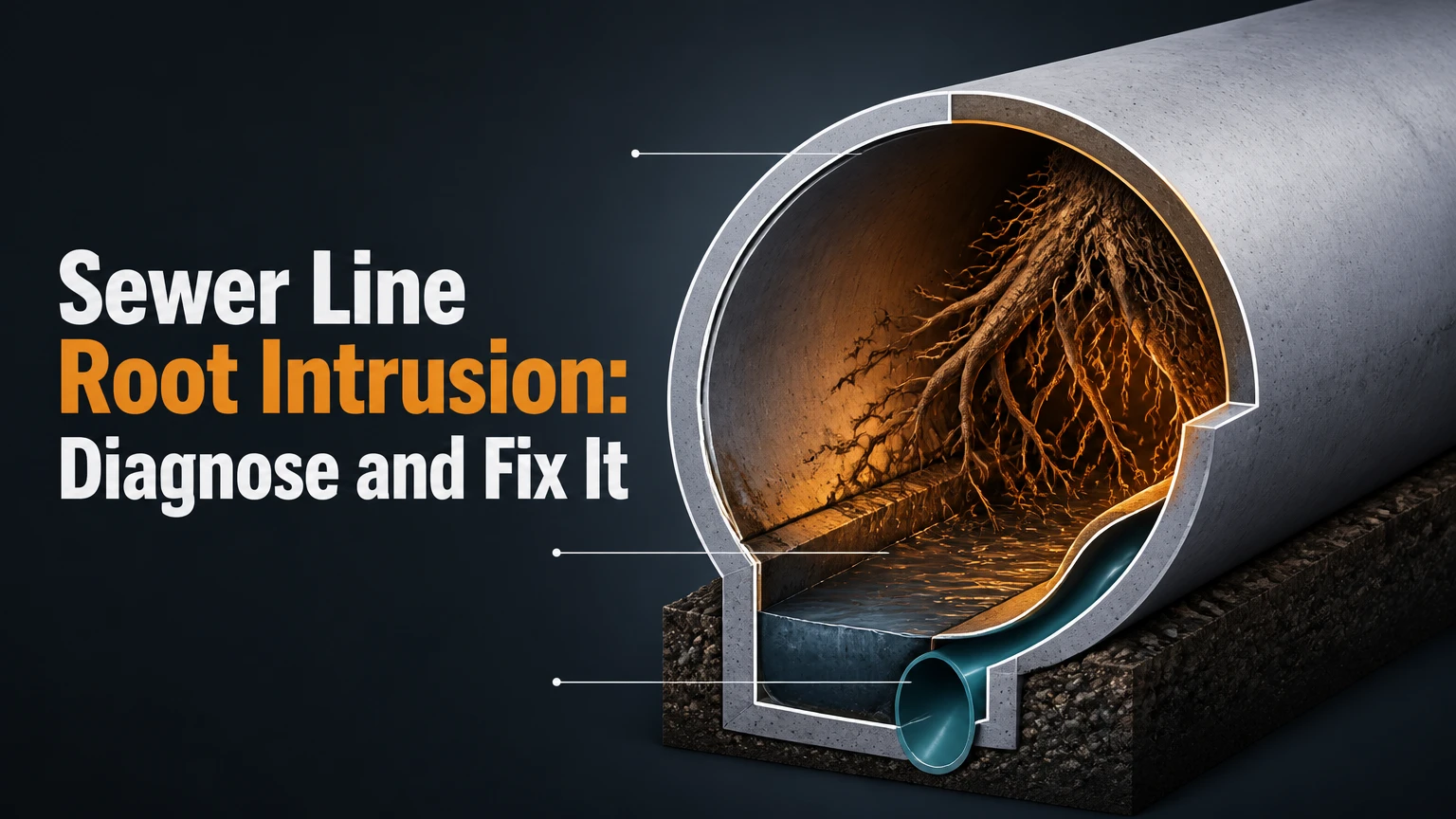
Sewer line root intrusion occurs when tree or plant roots enter a buried wastewater pipe through an open joint, crack, connection, or deteriorated wall. The roots create a fibrous blockage that catches paper and grease, so repeated backups usually require camera diagnosis, root removal, and repair of the entry defect rather than another routine drain cleaning.
Key facts at a glance
Roots usually enter through a pre-existing pipe defect; they rarely fracture a sound, properly joined modern pipe by growth pressure alone.
A sewer camera inspection should guide cleaning and repair decisions, especially before hydro jetting or pipe rehabilitation.
Mechanical cutting restores flow but leaves the defect and often allows regrowth within 6-18 months.
Hydro jetting removes more root material and deposits than a cable cutter, but high pressure can damage fragile or collapsed pipe.
CIPP lining can eliminate joints without open excavation when the pipe has suitable alignment, access, and remaining structural shape.
Typical U.S. project costs range from about $350 for root cutting to more than $25,000 for difficult excavation and restoration.
What Is Sewer Line Root Intrusion?
Sewer line root intrusion is the entry and growth of plant roots inside a buried sanitary sewer or building sewer. Roots follow moisture and nutrient gradients, but the pipe normally becomes accessible only where a joint has separated, a wall has cracked, a fitting has failed, or porous older material has deteriorated.
A wastewater pipe does not attract roots because roots can sense a perfectly sealed pipe from a great distance. A leaking joint releases moisture into surrounding soil, and roots already growing nearby exploit that favorable zone. The distinction matters because removing the root mass without correcting the leak treats the symptom, not the access route.
Tree species, soil moisture, pipe age, and sewer alignment all influence risk. Willows, poplars, cottonwoods, maples, and some fast-growing shrubs can produce extensive root systems, although any established plant near a defective sewer can contribute.
How Does Root Intrusion Progress?
Root intrusion usually develops in five stages, from a hidden pipe defect to a recurring blockage:
- A defect forms. Settlement, corrosion, freezing, poor joint installation, or age creates a gap or crack.
- Fine roots enter. Hairlike feeder roots pass through the opening while wastewater still flows normally.
- Roots branch inside the pipe. The root mass expands along the pipe wall and across part of the flow channel.
- Solids become trapped. Toilet paper, grease, hair, and wipes lodge in the fibrous network.
- The line restricts or fails. Repeated cleaning may expose a larger defect, offset joint, belly, or collapse.
Roots mainly enlarge by biological growth and branching, not by generating a reliable outward force that shatters every pipe type. The U.S. Forest Service describes roots as opportunistic occupants of available soil resources, and sewer practitioners apply the same principle underground: the defect usually precedes the intrusion.
Which Symptoms Point to Root Intrusion?
Recurring main-line backups, slow drainage across several fixtures, and root material on a drain cable are the strongest household clues. A single isolated sink clog usually indicates a fixture trap or branch-line problem, whereas a backup that returns after professional clearing points toward an unresolved main-line defect.
| Symptom | Likely location | Root-intrusion value | Recommended next action |
|---|---|---|---|
| Backup every 3-12 months | Building sewer or yard line | High | Camera inspection after cleaning |
| Toilet gurgles when shower drains | Shared main line | Moderate to high | Stop water use and inspect main |
| Green strip over sewer route | Leaking line or irrigation | Low to moderate | Confirm with camera, not landscaping alone |
| One slow bathroom sink | Fixture branch or trap | Low | Clear local drain first |
| Sewage at cleanout | Blocked downstream line | High | Limit use, protect occupants, call sewer professional |
| Roots on retrieved cable | Pipe defect at cable location | Very high | Record footage and measure defect length |
A lush strip of grass above a sewer line can indicate leakage, but irrigation, buried compost, a shallow water table, or uneven sunlight can produce the same pattern. Odor, wet soil, and repeated backups strengthen the inference, yet only a camera can locate and grade the pipe condition.
Can Roots Destroy an Intact Sewer Pipe?
Roots can obstruct a sewer and worsen an existing defect, but root growth alone does not normally crush an intact, properly installed PVC or HDPE pipe. Root entry can expose brittle clay, corroded cast iron, concrete, or Orangeburg pipe to further deterioration, while cleaning equipment can cause additional damage in a weakened line.
A camera report should distinguish root intrusion from root-related structural failure. Important findings include an open joint, circumferential crack, longitudinal crack, offset, sag, broken section, corrosion hole, or total collapse. A root ball inside an otherwise round and continuous pipe may need cleaning; a root ball at a displaced joint may require rehabilitation.
That distinction prevents an expensive mistake. A contractor who recommends replacement solely because roots are visible has not necessarily established that the pipe requires replacement.
How Is Root Intrusion Diagnosed?
Professional diagnosis combines a drain opening, a push camera, and a written or recorded condition assessment. The camera should travel far enough to identify the upstream and downstream limits of the defect, because a clean section near the house does not prove that the entire sewer is sound.
A useful inspection records:
- Pipe material and approximate diameter
- Distance from the cleanout or foundation to each intrusion
- Number and size of root-entry points
- Joint offsets, cracks, sags, corrosion, and collapse
- Connection points and municipal responsibility limits
- Whether a cutter or jetter can safely pass
- Available cleanouts and access points
- Video showing the pipe before and after cleaning
The inspection sequence matters. A heavy root mass can obscure a crack, so the line may need careful mechanical opening before a second camera pass. Conversely, jetting a severely collapsed clay or Orangeburg line can enlarge the failure or leave equipment stranded.
What Should a Camera Report Include?
A useful report names the defect, location, severity, and recommended response instead of saying only “roots present.” Ask for the original video, pipe measurements, and a diagram showing the house, cleanout, property boundary, street connection, and defect distances.
The National Association of Sewer Service Companies, or NASSCO, uses standardized defect terminology in its Pipeline Assessment Certification Program. Homeowners do not need certification to understand the terms, but reports using consistent categories are easier to compare between contractors.
Which Treatment Restores Flow Safely?
Mechanical root cutting is usually the first flow-restoration option when the pipe remains open and structurally stable. Hydro jetting cleans more of the pipe wall, but a camera inspection should precede both methods because neither approach repairs a separated joint or collapsed section.
| Treatment | Typical U.S. price | Service time | Typical recurrence | Main limitation |
|---|---|---|---|---|
| Cable root cutting | $350-$600 | 1-2 hours | 6-12 months | Leaves defect and root fragments |
| Hydro jetting | $400-$900 | 2-4 hours | 9-18 months | Unsafe for unstable pipe |
| Foaming root treatment | $100-$300 | About 1 hour | 12-24 months | Does not remove collapse |
| Local spot repair | $1,500-$6,000 | 1-3 days | Long-term at repaired section | Requires excavation |
| CIPP lining | $4,000-$12,000 | 1-2 days | Long-term, subject to installation | Needs an open, alignable host pipe |
| Pipe bursting | $6,000-$15,000 | 1-3 days | Long-term with new pipe | Needs access pits and suitable route |
These are typical planning ranges, not guaranteed bids. Labor markets, depth, diameter, access, permitting, traffic control, disposal, and surface restoration can change the final price substantially.
Is Hydro Jetting Better Than Snaking?
Hydro jetting is usually better for removing a broad root veil, grease, scale, and trapped debris from a structurally sound pipe. Cable cutting is often safer for an initial opening in an uncertain line because it uses less water and can restore a narrow passage before a more thorough cleaning.
A jetter operating at roughly 2,000-4,000 pounds per square inch can scour deposits, but pressure at the nozzle is not the same as pressure against every pipe surface. Nozzle selection, hose size, operator control, and pipe condition determine the actual risk.
Hydro jetting is a poor choice when a camera shows a collapsed pipe, severe offset, missing bottom, advanced corrosion, or fragile bituminous Orangeburg. The equipment may fail to pass, enlarge the opening, or push debris into a downstream obstruction.
Practitioner rule: camera first, open the line conservatively, camera again, then select jetting or rehabilitation based on the recorded condition.
Do Chemical Root Killers Work?
Foaming root treatments can kill or suppress root tissue inside a sewer and delay recurrence, but they cannot seal the entry defect or restore a collapsed pipe. Product performance depends on active ingredient, contact time, pipe condition, wastewater rules, and correct application.
Foam is preferable to a liquid-only treatment because it can contact the crown and sidewalls rather than flowing along the invert. Some commercial products use dichlobenil or metam compounds, but formulations and legal labels vary by country and state.
Copper sulfate deserves special caution. The U.S. Environmental Protection Agency regulates pesticide products by label, and local wastewater utilities may restrict copper compounds because repeated discharge can harm treatment processes or receiving waters. Septic owners face additional risks because biocides can disrupt biological treatment.
Never pour an unregistered agricultural herbicide, industrial chemical, or large quantity of copper sulfate into a toilet. Follow the product label, utility rules, septic guidance, and local hazardous-material requirements.
The EPA’s practical wastewater message is concise: “Flush only toilet paper.” That advice does not eliminate root intrusion, but it reduces the paper, wipes, and hygiene-product load that turns a partial root mass into a complete blockage.
Which Permanent Repair Fits the Pipe?
CIPP lining is usually the least disruptive permanent option when a sewer has a continuous route, manageable deformation, and enough remaining shape for a liner. Pipe bursting is better when the host pipe has collapsed or needs a larger, structurally independent replacement, while excavation remains necessary for severe access or alignment problems.
| Repair method | Structural result | Best condition | Access requirement | Typical disruption |
|---|---|---|---|---|
| CIPP lining | Resin liner inside existing route | Cracks, joints, moderate corrosion | Two cleanouts or approved access | Low, often no trench |
| Pipe bursting | New HDPE pipe replaces old route | Collapse, repeated intrusion, undersized line | Launch and receiving pits | Moderate, localized pits |
| Spot excavation | New section at one defect | One short crack or offset | Direct surface excavation | Local lawn or paving damage |
| Full excavation | Entire line replaced | Multiple failures or bad grade | Continuous trench | Highest restoration burden |
When Does CIPP Lining Make Sense?
CIPP lining makes sense when the original pipe can be cleaned, measured, and traversed, and when the liner can cure without blocking lateral connections or reducing capacity beyond acceptable limits. The resin-saturated tube forms a jointless interior surface that removes the original entry gaps from service.
CIPP is not a universal solution. A fully pancaked pipe, severe grade failure, major void, or inaccessible lateral may require excavation or bursting. The liner also reduces internal diameter, typically by the liner wall thickness, so a designer should check hydraulic capacity rather than assume any diameter is acceptable.
Ask whether the proposal includes lateral reinstatement, bypass pumping, resin type, cure method, post-installation camera footage, and a written warranty.
When Is Pipe Bursting Better?
Pipe bursting is better when the old line has lost structural integrity or when the replacement needs the same or greater diameter. A bursting head fractures or displaces the old pipe while pulling a new HDPE pipe through the prepared alignment.
The method still needs space for launch and receiving pits, and it may be unsuitable near other utilities, unstable soil, shallow foundations, or a route with sharp bends. Bursting can also damage nearby services if the design and utility locating are inadequate.
When Is Dig-and-Replace Necessary?
Open excavation is necessary when the sewer has severe grade problems, inaccessible connections, extensive collapse, contaminated soil, or a route that trenchless equipment cannot follow. Excavation also allows direct correction of bedding, depth, alignment, and connection defects.
A low excavation quote may exclude concrete removal, asphalt replacement, root removal, engineering, permits, landscaping, traffic control, and contaminated-soil disposal. Compare the complete project cost, not only the pipe-installation line item.
What Does Sewer Root Repair Cost?
Typical sewer root repair costs range from $350-$900 for professional clearing, $4,000-$12,000 for CIPP lining, $6,000-$15,000 for pipe bursting, and $4,000-$25,000 or more for excavation. Deep lines, streets, driveways, easements, and restoration work push projects toward the upper end.
| Cost factor | Typical low range | Typical high range | Why it changes the quote |
|---|---|---|---|
| Camera inspection | $150 | $500 | Access, cleaning, recording, travel |
| Root cutting | $350 | $600 | Depth, distance, severity |
| Jetting | $400 | $900 | Diameter, hose length, deposits |
| CIPP lining | $4,000 | $12,000 | Length, diameter, laterals, access |
| Pipe bursting | $6,000 | $15,000 | Pits, diameter, utility conflicts |
| Excavation and restoration | $4,000 | $25,000+ | Depth, paving, landscaping, traffic |
Price comparisons become unreliable when one contractor includes a camera, permits, bypass pumping, lateral reconnection, and surface restoration while another excludes them. Request an itemized scope and confirm whether the warranty covers root recurrence, structural failure, or only workmanship.
Does Pipe Material Change the Risk?
Pipe material changes both the likely entry defect and the safest repair method. Clay commonly develops open or offset joints, cast iron develops corrosion and scale, concrete can crack or separate, Orangeburg can deform, and PVC generally resists intrusion until a joint or connection fails.
| Pipe material | Common root entry | Cleaning concern | Common long-term option |
|---|---|---|---|
| Vitrified clay | Open or offset joints | Fragile joints and breaks | CIPP, spot repair, bursting |
| Cast iron | Corrosion holes and joints | Scale can hide defects | CIPP or replacement |
| Concrete | Cracks and separated joints | Abrasion and fragments | CIPP or excavation |
| Orangeburg | Deformation and delamination | High collapse risk | Replacement or bursting |
| PVC | Failed gasket or connection | Usually lower risk | Joint repair or CIPP |
PVC is not root-proof. A displaced gasket, poor solvent weld, settlement crack, or service connection can still admit roots. Newer pipe lowers the probability of intrusion, but camera evidence remains more useful than age alone.
How Can Homeowners Prevent Regrowth?
Homeowners reduce recurrence by repairing the pipe defect, managing nearby vegetation, and scheduling condition-based inspections. Tree removal alone is unreliable because established roots can remain in the soil, and replacement planting in the same corridor recreates the risk.
Use these measures:
- Obtain the sewer route from a camera diagram or utility records.
- Avoid planting aggressive, high-water-demand trees directly over the line.
- Follow local arborist guidance for planting distance, because mature root spread varies by species and soil.
- Install a professionally designed root barrier only where it will not redirect roots toward a foundation or utility.
- Keep grease, wipes, paper towels, and hygiene products out of the drain.
- Reinspect a previously affected line at a practical interval, often 12-24 months.
- Keep cleanouts accessible and capped to prevent soil and stormwater entry.
A root barrier cannot repair a leaking sewer. It is a landscape-management measure, not a substitute for pipe rehabilitation.
Who Pays for the Repair?
The property owner commonly pays for the building sewer from the house to the public connection, but responsibility changes by municipality, easement, ownership boundary, and local ordinance. Some utilities own or maintain the public lateral, while others place the entire private lateral on the owner.
Homeowners insurance often excludes gradual deterioration, tree-root maintenance, and preventable seepage, although policies may cover sudden resulting water damage or limited service-line failures through an endorsement. Coverage depends on the policy language and the event, not simply on the presence of roots.
Before authorizing work, verify:
- The private and public sewer responsibility boundary
- Local permit and right-of-way requirements
- Utility approval for lining or bursting
- Service-line or sewer-backup endorsements
- Whether a tree or landscaping claim is separate
- Required licensed-contractor documentation
What Should You Do During a Sewage Backup?
Stop using toilets, showers, washing machines, and sinks when sewage backs up into the building. Keep people and pets away from contaminated water, shut off electricity only if it is safe to do so, and call the sewer utility or an emergency plumber to determine whether the blockage is private or public.
Do not use chemical drain opener in a backed-up main line. Do not repeatedly flush to test flow. Porous materials contaminated by sewage may require removal, and cleanup should follow local public-health guidance.
If wastewater enters a finished basement, document the damage before disposal where possible, contact the insurer promptly, and use a qualified remediation provider. Sewage exposure can contain pathogens, so gloves, eye protection, ventilation, and proper disinfection are necessary.
Common Mistakes That Increase the Cost
- Repeating cable cleaning without a camera: repeated service charges accumulate while the joint continues leaking.
- Jetting a collapsed pipe: high-pressure cleaning cannot restore missing pipe structure and can worsen a fragile failure.
- Treating roots as the primary cause: roots often reveal a pre-existing joint or wall defect.
- Removing a tree before inspecting the sewer: the pipe may still leak, and neighboring plants may reach the same opening.
- Comparing incomplete quotes: a trenchless price may exclude lateral reconnections, permits, and restoration.
- Using raw copper sulfate: environmental, septic, utility, and legal restrictions may apply.
- Accepting “permanent” without a scope: ask whether permanent means no roots at the repaired segment or a warranty against every future blockage.
One experienced diagnostic rule is especially valuable: if a cable repeatedly stops at the same measured distance, the obstruction is probably a fixed defect or intrusion site rather than random household debris.
Which Solution Fits Your Situation?
Short-term budget constraint
Choose careful root cutting, followed by a camera inspection and a label-compliant foaming treatment if permitted. This approach can restore service for months, but it is maintenance rather than a structural repair.
Long-term occupancy with a sound pipe
Choose CIPP when the line is open, reasonably aligned, and accessible. The reduced excavation can justify the higher initial price when a driveway, mature garden, or retaining wall would make replacement expensive.
Collapsed or badly deformed line
Choose pipe bursting, spot excavation, or full replacement according to utility conflicts, grade, and access. CIPP cannot recreate a missing pipe shape or correct a severe sag.
One localized defect
Choose a spot repair when a camera identifies one short, accessible failure and the remaining line has good condition. Replacing the entire sewer for one soundly isolated defect may waste capital.
Property sale within one year
Obtain a camera report and written repair scope before deciding. A documented temporary clearance may be adequate for disclosure and immediate operation, but buyers and lenders may require structural repair.
FAQ
How quickly do sewer roots grow back after cutting?
Roots often recur within 6-18 months after cable cutting, although some lines remain open longer and heavily leaking joints can recur sooner. Regrowth depends on the size of the entry defect, nearby vegetation, moisture, climate, and how thoroughly the pipe wall was cleaned.
Can I remove tree roots from a sewer line myself?
A homeowner can sometimes use a small drain machine for a minor branch-line obstruction, but main sewer work presents equipment, contamination, and structural risks. Professional inspection is safer when multiple fixtures back up, roots recur, or the line runs beneath a slab, driveway, or public easement.
Are tree roots in a sewer line the plumber’s responsibility?
Responsibility usually follows pipe ownership and the defect location, not the biological source of the roots. A homeowner often owns the private lateral, while a municipality may own the public main or part of the street connection. Confirm the boundary with the utility and local code.
Will tree removal stop sewer root intrusion?
Tree removal may reduce future root growth, but it does not remove roots already inside the pipe or seal the damaged joint. Remaining roots can continue using the leak, and another nearby plant can occupy the same opening unless the sewer is repaired.
Can sewer roots enter a newer PVC pipe?
Roots can enter newer PVC through a failed gasket, separated joint, cracked fitting, poor connection, or construction damage. PVC has fewer age-related defects than clay or cast iron, but no installed sewer is immune to an open pathway.
Is a sewer camera inspection worth the cost?
A camera inspection is usually worth the cost when a main line backs up repeatedly or a contractor recommends permanent repair. The inspection identifies the defect distance, structural condition, repair length, and material, which prevents choosing jetting, lining, or excavation blindly.
The Bottom Line
Sewer line root intrusion is usually evidence of a leaking joint, crack, failed connection, or deteriorated pipe rather than a standalone tree problem. Clear the line safely, inspect the entire affected reach, and match the remedy to the defect: cutting for temporary flow, jetting for thorough cleaning of stable pipe, CIPP for suitable intact alignment, bursting or excavation for collapse. A camera-based diagnosis is the decision that prevents the most expensive wrong repair.