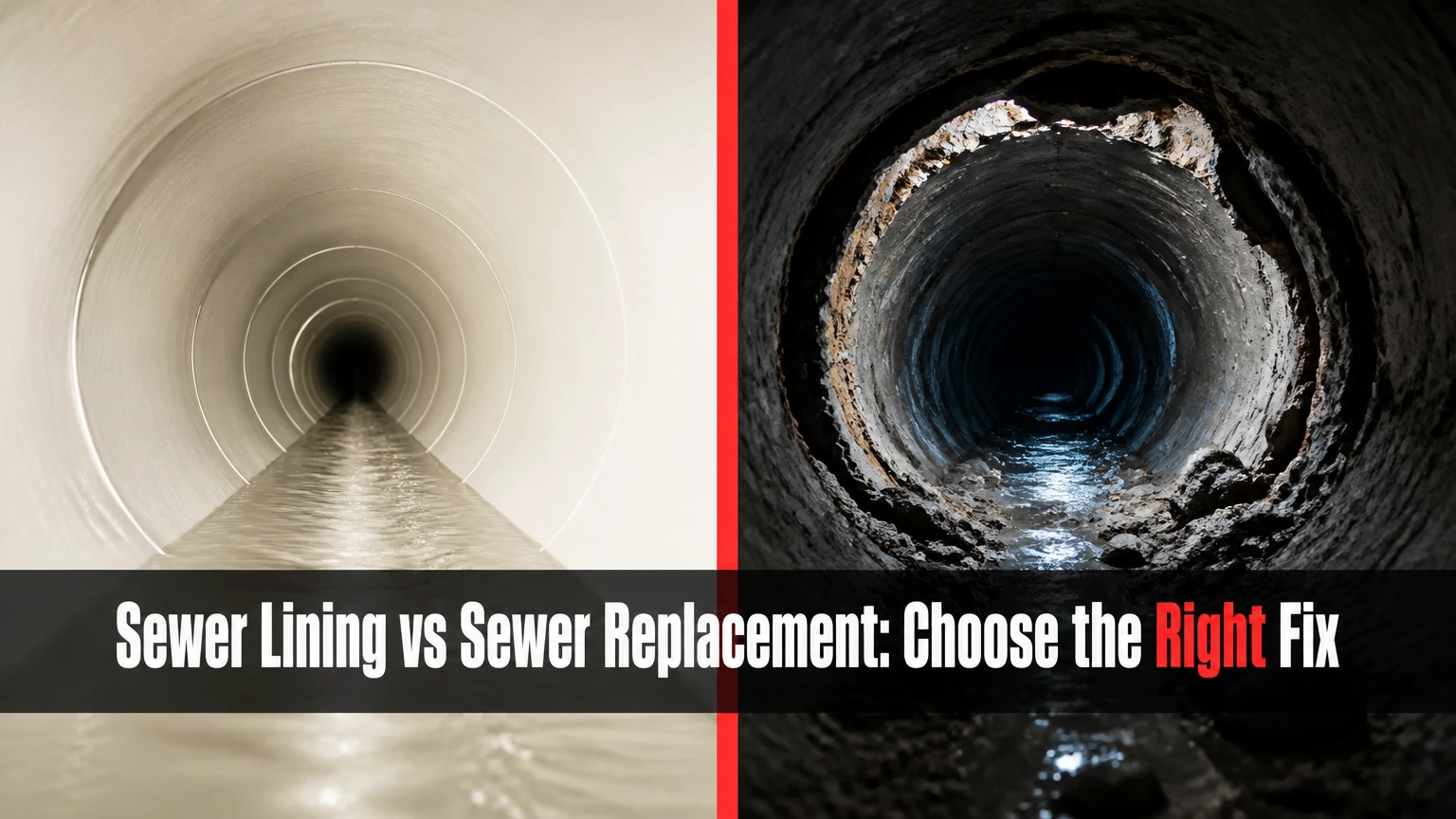
Sewer lining repairs a damaged pipe from the inside, while sewer replacement removes the existing pipe and installs a new one, usually through excavation. Lining is often the better choice for cracks, leaking joints, and root intrusion when the host pipe remains open and correctly graded. Replacement is usually necessary for collapse, severe deformation, or persistent sagging.
Key Facts at a Glance
- Cured-in-place pipe lining creates a structural, jointless pipe inside the existing sewer.
- Traditional replacement provides the best solution for collapsed, crushed, badly offset, or bellied pipe.
- Typical residential CIPP projects cost about $4,000-$12,000, while excavated replacement often costs $5,000-$25,000 or more after restoration.
- Sewer lining commonly takes one to two days, while open-trench work commonly takes three to seven days.
- A liner usually reduces internal diameter by roughly 3%-8%, but the effect depends on liner thickness and the original pipe size.
- A camera inspection, cleaning assessment, and elevation or slope review should precede either major repair.
What Is the Difference Between Sewer Lining and Replacement?
Sewer lining rehabilitates the existing line in place; sewer replacement installs a new physical sewer after removing or abandoning the old one. The two methods solve different classes of defects, so the lowest initial plumbing price does not necessarily identify the lower-cost project.
A lining crew normally uses an existing cleanout, manhole, or access opening. The crew cleans the host pipe, measures its geometry, inserts a resin-saturated tube, cures the tube, and cuts open covered lateral connections. The finished liner becomes a pipe within the old pipe.
Open-trench replacement exposes the sewer along its route. Workers remove the defective section, prepare the trench, install new pipe at the required grade, connect it to the building drain and public main, then restore soil, concrete, asphalt, or landscaping.
The central decision is structural feasibility. Sewer lining needs a host pipe with enough continuity and shape to contain the liner. Sewer replacement can correct the route, elevation, diameter, and bedding because the crew can access the entire installation zone.
How Does CIPP Sewer Lining Work?
Cured-in-place pipe, or CIPP, uses a flexible tube saturated with thermosetting resin. A camera inspection and thorough cleaning come first because roots, scale, groundwater, and debris can prevent proper contact between the liner and host pipe.
The six stages of a typical lining job
- Inspect the sewer. A CCTV camera records pipe material, diameter, defects, lateral connections, standing water, and distances from access points.
- Clean the host pipe. Hydro-jetting, root cutting, scraping, or milling removes deposits and intruding roots. Heavy scale may require several passes.
- Prepare and wet out the liner. The contractor selects a liner thickness based on diameter, groundwater, loading, and structural design. Resin saturates the tube under controlled conditions.
- Insert the liner. Crews pull the liner into position or invert it with air pressure. The liner must reach the planned endpoint without folds or excessive stretching.
- Cure the resin. Hot water, steam, ambient cure, or ultraviolet light hardens the resin. Cure temperature and duration depend on the resin system and liner design.
- Reinstate connections and inspect. A robotic cutter opens lateral junctions, and a final CCTV survey checks wrinkles, open ends, joints, and remaining obstructions.
A competent proposal should identify the resin type, liner thickness, curing method, design standard, expected reduction in diameter, lateral reinstatement method, and post-installation inspection. “Epoxy lining” alone is too vague to compare contractors meaningfully.
When does sewer lining need excavation?
Sewer lining may still require small excavations for inaccessible cleanouts, damaged access points, severe lateral connections, or a short section that cannot accept the liner. Trenchless describes the primary rehabilitation method, not a guarantee of zero digging.
How Does Open-Trench Sewer Replacement Work?
Open-trench replacement exposes the damaged sewer, removes the old pipe, corrects bedding and grade, installs new pipe, and restores the surface. Excavation is the most reliable option when the pipe has collapsed, changed elevation, lost its shape, or requires a new route.
The replacement sequence
- Locate utilities and confirm ownership. Utility markings, municipal requirements, and property records establish the work zone and connection responsibilities.
- Plan access and protection. The contractor identifies traffic controls, shoring, groundwater management, spoil storage, and protection for nearby foundations.
- Excavate safely. Trench depth, soil type, and local safety rules determine whether sloping or a trench shield is required.
- Remove defective pipe. Cast iron, vitrified clay, Orangeburg, PVC, or mixed materials may be removed, abandoned, or replaced according to local approval.
- Prepare bedding. Granular bedding supports the new pipe and limits point loading. The installer verifies invert elevations rather than relying on surface grade.
- Install and test new pipe. PVC, ABS, or HDPE may be used depending on location and code. Joints, cleanouts, and building connections require inspection.
- Backfill and restore. Compaction in controlled lifts reduces later settlement. Pavement, concrete, sod, irrigation, and planting may require separate restoration trades.
A commonly cited residential drainage target is a quarter-inch fall per foot for smaller gravity sewers, but the permitted slope depends on pipe diameter, local code, flow, connection elevations, and municipal requirements. The contractor should document the designed invert elevations instead of promising a generic slope.
Which Sewer Repair Method Is Better for Each Defect?
The defect, not the marketing label, should determine the method. Lining suits defects that preserve a usable pipe channel, whereas replacement suits defects involving geometry, elevation, inaccessible sections, or missing structural support.
| Pipe condition | Preferred method | Reason | Main qualification |
|---|---|---|---|
| Hairline cracks | CIPP lining | Seals the continuous crack internally | Host pipe must remain open |
| Root intrusion at joints | CIPP or spot repair | Removes entry paths and seals joints | Roots require complete cleaning |
| Several leaking joints | CIPP lining | Creates a jointless inner surface | Lateral connections need reopening |
| One isolated break | Spot repair | Limits excavation to the defective segment | Remaining pipe still needs inspection |
| Fully collapsed section | Open-trench replacement | Restores the missing passage and support | Pipe bursting may fit some sites |
| Long, shallow sag | Replacement | Re-establishes elevation and bedding | Short sags may need localized work |
| Offset joint with round profile | CIPP or spot repair | May bridge a moderate offset | Severe offsets prevent insertion |
| Heavy internal scale | Cleaning, then CIPP or replacement | Restores the bore before rehabilitation | Lost wall thickness changes the design |
| Wrong route or undersized pipe | Replacement | Permits rerouting or upsizing | Hydraulic design is required |
| Pipe beneath a mature tree | CIPP or bursting | Reduces root and landscape disturbance | Structural feasibility still controls |
| Pipe under a foundation | CIPP or interior excavation | Avoids broad foundation exposure | Access and lateral geometry matter |
| Sewer with repeated deformation | Replacement | Addresses the underlying ground movement | Soil and drainage causes need review |
Can sewer lining fix a collapsed or bellied pipe?
Sewer lining cannot reliably correct a fully collapsed pipe or a belly caused by a low section in the sewer route. A liner follows the host pipe’s existing geometry, so it can create a structurally stronger pipe while preserving an unacceptable sag, reverse grade, or severe flattening.
A partial collapse may be treatable if a contractor can open and clean the section, but the inspection must show enough circular profile and continuity for insertion. A belly requires a different question: where are the upstream and downstream invert elevations, and can standing water be eliminated without excavation?
This is a common practitioner mistake. A liner can seal a leak inside a sag, but it cannot lift the sag back to design elevation.
Winner for collapse or grade failure: open-trench replacement.
Does Sewer Lining Reduce Flow Capacity?
Sewer lining reduces the pipe’s internal diameter, but the resulting flow loss is not automatically significant. A typical liner may reduce diameter by 3%-8%, and the smoother resin surface can offset part of the hydraulic effect by reducing friction compared with rough, scaled cast iron or clay.
The actual result depends on original diameter, liner thickness, roughness, slope, deposits, and whether the pipe already operates partially full. A 4-inch residential line is less tolerant of diameter loss than a 10-inch building sewer with substantial spare capacity.
| Existing pipe | Typical liner thickness | Approximate finished diameter | Capacity concern |
|---|---|---|---|
| 4-inch clay or cast iron | 4-8 mm | 3.7-3.9 inches | High if already undersized |
| 6-inch clay or cast iron | 5-10 mm | 5.6-5.9 inches | Usually moderate |
| 8-inch municipal or commercial line | 6-12 mm | 7.5-7.9 inches | Often low if grade is adequate |
| 10-inch building sewer | 8-15 mm | 9.4-9.8 inches | Usually low with design review |
A contractor should provide the proposed finished diameter and, for larger or heavily loaded systems, a hydraulic calculation. Slip lining creates a larger annulus and generally reduces diameter more than CIPP, so it deserves additional flow scrutiny.
Winner for maximum diameter or future capacity: replacement.
Which Option Costs Less?
Sewer lining often costs more per installed foot of plumbing, but open-trench replacement frequently costs more as a complete property project. Excavation adds equipment, spoil handling, shoring, utility coordination, surface restoration, traffic control, and possible groundwater management.
The following are typical United States residential planning ranges, not fixed bids. Regional labor, depth, access, pipe diameter, permit fees, and restoration can move the final price substantially.
| Cost component | CIPP lining | Open-trench replacement | Typical price range |
|---|---|---|---|
| Main sewer work | $125-$250 per linear foot | $75-$200 per linear foot for pipe work | $2,500-$15,000 |
| CCTV inspection | Usually required | Usually required | $200-$600 |
| Hydro-jetting or mechanical cleaning | Common prerequisite | Sometimes required | $500-$1,500 |
| Surface restoration | $0-$1,500 | Sod, concrete, asphalt, or planting | $500-$10,000+ |
| Typical residential total | $4,000-$12,000 | $5,000-$25,000+ | Project-dependent |
| Emergency or deep excavation premium | Limited | $2,000-$15,000+ | Soil and depth dependent |
The cheapest quote may omit restoration, lateral reconnection, permits, bypass pumping, or post-repair inspection. Compare scopes, not only the headline price.
Winner on undisturbed property: CIPP lining.
Winner on lowest plumbing-only price for a short accessible section: spot repair or replacement.
How Long Do Lining and Replacement Last?
A properly designed and installed CIPP liner commonly carries a manufacturer or contractor warranty of 10-50 years, while many PVC or HDPE replacement systems have expected service lives of 50-100 years under suitable conditions. Neither figure guarantees performance when installation, soil movement, chemical exposure, or maintenance is poor.
The useful comparison is not simply “liner versus plastic.” It is the condition of the surrounding soil, the quality of joints, the resin design, the installation record, and whether the repair corrected the cause of failure.
| Attribute | CIPP lining | PVC or ABS replacement | HDPE pipe bursting |
|---|---|---|---|
| Typical service-life expectation | 50 years or more when properly designed | 50-100 years in suitable service | 50-100 years in suitable service |
| New joints along repaired run | None in the liner | Several solvent-welded or gasketed joints | Fusion joints or manufacturer connections |
| Resistance to root entry | High through liner wall | High at sound joints | High at fused joints |
| Response to ground movement | Flexible rehabilitation system | Depends on bedding and joints | Flexible pipe with fused joints |
| Warranty commonly offered | 10-50 years | 1-10 years installation warranty | 5-20 years, contractor-dependent |
| Main failure risk | Poor cure, wrinkles, delamination | Settlement, joint defects, installation damage | Utility conflicts, bursting path constraints |
The warranty should state whether it covers materials, labor, lateral reconnections, recurring blockages, and consequential property damage. A long warranty with narrow exclusions may provide less protection than a shorter warranty with clear coverage.
What Are the Main Trenchless Alternatives?
CIPP is not the only trenchless approach. Pipe bursting replaces the old line with a new pipe through two or more pits, while slip lining inserts a smaller carrier pipe into the existing host.
| Method | Excavation requirement | Finished diameter | Best use | Main limitation |
|---|---|---|---|---|
| CIPP lining | Access pits or existing cleanouts | About 92%-97% of original diameter | Cracks, roots, leaking joints | Needs a continuous host path |
| Pipe bursting | Launch and receiving pits | Same or larger than original | Severe structural failure without full trench | Cannot safely cross all utilities |
| Slip lining | Access pits and annular grouting | Commonly 70%-90% of original diameter | Large, straight, accessible pipes | Greater flow reduction |
| Spot repair | One localized excavation | Full replacement diameter | Single break or connection | Leaves other defects untreated |
| Open-trench replacement | Full route excavation | Same or larger diameter | Collapse, grade, route changes | Surface damage and disruption |
Pipe bursting is often called semi-trenchless because it still requires pits and can exert ground forces near utilities, foundations, and other buried services. It is not an automatic substitute for lining.
Which Method Fits Your Property?
Property context changes the financial value of each method. A technically suitable liner can be the wrong economic choice when access is poor, while excavation can be rational when the sewer already runs through a planned construction zone.
Mature landscaping or a protected tree
CIPP lining is usually attractive when a sound, round sewer runs beneath established trees, retaining walls, irrigation, or expensive hardscape. Root intrusion can recur outside the repaired segment, so the inspection should identify whether roots enter through joints along the full run.
Sidewalk, roadway, or shared access
CIPP or pipe bursting can reduce pavement removal, but public-right-of-way work may require permits, traffic control, municipal inspection, and special materials. The property owner should confirm whether the private owner, municipality, or utility district owns each section.
Historic home with cast-iron sewer
CIPP can rehabilitate internally scaled cast iron when the pipe retains its shape and access exists. Severe bottom corrosion, missing wall sections, or a failed building exit may require excavation, interior slab removal, or a hybrid repair.
Deep sewer or high groundwater
Deep excavation can require shoring, dewatering, trench access, and extended restoration. CIPP may reduce those costs, but groundwater infiltration can complicate cleaning, resin curing, and end seals, so the contractor must explain water-control measures.
Pipe with multiple defects and one failed section
A hybrid solution often provides the best balance: replace the collapsed or bellied section, then line the remaining cracked or root-damaged run. Replacing the entire route is not automatically better when most of the existing pipe remains structurally serviceable.
What Should a Sewer Inspection Confirm?
A sewer camera identifies visible defects, but a good decision also needs information about grade, access, ownership, and connections. Video alone may not prove that a liner can pass through every offset or that a replacement will have enough fall.
Request these items before approving work:
- A recorded CCTV survey with distance measurements and defect locations.
- Pipe diameter, material, approximate depth, and total repaired length.
- Identification of every lateral connection and cleanout.
- Evidence of standing water, reverse grade, belly, deformation, or collapse.
- Cleaning method and confirmation that roots and scale were removed.
- Proposed liner thickness, resin system, cure method, and design basis.
- Replacement pipe material, bedding, joint method, and invert elevations.
- Permit, inspection, traffic-control, and right-of-way responsibilities.
- Surface-restoration inclusions, exclusions, and allowances.
- Final CCTV inspection and written warranty terms.
NASSCO’s Pipeline Assessment and Certification Program, commonly called PACP, provides standardized condition terminology for inspected sewer assets. A contractor using consistent defect descriptions makes competing proposals easier to evaluate than a report that says only “bad pipe.”
What Problems Can Occur After Repair?
Post-repair problems usually result from an uncorrected defect, incomplete cleaning, poor installation, or an omitted connection. Persistent backups do not prove that the repair method was wrong until a new camera inspection identifies the actual obstruction.
Wrinkled or incompletely cured liner
A wrinkle can restrict flow, interfere with a lateral, or indicate poor installation control. Minor protrusions may be mechanically trimmed, but an uncured or badly failed section may require removal and replacement, localized excavation, or a second rehabilitation attempt.
Backups continue after lining
The cause may be a missed lateral, retained root mass, downstream municipal blockage, a belly outside the lined section, or a separate building drain defect. Require a post-job CCTV survey that tracks the camera through the entire repaired run and every reinstated connection.
Settlement follows replacement
Ground settlement commonly points to inadequate backfill compaction, water movement, trench collapse, or an unaddressed soil condition. The contractor should document lift thickness, compaction testing where required, drainage conditions, and the restoration warranty.
Roots return
A liner prevents root entry through the rehabilitated wall, but roots can still enter at unlined laterals, end seals, cleanouts, or downstream defects. Root treatment and inspection should cover the entire connected drainage path.
What Is the Best Decision Rule?
Choose sewer lining when the pipe is open, reasonably round, correctly graded, and damaged mainly by cracks, leaking joints, corrosion, or root intrusion. Choose replacement when the pipe is collapsed, badly flattened, persistently bellied, incorrectly routed, inaccessible to lining equipment, or too small after rehabilitation.
Use this decision sequence:
- First, confirm the defect with a recorded camera inspection.
- Second, separate structural failure from hydraulic failure. A pipe can be structurally sound but still fail because of a belly or undersized diameter.
- Third, price restoration separately. Include concrete, asphalt, sod, planting, irrigation, fencing, and interior slab work.
- Fourth, compare a hybrid option. One excavation plus lining may outperform full replacement.
- Fifth, verify ownership and permits. Private and public sewer sections may have different approval rules.
- Finally, require post-work evidence. The final camera recording and written warranty should be deliverables, not optional extras.
An honest limitation matters: no trenchless process can correct every underlying ground or grade problem. A contractor who recommends lining without discussing slope, access, lateral connections, and collapse risk has not completed the decision analysis.
The Bottom Line: Sewer Lining vs Sewer Replacement
Sewer lining is usually the better choice for a structurally continuous sewer with cracks, root intrusion, leaking joints, or corrosion beneath valuable property. Sewer replacement is usually the better choice for collapse, severe deformation, grade defects, route changes, inadequate diameter, or a host pipe that cannot accept a liner.
The best answer to sewer lining vs sewer replacement is often a condition-based or hybrid repair, not a universal preference. Approve the method only after reviewing the camera footage, defect locations, finished diameter, elevation information, restoration scope, and warranty.
Frequently Asked Questions
Is sewer lining as strong as a new pipe?
A properly designed CIPP liner can provide structural rehabilitation, but performance depends on resin, liner thickness, cure quality, host-pipe condition, and installation controls. A liner does not recreate missing grade or eliminate an unstable trench. A new pipe provides more control over diameter, alignment, bedding, and elevation.
Can sewer lining be used on clay or cast-iron pipe?
Yes, CIPP can rehabilitate many clay and cast-iron sewers when the pipe remains sufficiently open and continuous. Cleaning must remove roots and scale, and the contractor must assess wall loss, offsets, groundwater, and lateral connections. Severe corrosion or collapse may require spot excavation or full replacement.
How disruptive is CIPP lining?
A typical residential lining project takes about one to two days and uses existing cleanouts or small access excavations. Residents may need to avoid using plumbing during cleaning and curing, commonly for several hours. Odor-control and ventilation procedures matter because resin curing can produce noticeable odors indoors.
Does pipe bursting damage nearby utilities?
Pipe bursting can affect nearby utilities because the bursting head expands the existing path and pushes fragments into surrounding soil. Utility depth, spacing, soil conditions, and service crossings determine feasibility. A contractor should map utilities and explain launch pits, receiving pits, clearances, and restoration before proposing the method.
Should I repair or replace a sewer before selling a house?
Obtain a documented camera inspection and at least one detailed repair proposal before deciding. A completed repair with permits, final CCTV footage, transferable warranty, and invoices may reassure buyers, but disclosure and local real-estate requirements vary. Concealing recurring backups or known defects creates greater transaction risk.
Who pays for a sewer line under a public street?
Responsibility depends on local ownership rules, the property boundary, the utility district, and the point of connection. Some municipalities own the public main but assign the private lateral to the property owner, including the section beneath the roadway. Confirm responsibility with the sewer authority before excavation or lining.