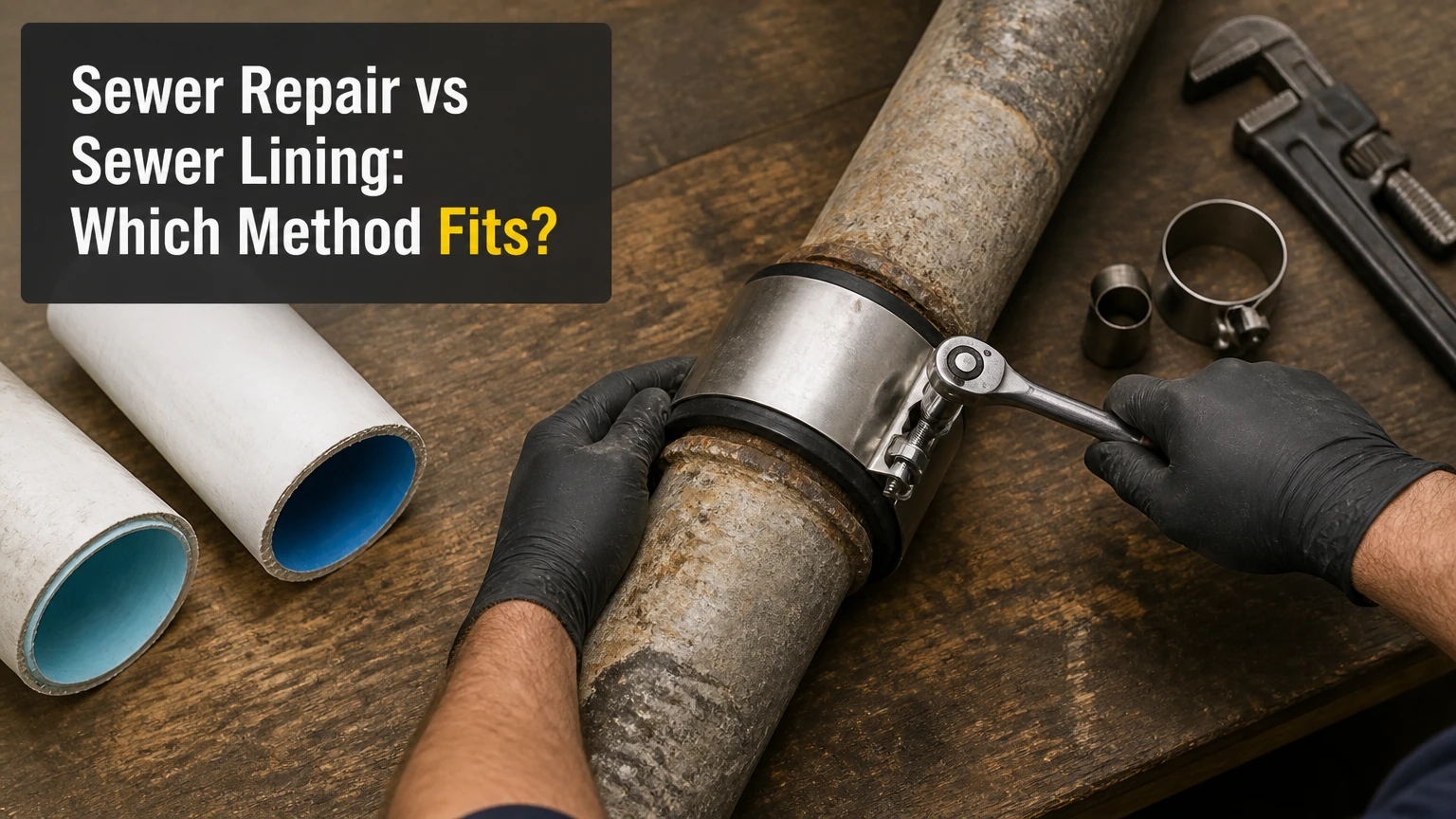
Sewer repair usually means excavating and replacing damaged pipe, while sewer lining rehabilitates the existing pipe from inside with a resin-saturated sleeve. Open-cut replacement is the better solution for collapsed, badly sagging, misaligned, or inaccessible lines. Sewer lining is often better for structurally sound pipes with cracks, root intrusion, leaking joints, and valuable landscaping above them.
Key Facts at a Glance
Open-cut sewer replacement exposes the pipe, removes it, and installs a new PVC or HDPE line.
Cured-in-place pipe lining, or CIPP, creates a seamless pipe inside a qualifying host pipe without continuous excavation.
A sewer camera inspection is the deciding evidence because symptoms alone cannot reveal a belly, collapse, offset joint, or lateral connection.
Typical residential pricing is about $4,000-$15,000 for open-cut replacement and $6,000-$12,000 for lining, before unusual access, traffic control, or restoration costs.
Lining cannot correct a sewer’s slope or geometry and usually cannot rehabilitate a fully collapsed host pipe.
Lining is not automatically cheaper. Its value often comes from avoiding driveway, patio, tree, floor, and business-interruption restoration.
Which Method Is Better Overall?
Sewer lining is generally the better choice when the pipe remains open and round, access is adequate, and excavation would damage expensive property. Traditional replacement is the better choice when the pipe has collapsed, holds standing water because of a belly, has severe displacement, or requires a new route, diameter, or slope.
The right decision is therefore structural and economic, not simply technological. A $7,000 lining estimate may be cheaper overall than a $5,000 excavation quote if the replacement requires removing a concrete driveway and restoring mature landscaping. Conversely, a low-complexity trench in an accessible lawn can make open-cut replacement the more economical and more permanent correction.
Quick Verdict by Property Type
| Property situation | Preferred method | Typical reason | Main qualification |
|---|---|---|---|
| Open dirt or lawn, shallow line | Open-cut replacement | Restoration may cost $500-$2,500 | Confirm no collapse beyond the repair area |
| Concrete driveway above pipe | CIPP lining | Avoids saw-cutting and slab replacement | Host pipe must retain usable shape |
| Mature trees over sewer route | CIPP lining | Avoids root-zone excavation | Existing roots still require thorough cleaning |
| Bellied clay or cast-iron pipe | Open-cut replacement | Restores grade and drainage | Spot replacement may work for a short defect |
| Fully collapsed Orangeburg pipe | Open-cut or pipe bursting | Liner lacks a round host path | Engineering and access determine the alternative |
| Commercial floor or active facility | CIPP lining | Reduces closure and interior demolition | Ventilation and cure management are required |
What Is Traditional Sewer Repair?
Traditional sewer repair, also called open-cut repair or dig-and-replace, excavates the ground above the sewer so technicians can remove defective pipe and install new pipe. The method provides direct access to the bedding, joints, grade, connections, and surrounding soil, which makes it suitable for major structural correction.
A contractor normally locates underground utilities before excavation, exposes the sewer with an excavator or vacuum excavation, removes the failed section, and checks the trench foundation. The new section is typically PVC, although HDPE or other approved materials may be used depending on local codes and design requirements. Proper bedding, joint assembly, slope, testing, and backfill determine whether the new pipe performs correctly.
How does open-cut replacement work?
Open-cut replacement usually follows six controlled stages:
- Inspect and locate: A camera identifies the defect, while utility services mark gas, electric, water, communications, and other buried infrastructure.
- Obtain approvals: The contractor confirms permits, easements, right-of-way limits, traffic control, and municipal connection requirements.
- Excavate: Soil, pavement, concrete, or landscaping is removed to expose enough pipe for safe work.
- Remove and prepare: The defective pipe is cut out, the trench is stabilized, and bedding is placed or corrected.
- Install and connect: New pipe is laid to the specified grade, connected with approved couplings, and connected to the building and public sewer.
- Test and restore: The line receives a camera inspection or flow test, the trench is backfilled and compacted, and the surface is restored.
The main advantage is control. Crews can fix a broken lateral, change pipe alignment, remove a belly, increase diameter, or replace unstable soil conditions. The principal disadvantage is collateral work, because excavation costs are only one part of the final project.
How Does Sewer Lining Work?
Sewer lining rehabilitates a qualifying existing pipe by inserting a flexible liner saturated with thermosetting resin, pressing it against the host-pipe wall, and curing it into a hardened inner pipe. CIPP commonly uses felt, fiberglass, or another textile carrier with epoxy, polyester, or vinyl-ester resin.
The process starts with a camera inspection and cleaning. Hydro-jetting removes roots, grease, mineral scale, and debris; mechanical cutters may remove protruding taps or hard obstructions. The liner is measured for the pipe’s diameter and length, impregnated with resin, installed through a cleanout or access point, and held in place with air, water, or an internal bladder while curing occurs.
Steam, hot water, or ultraviolet light may provide the cure, depending on the liner system. After curing, the bladder is removed and a robotic cutter reopens each lateral connection covered by the liner. A final camera verifies that the finished liner is continuous, properly cured, and open at all required connections.
What damage can sewer lining repair?
| Defect visible on camera | Lining suitability | Why | Likely extra work |
|---|---|---|---|
| Hairline or moderate longitudinal cracks | Usually suitable | Liner bridges the defect | Cleaning and structural design check |
| Leaking or offset joints under minor displacement | Often suitable | Seamless liner covers joint leakage | Root removal and possible localized opening |
| Repeated root intrusion | Often suitable | Cured liner removes future pipe joints | Root cutting before installation |
| Heavy mineral scale in cast iron | Conditional | Bonding requires a clean host surface | Descaling and wall-thickness assessment |
| Partial collapse with a continuous passage | Conditional | Liner may require a calibrated host path | Robotic opening or spot excavation |
| Complete collapse or flattened pipe | Usually unsuitable | Sleeve cannot pass or expand correctly | Excavation, bursting, or rerouting |
| Persistent belly with standing water | Unsuitable as a correction | Lining follows the existing low spot | Excavation to restore grade |
| Large missing section or severe displacement | Usually unsuitable | Host geometry cannot support installation | Open-cut repair or replacement |
Lining is a rehabilitation method, not a universal substitute for replacement. A structural CIPP liner can add substantial independent strength, but the installed product, design thickness, resin system, groundwater conditions, and contractor quality all affect performance.
What Does Each Method Cost?
Typical residential open-cut sewer replacement costs about $50-$250 per linear foot, while CIPP lining commonly costs about $125-$300 per linear foot. A typical whole-line project may total $4,000-$15,000 for open-cut replacement or $6,000-$12,000 for lining, but local labor, depth, access, pipe diameter, permits, and restoration can move the estimate substantially.
| Cost component | Open-cut replacement | CIPP lining | Common price effect |
|---|---|---|---|
| Residential sewer work | $4,000-$15,000 | $6,000-$12,000 | Typical 2025 contractor range |
| Unit pricing | $50-$250/linear foot | $125-$300/linear foot | Length and diameter change pricing |
| Concrete driveway restoration | $2,000-$10,000 | $0-$1,500 | Depends on access points and patching |
| Lawn and planting restoration | $500-$5,000 | $0-$1,500 | Mature trees can raise excavation costs |
| Access pits or cleanout installation | $500-$3,000 | $500-$3,000 | Lining may still need excavation |
| Street or sidewalk work | $3,000-$15,000-plus | Often avoided | Municipality and traffic control govern |
| Commercial interruption | $1,000s per day | Usually lower | Depends on facility operation |
These are typical planning ranges, not bids. Contractors may quote lining at a higher pipe price because it includes cleaning, resin preparation, curing equipment, lateral reinstatement, and post-installation inspection. Open-cut estimates can appear lower until concrete, soil disposal, permits, shoring, dewatering, and restoration are added.
Ask every bidder for two totals: the pipe-work price and the complete project price. The second figure should identify restoration assumptions rather than leaving them as allowances.
How Long Will Each Method Take?
A straightforward CIPP lining project often takes one to two days, with cleaning, installation, curing, and lateral reopening frequently completed within four to eight working hours. Open-cut replacement commonly takes three to seven business days, although deep excavation, public streets, inspections, groundwater, utility conflicts, and surface restoration can extend the schedule.
| Project activity | Open-cut timing | Sewer lining timing | Dependency |
|---|---|---|---|
| Camera inspection | 1-3 hours | 1-3 hours | Access and blockage |
| Cleaning and preparation | 2-8 hours | 2-8 hours | Roots, grease, and scale |
| Main repair activity | 1-3 days | 4-8 hours | Damage and pipe length |
| Lateral reconnections | 2-8 hours | 1-4 hours | Number of branch lines |
| Inspection or municipal test | 1-2 days | 1-4 hours | Local requirements |
| Surface restoration | 1-5 days | 0-2 days | Pavement, soil, and landscaping |
| Typical total | 3-7 business days | 1-2 days | Weather and access |
A lining project still requires temporary water-use restrictions. The contractor should state when toilets, showers, laundry, and sinks must remain unused, and when the resin system is safe for normal discharge.
Will Lining Reduce Sewer Capacity?
Sewer lining can reduce the pipe’s internal diameter, but the reduction is not automatically 5-10 percent. A liner’s thickness is engineered for the host pipe, and the practical flow effect depends on original diameter, liner thickness, surface smoothness, slope, and whether roots or offset joints previously restricted flow.
For example, a 6-inch pipe receiving a 6-10 millimeter liner loses more absolute diameter than a 12-inch pipe receiving the same liner. However, the cured liner has a smooth interior and eliminates joint ledges, root pathways, and rough corrosion, so hydraulic performance can remain acceptable or improve despite the smaller diameter.
Request the proposed finished inside diameter, liner thickness, design calculations, and applicable product standard. ASTM F1216 covers the rehabilitation of sewer and conduit pipelines by inversion and curing a resin-impregnated tube, while other systems use different standards or manufacturer specifications. The relevant question is finished hydraulic capacity, not diameter alone.
Which Method Lasts Longer?
A properly installed replacement pipe often has a service-life expectation of 50-100 years, while many structural CIPP systems are marketed or designed for 50 years or more. Neither figure is a universal guarantee, because soil movement, installation quality, chemical exposure, groundwater, resin selection, and maintenance influence actual service life.
| Longevity factor | Open-cut replacement | CIPP lining | Verification question |
|---|---|---|---|
| New pipe material | PVC, HDPE, or approved equivalent | Resin and textile carrier | Which product and resin are specified? |
| Joint exposure | Multiple joints remain | Continuous liner has few internal joints | How are ends and laterals sealed? |
| Root resistance | Joints can become entry points | Seamless interior resists new intrusion | Were roots completely removed first? |
| Grade correction | Yes, through excavation | No, follows existing alignment | Does the camera show a belly? |
| Warranty | Often 1-10 years | Often 5-10 years | What labor and materials are covered? |
| Design life | Commonly 50-100 years | Commonly 50-plus years | Is the period a design life or warranty? |
A long design life does not excuse a weak installation. A homeowner should receive the liner manufacturer, resin type, cure method, installed length, diameter, warranty, and final camera recording.
What Alternatives Should You Consider?
Pipe bursting is the main trenchless alternative to lining when the existing route can remain but the host pipe is unsuitable for CIPP. A bursting head fractures or displaces the old pipe while pulling a new HDPE or similar pipe into the enlarged path. The method typically requires launch and receiving pits, so it is less disruptive than continuous trenching but more invasive than lining.
| Method | Excavation amount | Best application | Main limitation |
|---|---|---|---|
| Spot repair | 5-10 feet typical | One localized break or joint | Misses defects outside the excavation |
| Full open-cut replacement | Full trench length | Collapse, belly, route or grade correction | Highest surface disruption |
| CIPP lining | Existing cleanouts or small pits | Cracks, roots, leaks, sound host pipe | Needs usable host geometry |
| Pipe bursting | Two pits or access areas | Replace pipe without continuous trench | Utility conflicts and limited space |
| Epoxy brush coating | Small access openings | Pinhole leaks and corrosion | Thin coating may not provide structural renewal |
| Slip lining | Access pits and annular grout | Large, relatively straight host pipe | Reduces diameter and needs grouting |
Epoxy brush coating should not be treated as interchangeable with a structural CIPP liner. Coating places a thin resin layer on the interior surface, which can seal pinholes but may not bridge major cracks or carry the same structural load.
Which Method Fits Each Property?
Should you choose lining under a driveway or patio?
CIPP lining is usually the stronger economic choice when a sewer runs beneath a driveway, masonry patio, finished basement floor, or mature tree canopy, because it avoids continuous demolition and reconstruction. The exception is a collapsed or badly bellied line, where preserving the surface cannot justify an unsuitable repair.
Confirm that the contractor can access the full line, identify every lateral, remove roots and scale, manage resin odor, and provide a restoration-free scope. Some lining jobs still need a small excavation to install a cleanout or create access.
Is open-cut repair better for an accessible yard?
Open-cut replacement can be the better value when the sewer lies in an unobstructed lawn, is shallow, and needs a major structural correction. Direct excavation allows the crew to verify bedding, correct slope, replace unstable soil, and install a larger or differently routed pipe.
The practical rule is simple: compare the complete restored-site price, not the pipe installation price. A rural or suburban lawn may need only grading and seed, while a narrow urban lot may require shoring, utility hand-digging, sidewalk permits, and traffic control.
What should commercial buildings and shared laterals use?
Commercial facilities often favor lining when a structurally suitable sewer lies below a floor, loading area, roadway, or occupied space, because reduced excavation can shorten closure time. Shared laterals, condominium lines, and multi-unit buildings need additional coordination because one missed connection can affect several occupants.
The owner should establish access rights, responsibility for the private lateral, water-use restrictions, fire and ventilation procedures, after-hours work, and lateral reinstatement before signing. A municipal main or public connection may require separate approval even when the private section is lined.
What Evidence Should You Require Before Choosing?
A homeowner should obtain a dated sewer camera recording, a written defect map, measured pipe length and diameter, and a proposal that identifies the line’s ownership and repair limits. The camera should show the pipe from the building connection toward the municipal main, with defect locations measured from a known access point.
Use this inspection checklist
- Ask whether the pipe is round, partially collapsed, offset, or bellied.
- Identify pipe material, diameter, depth, length, and connection points.
- Confirm whether roots, grease, mineral scale, groundwater, or soil are entering.
- Mark every active lateral before lining.
- Ask whether cleaning restored the full internal diameter.
- Request pre-repair and post-repair video files.
- Require the liner manufacturer, resin, cure method, and finished diameter.
- Check permits, utility locating, insurance, warranty, and disposal responsibilities.
- Ask who owns the section beneath the sidewalk, street, easement, or neighboring property.
- Compare restoration, access, and traffic-control allowances between bids.
A camera can show a defect without proving that lining will work. The contractor must also evaluate access, structural design, groundwater, pipe geometry, and the ability to reopen laterals.
What Causes Sewer Repair or Lining Failures?
The most common lining failures result from inadequate cleaning, incorrect liner sizing, poor resin impregnation, incomplete curing, wrinkles, blocked lateral connections, and failure to manage groundwater. Open-cut failures commonly involve poor bedding, incorrect slope, bad couplings, insufficient compaction, or incomplete restoration.
A post-lining backup does not automatically mean the liner failed structurally. A lateral may have been covered and not reopened, or debris may remain downstream. The correct diagnostic response is a new camera inspection, followed by robotic reinstatement, cleaning, or targeted repair rather than an assumption about the cause.
Practitioner rules that prevent expensive mistakes
- Never approve lining from symptoms alone. Frequent backups indicate a drainage problem, but only a camera can distinguish roots from collapse or a belly.
- Treat cleaning as part of the structural repair. Resin cannot reliably bond to grease, loose scale, standing debris, or root masses.
- Price restoration before choosing the cheaper method. The lowest plumbing estimate can become the highest completed-project cost after pavement and landscaping work.
- Do not accept a life expectancy without a warranty scope. Design life, manufacturer testing, contractor warranty, and actual repair coverage are different promises.
Lining is also a poor fit when the pipe has severe grade failure, major displacement, insufficient access, or a diameter that cannot accommodate the required finished flow. Open-cut work is disruptive, but it provides the physical access needed to correct those conditions.
The Bottom Line on Sewer Repair vs Sewer Lining
Sewer repair vs sewer lining is a choice between physical correction and internal rehabilitation. Choose open-cut replacement for collapse, severe displacement, bellies, unstable bedding, route changes, or an accessible excavation area. Choose structural CIPP lining for cracks, leaking joints, recurring roots, and corrosion when the host pipe is open, reasonably round, and difficult or expensive to excavate.
Get two comparable proposals based on the same camera findings. Each proposal should include pipe work, access, permits, restoration, testing, warranty, finished diameter, and lateral connections. The best method is the one that corrects the actual defect at the lowest complete-project cost, not the method with the lowest initial invoice.
Frequently Asked Questions
Can sewer lining fix tree roots permanently?
Structural CIPP lining can prevent new root intrusion through the lined section because the cured liner has a continuous interior without the original open joints. Roots must first be cut and removed, and damaged lateral connections or pipe ends still require attention. Roots can return through unlined sections, cleanouts, or downstream defects.
Is sewer lining safe for old clay or cast-iron pipes?
Sewer lining can suit old clay or cast-iron pipe when the host remains accessible and sufficiently stable for cleaning and installation. Cast iron may contain heavy corrosion or scale that must be removed carefully, while clay may have offset joints. A camera and cleaning assessment should precede any structural recommendation.
Can I use plumbing fixtures during CIPP installation?
Most contractors require occupants to stop discharging water during cleaning, installation, curing, and lateral reinstatement. The restriction may last several hours or longer if the line is extensive. The contractor should provide written start and release times, especially for homes with multiple bathrooms, rentals, restaurants, or medical facilities.
Does homeowners insurance pay for sewer lining or replacement?
Homeowners insurance often excludes gradual wear, roots, corrosion, and maintenance-related sewer deterioration, although sudden accidental damage or resulting interior water damage may receive different treatment. Coverage varies by policy and location. Review service-line endorsements, sewer-backup coverage, exclusions, deductibles, and responsibility for the private lateral before work begins.
Should a buyer request a sewer camera before purchasing a house?
A sewer camera inspection is prudent for older homes, properties with mature trees, recurring drainage symptoms, or buried lines made from clay, cast iron, Orangeburg, or no longer accepted materials. The inspection can reveal defects that a routine drain test misses, giving the buyer evidence for negotiation or a repair decision.
How often should a repaired sewer line be inspected?
There is no universal inspection interval for every property. A camera review is reasonable after repair, after unexplained backups, and before purchasing or selling an older property. Homes with recurring roots, settling soil, large trees, or a history of grease accumulation may need more frequent professional cleaning and inspection.