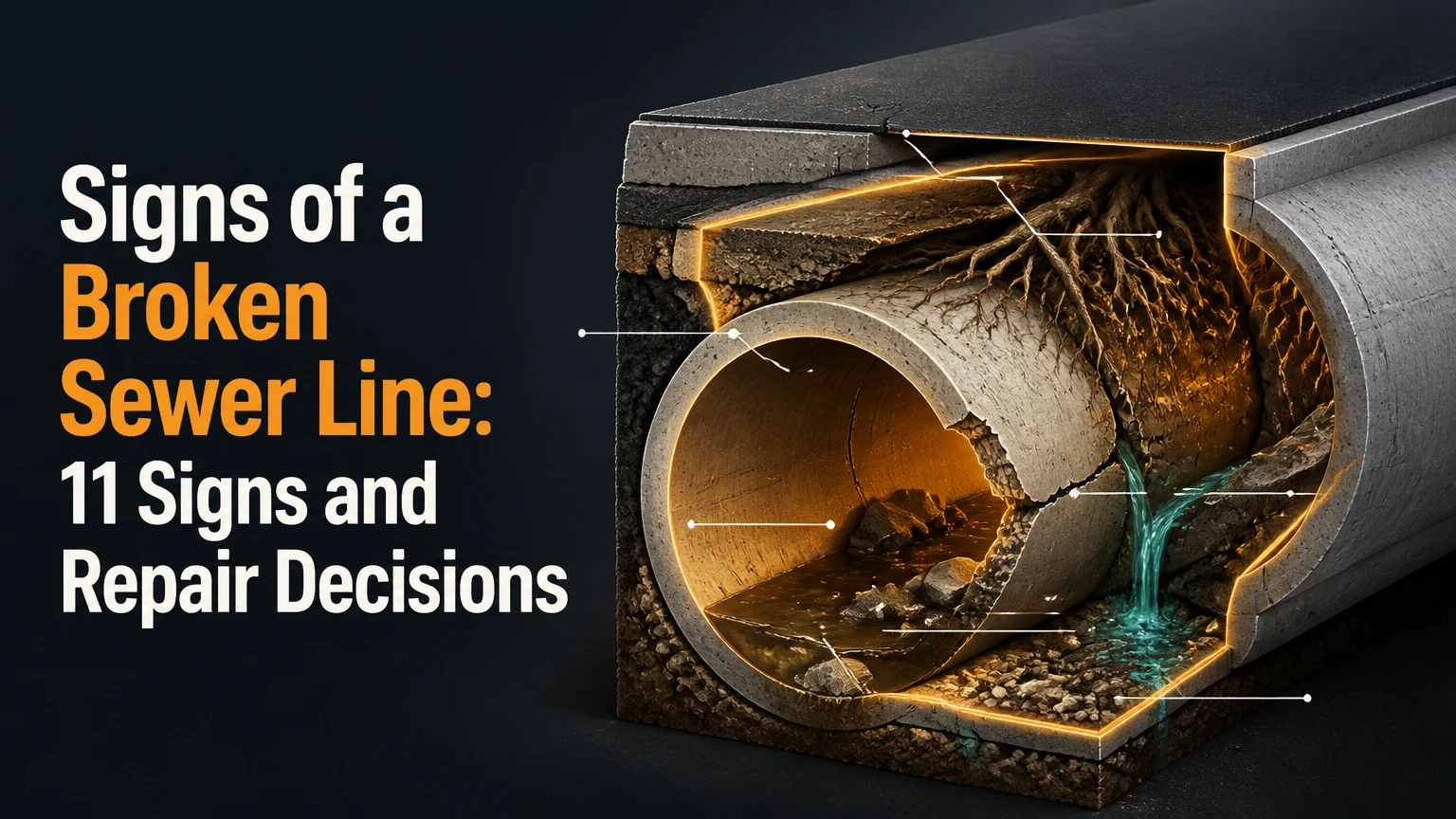
The most reliable signs of a broken sewer line are recurring backups in multiple fixtures, sewage odors that persist after traps are checked, unusually wet or settled ground, and camera-confirmed cracks, root intrusion, sagging, or collapse. A single slow sink usually indicates a local clog, while system-wide symptoms point toward the building sewer or private lateral.
Key facts
A broken sewer line can leak wastewater into soil while still draining normally for weeks or months.
Backups affecting toilets, tubs, floor drains, or washing machines are stronger evidence than one slow fixture.
Sewer odor alone does not prove a broken pipe because dry traps, blocked vents, and loose cleanout caps cause similar smells.
A sewer camera inspection identifies the defect, but a camera cannot reliably assess soil voids or every leak outside its view.
CIPP lining and pipe bursting generally require a structurally continuous path; a severe belly or collapsed section usually needs excavation.
Typical United States repair costs range from about $1,500 for a localized repair to more than $15,000 for deep, difficult, or street-side replacement.
What Is a Broken Sewer Line?
A broken sewer line is a structural failure in the buried pipe that carries wastewater from a building drain to a public sewer main or private septic tank. The damaged section may be cracked, separated at a joint, crushed, offset, perforated by roots, or distorted into a low area called a belly.
Most detached homes have a private building sewer, commonly called a sewer lateral, between the house and the public main. Responsibility varies by municipality: the homeowner often owns the line to the connection or property boundary, while the utility owns the public main, but local ordinances can assign responsibility differently.
A break does not always mean a dramatic underground rupture. A narrow longitudinal crack can admit roots and soil, while a separated joint can leak wastewater and allow surrounding material into the pipe. A pipe can therefore produce odor, settlement, or repeated backups before it completely collapses.
Which sewer-line failures produce which symptoms?
| Failure type | Typical internal effect | Typical external clue | Camera description |
|---|---|---|---|
| Root intrusion | Recurring blockage and slow drainage | Lush strip is possible, but not diagnostic | Fine or dense roots entering a joint or crack |
| Separated joint | Soil enters and wastewater escapes | Local wetness or settlement | Offset connection with an open gap |
| Cracked pipe | Partial leakage and eventual obstruction | Damp soil, odor, occasional depression | Linear crack, fracture, or irregular wall |
| Belly or sag | Solids collect in standing water | Usually no visible clue | Long low section holding water after flow stops |
| Crushed or collapsed pipe | Severe restriction or total blockage | Sinkhole or settled surface may develop | Deformed, pinched, or impassable passage |
| Corroded cast iron | Scale reduces diameter and leaks emerge | Rust staining or damp soil | Flaking wall, heavy tuberculation, holes |
How Does a Sewer Lateral Fail?
A sewer lateral fails when structural damage, poor grade, soil movement, corrosion, roots, or excessive loading prevents wastewater from traveling through a stable, continuous passage. Gravity systems need a consistent designed slope, but the exact grade depends on pipe diameter, local plumbing code, flow calculations, and the approved installation.
The often-cited 1/4-inch-per-foot slope for smaller horizontal drainage piping and 1/8-inch-per-foot slope for larger piping are design references, not a universal diagnostic rule. A plumber cannot confirm a belly by looking at a lawn, and adding slope to an existing buried line requires excavation or engineered rehabilitation.
Water escaping through a crack can saturate surrounding soil. Soil entering through the same defect can reduce capacity, feed root growth, and turn a leak into a blockage. Heavy vehicles, freeze-thaw movement, expansive clay, poor bedding, old vitrified clay joints, and cast-iron corrosion create different failure patterns.
Why can roots break a sewer pipe?
Tree roots usually enter through an existing joint gap or crack rather than breaking an intact modern pipe by force. Once inside, roots enlarge the opening as they grow, trap paper and grease, and create recurring blockages that return after mechanical cleaning.
Root cutting restores flow temporarily. It does not reseal the pipe. Repeated root service is therefore a reason to obtain a camera inspection and evaluate joint sealing, CIPP lining, a localized replacement, or removal of an invasive root only when an arborist confirms that removal will not destabilize the tree.
What Are the First Signs of a Broken Sewer Line?
The first meaningful signs are usually a pattern: several fixtures drain slowly, flushing changes water levels elsewhere, or the same blockage returns soon after professional cleaning. A single clogged bathroom sink, shower, or toilet usually remains a fixture-level problem unless other drains begin reacting.
1. Multiple fixtures back up together
A toilet that overflows when the washing machine drains, a bathtub that rises during a toilet flush, or a basement floor drain that receives wastewater indicates restricted capacity downstream of those fixtures. The lowest drain often shows the problem first because wastewater seeks the easiest available opening.
A main-line blockage can produce the same symptom as a broken pipe. The symptom establishes location, not cause. A camera, cleanout assessment, or controlled professional clearing is needed to distinguish grease, roots, a belly, and structural failure.
2. Drains gurgle when another fixture runs
Gurgling occurs when restricted wastewater flow or abnormal venting forces air through traps. Bubbling in a toilet while a nearby tub drains is more concerning than a solitary sink gurgle because the fixtures share a larger branch or building drain.
Blocked vents, however, can imitate sewer-line damage. A plumber should test venting and inspect accessible cleanouts before recommending excavation.
3. Backups recur after snaking
A drain that works for a few days and then blocks again may contain roots, heavy scale, a belly, or a damaged joint. Mechanical augering can open a channel without restoring the pipe’s full diameter, so recurrence is evidence that the cause remains.
Hydro-jetting can remove grease and root material more completely, but high-pressure water is not a structural repair. Jetting an old, fragile pipe without first assessing its condition can expose or worsen a defect.
4. Persistent sewage odor appears indoors or outside
A rotten-egg or sewage smell can come from a broken sewer line, but dry P-traps, a damaged toilet seal, a loose cleanout cap, blocked venting, or a cracked drain inside the building are common alternatives. Odor becomes stronger evidence when it accompanies wet soil, recurring backups, or a documented pipe defect.
Hydrogen sulfide can be hazardous at high concentrations, particularly in confined spaces. Do not enter a sewer pit, crawlspace excavation, or manhole to investigate an odor. Ventilate the area, keep children and pets away, and call a qualified plumber if the smell is strong or persistent.
5. Wet, unusually lush, or foul-smelling soil follows the pipe route
A leaking lateral can create a narrow damp strip or unusually vigorous vegetation because wastewater adds moisture and nutrients. Irrigation overspray, a broken water line, poor grading, and natural drainage can create the same appearance, so vegetation alone cannot identify a sewer break.
The strongest exterior pattern combines a persistent damp area with sewage odor, settlement, or a nearby cleanout containing wastewater. A utility locate and camera trace can determine whether the observed ground feature aligns with the actual pipe.
6. Ground, paving, or foundation areas settle
A separated or leaking sewer joint may allow soil to migrate into the pipe or wash out supporting material. Depressed pavers, a sunken driveway strip, or a small lawn depression along the lateral deserve inspection, especially after repeated backups.
Foundation cracks are not specific proof of sewer leakage. Settlement can result from expansive soil, poor compaction, roof drainage, or foundation movement. A structural engineer is appropriate when cracks widen, doors bind, floors slope, or the foundation itself shows movement.
7. Basement or crawlspace moisture develops
A broken line beneath or beside a foundation can raise local moisture and produce sewage contamination. Sewer-related moisture generally has a wastewater odor or contamination pattern, while condensation and groundwater often follow seasonal temperature or rainfall changes.
Mold color and location cannot identify the source reliably. Moisture-meter readings, dye or smoke testing where appropriate, and sewer inspection provide stronger evidence than a visual guess.
8. Sewer flies or pest activity increases
Drain flies can multiply in organic buildup inside a drain, while cockroaches and rodents may use damaged utility routes. Pest activity is a weak standalone sign because these organisms also enter through wall penetrations, floor drains, vents, and exterior cracks.
Pest evidence matters more when it coincides with odor and a known open or damaged line. Seal interior openings only after the plumbing defect has been addressed, or the trapped contamination may remain inside the structure.
9. Water levels change without normal fixture use
A toilet bowl that rises or falls unexpectedly, water appearing in a floor drain, or a cleanout that repeatedly fills can indicate downstream restriction or surcharge. Public sewer backups, heavy rain, and a failed backwater valve can create similar effects.
Record when the change occurs. Symptoms during rainfall suggest storm-related infiltration, a combined sewer condition, or municipal surcharge, while symptoms during ordinary household use more often implicate the private drainage path.
Is a Broken Sewer Line Different From a Clogged Sewer?
A clog blocks flow inside an otherwise continuous pipe; a broken sewer line damages the pipe wall, joints, shape, or alignment. Both can cause backups, so repeated symptoms, visible soil intrusion, and camera findings matter more than the backup alone.
| Observation | More consistent with a clog | More consistent with structural damage |
|---|---|---|
| One fixture affected | Yes, especially a sink or shower | Uncommon |
| Several fixtures affected | Possible at a shared branch | Common at the building sewer |
| Relief after plunging or snaking | Often lasting | Usually temporary or absent |
| Roots or soil on cable | Possible warning of pipe defect | Strong reason for camera inspection |
| Water standing in a belly | No | Yes |
| Camera shows open, round pipe | Yes, if obstruction is removed | No, if crack, offset, or collapse appears |
A professional should not promise “the line is fixed” merely because a cable reaches the street. Ask whether the obstruction was removed, whether the pipe wall was inspected, and whether the video shows the entire route.
How Should You Confirm a Broken Sewer Line?
Confirm a suspected broken sewer line with a controlled fixture test, a cleanout assessment, and a recorded camera inspection. The camera should be locatable above ground so the contractor can mark the defect’s distance and depth before pricing excavation or trenchless work.
Step 1: Stop adding wastewater
Stop using toilets, showers, washing machines, and dishwashers if sewage is backing up. Keep people and pets away from contaminated water, and avoid electrical equipment near wet floors.
Step 2: Compare fixture behavior
Run a small, controlled amount of water only if no active backup exists. Observe the lowest drain and nearby toilets for 2-3 minutes. Stop immediately if levels rise, gurgling intensifies, or wastewater appears.
Step 3: Identify the cleanout
The main cleanout may be in a basement, crawlspace, garage, or yard, often as a capped 3- or 4-inch pipe. Do not force a stuck cap or stand directly over it: a backed-up line can release pressurized wastewater when the cap is loosened.
A plumber can open the cleanout safely and interpret the water level. Water standing in the cleanout toward the house suggests an upstream restriction; water present toward the street suggests a downstream restriction, although cleanout layout varies.
Step 4: Request a full sewer scope
Request a self-leveling camera inspection from the building drain to the municipal connection or septic tank. The deliverable should include the unedited video, defect location, depth, pipe material, approximate diameter, and a written description of whether the issue is a blockage, crack, root intrusion, belly, offset, or collapse.
A camera cannot see soil voids outside the pipe, and a water-filled belly can obscure the bottom wall. A scope is powerful evidence, not a complete structural survey.
Which Repair Method Fits the Damage?
Open excavation is usually the dependable choice for a collapsed, severely sagging, deeply buried, or badly misaligned sewer line. CIPP lining suits a continuous pipe with cracks or root intrusion, while pipe bursting suits selected replacement paths where the existing route and surrounding utilities permit expansion.
| Method | Typical United States cost | Typical duration | Suitable damage | Main limitation |
|---|---|---|---|---|
| Localized excavation | $1,500-$5,000 | 1-3 days | One accessible crack or joint | Surface removal and uncertain hidden damage |
| Full open replacement | $3,000-$15,000+ | 2-5 days | Collapse, belly, major misalignment | Trench, restoration, shoring |
| CIPP lining | $4,000-$12,000 | 1-2 days | Cracks, joints, moderate roots | Cannot correct a belly or missing pipe |
| Pipe bursting | $5,000-$15,000+ | 1-3 days | Replacement along a suitable route | Requires pits and utility clearance |
| Epoxy coating or spin casting | $3,000-$9,000 | 1-2 days | Limited internal corrosion and small defects | Not appropriate for collapse or major shape loss |
CIPP creates a resin liner inside the existing pipe, so the host pipe must retain enough shape and continuity for installation. Pipe bursting replaces the old pipe by pulling a new line through while displacing or fracturing the old material, which can threaten nearby utilities if planning is inadequate.
Trenchless work is not automatically better. Preserving a driveway has value, but a liner that follows a severe belly preserves the obstruction. The correct method follows the camera findings, pipe geometry, access, soil, utility conflicts, and local code.
What does sewer-line repair usually cost?
Typical residential sewer-line repair costs range from $1,500-$5,000 for a localized accessible defect and $3,000-$15,000 or more for full replacement. A realistic quote must include excavation depth, surface restoration, permits, traffic control, cleanout installation, connection fees, and the extent of damaged pipe.
| Cost factor | Typical added range | Why it changes price |
|---|---|---|
| Camera inspection and locating | $150-$800 | Scope length, access, locating equipment |
| Concrete or slab access | $100-$350 per linear foot | Saw cutting, excavation, reinforcement, repair |
| Deep trench over 5 feet | $1,000-$5,000+ | Shoring, equipment, safety requirements |
| Driveway or patio restoration | $1,000-$8,000+ | Concrete, asphalt, pavers, finish matching |
| Street or sidewalk work | $2,000-$10,000+ | Permits, traffic control, municipal restoration |
| Permit and inspection | $100-$1,000 | Local authority and project scope |
These are typical planning ranges, not a national price list. Regional labor rates, pipe depth, access, soil, groundwater, and municipal requirements can move the final price substantially.
What Should You Ask Before Hiring a Sewer Contractor?
Ask for the camera video, exact defect station, measured depth, pipe material, repair length, permit responsibility, restoration scope, warranty exclusions, and a post-repair inspection. A quote that says only “replace sewer line” does not establish what failed or what work the price includes.
Compare at least two written proposals when time permits. Require the proposals to distinguish cleaning, structural repair, lining, excavation, traffic control, disposal, reconnection, testing, and surface restoration.
Practitioner rules that prevent expensive mistakes
- Do not accept a root-cutting diagnosis without a camera. Roots identify an opening, not the extent of the structural failure.
- Do not approve lining for a belly without independent review. A liner does not restore missing grade.
- Do not compare per-foot prices alone. A $100-per-foot quote may exclude mobilization, pits, permits, slab work, and restoration.
- Do not treat a clean camera as proof that the ground is stable. Soil washout can persist outside a pipe that appears open.
- Do not enter an excavation or sewer space yourself. OSHA excavation hazards and toxic gases require professional controls.
What If the Break Is Under a Slab, Street, or Septic System?
A sewer defect under a slab often requires interior concrete removal, while a street-side failure may require municipal permits and restoration. A septic property has the same basic failure symptoms, but the destination is the septic tank inlet rather than a city main, and tank, baffle, or drainfield failures can imitate a broken lateral.
For a slab repair, confirm whether the line can be rerouted through a wall or ceiling before opening the floor. Rerouting may reduce demolition but can change slope, cleanout access, and fixture vent relationships.
For a street connection, identify ownership before authorizing work. Some utilities repair the public main but leave the private lateral to the homeowner; others use a property-line responsibility point.
For a septic system, inspect the line from the house to the tank, then check tank inlet flow, liquid level, baffles, and effluent disposal. Slow drains across the home do not prove a lateral break when the tank is full or the drainfield is failing.
Can Homeowners Insurance Pay for a Broken Sewer Line?
Standard homeowners insurance commonly excludes gradual deterioration, corrosion, root intrusion, and neglected maintenance, while some policies cover sudden accidental damage or offer a service-line endorsement. Coverage, limits, deductibles, and exclusions vary by insurer and policy wording.
Call the insurer before excavating if there is no immediate health emergency, and photograph the backup, surface damage, cleanout, and camera findings. Ask specifically whether the policy covers excavation, pipe replacement, landscaping, pavement, temporary lodging, sewage cleanup, and municipal portions.
Do not assume a service-line endorsement covers every lateral. Some endorsements exclude shared lines, septic components, pre-existing defects, or damage caused by roots.
What Should You Do During an Active Sewer Backup?
During an active sewer backup, stop water use, keep away from contaminated water, avoid electrical hazards, and call a licensed plumber or the utility if the blockage may be public. Sewage cleanup requires prompt professional disinfection because porous flooring, drywall, and insulation can retain pathogens.
Use gloves and waterproof footwear only for minimal isolation work, never mix bleach with ammonia or acidic cleaners, and do not use chemical drain openers in a backed-up main line. Report the incident to the municipality when neighboring properties are affected or the backup follows heavy rain.
How Can You Prevent Another Sewer-Line Failure?
Prevention reduces blockages but cannot reverse a cracked or collapsed pipe. Keep grease, wipes, paper towels, diapers, and chemicals out of drains, maintain accessible cleanouts, manage tree planting near the lateral, and obtain periodic camera inspections for older clay or cast-iron systems with recurring symptoms.
A practical inspection interval depends on risk. A new PVC line with no symptoms may need inspection only during a sale or suspected failure, while an older clay or cast-iron lateral with repeated roots may justify a camera every 1-3 years after professional assessment.
Do not plant aggressive trees directly over a sewer route. Roots follow moisture, so a small leak can attract root growth even when the nearest tree is several yards away.
Frequently Asked Questions
Can a broken sewer line cause low water pressure?
A broken sewer line normally does not reduce potable-water pressure because the water supply and wastewater systems are separate. Low pressure usually indicates a supply leak, failing pressure regulator, partially closed valve, clogged aerator, or utility problem. A simultaneous sewer backup and low pressure can reflect two unrelated defects.
Can a sewer line collapse without causing an indoor backup?
Yes. A partially collapsed sewer line can continue passing liquid while trapping solids, and a leak may discharge into soil instead of the building. Indoor symptoms may appear only after heavy use, rainfall, increased occupancy, or further root and soil intrusion. Exterior settlement or recurring odor can precede a backup.
Should a home buyer pay for a sewer scope?
A sewer scope is usually worthwhile for an older property, a home with mature trees, a long lateral, a slab foundation, or any history of slow drains. A standard home inspection generally does not inspect the buried sewer lateral. A recorded scope can support repair negotiations before closing.
How long does a sewer-line repair take?
A localized replacement commonly takes 1-3 days, open full-line replacement often takes 2-5 days, and trenchless lining may take 1-2 days when access and permitting are ready. Weather, groundwater, concrete curing, utility conflicts, inspections, and surface restoration can extend the schedule.
Is hydro-jetting enough to fix a broken sewer line?
Hydro-jetting removes grease, scale, and many root obstructions, but it does not repair a crack, separated joint, belly, or collapse. Jetting is appropriate after a professional evaluates pipe condition and when the goal is cleaning before a camera inspection, lining, or other structural work.
The Bottom Line
The most useful signs of a broken sewer line are system-wide backups, cross-fixture gurgling, recurring blockage after cleaning, persistent sewage odor combined with other evidence, and unexplained wet or settled ground along the lateral route. Confirm the cause with a locatable camera inspection before choosing excavation, lining, bursting, or a localized repair.
Do not confuse a temporary flow improvement with a structural solution. The correct response to signs of a broken sewer line is to limit wastewater use, protect occupants from contamination, document the defect, verify ownership and insurance, and obtain a written repair scope tied to camera evidence.