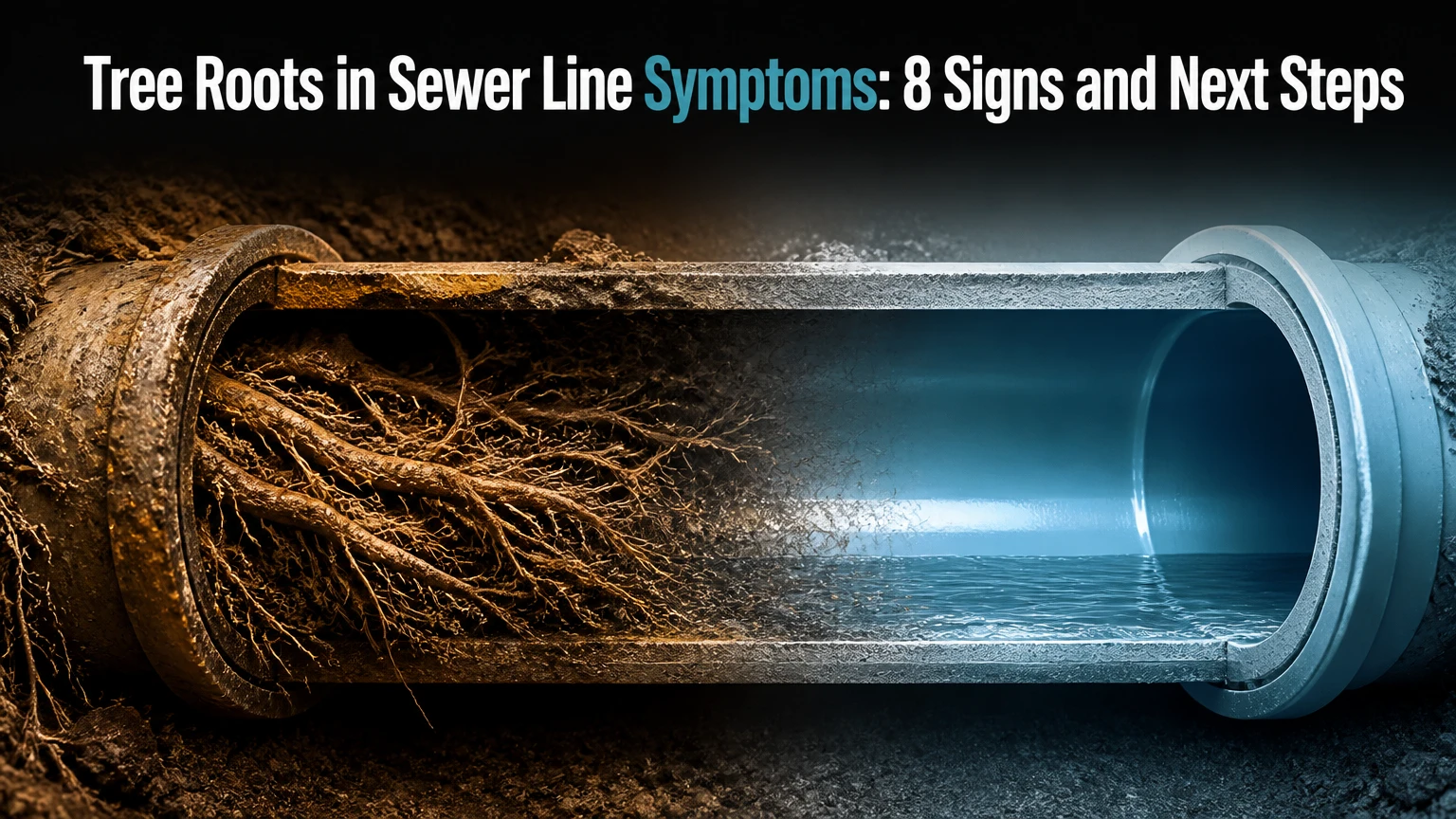
Tree roots in sewer line symptoms usually include recurring clogs, multiple slow drains, gurgling toilets, sewer odors, sewage backups, and unusual lawn changes above the pipe. Roots enter through cracked pipes or separated joints, but a sewer camera inspection is the only reliable way to confirm root intrusion and locate structural damage.
Key Facts at a Glance
- Tree roots usually enter a sewer pipe through an existing crack, open joint, failed seal, or damaged connection.
- A single slow sink does not prove root intrusion; several affected fixtures point more strongly to a building sewer problem.
- Mechanical cutting restores flow quickly, but it does not close the opening that allowed roots to enter.
- Hydro-jetting removes roots and deposits more completely than cutting, but high pressure can damage weak or collapsed pipe.
- A camera inspection identifies root location, pipe material, cracks, offsets, bellies, and collapse before repair decisions are made.
- Typical residential costs range from about $150 for root cutting to more than $15,000 for difficult excavation and replacement.
What Are the First Symptoms of Tree Roots in a Sewer Line?
The first symptoms of tree roots in a sewer line are usually intermittent, recurring drainage problems rather than an immediate total blockage. Toilets may bubble when a bathtub drains, and a clog may return weeks after a plumber clears it because the root mass remains attached to a pipe joint.
Root intrusion often develops gradually. Fine roots initially allow wastewater through, although they catch toilet paper, grease, hair, and other solids. As the root bundle thickens, the same household may experience slower drainage, more frequent backups, and odors between blockages.
A useful diagnostic distinction is the number and location of affected fixtures:
| Household pattern | More likely location | Root-intrusion implication |
|---|---|---|
| One bathroom sink drains slowly | Local trap or branch drain | Low evidence for sewer roots |
| Toilet and nearby tub drain slowly | Shared bathroom branch | Possible branch obstruction |
| Several fixtures drain slowly together | Building sewer lateral | Moderate to strong evidence |
| Lowest drain backs up after laundry | Main sewer line or municipal sewer | Urgent inspection required |
| Neighboring homes back up simultaneously | Public sewer or storm event | Contact utility before private repair |
What do the symptoms mean?
Each symptom identifies a flow or structural change, but none proves roots alone. Gurgling indicates air displacement around a restriction, a sewer odor indicates an open pathway for sewer gas or a dry trap, and a sewage backup indicates that wastewater cannot reach the public sewer or septic system fast enough.
The strongest pattern is recurrence after ordinary drain cleaning. A hand auger can create a narrow passage through a root mat without removing the material attached to the pipe wall. If the same line clogs again after a short interval, request a camera inspection rather than repeating the same clearing service indefinitely.
How Do Tree Roots Get Into Sewer Pipes?
Tree roots enter sewer pipes through defects that expose moisture, including separated clay joints, cracked vitrified clay, corroded cast iron, failed connections, and damaged older pipe materials. Roots do not normally drill through an intact, pressurized sewer pipe, although they can exploit very small openings once a defect exists.
Sewer laterals release moisture into surrounding soil through joints and cracks. Root tips grow toward favorable moisture conditions, and a fine root can pass through an opening that later becomes enlarged by root growth and pipe movement. Wastewater also supplies oxygen and dissolved organic material inside the pipe, allowing the intrusion to form a dense, brush-like obstruction.
Pipe material changes the common failure pattern:
| Pipe material | Typical age-related defect | Root entry risk |
|---|---|---|
| Vitrified clay | Open bell-and-spigot joints, cracks | High at separated joints |
| Cast iron | Corrosion, failed hubs, cracks | Moderate to high in older lines |
| Orangeburg | Flattening, delamination, collapse | High, but cutting can worsen damage |
| PVC or ABS | Failed coupling, settlement, poor connection | Lower through intact pipe |
| Concrete | Cracks, joint displacement | Moderate, especially after settlement |
Tree proximity raises suspicion but does not establish causation. A mature willow, poplar, silver maple, elm, or ficus near a sewer route deserves attention, yet small ornamental trees can also exploit a defective line. Roots may travel considerable distances through soil, so measuring from the trunk alone is an unreliable diagnosis.
Which Symptoms Distinguish Roots From Other Sewer Problems?
Recurring clogs combined with multiple slow fixtures are more suggestive of root intrusion than a single isolated drain problem. A sewer camera must still distinguish roots from grease, wipes, mineral scale, a sagging pipe, a collapsed section, or a blockage in the public main.
Use symptom combinations rather than one sign:
- Roots: recurring blockage, visible fibrous material, often at a joint or crack.
- Grease: sluggish flow, greasy deposits, commonly near kitchens, with no lawn change.
- Flushable wipes: sudden or recurring obstruction, often without a pipe defect.
- Pipe belly: repeated backup at a fixed low point, with standing water visible on camera.
- Collapse: severe or complete blockage, soil or debris entering the pipe, and no sustained improvement after cleaning.
- Municipal obstruction: several properties affected, especially after heavy rain or a public sewer incident.
- Septic-system failure: slow drainage, odors, and backups across the property, often with a high or overdue septic tank.
A lush patch over the sewer route is weak evidence by itself. Leaking wastewater can increase soil moisture and nutrients, but irrigation, fertilizer, drainage, or a leaking water service can create the same lawn pattern. Treat vegetation as a location clue, not a diagnosis.
How Should You Diagnose Root Intrusion?
A sewer camera inspection is the dependable confirmation method because the camera shows the obstruction, pipe condition, and defect that permits entry. A locating transmitter can mark the camera head at the root mass, allowing a contractor to estimate depth and position before excavation or trenchless repair.
A practical diagnostic sequence is:
- Document the symptoms. Record which fixtures back up, when the problem occurs, and how long a previous clearing lasted.
- Check the cleanout. Locate the capped access pipe in the yard, basement, garage, or side passage. Do not remove a pressurized cap without protection and a plan for overflow.
- Inspect from the correct access point. The contractor should identify whether the camera is traveling through the private lateral, a branch, or the public main.
- Record the pipe material and diameter. Clay, cast iron, Orangeburg, PVC, and concrete require different cleaning and repair choices.
- Map each defect. The report should identify distance from the cleanout, clock position, depth if located, roots, cracks, offsets, standing water, and collapse.
- Request usable footage. A still image of roots is insufficient if the recording does not show the pipe immediately upstream and downstream.
A push camera may not pass a complete blockage, a sharp offset, or a collapsed pipe. In that situation, clearing enough flow for a second inspection is often more informative than authorizing replacement from symptoms alone.
What Should You Do During a Sewer Backup?
Stop using water immediately when sewage backs up into a floor drain, shower, toilet, or basement fixture. Keep people and pets away from contaminated water, avoid electrical hazards, and arrange urgent plumbing service because continued discharge can expand the affected area.
The immediate response is:
- Stop toilets, showers, washing machines, dishwashers, and faucets.
- Do not pour acid, caustic drain cleaner, or root killer into a fully blocked line.
- Do not use a cleanout cap as a casual test if wastewater may discharge under pressure.
- Photograph the affected area and damaged belongings before cleanup.
- Contact the local sewer utility if nearby properties report the same problem.
- Use a qualified remediation contractor for sewage-contaminated porous materials.
A private sewer lateral and a public sewer main have different owners, and boundaries vary by municipality. Local ordinances, easements, and service agreements determine responsibility. Standard homeowners policies often exclude gradual pipe deterioration and root intrusion, while optional sewer-backup coverage may address resulting interior damage, subject to the policy terms and deductible. Confirm coverage before assuming either outcome.
Which Root-Removal Method Fits the Pipe?
Mechanical root cutting is usually the fastest first response for a flowing but obstructed line, while hydro-jetting gives a more thorough cleaning when the pipe is structurally sound. Chemical treatment can slow regrowth after cleaning, but none of these methods permanently repairs a cracked or separated sewer pipe.
| Method | Typical residential price | Typical duration | Best use | Main limitation |
|---|---|---|---|---|
| Motorized root cutting | $150-$400 | 1-3 hours | Immediate flow restoration | Leaves the pipe defect open |
| Hydro-jetting | $350-$900 | 2-4 hours | Roots plus grease and scale | Riskier in weak pipe |
| Foaming root treatment | $20-$50 product dose | 30 minutes application | Maintenance after clearing | Does not remove a heavy blockage |
| CIPP lining | $100-$250 per linear foot | 1-2 days | Sound, continuous host pipe | Needs suitable diameter and alignment |
| Pipe bursting | $4,000-$15,000 typical project | 1-3 days | Full replacement with limited trenching | Needs access and clearance |
| Open excavation | $3,000-$15,000 or more | 2-5 days | Collapse, offset, or unsuitable host pipe | Damages landscaping and hardscape |
Is hydro-jetting better than root cutting?
Hydro-jetting is generally better for cleaning the entire internal circumference of a sound pipe, whereas root cutting is better when the immediate priority is to reopen a severely restricted line. A rotating cutter slices through the root mass; water jets can remove loosened fibers, grease, and sludge from the pipe wall.
Hydro-jetting is not automatically safer. Older clay, heavily corroded cast iron, Orangeburg, or visibly fractured pipe can deteriorate under high pressure. A contractor should review camera footage first, select a nozzle and pressure appropriate to the pipe, and confirm where discharged debris will go.
Practitioner rule: do not approve a high-pressure cleaning based only on a verbal claim that roots are present. Ask for the pipe condition and cleaning plan in writing.
Do chemical root killers permanently solve the problem?
Chemical root killers do not permanently solve root intrusion because they kill or suppress roots inside the pipe without closing the crack or joint. Foaming products can contact the upper pipe surfaces more evenly than loose crystals, but their use remains a maintenance measure rather than a structural repair.
Copper-based products can create disposal and environmental concerns, particularly where wastewater reaches a septic system, surface water, or a treatment plant. Dichlobenil-containing products have different labels and restrictions by country and jurisdiction. Follow the product label, local wastewater rules, and septic-system guidance; never improvise a stronger concentration.
Chemical treatment is unsuitable when the line is completely blocked. The product may remain in a trap or localized section instead of reaching the root mass, exposing plumbing and occupants to avoidable chemical risk.
Which Repair Lasts Longest?
Pipe lining or full pipe replacement lasts longer than repeated root cutting because a continuous repaired pipe removes or seals the entry route. CIPP lining is usually appropriate when the existing pipe remains round, aligned, and structurally capable of supporting installation; excavation or bursting is more suitable for collapse, severe displacement, or an unsuitable host pipe.
| Repair option | Structural requirement | Yard disruption | Typical service-life claim | Common exclusion |
|---|---|---|---|---|
| CIPP lining | Host pipe remains aligned and open | Low, access pits may be needed | 40-50 years or more, product dependent | Severe collapse or major voids |
| Pipe bursting | Entry and exit access, surrounding clearance | Moderate, usually two pits | About 50 years or more for new HDPE, installation dependent | Congested utilities or unstable soil |
| Spot repair | Localized defect with sound pipe nearby | Small excavation | Depends on replacement section | Multiple defects |
| Open replacement | Any accessible damaged section | High | About 50 years or more for modern PVC, installation dependent | Restricted access or high restoration cost |
No repair method deserves a universal “never roots again” promise. A liner can stop roots through the lined segment, but unlined sections, service connections, defects beyond the repair, or a missed branch can still permit future intrusion. Pipe bursting installs a new pipe but may leave connection and alignment issues that require separate work.
CIPP also reduces excavation rather than eliminating all site work. Contractors may need access pits, service reconnections, bypass pumping, traffic control, or a second opening where the line cannot be reached from one cleanout.
What Does Treatment Cost?
Typical treatment costs range from $150-$400 for root cutting, $350-$900 for hydro-jetting, and $3,000-$15,000 or more for open replacement. The final invoice depends on pipe depth, footage, access, permits, restoration, emergency timing, and whether the contractor must locate utilities or pump around the work.
A camera inspection commonly costs about $250-$500 and takes one to two hours, although some companies credit the inspection against authorized repair. Per-foot lining estimates can exclude cleaning, reinstatement of connections, permits, excavation at access points, and landscaping.
Cost should be judged against recurrence:
- One minor intrusion in an otherwise sound pipe may justify cleaning and monitoring.
- Root cutting every few months indicates that maintenance costs are accumulating.
- Multiple cracks, offsets, or heavy root coverage support a repair comparison.
- Collapse or sewage entering soil requires urgent structural assessment.
- A shared line or public main should be assigned to the responsible owner before private payment.
Ask for an itemized proposal with inspection footage, cleaning method, repair length, connection treatment, restoration, warranty terms, and exclusions.
How Can You Prevent Roots From Returning?
The most reliable prevention is to eliminate the pipe defect, maintain accessible cleanouts, and avoid planting aggressive, moisture-seeking trees directly over the sewer route. Root barriers may redirect roots in some landscape designs, but they cannot repair a leaking or separated pipe.
Prevention actions include:
- Obtain a sewer camera inspection before planting a large tree or installing hardscape.
- Keep an accurate route map with cleanout locations and approximate depth.
- Use the mature canopy and root behavior, not the nursery plant size, when planning distance.
- Maintain a visible, serviceable cleanout rather than burying it under paving.
- Schedule periodic inspection for older clay, Orangeburg, or corroded cast-iron lines.
- Remove invasive roots only with an arborist and plumber coordinating the work.
- Use root-control products only when the product label and wastewater system allow them.
There is no universal safe planting distance because soil, species, pipe depth, and municipal requirements differ. A distance of 10 feet may be inadequate for a large mature tree, while a smaller tree may pose less risk farther away. Utility-locate services identify public infrastructure, but private sewer laterals may require a separate survey or camera locator.
Common Mistakes That Make Root Damage Worse
Repeatedly cutting roots without inspecting the pipe is the most expensive common mistake because temporary flow restoration can conceal a deteriorating lateral. A root mass is evidence of a defect, not merely an independent clog.
Avoid these errors:
- Using chemical cleaner on a total blockage: Stop water use and obtain professional clearing instead.
- Hydro-jetting fragile pipe: Confirm the camera shows a sound pipe before high-pressure cleaning.
- Planting over the lateral: Tree roots can exploit future defects even when the current pipe appears intact.
- Assuming a greener lawn proves a sewer leak: Verify irrigation, water-service leaks, and drainage first.
- Accepting a replacement quote without footage: Ask the contractor to show collapse, offset, or repeated defects.
- Cutting a tree to fix a pipe: Tree removal may reduce future pressure but does not extract roots already inside the line or seal the pipe.
Expert insight: roots rarely create a defect in a sound gravity sewer by themselves. They usually reveal an existing weakness, which is why permanent repair must address both the root mass and the opening.
When Should You Call a Plumber?
Call a plumber promptly for sewage backup, repeated main-line clogs, multiple slow fixtures, or a cleanout that fills with wastewater. A single slow bathroom sink can usually begin with local drain troubleshooting, but symptoms that spread across the home indicate a larger sewer problem.
Use this urgency guide:
| Situation | Recommended response | Reason |
|---|---|---|
| One slow sink, no odor | Check trap and local drain | Main sewer involvement is unlikely |
| Recurring toilet clog every 1-3 months | Schedule camera inspection | Root mass or structural defect may persist |
| Multiple fixtures gurgle together | Limit water and call plumber | Main lateral restriction is possible |
| Sewage enters basement or shower | Stop water and request emergency service | Contamination and property damage risk |
| Cleanout overflows outdoors | Keep people away and arrange inspection | Possible private or public sewer failure |
| Several homes back up | Contact utility and plumber | Public main obstruction may be involved |
FAQ
Can tree roots enter a PVC sewer pipe?
Tree roots can enter PVC sewer pipes through failed couplings, loose connections, cracked fittings, or improperly sealed service taps, but intact PVC has fewer entry points than older jointed clay or corroded cast iron. A camera inspection can distinguish a connection defect from roots entering through a damaged section.
How long does root cutting last?
Root cutting commonly restores flow for six to twelve months, but the interval varies with root density, pipe damage, tree species, and household solids. A recurrence after only a few weeks suggests severe intrusion, incomplete removal, collapse, or another obstruction that requires camera verification.
Will cutting tree roots damage the tree?
Cutting roots inside a sewer pipe does not automatically damage the tree because the roots may be localized and nonstructural. Excavation near a mature tree can sever structural roots, destabilize the tree, or create decay pathways, so an arborist should assess significant excavation before work begins.
Can I use rock salt in a sewer line?
Rock salt is not a dependable or universally acceptable sewer-root treatment. Salt may move through the plumbing without treating the full root mass, can affect soil and vegetation, and may create disposal concerns for septic or wastewater systems. Use only a labeled product permitted by local rules.
Does homeowners insurance pay for tree-root sewer damage?
Homeowners insurance often excludes the cost of repairing deteriorated or root-damaged sewer pipe, although optional sewer-backup coverage may cover certain resulting interior losses. Policy language, endorsements, exclusions, deductibles, and the cause of damage control the outcome, so contact the insurer before cleanup or repair when safe.
Is a sewer camera inspection worth the cost?
A sewer camera inspection is usually worthwhile when a line clogs repeatedly, because a $250-$500 diagnostic can prevent unsuitable cleaning or unnecessary excavation. Inspection value is highest when the report includes recorded footage, pipe material, defect distance, locator marks, and a repair recommendation tied to visible conditions.
The Bottom Line
The most reliable tree roots in sewer line symptoms are recurring main-line clogs, several slow fixtures, gurgling toilets, sewer odors, and sewage backups, especially when a nearby tree and an older pipe are present. Symptoms raise suspicion, but only a camera inspection confirms root intrusion and shows whether the pipe needs cleaning, lining, spot repair, or replacement.
Use root cutting for immediate flow restoration, hydro-jetting for thorough cleaning of sound pipe, and chemical treatment only as compliant maintenance after flow is restored. If the camera shows cracks, separated joints, offsets, or collapse, permanent repair is the practical next step because removing roots alone leaves the entry defect open.