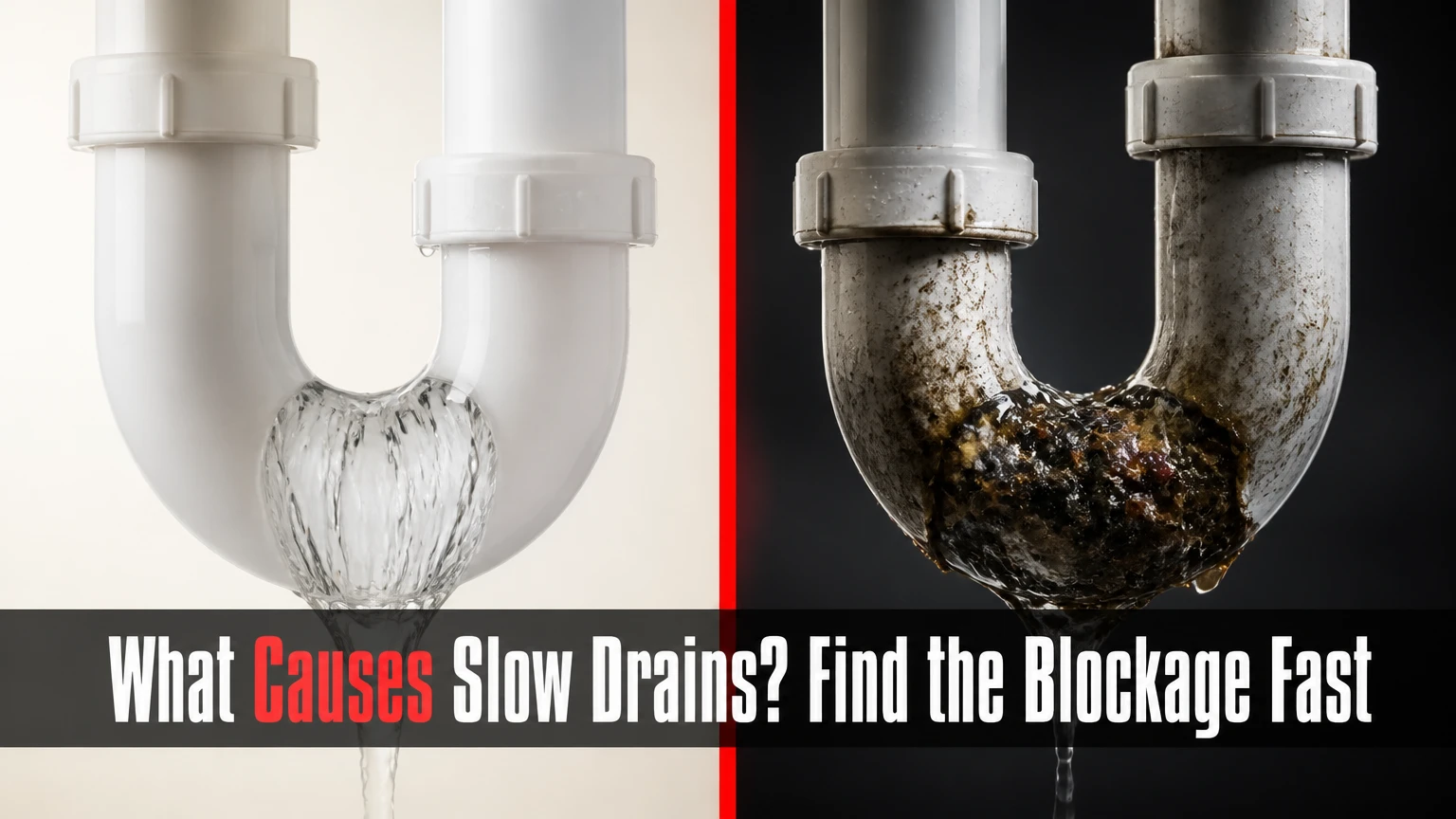
A slow drain is usually caused by a partial blockage from hair, grease, soap residue, food, mineral scale, or foreign material inside a branch pipe. Reduced flow can also result from a blocked vent, incorrect pipe slope, a sagging or damaged sewer line, or tree-root intrusion. The number of affected fixtures identifies the likely location.
Key Facts at a Glance
- One slow fixture usually indicates a local restriction in its stopper, trap, or branch pipe.
- Several slow fixtures, sewage odors, or toilet bubbling can indicate a main drain or sewer-line problem.
- Hair and soap residue commonly restrict shower and bathroom-sink drains.
- Fats, oils, grease, starch, and food particles commonly restrict kitchen drain lines.
- Gurgling often indicates trapped air from a partial blockage or obstructed plumbing vent.
- Chemical drain openers are a poor choice for standing water, recurring blockages, damaged pipes, or septic systems.
What Causes Slow Drains?
Slow drains occur when water meets increased resistance or cannot exchange air normally within the drainage system. Most cases begin with a partial obstruction that narrows the pipe, but plumbing vents, pipe geometry, mineral deposits, and underground damage can produce similar symptoms.
The most common causes are hair mixed with soap scum, kitchen grease mixed with food particles, sediment around a pop-up stopper, and debris trapped in a P-trap. Older properties may also develop cast-iron scale, root intrusion, displaced joints, or a sewer lateral that has collapsed.
A drain that slowly worsens over weeks usually has accumulating material. A drain that becomes slow immediately after remodeling may have construction debris, an improperly installed fitting, or inadequate slope. A drain that slows only during heavy rain may be affected by a saturated sewer system, groundwater intrusion, or a storm-related backup.
How Drainage Flow Works
Household drainage depends on gravity, pipe slope, atmospheric pressure, and relatively smooth internal pipe walls. Incoming water pushes wastewater toward the building drain while air moves through the drainage network and exits through vent piping.
A roof vent does not normally carry wastewater. Its job is to keep pressure near atmospheric pressure as water travels through the system. If a restriction blocks air movement, negative pressure can slow discharge and pull water from nearby traps, producing gurgling or sewer odor.
Pipe friction rises as the open cross-sectional area becomes smaller. A thin coating may have little effect, but a coating that reduces a 1.5-inch bathroom branch to a narrow passage can sharply reduce flow and capture more debris. The restriction then grows faster because each subsequent discharge encounters a rougher, smaller path.
How Blockages Form
Most organic blockages develop through several stages rather than appearing at once. Grease, soap fats, and biofilm first coat the pipe wall; hair, lint, food particles, and paper then attach to the sticky surface.
Hard-water minerals can make the restriction more durable. Calcium and magnesium react with fatty soap residues to form insoluble soap scum, while scale can accumulate on aging metal pipes and roughen the passage. Bacteria consume organic waste inside the damp deposit, creating a slimy layer that holds additional particles.
A partial clog may allow water to drain when the fixture releases a small volume, then fail when a bathtub, washing machine, or dishwasher discharges several gallons quickly. That pattern explains why a drain can appear acceptable during handwashing but overflow during a full appliance cycle.
Which Drain Is Slow?
The fixture location provides the first useful diagnostic signal because each drain receives a different waste stream. Shower drains collect hair and body oils, bathroom sinks collect hair and toothpaste residue, and kitchen drains collect grease, starch, and food particles.
| Slow fixture or symptom | Most likely causes | First inspection | Typical next step |
|---|---|---|---|
| Shower or tub | Hair, soap scum, bath products | Drain cover and stopper | Remove debris, then use a hand auger |
| Bathroom sink | Pop-up stopper sludge, hair, toothpaste | Stopper linkage and P-trap | Clean stopper and trap |
| Kitchen sink | Grease, starch, food particles, disposal debris | Strainer, disposal baffle, trap | Clean trap, then plunge or auger |
| Toilet plus nearby fixtures | Branch or main-line restriction | Toilet bowl level and cleanout | Stop water use and call a plumber if repeated |
| Basement floor drain | Sediment, lint, main sewer backup, trap issues | Drain grate and standing water | Remove grate, check for backup, escalate if sewage appears |
| Laundry drain | Lint, detergent residue, undersized or restricted standpipe | Standpipe and hose discharge | Inspect branch line and washing-machine discharge |
Why Is a Shower Drain Slow?
A slow shower drain is most often caused by hair bound together with soap scum near the drain opening or in the first several feet of branch piping. Remove the cover and pull out the visible mat before using a plastic drain-cleaning strip or small hand auger.
Shower drains receive repeated hair loads, and soap reduces surface tension while body oils make the material adhesive. A mesh or silicone drain catcher can prevent most new hair from entering, but the catcher must be emptied frequently so water does not bypass it.
If the shower slows only when another bathroom fixture runs, the restriction may be farther downstream. If the shower pan fills while the toilet bubbles, stop using water because the problem may involve the shared branch or main drain.
Why Is a Kitchen Sink Slow?
A kitchen sink usually slows because cooled fats, oils, and grease adhere to the pipe wall and trap food particles. Pasta, rice, flour, potato residue, coffee grounds, and fibrous vegetable material can enlarge the deposit or jam a garbage-disposal discharge line.
A disposal reduces food particle size but does not eliminate the need for disposal. Grease should enter a sealed container for disposal in household waste, and large food scraps should go into compost or trash where local rules permit.
Dishwashers can reveal a kitchen-line restriction because their discharge enters the sink branch under pressure. If the sink fills when the dishwasher runs, inspect the air gap or high loop, disposal connection, and shared branch line rather than repeatedly pouring cleaner into the sink.
What System Problems Cause Slow Drains?
Systemic drainage problems affect pipe capacity, air pressure, or pipe continuity rather than one easily accessible trap. Blocked vents, incorrect slope, pipe bellies, mineral scale, root intrusion, and structural collapse can all produce recurring slow flow after a surface clog has been removed.
| System problem | Distinctive clue | Usual confirmation method | Typical repair range |
|---|---|---|---|
| Blocked vent stack | Gurgling, trap odor, several fixtures affected | Roof-level inspection by a professional | $150-$500 |
| Pipe belly or poor slope | Recurring sediment, standing wastewater | Camera and level assessment | $1,000-$6,000 |
| Cast-iron scale | Gradual decline across old fixtures | Camera inspection and descaling | $400-$2,000 |
| Tree-root intrusion | Recurring outdoor or whole-house backup | Sewer camera from cleanout | $500-$2,500 for clearing |
| Cracked or collapsed line | Sewage in yard, persistent backup, voids | Camera, dye, excavation assessment | $3,000-$12,000 or more |
Can a Blocked Vent Cause Slow Drainage?
A blocked plumbing vent can cause slow drainage, gurgling, trap-water movement, and sewer odors because the drainage system cannot equalize air pressure normally. Leaves, bird nests, ice, debris, or an improperly terminated vent can restrict the stack above the roof.
Vent trouble becomes more likely when several fixtures drain slowly without a clear local clog, or when a toilet bubbles as a nearby sink empties. A vent diagnosis may require roof access and should not involve climbing onto a wet or steep roof without proper equipment.
A blocked vent is not the same as a clogged drain. Pouring cleaner into a fixture cannot clear a roof vent, and repeated plunging may temporarily change pressure without correcting the obstruction.
Can Pipe Slope or a Belly Slow a Drain?
Incorrect slope and a belly in a horizontal drain can slow flow because wastewater and solids collect in a low section instead of moving continuously toward the building drain. The commonly cited residential drainage slope is approximately 1/4 inch per foot for many small horizontal lines, while exact requirements depend on pipe diameter and local plumbing code.
A line that is nearly flat may retain sediment, but a line that is excessively steep can allow liquid to outrun solids. The result is also poor transport, particularly in lines carrying paper or food waste.
A camera inspection can distinguish a belly from an ordinary clog. Snaking may restore flow for days or weeks, but it cannot correct a sagging pipe.
Can Roots or a Collapsed Sewer Line Cause Slow Drains?
Tree roots can cause slow drains when they enter cracked joints or deteriorated underground sewer pipes and form a fibrous obstruction. A collapsed, shifted, or separated pipe can restrict flow even when the interior has been mechanically cleaned.
Root-related symptoms often recur at similar intervals after drain cleaning. Multiple fixtures may slow together, especially at the lowest levels of the building, and sewage may appear near a cleanout, yard line, or basement floor drain.
A sewer camera is the appropriate confirmation tool because it shows roots, scale, standing water, cracks, offset joints, and collapse. Hydro-jetting can remove some deposits, but structural defects require repair or replacement.
How Can You Diagnose a Slow Drain Safely?
Start by determining whether one fixture or several fixtures are affected, then inspect the accessible stopper, strainer, trap, and branch line in that order. A basic local restriction may take 15-30 minutes to address, while a whole-house problem requires professional diagnosis before more water enters the system.
| Diagnostic result | Likely location | Safe action | Escalation trigger |
|---|---|---|---|
| One sink drains slowly | Stopper, trap, local branch | Clean stopper and P-trap | No improvement after augering |
| Tub and shower both slow | Shared bathroom branch | Remove covers and auger | Toilet bubbles or sewage odor |
| Kitchen fills during dishwasher use | Sink branch or disposal connection | Check air gap and trap | Repeated backup after cleaning |
| All fixtures slow | Building drain, sewer lateral, or vent | Stop water use | Immediate professional inspection |
| Slow flow after rain | Sewer surcharge or groundwater | Limit discharge | Basement or yard sewage |
| Drain clears briefly, then slows | Incomplete cleaning, roots, scale, or belly | Record recurrence interval | Camera inspection |
Step 1: Identify the Scope
Run a small amount of water in the affected fixture and observe nearby drains. Check whether toilets bubble, whether another sink rises, and whether a basement floor drain contains water.
Do not run a washing machine or take a full shower while a main-line blockage is suspected. A washing machine can discharge dozens of gallons quickly and force wastewater through the lowest available fixture.
Step 2: Clean the Accessible Opening
Remove the drain cover, stopper, or strainer and use gloves, a flashlight, and needle-nose pliers to remove hair or sludge. Bathroom sink pop-up stoppers often hold material below the visible drain opening.
Place a strainer over an open sink drain before rinsing removed debris. The success checkpoint is a clear vortex and uninterrupted flow without rising water.
Step 3: Plunge With a Sealed Opening
Add enough water to cover the plunger cup, then seal an overflow opening with a wet cloth. Use a flat-cup sink plunger for sinks and a flange plunger for toilets, keeping the cup sealed while making 15-20 controlled strokes.
Remove the plunger and test with a measured one-quart pour. A common mistake is plunging a sink without blocking the overflow, which allows pressure to escape instead of reaching the restriction.
Step 4: Check the P-Trap
Put a bucket under the sink, loosen the slip nuts, and remove the U-shaped P-trap if the fittings are accessible and not corroded. Empty the trap, rinse it outdoors or into a separate container, inspect the washers, and reinstall it without overtightening.
The P-trap commonly holds hair, food particles, coins, and grease. Do not dismantle a corroded trap forcefully because a cracked fitting can turn a slow drain into an active leak.
Step 5: Use a Hand Auger for a Local Clog
Feed a 15-25-foot hand auger slowly through the drain opening or a suitable cleanout, rotating the cable when resistance increases. Withdraw the cable periodically to remove captured material instead of forcing it through the pipe.
An auger is appropriate for hair, paper, and moderate organic restrictions. It is not a repair for collapsed pipes, severe cast-iron scale, or a recurring root intrusion.
Which Drain-Clearing Method Fits the Problem?
Mechanical clearing is usually the safest first-line approach for a localized blockage because it removes or breaks up material without leaving corrosive chemicals in the pipe. Enzymatic products can help maintain organic residue, while hydro-jetting is better for extensive grease or scale after pipe condition is confirmed.
| Method | Typical cost | Typical time | Best application | Main limitation |
|---|---|---|---|---|
| Plastic drain strip | $5-$10 | 5-10 minutes | Hair at shower or sink opening | Reaches only a short distance |
| Hand auger | $20-$80 | 15-45 minutes | Local hair, paper, soft buildup | Limited reach and cutting force |
| Enzyme maintenance product | $10-$30 | 8-24 hours | Organic film prevention | Does not remove a hard blockage |
| Professional cable machine | $150-$500 | 30-120 minutes | Branch or main-line obstruction | May leave scale or roots behind |
| Hydro-jetting | $400-$900 | 2-4 hours | Grease, sediment, heavy deposits | Unsafe for some weakened pipes |
| Sewer repair or replacement | $3,000-$12,000+ | 1-3 days | Collapse, severe roots, separated joints | Requires structural work |
Chemical drain openers can burn skin and eyes, damage some finishes, and create a dangerous liquid hazard for anyone who later opens the trap. Never mix products, never combine drain cleaner with bleach or acids, and tell a plumber if chemical product entered the line.
Boiling water is not universally safe. A small amount of hot water may help dissolve fresh kitchen grease, but repeated boiling water can damage some plastic fittings, soften joint compounds, or crack porcelain through thermal shock. Use hot tap water instead when pipe material and fixture condition are uncertain.
How Much Does Slow-Drain Repair Cost?
Typical costs range from $5-$20 for a simple homeowner tool, $150-$500 for professional cable cleaning, $400-$900 for hydro-jetting, and $3,000-$12,000 or more for a collapsed sewer line. Local labor rates, access, pipe condition, emergency timing, and excavation requirements create substantial variation.
| Problem | Likely service | Typical DIY cost | Typical professional cost | Typical duration |
|---|---|---|---|---|
| Hair at drain opening | Strip or hand cleaning | $5-$20 | $100-$250 | 15-30 minutes |
| Sink P-trap restriction | Trap removal | $0-$15 | $125-$300 | 20-60 minutes |
| Branch-line clog | Cable auger | $30-$80 rental | $150-$500 | 30-120 minutes |
| Heavy grease or scale | Hydro-jetting | Not usually DIY | $400-$900 | 2-4 hours |
| Root intrusion | Cable or jetting plus camera | Not recommended | $500-$2,500 | 1-4 hours |
| Collapsed sewer pipe | Repair or replacement | Not DIY | $3,000-$12,000+ | 1-3 days |
A camera inspection commonly adds approximately $150-$500, although some companies include it with cleaning. The expense is justified when a blockage recurs, multiple fixtures are affected, the property is older, or roots and structural damage are plausible.
When Is a Slow Drain an Emergency?
A slow drain needs prompt professional attention when several fixtures are affected, sewage appears, a toilet bubbles, wastewater rises from a floor drain, or the problem returns shortly after cleaning. These signs point beyond a removable sink or shower obstruction.
Stop using toilets, showers, washing machines, dishwashers, and other high-discharge fixtures. Keep children and pets away from contaminated water, avoid electrical contact near basement flooding, and do not use chemical cleaner before a plumber examines the line.
Apartment residents should notify building management before removing traps or using powered equipment because the restriction may be in a shared stack or municipal connection. Renters also need permission for roof access, sewer-camera work, and any alteration to plumbing.
What Mistakes Make Drains Slower?
Several common habits turn a manageable restriction into a recurring or hazardous blockage.
- Pouring grease into the sink: Liquid grease cools against pipe walls and later captures food particles. Collect it in a container instead.
- Treating wipes as dissolvable: Products labeled flushable can remain intact long enough to collect paper and fat in a sewer line. Dispose of wipes in household waste.
- Using chemical cleaner in standing water: The product can remain concentrated in the trap and expose the next person who loosens it.
- Grinding fibrous or starchy food in a disposal: Celery fibers can wrap around components, while pasta, rice, and potato starch can swell or form paste.
- Ignoring recurring symptoms: Temporary flow after snaking does not prove the underlying pipe is healthy.
- Using the wrong plunger: A toilet flange plunger seals a toilet opening; a flat cup is designed for sinks and flat drains.
How Do You Prevent Slow Drains?
Prevention depends on keeping solids, grease, and hair out of the drainage network and responding to early symptoms before deposits harden. Strainers, regular stopper cleaning, correct disposal use, and prompt investigation of recurring flow problems provide more reliable protection than monthly chemical treatments.
| Location | Preventive action | Frequency | Material or quantity |
|---|---|---|---|
| Shower and tub | Empty hair catcher | Every 1-7 days | One fitted catcher |
| Bathroom sink | Remove and clean stopper | Monthly | Warm water and brush |
| Kitchen sink | Wipe grease from cookware | Every use | Paper towel or container |
| Garbage disposal | Run cold water while grinding | Every use | 15-30 seconds after use |
| Laundry drain | Inspect lint and discharge hose | Every 6 months | One screen or lint filter |
| Main sewer line | Camera inspection on aging property | Every 3-5 years if advised | Professional camera |
A maintenance enzyme may reduce organic film, but it cannot correct poor slope, roots, a blocked vent, or a collapsed pipe. Property managers should track the date, fixture, weather, and duration of every backup because recurrence patterns help identify shared infrastructure problems.
Practitioner Rules That Prevent Misdiagnosis
- A drain that clears for a week after snaking is often a partially cleaned line, not a successful permanent repair.
- The lowest fixture usually reveals a main-line backup first because gravity directs excess wastewater there.
- Gurgling without slow flow can indicate a vent or pressure problem, while slow flow without noise more often indicates a physical restriction.
- Hydro-jetting should follow a pipe-condition assessment when old cast iron, clay, or brittle Orangeburg pipe may be present.
- A clean P-trap does not rule out a blockage. Material may sit several feet downstream in the branch line.
Frequently Asked Questions
Can hard water make a drain slow?
Hard water can contribute to slow drainage by leaving calcium and magnesium deposits, especially when minerals combine with soap residue. Scale is more likely in older metal or heavily used lines than in a clean, modern plastic branch. A camera inspection or removed fitting can confirm deposits, while a drain cleaner cannot restore pipe diameter reliably.
Why does a drain slow down only sometimes?
Intermittent slow flow usually means a movable partial obstruction, an air-pressure problem, or a high-volume discharge that exceeds the restricted pipe’s capacity. Grease can shift with temperature, and a vent can behave differently during wind or freezing conditions. Record when the symptom occurs, which fixtures run, and whether rainfall changes it.
Can a washing machine cause a slow drain?
A washing machine can expose an existing branch or main-line restriction because its pump releases a large volume of water quickly. If the laundry standpipe overflows only during discharge, inspect the standpipe, hose arrangement, trap, and shared branch. Do not reduce the hose opening to force a temporary seal, since that can cause leaks.
Is an enzymatic drain cleaner safe for septic systems?
Many enzyme products are marketed as septic-compatible, but compatibility depends on the label, ingredients, dosage, and septic-system guidance. Enzymes work slowly on organic residue and cannot clear hair mats, grease plugs, roots, or structural defects. Mechanical cleaning remains the appropriate response to a stopped or repeatedly backing-up drain.
Why is a basement floor drain slow after heavy rain?
A basement floor drain that slows after heavy rain may be receiving a surcharge from the municipal sewer, groundwater through a damaged lateral, or runoff entering an inadequate drainage system. A dry-weather clog remains possible. Avoid running indoor water, check for sewage contamination, and arrange professional inspection if the pattern repeats.
Should I call a plumber for one slow sink?
Call a plumber when one sink remains slow after cleaning the stopper, P-trap, and accessible branch, or when the trap is corroded and cannot be removed safely. A single fixture usually permits controlled DIY troubleshooting, but chemical exposure, leaks, recurring clogs, and old fragile piping raise the risk of making the repair worse.
The Bottom Line
The most common answer to what causes slow drains is a partial physical restriction, usually hair and soap in bathrooms or grease and food residue in kitchens. The most useful diagnostic distinction is scope: one fixture points toward a local trap or branch, while several fixtures, gurgling, sewage odors, or recurring backups point toward venting, the building drain, or the sewer line. Start with mechanical cleaning, avoid hazardous chemical mixtures, and use a camera inspection when the problem returns or affects multiple fixtures.