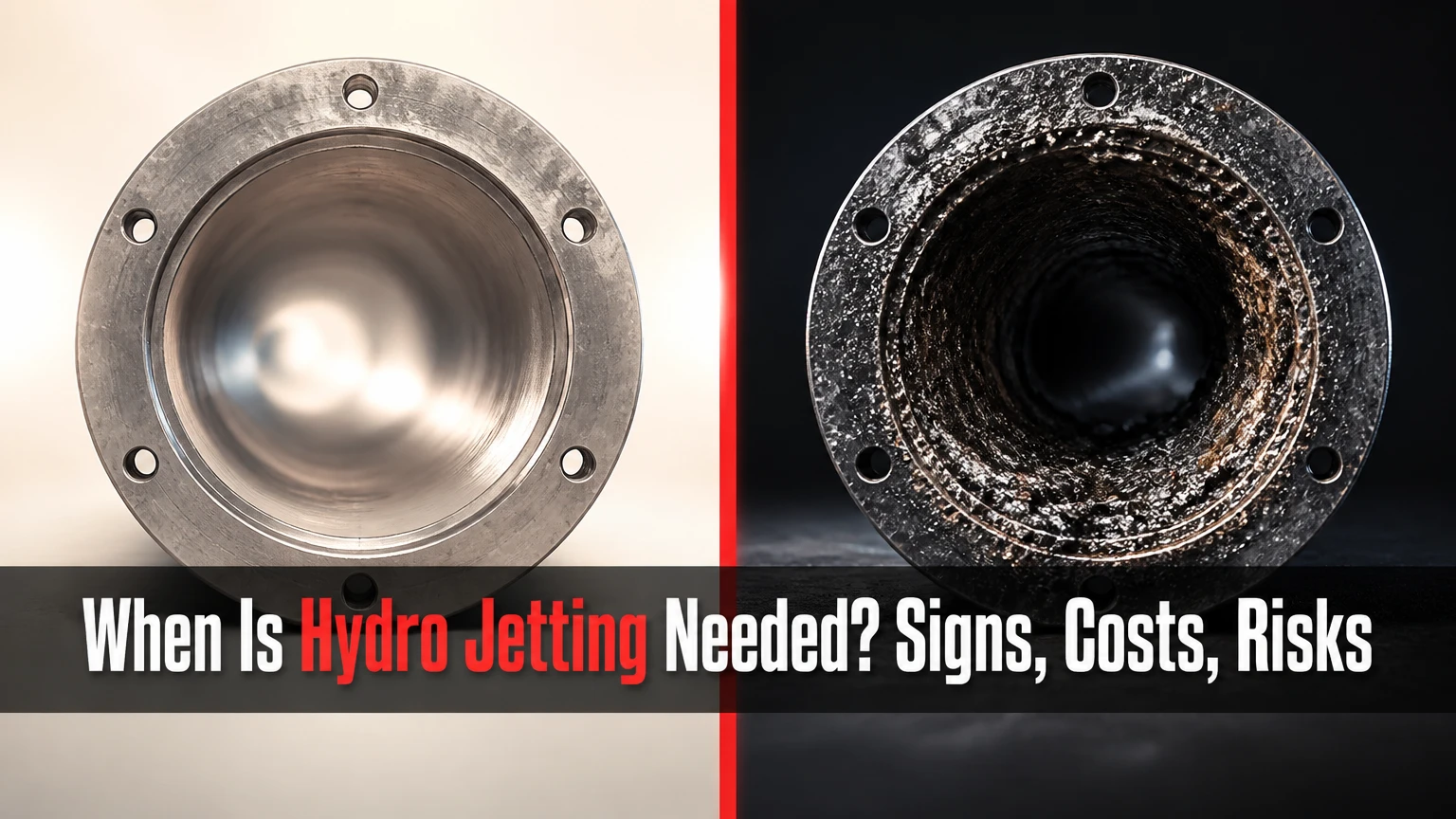
Hydro jetting is needed when grease, scale, sludge, roots, or recurring debris restrict a drain or sewer line beyond what plunging or snaking can reliably remove. It is especially appropriate for multiple slow fixtures, repeated main-line backups, commercial grease buildup, or preparation for pipe lining, provided a camera inspection finds a structurally sound pipe.
Key Facts at a Glance
Hydro jetting cleans pipe walls with high-volume water, rather than creating a narrow passage through a clog.
Multiple slow drains usually indicate a blockage in a shared branch or main sewer line.
A CCTV inspection should precede jetting when pipe age, material, damage, or blockage location is uncertain.
Typical residential hydro jetting costs range from $350-$600, while complex lines can cost $700-$1,400.
Hydro jetting removes roots and grease temporarily when the underlying pipe defect remains unrepaired.
A collapsed, severely cracked, or badly misaligned line generally needs repair or replacement, not stronger water pressure.
When Is Hydro Jetting Needed?
Hydro jetting is generally needed for a systemic or recurring drainage problem, not a single isolated sink clog. Strong indicators include two or more slow fixtures, repeated sewer backups after snaking, heavy grease or mineral scale, tree-root intrusion, sewage odors with poor drainage, and a clean pipe required before trenchless lining.
A single bathroom sink blocked by hair rarely needs a sewer jetter. A kitchen line that backs up every two months after mechanical cabling presents a different problem because the cable may puncture the obstruction while leaving grease attached to the pipe wall.
Symptom-to-action guide
| Observed condition | Likely location or cause | Typical next action |
|---|---|---|
| One sink drains slowly | Hair, soap, or local trap blockage | Trap cleaning or small auger |
| Kitchen sink backs up repeatedly | Grease film or a restricted branch line | Camera inspection and possible branch-line jetting |
| Toilet and shower back up together | Shared bathroom branch blockage | Mechanical clearing, then camera diagnosis |
| Several fixtures back up | Main sewer restriction or surcharge | Emergency assessment and main-line inspection |
| Gurgling toilet with slow drains | Air displacement around a restriction | Inspect branch or main sewer line |
| Yard cleanout contains sewage | Downstream main-line blockage | Main-line clearing and camera inspection |
| Drain works after snaking, then fails | Residual grease, roots, or scale | Full-wall cleaning, often hydro jetting |
| Repaired pipe still has debris | Construction residue or sediment | Post-repair flushing and camera verification |
Sewer odors alone do not prove that hydro jetting is necessary. A dry floor drain trap, blocked vent, broken cleanout cap, or damaged sewer pipe can produce similar smells, so the odor must be interpreted with drainage behavior and inspection results.
How Does Hydro Jetting Work?
Hydro jetting uses a pump, hose, and engineered nozzle to direct pressurized water through the pipe. Forward jets break or penetrate deposits, while rear-facing jets propel the hose and carry loosened material toward an approved downstream outlet.
The cleaning result depends on both pressure and flow. Pressure supplies cutting force at the nozzle, but gallons per minute determines how effectively loosened grease, sediment, and root fragments leave the pipe instead of settling downstream.
What happens during a professional service?
- Technicians inspect the line. A CCTV camera identifies pipe material, cracks, offsets, root entry, standing water, and the obstruction’s position.
- Technicians confirm access. Common entry points include a sewer cleanout, basement access, exterior rodding point, or occasionally a roof vent.
- Technicians select settings. Nozzle size, hose diameter, pressure, flow, and water volume are matched to the pipe diameter and condition.
- Technicians establish a discharge path. The downstream route must accept debris and water without flooding a building or contaminating a yard.
- Technicians advance and retrieve the hose. The nozzle works through the restriction, then the operator slowly pulls it back to scour the full circumference.
- Technicians verify the result. A second camera pass can confirm removal, reveal defects, and identify deposits that remain.
A professional operator does not simply turn a pressure control to its maximum setting. Nozzle geometry, water volume, pipe diameter, access distance, and the pipe’s structural condition determine the appropriate setup.
What Can Hydro Jetting Remove?
Hydro jetting can remove grease, fats, soap residue, sludge, mineral scale, paper accumulations, sediment, and many tree-root intrusions. Hydro jetting cannot permanently correct a collapsed pipe, missing section, severe joint displacement, or a root entry caused by an unrepaired structural opening.
| Deposit or obstruction | Jetting performance | Limitation that remains |
|---|---|---|
| Soft grease film | High effectiveness with rotary nozzle | Grease returns if disposal practices remain poor |
| Hardened grease mass | High effectiveness with penetrating nozzle | Large fragments can obstruct a downstream section |
| Mineral scale | Moderate to high with descaling nozzle | Severely corroded pipe may lose wall material |
| Fine roots | High effectiveness with root-cutting nozzle | Roots can regrow through the same defect |
| Heavy sediment | High effectiveness with adequate flow | Low spots may collect sediment again |
| Hair and soap residue | Moderate effectiveness | A small auger may be faster for one fixture |
| Concrete or hardened mortar | Low or specialized | Structural repair may be safer |
| Collapsed pipe | No corrective effect | Excavation, spot repair, or replacement is required |
Hydro jetting is a cleaning method, not a structural restoration method. A jetter can make a damaged line look open while leaving the defect that caused the blockage, so a clean post-service camera image is more informative than temporary drainage improvement.
What Equipment and Pressure Are Used?
Typical residential branch-line jetters operate around 1,500-2,200 PSI and 1.5-3 gallons per minute, while main-line equipment commonly operates around 3,000-4,000 PSI and 4-18 gallons per minute. These figures are broad operating ranges, not universal prescriptions.
| Application | Typical pipe size | Typical equipment range | Common nozzle |
|---|---|---|---|
| Interior sink or laundry branch | 1.5-2 inches | 1,500-2,200 PSI, 1.5-3 GPM | Small penetrating or rotating nozzle |
| Residential building drain | 3-4 inches | 2,000-3,500 PSI, 4-10 GPM | Flushing or rotary nozzle |
| Residential sewer main | 4-6 inches | 3,000-4,000 PSI, 8-18 GPM | Root-cutting or penetrator nozzle |
| Commercial kitchen line | 3-6 inches | 3,000-4,000 PSI, 8-18 GPM | Grease-cutting rotary nozzle |
| Large commercial sewer | 6-8 inches or larger | 3,000-4,000 PSI, 12-18 GPM or more | High-flow flushing nozzle |
A penetrator nozzle creates a pilot opening through a dense blockage. A rotary nozzle distributes water around the pipe and is useful for wall deposits. A root-cutting nozzle uses focused water or water-driven cutting elements to shave roots, but the operator must control fragments and verify downstream flow.
Pressure should not be used as a proxy for quality. A lower-pressure, high-flow setup can flush a larger line more effectively than a high-pressure, low-flow setup, and excessive force can worsen defects in fragile pipe.
Can Hydro Jetting Damage Old Pipes?
Hydro jetting can damage old or defective pipes when an operator applies unsuitable pressure, uses the wrong nozzle, or skips inspection. Sound clay, cast-iron, PVC, and concrete lines can often be cleaned safely, but brittle Orangeburg, severely corroded cast iron, cracked vitrified clay, and badly separated joints require special caution.
The common rule that old pipes must always be jetted below 2,000 PSI is too simplistic. Safe settings depend on pipe condition, diameter, nozzle distance, water flow, and the operator’s control of hose movement.
Situations requiring caution
- Orangeburg pipe: Bitumen-impregnated fiber pipe can deform, delaminate, or collapse with age.
- Rusted cast iron: Jetting may remove deposits that were masking thin pipe walls.
- Vitrified clay: Sound clay can tolerate professional cleaning, but displaced joints and fractures can worsen.
- Unreinforced or damaged PVC: High pressure at a close nozzle distance can cut or deform weakened areas.
- Pipe with an open joint: Water can escape into surrounding soil and enlarge a void.
- Low-slope or sagging pipe: Cleaning may restore flow briefly while the belly continues collecting solids.
The first camera inspection should document whether the line is structurally sound enough for cleaning. If the camera cannot pass, the technician should explain whether a limited mechanical opening, access excavation, or repair is needed before jetting.
How Does Hydro Jetting Compare With Snaking?
Hydro jetting is the stronger choice for wall deposits and recurring blockages, while snaking is usually the faster and less expensive first response for a single localized obstruction. A cable auger cuts a passage through material; hydro jetting removes deposits around the pipe circumference and flushes loosened waste away.
| Decision factor | Hydro jetting | Snaking or augering | Chemical drain cleaner |
|---|---|---|---|
| Primary action | High-volume water scours walls | Cable punctures or cuts blockage | Chemical reaction attacks deposits |
| Grease removal | Strong for attached films and masses | Often leaves wall coating | Unreliable on thick grease |
| Tree-root response | Cuts or shaves accessible roots | Opens a narrow channel | Usually ineffective |
| Best first use | Recurring or systemic blockage | One fixture with a clear local clog | Limited household maintenance |
| Typical residential cost | $350-$1,400 | $150-$500 | $8-$30 per container |
| Structural risk | Significant if misapplied | Cable can snag or damage defects | Corrosion, fumes, and splash injury |
| Long-term result | Depends on pipe condition | Often temporary for wall buildup | Usually temporary |
Chemical drain openers are a poor choice for suspected sewer-line restrictions because they may sit in backed-up water, damage some materials, and expose the next technician to caustic liquid. Never combine products or use chemicals before requesting professional drain service.
How Much Does Hydro Jetting Cost?
Typical US residential hydro jetting costs range from $350-$600 for a standard accessible line, $700-$1,400 for a severe or complex main-line job, and $950-$2,500 or more for commercial work. A separate CCTV inspection commonly adds $250-$400, although some companies bundle the inspection with cleaning.
| Service situation | Typical price range | Typical active work time | Main price variables |
|---|---|---|---|
| Short interior branch line | $250-$500 | 30-60 minutes | Access, diameter, buildup |
| Standard residential main | $350-$600 | 45-90 minutes | Length, cleanout, blockage |
| Root-heavy or long main | $700-$1,400 | 1-2 hours | Roots, access, repeat passes |
| Commercial kitchen drain | $950-$2,500+ | 1-4 hours | Grease load, traps, regulations |
| CCTV inspection alone | $250-$400 | 30-60 minutes | Camera access and reporting |
Typical total appointment time is 1-2.5 hours for a straightforward home service, including setup and inspection. Emergency, after-hours, difficult-access, and excavated-cleanout work can increase the bill substantially.
A written estimate should identify whether the price includes camera inspection, water disposal, nozzle selection, travel, emergency labor, post-jet verification, and any cleanout repair. A low quote that excludes diagnosis may become more expensive after the line fails again.
What Happens When Hydro Jetting Fails?
A failed hydro jetting service usually indicates a structural defect, inaccessible blockage, inadequate flow, or debris that has not been removed from the downstream system. Restored drainage without a clear camera image should be treated as an incomplete diagnosis rather than proof that the line is fixed.
| Failure during or after service | Likely reason | Appropriate response |
|---|---|---|
| Water backs up during jetting | Downstream path is blocked | Stop flow and clear the receiving section |
| Hose will not retract | Tight bend, damaged pipe, or nozzle entrapment | Reduce force, pulse carefully, inspect access |
| Line clogs again within days | Collapse, offset, roots, or remaining deposits | Repeat camera inspection and evaluate repair |
| Camera cannot pass after cleaning | Severe offset, sediment, or collapsed segment | Locate the defect and consider excavation |
| Sewer odor continues | Dry trap, vent issue, or broken pipe | Inspect traps, vents, and the sewer route |
| Cleanout overflows | Main outlet remains restricted | Clear downstream or municipal connection |
| Water drains slowly but appears open | Belly, scale, or partial restriction remains | Measure slope and review camera footage |
A hose should never be pulled violently when stuck. Excessive pulling can damage the hose, nozzle, cleanout, or pipe connection. The operator should use controlled pressure changes and mechanical recovery procedures.
When Is Pipe Repair Better Than Hydro Jetting?
Pipe repair is better than hydro jetting when inspection shows collapse, extensive corrosion, a missing section, a major offset, persistent groundwater intrusion, or a recurring root entry caused by an open joint. Jetting can clear the immediate blockage, but it cannot seal a defective pipe wall.
Hydro jetting is often used before cured-in-place pipe lining because epoxy liner adhesion requires a clean host-pipe surface. Cleaning does not make lining appropriate by itself; the host pipe must retain enough shape and continuity for the liner to be installed.
Repair indicators
- The camera shows a complete collapse or severe oval deformation.
- The pipe has separated enough to allow soil into the line.
- Repeated root growth returns after cleaning.
- Corrosion has removed substantial wall thickness.
- The line has a persistent belly that traps solids.
- Water infiltration continues through joints or fractures.
- Jetting cannot pass the same location more than once.
A spot repair may correct one defective joint, while replacement or trenchless rehabilitation may be justified for long damaged sections. The decision should follow the camera report, pipe material, depth, access conditions, and local plumbing requirements.
Should You DIY Hydro Jetting?
Homeowners should generally not rent professional hydro jetting equipment for sewer work. Sewer jetters combine high-pressure water, heavy hoses, rotating nozzles, contaminated wastewater, and unknown pipe conditions, creating risks that a household pressure washer cannot safely manage.
The US Occupational Safety and Health Administration treats high-pressure water exposure as an injury hazard because water can penetrate skin and inject contaminants into tissue. Sewer work also involves biological exposure, electrical hazards, confined spaces, and potential property contamination.
A homeowner can safely perform useful preparation:
- Stop using fixtures if sewage is backing up.
- Avoid chemical drain cleaners before service.
- Locate the cleanout if access is known.
- Photograph visible overflow and fixture symptoms.
- Record when the problem began and how often it recurs.
- Ask for a camera inspection and written scope of work.
A small hand auger may be reasonable for a reachable sink trap, but a main sewer line requires professional diagnosis and equipment. DIY pressure washing is not an equivalent substitute for calibrated sewer jetting.
How Often Should Lines Be Hydro Jetted?
Residential lines should be hydro jetted when symptoms, inspection findings, or a known buildup pattern justify cleaning, rather than on a universal calendar. A typical commercial kitchen may need service every 3-6 months, while a root-prone residential sewer may need annual or condition-based cleaning.
| Property or line condition | Typical maintenance interval | Reason for the interval |
|---|---|---|
| Modern PVC home with no symptoms | Condition-based | Little value from unnecessary cleaning |
| Older home with grease buildup | 12-24 months | Deposits can accumulate before a backup |
| Root-prone residential line | 6-18 months | Seasonal regrowth may recur |
| Restaurant kitchen drain | 3-6 months | Fats, oils, and grease accumulate rapidly |
| Apartment building main | 6-12 months | Higher fixture count increases loading |
| Line awaiting trenchless lining | One pre-installation cleaning | Adhesion requires a prepared surface |
Preventive jetting cannot replace correct grease disposal, root management, or pipe repair. If a line requires cleaning every few weeks, the interval is evidence of an unresolved cause, not a successful maintenance program.
Can Septic Systems Be Hydro Jetted?
Septic drain lines can sometimes be hydro jetted, but the septic tank, distribution box, and drain field require separate evaluation. Jetting a building sewer may clear the line leading to the tank, while jetting a clogged drain-field lateral without a qualified septic assessment can damage components or move solids where they should not go.
Before service, identify whether the blockage is:
- Between the building and septic tank.
- At the tank inlet or outlet baffle.
- Inside a distribution box.
- Within a pump chamber.
- In the drain field.
- Caused by a full tank rather than a blocked pipe.
A full septic tank, failed pump, saturated drain field, or damaged baffle will not be fixed by cleaning the house sewer. A licensed septic professional should determine the correct access point and disposal procedure.
What Should You Ask a Hydro Jetting Company?
Ask the contractor to connect the proposed service to a diagnosed condition, not simply recommend a machine by pressure rating. The most useful questions concern inspection, pipe safety, scope, verification, and what happens if the blockage reveals structural damage.
Use this checklist:
- Will you perform a CCTV inspection before jetting?
- What pipe material and diameter did the camera identify?
- What pressure and flow rate will you use, and why?
- Which nozzle matches the deposit or root condition?
- Where will wastewater and debris discharge?
- Does the estimate include pre- and post-jet camera footage?
- What happens if the hose cannot pass the blockage?
- What repair options apply if the pipe is collapsed?
- Does the price include cleanout access or repair?
- What recurrence pattern would indicate a structural problem?
A responsible technician should explain why jetting is suitable and when they would refuse it. Pressure alone is not a credential, and “maximum PSI” is not a safety specification.
FAQ
Is hydro jetting worth it for one clogged drain?
Hydro jetting is usually unnecessary for one isolated sink or shower clog caused by hair, soap, or a local trap blockage. The service becomes more defensible when the same drain repeatedly clogs, a nearby fixture backs up, or inspection finds grease, scale, or roots extending through a branch line.
How long does hydro jetting keep a sewer line clear?
A clean, structurally sound line may remain open for months or several years, but no fixed lifespan applies. Grease-producing businesses, root-prone properties, low-slope pipes, and damaged joints recur faster; a claim of guaranteed two-to-five-year clearance should be treated cautiously.
Can hydro jetting remove tree roots permanently?
Hydro jetting can cut or strip accessible tree roots from the pipe, but it does not permanently stop regrowth when roots enter through a cracked joint or broken pipe. Long-term control requires repairing the entry point, replacing the damaged section, or using a suitable root-management program.
Does hydro jetting clean the entire sewer line?
Hydro jetting can clean the accessible section reached by the hose, but bends, collapsed segments, disconnected pipes, and inaccessible sections may remain untreated. A camera report should identify the starting access, approximate endpoint, obstructions, and any portion the equipment could not reach.
Is hydro jetting covered by homeowners insurance?
Homeowners insurance commonly excludes gradual maintenance issues and wear, while sudden damage from a covered event may receive different treatment. Coverage depends on the policy, cause of loss, service line endorsement, and local rules, so obtain the diagnosis and contact the insurer before authorizing expensive excavation.
What is the safest first step during a sewer backup?
Stop using water throughout the property, keep people and pets away from contaminated areas, and arrange professional assessment. Do not pour chemical cleaners into a backed-up line, operate electrical equipment near wastewater, or open a pressurized cleanout without understanding where sewage may discharge.
The Bottom Line
Hydro jetting is needed when a drain or sewer line has recurring, widespread, or deposit-based restriction that ordinary snaking does not remove completely. Multiple slow fixtures, repeated main-line clogs, grease, scale, roots, and pipe-lining preparation are strong indications, but a camera inspection should determine whether the pipe can safely withstand the cleaning.
Hydro jetting is not a cure for collapse, severe corrosion, misalignment, or an open root-entry defect. Compare the inspection findings with the quoted pressure, flow, nozzle, cost, and verification plan before approving the work. That decision process answers when is hydro jetting needed more accurately than any fixed schedule or maximum-pressure promise.