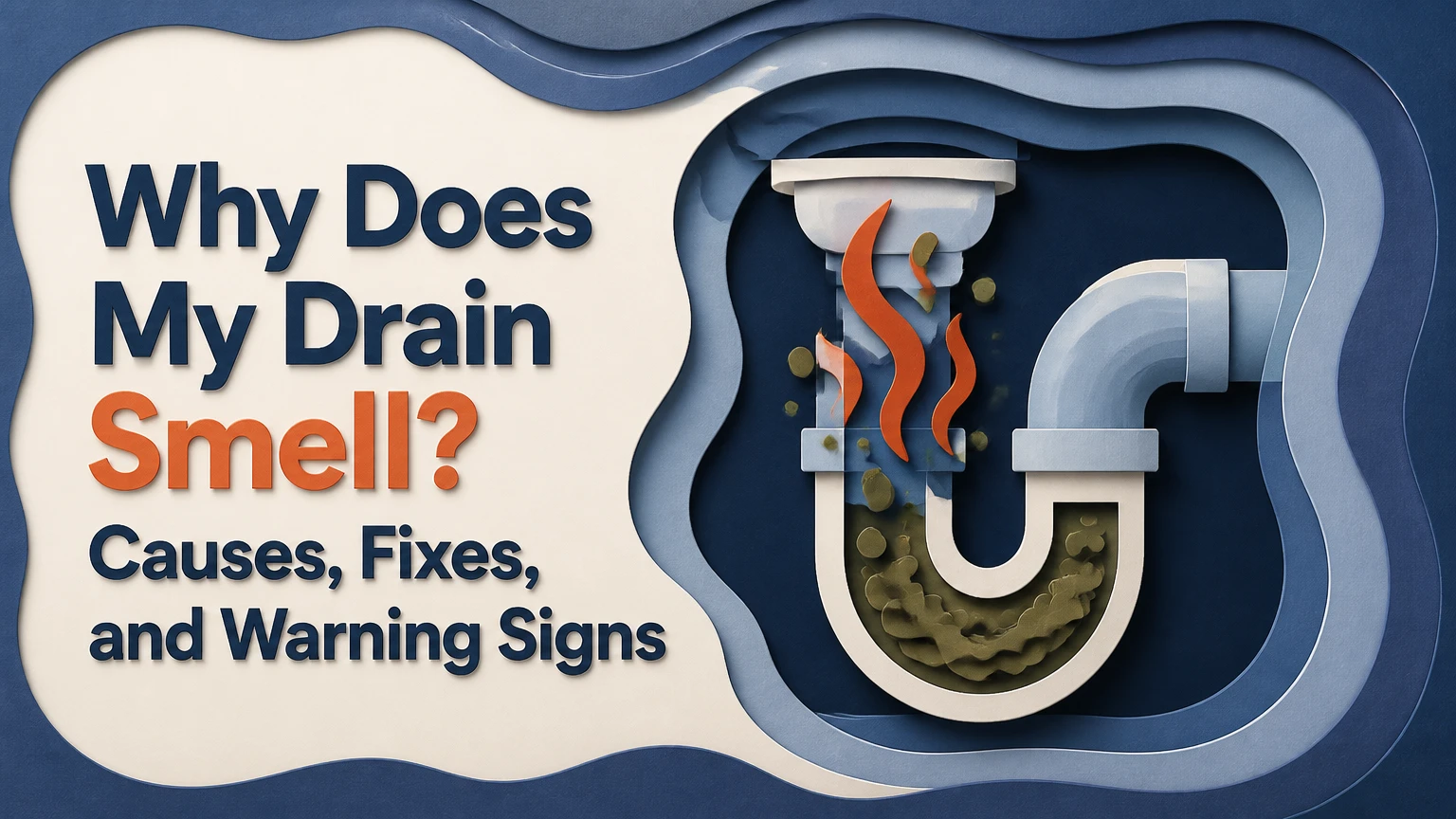
A smelly drain usually indicates either sewer gas escaping through a failed water seal or organic residue decomposing inside the drain. The most common causes are a dry P-trap, biofilm, a blocked plumbing vent, a dirty garbage disposal, or a leaking drain connection. The odor’s location, timing, and accompanying sounds identify the likely fault.
Key Facts
A P-trap normally holds water that blocks sewer gases from entering a room.
Running water for 30-60 seconds can restore a dry trap, but recurring odor indicates another fault.
A sour kitchen smell usually comes from food residue or grease, not the sewer line.
Gurgling across multiple fixtures suggests a venting or main-drain problem.
Chemical drain openers are poor odor treatments and create burn, corrosion, and mixing hazards.
Sewage backup, visible wastewater, or strong widespread sewer odor requires prompt professional assessment.
Why Does My Drain Smell?
A drain smells when odor-producing gases or decomposing material have a path into the room. That path may be the open drain itself, a dry floor-drain trap, a failed sink overflow, a loose cleanout, a cracked pipe, or a toilet seal that is mistaken for a drain problem.
The odor does not prove that the underground sewer line is failing. In practice, a small amount of hair, skin oil, soap, and grease inside a wet drain often creates a persistent sour or musty smell, while a rotten-egg odor is more consistent with sulfur compounds from sewage or anaerobic bacteria. Hydrogen sulfide is associated with the characteristic rotten-egg smell, although smell is not a reliable safety meter because high exposure can reduce the ability to detect it.
A useful first test is simple: remove nearby drain covers, run each fixture, and determine whether the odor changes immediately. If water removes the smell temporarily, inspect the trap and drain walls. If the smell returns after every toilet flush, appears at several fixtures, or accompanies gurgling, investigate venting and the building drain instead.
How Does a Drain Prevent Sewer Gas?
A P-trap prevents sewer gas by retaining water in the U-shaped section below a sink, shower, bathtub, or floor drain. The water forms a barrier between the room and the drainage system, while the vent system balances air pressure so normal discharge does not pull the barrier away.
When a trap dries from evaporation, the barrier disappears. A pressure imbalance can also siphon water from the trap, and an incorrectly installed trap can lose its seal even when the fixture is used regularly. A damaged trap, loose slip joint, or floor drain without a functioning trap primer creates similar access for odor.
P-trap water is not a permanent mechanical plug for every gas under every condition. Sewer gases can bypass the trap through a defective connection, a failed toilet seal, or a crack downstream. The correct diagnosis therefore considers the entire waste-and-vent assembly, not only the visible drain opening.
What removes water from a P-trap?
| Cause | Typical setting | Diagnostic clue | Corrective action |
|---|---|---|---|
| Evaporation | Guest bath or floor drain | Odor follows 2-8 weeks of non-use | Add water and maintain the fixture |
| Siphonage | Poor venting or long branch drain | Odor follows flushing or draining elsewhere | Inspect vent and trap configuration |
| Backpressure | Partial main blockage | Gurgling, slow drainage, or bubbling | Clear and inspect the drain line |
| Leakage | Corroded or loose trap | Damp cabinet, staining, or visible drip | Repair or replace the trap assembly |
| Missing trap primer | Basement floor drain | Trap repeatedly dries despite added water | Repair primer or install an approved solution |
What Does the Smell Tell You?
The odor type narrows the diagnosis, but smell alone cannot confirm a sewer-gas leak. Sour, rotten-egg, musty, and sewage odors commonly arise from different materials and locations, so use the following clues with drainage behavior.
| Odor description | More likely source | Check first | Typical fix |
|---|---|---|---|
| Rotten egg or sulfur | Sewer gas, stagnant trap, sewage residue | P-trap water and nearby toilet base | Restore trap seal or arrange inspection |
| Sour food or rancid grease | Kitchen biofilm or disposal | Splash guard, strainer, overflow, tailpiece | Scrub, remove residue, improve rinsing |
| Musty or earthy | Mold, damp cabinet, wet insulation | Cabinet base and wall penetration | Dry area and repair moisture source |
| Sewage after flushing | Vent fault, toilet seal, branch drain | Toilet base, gurgling, multiple fixtures | Replace seal or inspect vent/drain |
| Mildew with slow water | Organic sludge and standing water | Hair trap and drain stopper | Extract blockage and clean drain |
| Sweet chemical odor | Cleaner residue or solvent | Recent products and stored chemicals | Ventilate and never mix products |
A drain can smell without being clogged. Conversely, a partially blocked drain can remain odor-free until bacteria colonize the trapped material. Odor and flow are separate diagnostic signals.
Is a Dry P-Trap the Cause?
A dry P-trap is the fastest and least expensive cause to test. Pour approximately 0.5-1 liter of water into an unused sink, shower, or floor drain, then wait 5-10 minutes; if the odor stops and does not return, evaporation was probably responsible.
Unused fixtures lose trap water faster in warm, dry rooms and in properties with continuous ventilation. Basement floor drains can also dry because they receive little routine flow. After adding water to a floor drain, 1-2 tablespoons of mineral oil can slow evaporation, but local plumbing guidance and the drain’s intended use should be considered. A trap primer is the more durable solution where evaporation is recurrent.
Do not add oil, antifreeze, or disinfectant to a drain connected to a septic system unless the product label and local authority specifically permit it. Water is the safest initial test. A trap that dries again within days needs investigation for siphonage, leakage, or a missing primer.
How Do You Clean Biofilm Safely?
Clean biofilm by removing the physical residue, not by masking it with fragrance. Remove the stopper or strainer, extract hair with a plastic barbed tool, scrub accessible drain surfaces with a narrow brush and detergent, then flush with hot tap water.
Kitchen sinks often retain grease beneath the strainer, inside the tailpiece, or under a garbage-disposal splash guard. Bathroom sinks can hide sludge in the stopper rod opening and overflow channel. A small bottle brush reaches these surfaces more effectively than a chemical opener.
Baking soda followed by vinegar may loosen light surface residue, but the fizzing reaction has limited mechanical force and does not replace brushing or trap cleaning. Never combine vinegar with bleach, caustic drain opener, ammonia, or another cleaning product. If a product has already entered the drain, follow its label before introducing anything else.
When are enzyme cleaners useful?
Enzyme or biological drain treatments can help maintain a lightly contaminated drain because their microorganisms and enzymes break down some organic residue over several hours. They are maintenance products, not reliable solutions for a solid blockage, a failed trap seal, tree roots, pipe collapse, or a vent obstruction.
Use only the quantity and contact time on the label. Typical treatment times range from 6-12 hours, often overnight, and repeated applications may be required. Septic compatibility depends on the specific formulation, so “natural” or “biological” does not automatically mean approved for every septic system.
Why Does My Kitchen Drain Smell?
A kitchen drain commonly smells because grease, starch, meat particles, and food debris collect in the strainer, trap, dishwasher connection, or garbage-disposal baffle. The most effective first treatment is physical cleaning of those surfaces, followed by normal hot-water flushing and better waste control.
If the sink drains slowly, remove the standing water and clean the stopper and strainer before attempting any chemical treatment. Inspect the dishwasher hose connection for stagnant water and confirm that the hose rises high under the counter or connects through an appropriate air-gap arrangement. Installation requirements vary by jurisdiction and appliance design.
A garbage disposal needs special attention. Turn off power at the switch and unplug the unit or isolate its circuit before placing hands near the opening. Scrub both sides of the rubber splash guard, where food particles frequently remain, and use a disposal-safe brush. Do not assume ice, citrus peels, or drain chemicals sharpen the impellers or disinfect the chamber; they may reduce temporary odor while leaving the underlying film.
Why Does My Bathroom or Shower Drain Smell?
A bathroom or shower drain usually smells because hair, skin oils, soap, and standing water have formed biofilm around the stopper, strainer, trap, or overflow passage. Remove the cover, extract visible hair, scrub the drain opening, and run hot tap water for several minutes.
A shower drain that smells like sewage despite regular use may have a venting issue, a damaged trap, or a connection leak beneath the floor. A bathroom odor that becomes stronger near the toilet may originate from a failed wax or rubber closet seal rather than the shower drain. Loose toilet mounting, staining at the base, or movement when sitting increases suspicion of a failed seal.
Drain flies provide another clue. Tiny moth-like flies near a shower or floor drain breed in gelatinous organic film, so aerosol insecticide treats the adult insects but not the breeding material. Scrubbing the drain and trap is the necessary control step.
Can a Blocked Vent Cause Drain Odor?
A blocked plumbing vent can cause drain odor by disrupting pressure balance and pulling water from P-traps. The strongest clues are gurgling, bubbling, slow drainage at multiple fixtures, or an odor that appears when a toilet flushes or a washing machine discharges.
Roof vents can be obstructed by leaves, bird nests, ice, or debris, but a vent problem is not safe to diagnose by climbing onto a roof without appropriate equipment. A plumber can test drainage behavior, inspect accessible vent sections, and use a camera or smoke test when the layout warrants it.
One gurgle does not prove a blocked vent. A partial branch clog can produce similar sounds, and a poorly shaped trap can siphon independently. The pattern matters: one fixture points toward a local restriction, while several fixtures reacting together point toward a shared vent or building drain.
Could a Pipe or Toilet Seal Be Leaking?
A leaking pipe or failed toilet seal can release sewer odor even when every visible drain contains water. Hidden leaks often produce dampness, staining, swollen cabinetry, peeling flooring, insect activity, or an odor concentrated inside a wall, cabinet, crawl space, or floor penetration.
Cast-iron drain lines may develop corrosion holes, while plastic systems can fail at joints, fittings, or penetrations. A loose slip-joint washer under a sink may leak wastewater but usually creates a localized damp smell rather than a widespread sewer-gas odor. A failed toilet seal often creates odor around the toilet base and may allow contaminated water beneath flooring.
Do not seal over a suspicious opening with caulk before finding the source. Cosmetic sealing can trap moisture and delay detection of structural damage. A plumber may use a smoke test, drain camera, moisture meter, or pressure test, depending on whether the suspected failure involves gas, water, or the pipe structure.
What Should You Do First?
Use a low-risk diagnostic sequence before buying a chemical cleaner. The sequence takes approximately 15-30 minutes for one fixture and separates a dry trap, surface residue, local blockage, and shared plumbing fault.
- Identify the exact fixture. Smell the drain, overflow opening, cabinet, toilet base, and nearby floor drain separately.
- Run water for 30-60 seconds. Use enough water to refill the P-trap, then observe whether the odor changes within 5-10 minutes.
- Check flow and sound. Record slow drainage, bubbling, backup, or gurgling when another fixture runs.
- Remove accessible residue. Clean the stopper, strainer, overflow, and disposal splash guard with a brush and detergent.
- Inspect visible connections. Look for drips, corrosion, damp wood, staining, or a loose trap joint.
- Test other fixtures. Flush a toilet and run a nearby sink while listening for shared gurgling.
- Stop and escalate when warning signs appear. Do not open a contaminated drain repeatedly if wastewater backs up or the odor is widespread.
You will know a dry trap was the cause when the smell disappears after adding water and remains absent through normal fixture use. If the odor returns quickly, the water seal is being lost or the source is elsewhere.
Which Drain-Cleaning Method Should You Choose?
Choose mechanical cleaning for hair and accessible sludge, biological treatment for light organic maintenance, and professional inspection for recurring odor, shared-fixture symptoms, or suspected pipe defects. Chemical openers are a poor default because they target blockages, not failed traps, vent faults, or leaking connections.
| Method | Typical time | Typical cost | Best use | Main limitation |
|---|---|---|---|---|
| Water and brush cleaning | 15-30 minutes | $0-$15 | Dry trap or surface biofilm | Cannot reach structural defects |
| Plastic drain tool | 10-20 minutes | $5-$15 | Hair near shower or sink opening | Limited reach and capacity |
| Biological cleaner | 6-12 hours | $10-$30 | Light recurring organic residue | Slow and ineffective for roots |
| Hand auger | 20-60 minutes | $20-$60 | Local soft blockage | Can damage fragile fittings if forced |
| Professional snaking | 1-3 hours | $150-$500 typical | Deeper branch-line obstruction | May not remove heavy scale completely |
| Hydro-jetting | 2-4 hours | $500-$1,500 typical | Grease, scale, or recurring buildup | Requires suitable pipe condition |
| Camera inspection | 1-2 hours | $150-$500 typical | Recurring odor or suspected damage | Diagnostic service, not a repair |
Prices vary by country, access, emergency timing, and local labor rates. The figures above are typical consumer ranges, not a guaranteed quote. Hydro-jetting is not automatically better than snaking: high-pressure water can damage severely deteriorated cast iron or fragile lines, so pipe condition should be assessed first.
Are Chemical Cleaners or Boiling Water Safe?
Chemical drain openers should not be the first response to odor, and boiling water should not be treated as universally safe. Chemical products can burn skin and eyes, react dangerously with other cleaners, damage some metals or seals, and remain in a trap when someone later disassembles the pipe.
The claim that one kettle of boiling water will normally melt sound PVC is too broad. PVC drainage components tolerate routine hot wastewater, but repeated extreme heat, thin fittings, glued joints in poor condition, or temperature shock can contribute to deformation or failure. Hot tap water is the safer general flush; follow the fixture and pipe manufacturer’s instructions.
Never mix bleach, acids, vinegar, ammonia, or caustic products. If a chemical opener was used, tell the plumber exactly which product and how much entered the drain. That information changes the required protective equipment and repair procedure.
When Is a Smelly Drain an Emergency?
A smelly drain needs urgent professional attention when sewage backs up, wastewater reaches living areas, multiple fixtures fail together, or a strong sewer odor causes dizziness, headache, nausea, or breathing discomfort. Leave the area, ventilate it if safe, avoid flames and electrical switching, and contact the appropriate emergency service or plumber.
Sewer gas can contain hydrogen sulfide, methane, ammonia, and other compounds. Odor intensity does not measure concentration, and the ability to smell hydrogen sulfide can diminish at higher exposure levels. Never enter a confined space, pit, crawl space, or tank to investigate an odor.
Visible sewage requires gloves, eye protection, isolation of children and pets, and appropriate disinfection after the plumbing fault is corrected. Porous materials contaminated by sewage may need professional remediation rather than household wiping.
Why Does the Smell Keep Coming Back?
Recurring odor means the first treatment removed a symptom rather than the cause. Common repeat failures include a trap that siphons after flushing, a loose connection, a vent restriction, a dirty overflow, a damaged toilet seal, or a partially blocked shared drain.
Use the recurrence pattern as evidence:
| Recurrence pattern | Likely cause | Useful next test | Likely professional service |
|---|---|---|---|
| Returns after 1-3 days | Trap leakage or siphonage | Mark trap water level and observe | Trap repair or vent assessment |
| Appears after toilet flush | Vent or shared branch issue | Listen at nearby fixtures | Vent and drain diagnosis |
| Returns after brushing | Deep biofilm or trap residue | Remove and inspect trap | Trap cleaning or branch snaking |
| Worsens during rain | Sewer surcharge or exterior defect | Check floor drains and cleanouts | Building drain or sewer inspection |
| Comes from cabinet or wall | Joint leak or damp material | Inspect with flashlight and moisture meter | Leak repair and drying |
| Affects several rooms | Main drain or vent fault | Test fixtures together | Main-line cleaning or camera inspection |
Rain-related sewer odor deserves special attention in homes with floor drains, backwater conditions, or combined sewer systems. A municipal sewer surcharge, a failed backwater valve, or groundwater entering a damaged line can create odors that a sink-cleaning routine cannot resolve.
How Can You Prevent Drain Odors?
Prevent odor by maintaining trap water, removing organic residue before it hardens, and responding to slow drainage before a blockage becomes a backup. Run seldom-used fixtures weekly or according to local maintenance guidance, especially in warm or dry spaces.
Use sink strainers, scrape plates into waste containers, and keep cooking fats, oils, and grease out of drains. Wipe greasy pans with paper or an absorbent material before washing them. Do not rely on hot water to transport large amounts of grease through the building drain because cooled grease can adhere farther downstream.
Clean disposal baffles and sink overflows monthly when odor is recurrent. Keep an accessible cleanout clear, and record repairs for rental or multi-unit properties. Buildings with floor drains that repeatedly dry may need a trap primer rather than increasingly frequent chemical treatment.
What mistakes make odors worse?
- Masking odor with fragrance: Perfume does not restore a trap seal or remove biofilm.
- Forcing a tool through a fragile trap: Excess pressure can split aged plastic or corroded metal.
- Using multiple chemicals: Chemical reactions can generate heat or toxic gas.
- Ignoring a toilet-base odor: The toilet seal may be the actual gas pathway.
- Cleaning only the drain opening: The stopper, overflow, trap, or disposal baffle may hold the residue.
- Assuming a clear drain is a healthy drain: Sewer gas and structural leaks can occur with normal flow.
Who Should Handle the Repair?
Renters should perform only reversible cleaning allowed by the lease, such as removing visible hair, adding water to a dry trap, and cleaning a removable strainer. Report recurring odor, gurgling, sewage, leaks, or toilet movement to the landlord because opening concealed plumbing can create liability and property damage.
Homes with septic systems should avoid routine caustic drain openers unless the septic manufacturer and product label specifically approve them. A single occasional product use may not produce the same outcome as repeated use, but septic compatibility, pipe condition, and treatment concentration all matter. Mechanical removal and approved biological maintenance are safer starting points.
Owners of older homes with cast-iron drains should treat recurring odor as a reason to inspect pipe condition, not as a reason to use acid. Camera inspection can identify scale, root intrusion, offsets, and collapse before aggressive cleaning damages a weakened line.
FAQ
Can a drain smell even when the P-trap has water?
Yes. A filled P-trap does not rule out biofilm, a dirty overflow, a garbage-disposal baffle, a leaking joint, a failed toilet seal, or sewer gas entering through another opening. Inspect the entire fixture assembly and compare the odor with nearby fixtures before replacing the trap.
Why does my drain smell worse when it rains?
Rain can worsen odor when a municipal sewer becomes surcharged, groundwater enters a damaged private line, or a basement floor drain loses its seal. Check for bubbling, dampness, backup, or odor from cleanouts and floor drains. Recurrent rain-linked odor merits a building-drain or sewer inspection.
How long should I run water to fix a smelly drain?
Run the affected fixture for 30-60 seconds, which normally replenishes the P-trap. A floor drain may need approximately 0.5-1 liter of water. If the smell returns within hours or days, evaporation is unlikely to be the only cause.
Is baking soda and vinegar effective for a sewer smell?
Baking soda and vinegar may loosen light surface residue, but the reaction is not a dependable treatment for sewer gas, a dry trap, a vent blockage, roots, or a leaking pipe. Brush accessible surfaces first, and never combine the mixture with bleach or a commercial drain opener.
Can a washing machine cause a bad drain smell?
Yes. A washing-machine standpipe can smell when its trap is dry, its drain is partially blocked, or the hose is installed incorrectly. Gurgling during discharge points toward restricted venting or drainage. Because washing machines release water rapidly, repeated overflow or backup requires prompt inspection.
How much does it cost to fix a smelly drain?
A simple dry trap or surface cleaning costs $0-$30 in materials, while typical professional snaking costs $150-$500 and camera inspection costs $150-$500. Hydro-jetting commonly costs $500-$1,500. Local labor, access, emergency timing, and the actual fault determine the final price.
The Bottom Line
Why does my drain smell? Most cases involve a dry P-trap or organic buildup, but gurgling, multiple affected fixtures, sewage backup, recurring odor, or a smell near a toilet indicates a broader plumbing fault. Add water, clean accessible residue, avoid chemical mixing, and arrange a professional diagnosis when the odor returns or the system shows pressure, flow, or leakage problems.