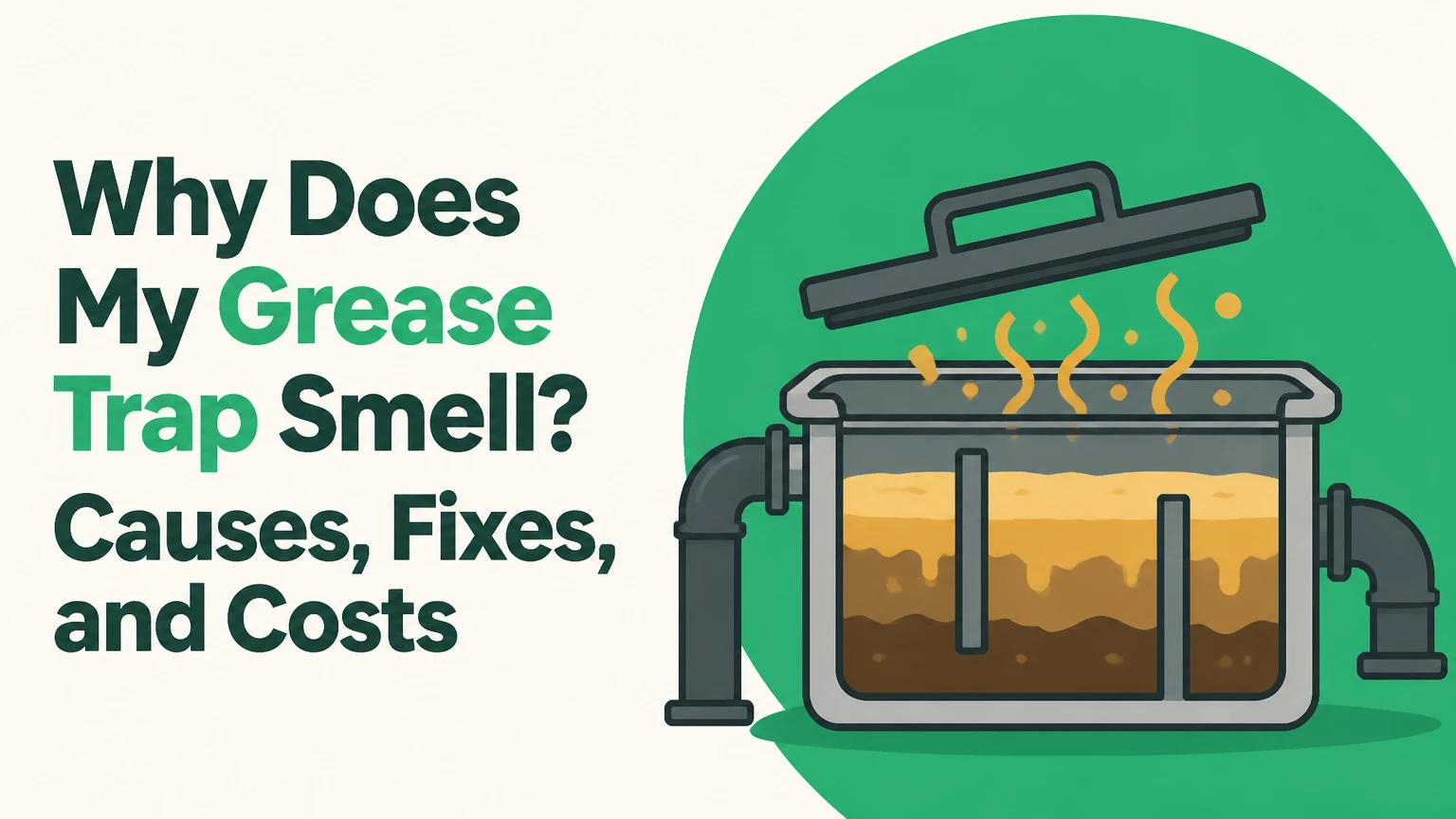
A grease trap smells because fats, oils, grease, and food solids are decomposing in oxygen-poor wastewater, producing odorous compounds such as hydrogen sulfide and volatile fatty acids. A full trap, failed seal, blocked vent, dry drain trap, damaged baffle, or grease-coated drain line can let those odors enter the kitchen instead of containing them.
Key Facts at a Glance
- Hydrogen sulfide is the main source of the familiar rotten-egg odor associated with decomposing organic material in many grease traps.
- A grease trap needs mechanical removal of accumulated grease and solids; chemical degreasers do not eliminate the waste.
- The commonly cited 25% rule means pumping when the combined grease and settled-solids layers reach about one-quarter of the operating depth, but local sewer authorities may set different requirements.
- A dry floor-drain P-trap can allow odors into a room even when the grease interceptor itself is not overflowing.
- Hot water can liquefy grease inside a trap, allowing it to move into cooler pipes where it solidifies and causes blockages.
- A strong odor after cleaning usually indicates residue, a failed lid gasket, blocked venting, incorrect baffle placement, or contamination elsewhere in the drain system.
Why Does My Grease Trap Smell?
A smelly grease trap usually contains too much decomposing grease and food waste, or the plumbing system is allowing trapped gases to escape. The most common immediate cause is an overdue pump-out, but odor can persist after service when the lid seal, vent, drain line, or P-trap remains faulty.
Grease traps receive wastewater from sinks, dishwashing equipment, preparation areas, and sometimes floor drains. Warm wastewater cools inside the vessel. Fats and oils rise, food particles settle, and partially clarified water leaves through the outlet. The retained material then becomes an oxygen-poor environment where bacteria break down proteins, carbohydrates, and fats.
That process creates hydrogen sulfide, volatile fatty acids, amines, and other odor compounds. Methane may also form in anaerobic wastewater, but methane itself has no smell. Natural gas odorants, such as mercaptans, are responsible for the rotten-cabbage smell associated with fuel gas, not methane.
What Does the Smell Tell You?
The odor character and location provide useful diagnostic clues, although smell alone cannot identify a gas concentration.
| Odor or symptom | Most likely source | First inspection | Typical corrective action |
|---|---|---|---|
| Rotten eggs at open lid | Hydrogen sulfide from organic sludge | Grease and solids depth | Pump and scrape the trap |
| Sour, rancid odor | Aged grease and volatile fatty acids | Grease layer and wall residue | Remove grease, wash approved surfaces |
| Odor from floor drain | Dry P-trap or contaminated drain | Add water and inspect trap seal | Restore water seal or clean drain |
| Smell after every discharge | Blocked vent or poor air movement | Roof vent and vent piping | Clear vent through a qualified plumber |
| Odor beneath sink | Failed lid gasket or loose fasteners | Lid seal, cracks, fittings | Replace gasket or repair enclosure |
| Smell outside near manhole | Full interceptor or damaged cover | Liquid level and cover seal | Pump interceptor and repair cover |
A rotten-egg odor deserves caution. The human nose can detect hydrogen sulfide at very low concentrations, but odor perception becomes unreliable at higher concentrations because the sense of smell can fatigue. Never lean into a tank, enter an interceptor, or use a flame to investigate gas.
How Does a Grease Trap Work?
A grease trap separates wastewater by gravity, temperature, residence time, and internal baffling. Grease floats, dense food solids settle, and the middle liquid layer exits through an outlet positioned below the floating layer and above the settled sludge.
The basic flow sequence is:
- Wastewater enters through the inlet.
- An inlet baffle reduces turbulence.
- Grease cools and accumulates at the surface.
- Solids settle at the bottom.
- Relatively clarified wastewater passes beneath or through the outlet baffle.
- FOG and solids remain until removed during service.
A trap does not destroy grease. It stores grease and solids so they can be removed before entering the sewer. Its separation performance declines when excessive grease or sludge reduces the liquid volume, when turbulence breaks up the layers, or when a broken baffle creates a direct path from inlet to outlet.
Dishwashers and very hot rinse water are frequent contributors to poor separation. Water above roughly 140°F, or 60°C, can carry melted grease through the trap. The grease may then cool inside downstream piping, where it adheres to walls and produces odor or a blockage.
What Is the Difference Between a Trap and an Interceptor?
A hydromechanical grease trap is a smaller point-of-use unit, while a gravity grease interceptor is a larger tank that usually sits outside or below ground. An automatic grease removal device adds mechanical skimming to remove floating grease during operation.
| System type | Typical capacity or flow | Usual location | Typical service pattern | Main odor risk |
|---|---|---|---|---|
| Passive under-sink trap | 20-50 gallons per minute; 40-100 lb grease | Beneath commercial sink | 1-4 weeks | Frequent manual accumulation |
| Floor-mounted passive trap | 20-100 gallons per minute | Kitchen floor or service area | 1-4 weeks | Poor lid seal and residue |
| Automatic grease removal device | 15-50 gallons per minute | Under or beside sink | Daily skimming; deep service 6-12 months | Failed motor, scraper, or collection bin |
| Gravity interceptor | 500-5,000+ gallons | Outside or underground | Often 30-90 days, subject to local rules | Full tank, cover, or vent failure |
The capacity figures are typical equipment ranges, not design recommendations. Flow rate, fixture count, menu, water temperature, local plumbing requirements, and manufacturer instructions determine the correct system.
What Usually Causes Grease Trap Odor?
The leading causes are accumulated waste, poor operating practices, failed seals, inadequate ventilation, and drain-line contamination. A professional diagnosis should inspect the entire connected plumbing path rather than assuming the trap itself is the only source.
1. The Grease and Solids Layers Are Too Thick
A trap loses effective liquid volume as grease floats upward and sludge builds from below. The common 25% rule uses the combined depth of the grease and solids layers as a pumping trigger, but the exact threshold may be set by a city sewer department, water utility, or manufacturer.
Measure the layers with an appropriate sludge or grease gauge, record the result, and compare it with the trap’s total operating depth. Do not use the 25% figure to postpone service where a local rule requires more frequent pumping.
2. The Lid Gasket Is Damaged
A cracked, hardened, compressed, or grease-swollen gasket can leak odor directly from an indoor trap. Loose lid bolts, warped covers, missing fasteners, and corrosion around the rim create the same pathway.
A gasket replacement is inexpensive compared with repeated odor treatment. The replacement must match the manufacturer’s profile and temperature or chemical-resistance requirements.
3. A Plumbing Vent Is Blocked
Drain vents equalize pressure and route sewer gases above the building. Bird nests, leaves, ice, construction debris, mineral deposits, or a failed vent configuration can push odor toward sinks, floor drains, or a loose trap lid.
Vent symptoms often include gurgling, slow drainage, bubbling water in nearby fixtures, and odor that intensifies when another fixture discharges. Roof-vent work belongs to a qualified plumber because the blockage may be deep in the vent stack.
4. A P-Trap Has Lost Its Water Seal
A floor drain or rarely used sink can develop a dry P-trap when evaporation removes its water barrier. The grease trap may be blamed because the smell emerges near the kitchen, although the gas is traveling through a separate fixture connection.
Pour enough water into the drain to restore the seal, then monitor the odor for several hours. If the trap repeatedly dries, a trap primer, approved evaporation-control device, or plumbing repair may be necessary.
5. Internal Baffles Are Missing or Broken
Baffles direct flow and protect the outlet from floating grease and settled sludge. Rusted metal, cracked plastic, incorrect reassembly, or a missing center baffle permits turbulence and short-circuiting.
The result is two problems: grease enters the sewer, while unseparated organic waste remains disturbed inside the trap. Photograph the original arrangement before disassembly, and follow the equipment manufacturer’s diagram during reassembly.
6. Grease Has Coated the Drain Line
A clean trap does not remove grease already attached to the inlet pipe, outlet pipe, branch drain, or floor-drain lateral. That residue can support biofilm and produce odor for days or weeks after pumping.
Drain-line inspection is especially important when odor is strongest at a sink or floor drain rather than at the trap lid. Mechanical cleaning may be required, but the method should match the pipe material and local wastewater requirements.
7. The Kitchen Is Sending Excess Solids or Grease Downstream
Plate scrapings, fryer oil, sauces, dairy residue, and food scraps increase the organic load. A sink strainer captures large particles, but it does not replace dry scraping and proper waste segregation.
The simplest control is behavioral: scrape plates into waste containers, collect fryer oil separately, keep sink strainers installed, and prevent mop water or outdoor runoff from entering the grease system unless the design specifically allows it.
How Full Can a Grease Trap Get?
A grease trap should generally be serviced before grease and settled solids occupy about 25% of the liquid depth, unless the local authority or manufacturer requires a stricter limit. Capacity is not measured by the lid’s empty volume; the relevant measurement is the combined accumulated layer inside the operating tank.
Service frequency depends on daily flow, menu, cooking method, staff practice, trap size, and wastewater temperature. A bakery with little frying may need a different schedule from a restaurant serving fried food throughout the day.
| Kitchen profile | Typical cleaning interval | Main loading factor | Adjustment trigger |
|---|---|---|---|
| Coffee shop with light food preparation | 2-6 weeks | Milk, dishwashing, low frying | Odor before scheduled service |
| Small cafe or bakery | 1-4 weeks | Dough, dairy, wash water | Grease layer near 25% depth |
| Full-service restaurant | 1-4 weeks for indoor trap | Frying, sauces, plate solids | Fast grease accumulation |
| High-volume fryer kitchen | 1-2 weeks for passive trap | Large FOG discharge | Slow drains or frequent overflow |
| Outdoor gravity interceptor | 30-90 days typical | High wastewater volume | Local pumping mandate |
These are planning ranges, not legal schedules. Many municipalities require maintenance logs, manifests, or pump-out intervals that override a business’s preferred timetable.
What Should You Do When a Grease Trap Smells?
Start with a visual, odor-location, and maintenance-history inspection, then arrange mechanical cleaning if the accumulated layers are excessive. Do not pour solvents, caustic drain openers, boiling water, or unapproved biological products into the trap while trying to suppress the smell.
Use this sequence:
- Identify the odor location. Check the lid, sink drain, floor drain, adjacent wall, and outdoor interceptor cover without opening a tank unnecessarily.
- Check the service record. Note the last pump-out date, measured grease depth, solids depth, and any recent menu or equipment change.
- Inspect the lid and fittings. Look for a hardened gasket, loose fasteners, cracks, corrosion, and visible leakage.
- Restore dry P-traps. Add water to rarely used drains and observe whether the odor decreases.
- Arrange mechanical cleaning. A licensed or properly equipped service provider should remove grease and sludge, clean accessible surfaces, and dispose of waste legally.
- Inspect baffles and flow direction. Confirm that internal components are intact and correctly installed.
- Test drainage and venting. Persistent gurgling, bubbling, or recurring odor requires plumbing diagnosis.
- Record the result. Measure the next accumulation rate and shorten or lengthen the interval based on evidence.
A successful cleanout leaves the trap free of removable grease and sludge, restores the lid seal, and produces normal flow without recurring odor. A common mistake is to stop after pumping when the actual source is a dry floor drain or grease-coated branch line.
Why Does the Trap Smell After Cleaning?
A grease trap can smell after cleaning because residue remains on the tank walls, the connected drain line was not cleaned, the lid gasket leaks, or the interceptor was reassembled incorrectly. A post-service odor that returns within hours is more consistent with a seal, vent, or nearby drain problem than with newly decomposed trap contents.
Inspect the inlet and outlet piping for retained grease. Confirm that baffles are seated, the lid is evenly tightened, and the service provider removed settled solids rather than skimming only the floating layer.
Persistent odor can also come from the building sewer. If several fixtures smell, drain slowly, or gurgle, the problem may involve the main vent, a partial sewer blockage, or a missing trap seal. Odor-blocking tablets and fragrances can conceal the symptom while leaving the cause untouched.
Should You Use Enzymes or Degreasers?
Chemical degreasers are generally a poor odor solution because they emulsify or liquefy grease rather than remove it. Enzymatic or bacterial products may reduce certain organic residues in some systems, but they cannot replace pumping, inspection, or compliance with a wastewater authority.
Caustic chemicals can damage seals, corrode metal, create worker hazards, and move grease into downstream pipes. Solvents can also create flammable or toxic conditions. Never mix drain chemicals, disinfectants, acids, or bleach.
Biological additives have a narrower role. A manufacturer or wastewater professional may approve a product for a specific automatic device or drain-maintenance program, but approval does not change the need to remove accumulated grease and solids mechanically.
Is a Grease Trap Smell Dangerous?
A grease trap odor can indicate exposure to hydrogen sulfide and other irritating gases, while methane can contribute a fire or explosion hazard in an enclosed space. Brief odor near a properly ventilated, closed trap is not the same risk as entering an interceptor or working over concentrated wastewater.
Leave the area and call a qualified professional if anyone experiences headache, dizziness, nausea, eye irritation, breathing difficulty, confusion, or sudden loss of odor perception. Do not enter a grease interceptor, pit, or tank. Such spaces may be confined spaces with oxygen deficiency and toxic gas accumulation.
Keep ignition sources away from open tanks, provide ventilation from a safe position, and follow the United States Occupational Safety and Health Administration requirements that apply to confined-space work. A consumer gas detector is not a substitute for a trained confined-space assessment.
Which Type of Grease Trap Is Smelling?
The system type changes the likely failure point, but every grease trap can smell when retained organic material becomes excessive or gas control fails. Indoor passive traps usually produce direct kitchen odor, whereas outdoor interceptors more often create courtyard or manhole odor.
| System | Common odor location | Frequent failure | Best first action | Typical repair range |
|---|---|---|---|---|
| Under-sink passive trap | Cabinet or wash area | Full contents or gasket | Inspect, pump, replace seal | $150-$600 |
| Floor passive trap | Kitchen floor | Loose cover or sludge | Restrict access, service unit | $250-$900 |
| Automatic removal device | Sink area or collection barrel | Full bin, failed scraper | Empty bin, inspect motor | $200-$1,500 |
| Outdoor interceptor | Yard, loading area, manhole | Full tank or cover seal | Schedule pump-out | $500-$2,000 |
| Grease-coated branch line | Sink or floor drain | Old downstream residue | Mechanical drain cleaning | $300-$1,500 |
Costs vary by region, access, waste volume, emergency timing, and disposal requirements. Replacement or excavation costs can exceed these service figures.
How Much Does Odor Repair Cost?
Typical grease-trap odor correction costs range from $150 for a gasket or routine cleanout to more than $15,000 for interceptor replacement or excavation. The lowest-cost repair is often a scheduled pump-out, while blocked lines, failed baffles, vent defects, and structural damage increase the bill.
| Work required | Typical price range | Typical duration | What the service should include |
|---|---|---|---|
| Indoor trap cleanout | $150-$600 | 30-90 minutes | Remove grease and solids; basic rinse |
| Gasket replacement | $50-$300 | 30-60 minutes | Correct seal and lid inspection |
| Drain-line cleaning | $300-$1,500 | 1-4 hours | Mechanical removal of pipe buildup |
| Outdoor interceptor pump-out | $500-$2,000 | 1-3 hours | Pump liquid, grease, and sludge |
| Vent diagnosis or clearing | $200-$1,000 | 1-3 hours | Inspect and restore air path |
| Baffle repair or replacement | $300-$2,500 | 2-8 hours | Install compatible internal parts |
| Interceptor replacement | $4,000-$15,000+ | 1-5 days | Tank, excavation, connections, permits |
Ask for a written scope that identifies the waste removed, tank condition, measured layer depth, disposal documentation, and recommended next interval. A low quote that only pumps liquid may leave the odor-producing sludge behind.
How Often Should a Grease Trap Be Serviced?
Most small indoor passive traps need service every 1-4 weeks, while outdoor gravity interceptors often need service every 30-90 days under typical commercial conditions. The correct interval is the shortest period that prevents the local accumulation threshold, recurring odor, overflow, or regulatory violation.
Use measured accumulation rather than a calendar alone. If a trap reaches 20% combined grease and solids in two weeks, a monthly schedule is unsuitable. If it remains below 10% after a month, local rules may still require a fixed interval.
Operators should maintain:
- Service date and provider name
- Grease and solids measurements
- Volume or weight removed
- Waste manifest or disposal record
- Odor, drainage, and overflow observations
- Changes to menu, operating hours, or equipment
An automatic grease removal device still needs inspection. The skimmer cannot correct a blocked outlet, broken baffle, failed motor, full collection container, or contaminated drain line.
What Should a Small Kitchen Do?
A small cafe, coffee shop, or bakery should reduce solids at the source, inspect an indoor trap weekly, and establish a service interval based on measured accumulation. A passive 20-30 gallon-per-minute trap may be suitable only when fixture flow and local design requirements support that selection.
Staff should dry-scrape plates, collect fryer oil in a separate container, keep sink strainers in place, and avoid sending mop water into the trap unless the plumbing design permits it. A manager should check the lid gasket monthly and document every cleanout.
A high-volume restaurant may need a larger or automatic system rather than simply cleaning a small trap more often. An automatic device reduces manual skimming but adds motors, controls, heating components, and collection-bin maintenance.
Large restaurants and hotels with outdoor interceptors should inspect covers, vents, access points, and surrounding soil for leakage. Pumping every 30-60 days is a common planning range for heavy commercial use, but the authority having jurisdiction determines the enforceable requirement.
Common Mistakes That Make Odor Worse
- Pouring fryer oil into a sink: Liquid oil cools in the trap or downstream pipe and adds a large FOG load.
- Using boiling water as a remedy: Heat moves grease away from the trap instead of removing it.
- Pumping only the top layer: Bottom sludge continues decomposing and can block the outlet.
- Leaving the lid open: Ventilation may disperse odor temporarily while increasing worker exposure.
- Removing baffles without recording positions: Incorrect reassembly causes turbulence and poor separation.
- Adding fragrance or drain chemicals: Masking odor does not correct gas escape, buildup, or failed seals.
One practitioner rule is particularly useful: if odor returns immediately after a documented full cleanout, look outside the tank. Inspect the lid seal, floor drains, branch piping, and vent before paying for another routine pump-out.
FAQ
Can I clean a grease trap myself?
A trained employee can often clean a small accessible indoor trap if local rules, equipment instructions, and workplace procedures allow it. Wear chemical-resistant gloves, eye protection, protective clothing, and suitable respiratory controls, and never enter the tank. Commercial waste may require a licensed hauler and disposal record.
Why does my grease trap smell worse in hot weather?
Hot weather accelerates microbial activity and increases volatilization of odor compounds, so a trap can smell stronger even when the accumulation rate has not changed. Outdoor interceptors also heat up under direct sun. Schedule service by measured buildup, inspect the cover seal, and improve safe ventilation around the access point.
Can a grease trap smell like sewage?
A grease trap can smell like sewage because both systems contain anaerobic wastewater and produce overlapping odor compounds. A sewage odor from several fixtures, accompanied by gurgling or slow drainage, points toward a vent, sewer, or P-trap problem rather than grease alone.
How long does grease trap odor last after pumping?
A mild residual odor may last several hours after pumping if grease remains on accessible surfaces or drain piping. Odor that persists beyond 24-48 hours, returns after every fixture discharge, or comes from multiple drains requires inspection of the gasket, baffles, vent, P-traps, and branch lines.
Does bleach remove grease trap odor?
Bleach may reduce some surface microorganisms temporarily, but bleach does not remove grease or settled solids and can create hazardous reactions with other chemicals. Mechanical waste removal, approved washing, restored water seals, and proper venting provide a more reliable correction.
When should I replace a grease trap?
Replace a grease trap when the tank leaks, baffles cannot be restored, corrosion compromises structural integrity, capacity is consistently inadequate, or repeated repairs cost more than a compliant replacement. A licensed plumber or engineer should verify sizing, flow rate, access, permits, and local sewer authority requirements before installation.
The Bottom Line
Why does my grease trap smell? The usual answer is decomposing grease and solids combined with a failed odor-control pathway, such as an overdue cleanout, damaged gasket, blocked vent, dry P-trap, broken baffle, or grease-coated drain line. Start by locating the odor and checking service records, then arrange mechanical cleaning and inspect connected plumbing. Never rely on boiling water, degreasers, or fragrance to solve the underlying problem.