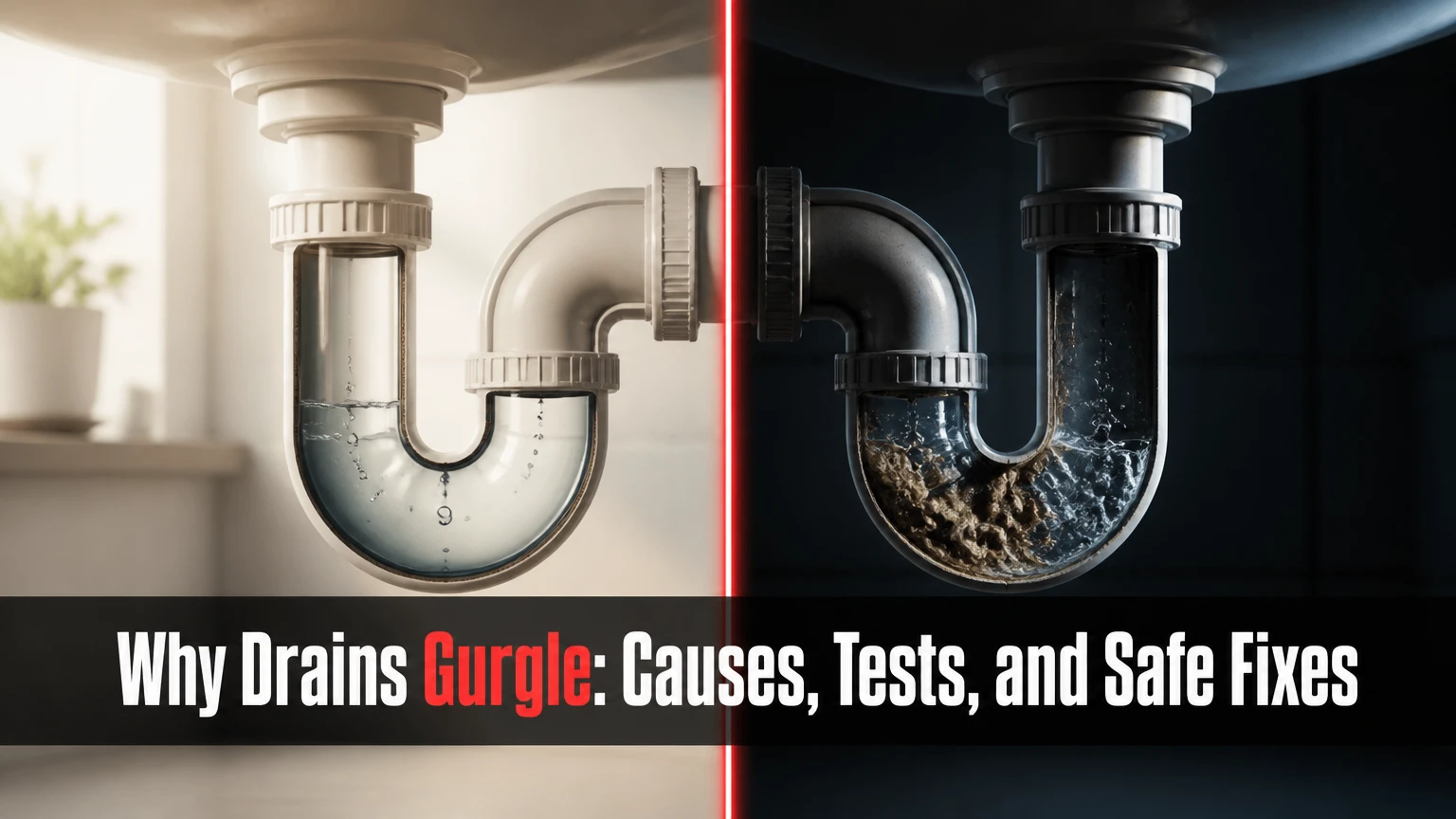
Why drains gurgle is usually explained by air and water competing for space inside a drainage, waste, and vent system. A partial clog, blocked vent, or main sewer restriction changes pipe pressure, forcing air through a P-trap and producing the familiar glugging sound. A dry trap can also make noise, but it does not indicate the same fault.
Key Facts at a Glance
- A gurgling drain usually indicates restricted wastewater flow, restricted vent airflow, or a dry or disturbed trap seal.
- One fixture gurgling points more often to a local trap or branch-line problem than a main sewer blockage.
- A toilet flush that makes a shower, sink, or floor drain bubble suggests a shared branch, vent, or downstream sewer restriction.
- Multiple fixtures gurgling with slow drainage or sewage backup requires prompt professional diagnosis.
- A P-trap normally holds water that blocks sewer gases; repeated pressure disturbances can reduce that protection.
- Chemical drain openers rarely correct a blocked vent and can create burn, splash, or pipe-damage hazards.
What Causes a Gurgling Drain?
A gurgling drain is the sound of air passing through water in a trap or drain pipe because the DWV system cannot equalize pressure normally. The most common causes are a partial branch-line clog, a blocked plumbing vent, a downstream sewer obstruction, or a P-trap with too little water.
Drainage pipes need both gravity and air. When wastewater moves through a pipe, air must move around the water column. A restriction changes that balance, so the nearest open route may be the water inside a sink, shower, floor drain, or laundry standpipe trap.
A short noise immediately after a fixture drains can result from a small local obstruction. A gurgle synchronized with another fixture is more informative because it shows that two plumbing fixtures are sharing pressure through a branch or vent system.
How does the pressure create the glugging sound?
A falling water column can create negative pressure behind the flow, while water meeting a downstream restriction can compress air in front of it. The pressure difference pushes bubbles through the P-trap, where the bubbles break through the water surface and create the uneven glug-glug sound.
A P-trap is therefore both a gas barrier and a diagnostic location. The trap does not cause the original blockage. It reveals the pressure disturbance because water is easier for displaced air to move than a sealed pipe wall.
The AI Overview’s general mechanism is correct, but “exclusively” is too broad. A dry trap, loose fitting, poorly supported drain, or air admittance valve can produce bubbling or gulping without the same pressure pattern found in a blocked vent or sewer line.
Which Drain Gurgling Pattern Do You Have?
The location, trigger, and number of affected fixtures provide a better first diagnosis than the sound alone. A single fixture with slow drainage usually indicates a local restriction, while several fixtures reacting to one discharge indicate shared plumbing.
Record three observations: which fixture makes the noise, what action triggers it, and whether water rises or drains slowly. Also note sewage odor, recent storms, basement flooding, remodeling, and whether the home uses a septic system.
| Observed pattern | Likely location | Typical accompanying clue | First diagnostic action |
|---|---|---|---|
| Kitchen sink gurgles alone | Trap or 1.5-inch branch arm | Grease, food debris, slow sink | Clean trap and plunge with the stopper sealed |
| Shower bubbles when toilet flushes | Shared bathroom branch or vent | Toilet flush triggers immediate bubbling | Stop repeated flushing and inspect accessible drains |
| Laundry standpipe gurgles during washer discharge | Standpipe branch or undersized drain | Noise occurs during high-volume pump-out | Check standpipe overflow, hose position, and branch drainage |
| Several low fixtures gurgle | Main building drain or sewer lateral | Tub level rises or drains run slowly | Check the main cleanout without fully removing a pressurized cap |
| Floor drain smells and gurgles after vacancy | Dry trap or trap primer failure | Odor is stronger than drainage symptoms | Add water, then investigate evaporation or primer operation |
| Drains gurgle after heavy rain | Surcharged sewer or septic system | Outdoor cleanout or basement drain backs up | Reduce water use and call for sewer or septic assessment |
Why does a sink gurgle when the toilet flushes?
A sink gurgles when a toilet flushes because the fixtures usually connect to a shared branch drain or vent path. If the vent cannot admit air, or if wastewater encounters a downstream restriction, the flushing water changes pressure and draws or pushes air through the sink’s P-trap.
The farther the restriction is from the sink, the more likely other nearby fixtures will react. A blocked roof vent, an obstructed wall vent, a failed air admittance valve, or a partially blocked bathroom branch can produce the same symptom, so the flush trigger identifies the network but not the exact component.
Do not assume that the toilet itself is blocked. If the toilet flushes strongly but the shower bubbles, the shared drainage or vent arrangement deserves attention.
Why does a shower drain bubble?
A shower drain bubbles when air or wastewater pressure reaches the shower branch, commonly because a toilet, bathtub, or washing machine discharges into a restricted shared line. Hair in the shower trap is possible, but hair alone does not explain bubbling that starts when another fixture runs.
If shower water rises while a toilet flushes, stop using fixtures until the obstruction is located. A shower is often lower than a sink, so a downstream blockage may send contaminated water toward it before any sink overflows.
Is the Problem a Clog, Blocked Vent, or Sewer Line?
A local clog affects one fixture; a blocked vent commonly causes cross-fixture bubbling; and a main sewer restriction affects several fixtures, especially those on lower floors. These patterns overlap, so a plumber may need a drain auger, vent assessment, cleanout inspection, or sewer camera.
| Cause | Pressure or flow effect | Strongest symptom | Appropriate confirmation |
|---|---|---|---|
| Trap obstruction | Restricts one fixture outlet | One basin drains slowly and gurgles | Remove and inspect the P-trap |
| Branch-line clog | Restricts several connected fixtures | Bathroom group reacts together | Auger through a cleanout or fixture access |
| Blocked vent stack | Limits replacement air | Fixtures gurgle during discharge | Professional vent inspection and airflow test |
| Main sewer restriction | Restricts the whole building outlet | Low fixtures back up or gurgle | Cleanout water check and CCTV camera |
| Full septic tank or failed field | Limits septic discharge | Slow drains, odors, wet yard, alarms | Septic inspection and tank level check |
| Dry trap | Removes water seal | Odor and hollow gulping after vacancy | Add water and monitor recurrence |
A practical rule is to diagnose from the widest affected area inward. Testing a kitchen P-trap will not solve a sewer lateral obstruction, and clearing a vent will not remove grease packed inside a horizontal branch.
Can a blocked vent cause a gurgling drain?
A blocked plumbing vent can cause a gurgling drain when the vent cannot admit or release air during drainage. Leaves, bird nests, ice, snow, insects, construction debris, and displaced vent caps can restrict the opening, although a vent problem can also occur inside a wall.
Vent work has a serious limitation: a visible rooftop opening does not prove that the entire vent path is clear. Roof access is hazardous, and pushing debris into a stack can move the obstruction deeper. A licensed plumber should inspect steep, wet, icy, or high roofs and verify that the vent connects correctly to the affected branch.
Can a sewer line cause drains to gurgle?
A partially blocked sewer lateral can cause drains to gurgle when wastewater from the house meets roots, collapsed pipe, scale, sediment, or a displaced joint. The strongest clues are multiple affected fixtures, low-level backup, sewage odor, and a cleanout that contains standing wastewater.
Tree roots do not need to fully close a pipe to create symptoms. Root intrusion narrows the channel, catches toilet paper, and repeatedly produces a partial obstruction. A camera inspection can distinguish roots from grease, bellies, fractures, and collapsed sections before excavation or replacement.
How Can You Troubleshoot a Gurgling Drain Safely?
Troubleshoot a gurgling drain by isolating the trigger, checking for a dry trap, testing an accessible local trap, and observing the main cleanout without exposing yourself to pressurized sewage. The process usually takes 20-60 minutes and costs $0-$30 for basic supplies if no professional visit is needed.
Before you start
- Difficulty: Easy for fixture observation and trap filling; moderate for trap removal.
- Time: 20-60 minutes for non-invasive checks.
- Supplies: Bucket, gloves, flashlight, adjustable pliers, rag, sink stopper, and a small hand auger.
- Avoid: Roof climbing, chemical cleaner, and complete removal of a cleanout cap with standing water behind it.
Step 1: Map the trigger
Run a small amount of water in the affected fixture, then operate nearby fixtures one at a time. Record whether the sound occurs during filling, draining, toilet flushing, washer discharge, or after rainfall.
You will know this step worked when the symptom has a repeatable trigger. A repeatable trigger separates a fixture problem from a shared-system problem.
A common mistake is testing every fixture simultaneously. That hides the sequence that identifies the affected branch.
Step 2: Check the trap and visible drain
Place a bucket below an accessible sink P-trap. Loosen the slip nuts carefully, remove the trap, empty it, and inspect for grease, hair, food, or a small object; reinstall the washers in their original orientation and run water for leaks.
You will know the local check helped when the fixture drains quickly and stops gurgling during a controlled test. Trap cleaning cannot clear a blockage farther inside the wall.
A common mistake is using pliers aggressively on brittle plastic nuts. Hand-tighten first, then apply only enough tool force to stop a drip.
Step 3: Use controlled plunging
Seal the overflow opening with a wet rag, add enough water to cover the plunger cup, and use 10-15 moderate strokes rather than violent impacts. Remove the stopper or screen first when the fixture design allows it.
You will know the attempt worked when drainage speed improves and the same trigger no longer produces bubbles. Stop if water rises in another fixture, because pressure may be moving toward a connected trap.
A plunger is a poor choice when sewage is already backing up through a shower or floor drain. That condition needs isolation and professional assessment.
Step 4: Check an accessible cleanout cautiously
Locate the building drain cleanout near the foundation, basement, crawlspace, or property line. Loosen the cap slowly with gloves and eye protection, keeping your face away; standing water at the opening indicates a downstream restriction.
You will know the cleanout test is informative when the water level is visible without removing a pressurized cap. A full cleanout does not identify whether the cause is roots, grease, collapse, or a municipal sewer problem.
A common mistake is fully unscrewing a cap against a column of sewage. Stop, replace the cap, and call a drain professional.
Step 5: Escalate based on the pattern
Request a professional drain evaluation when symptoms affect multiple fixtures, recur after snaking, involve sewage, or continue despite a clean trap. Ask whether the proposed test is a branch auger, vent inspection, cleanout auger, or CCTV camera.
You will know the diagnosis is progressing when the contractor identifies the obstruction’s location and material rather than recommending repeated chemical treatment. The repair should match evidence from the pipe, not only the noise.
Which Repair Method Fits the Cause?
Mechanical snaking is usually the first professional treatment for a localized obstruction, while hydro-jetting suits heavy buildup in structurally sound pipes. Vent clearing addresses airflow, not drain-wall deposits, and an AAV retrofit can help an approved unvented fixture but cannot repair a blocked sewer.
| Method | Typical price | Typical time | Best use | Important limitation |
|---|---|---|---|---|
| P-trap cleaning | $0-$30 DIY | 15-30 minutes | Sink trap debris | Cannot reach a concealed branch |
| Hand or machine auger | $100-$275 | 15-60 minutes | Local clog or soft root mass | May create only a temporary channel |
| Vent inspection or clearing | $150-$400 | 1-2 hours | Roof or branch vent obstruction | Roof access and code issues remain |
| Hydro-jetting | $350-$700+ | 1-3 hours | Grease, sludge, scale in sound pipe | Can expose weak or corroded pipe |
| CCTV sewer inspection | $250-$900 | 45-90 minutes | Roots, collapse, recurring blockage | Inspection does not itself remove debris |
| Septic service | $300-$600 typical | 1-3 hours | Full tank or maintenance pumping | Field failure may require separate work |
Prices are typical United States residential ranges, not guaranteed quotes. Labor rates, access, emergency timing, municipal requirements, pipe material, and local disposal charges can change the total substantially.
Is hydro-jetting better than snaking?
Hydro-jetting is better than snaking when grease, sludge, or scale coats a substantial length of structurally sound pipe. Snaking is better for a fast localized opening, foreign-object removal, or an initial diagnosis when the pipe’s condition is unknown.
Hydro-jetting uses high-pressure water to clean pipe walls, but it is not automatically safer or more permanent. A camera inspection is prudent for old cast iron, clay, Orangeburg, heavily rooted lines, or any pipe with a history of collapse.
Can an air admittance valve fix gurgling?
An air admittance valve can fix gurgling caused by an improperly vented fixture when local plumbing code permits the valve and the valve is correctly sized and accessible. An AAV cannot fix a clogged branch, blocked main sewer, failed septic field, or inadequate drain slope.
AAVs open under negative pressure and close to limit sewer-gas release. They are mechanical components, so replacement access matters. Local code authorities may restrict their use, especially for certain fixtures, drainage arrangements, or whole-house venting.
What Drainage Specifications Matter?
A horizontal drain commonly uses a 1/4-inch-per-foot slope for smaller residential pipe, but allowable slope depends on pipe diameter and local code. A P-trap seal is commonly designed within a 2-4-inch range, with exact requirements governed by the adopted plumbing code and fixture arrangement.
Poor slope can leave solids behind, while excessive slope may let liquid outrun solids in some configurations. Neither condition should be diagnosed from a gurgle alone because concealed installation defects require inspection or selective access.
| Component | Typical residential value | Why it matters | Verification method |
|---|---|---|---|
| Small horizontal drain slope | 1/4 inch per foot | Maintains gravity drainage | Level, measurement, or exposed-pipe check |
| Larger horizontal drain slope | Often 1/8 inch per foot or code-specific | Prevents poor solids transport | Plumbing-code review and inspection |
| P-trap water seal | Commonly 2-4 inches | Blocks sewer gas and limits trap siphoning | Visual water presence and code check |
| Sink branch diameter | Commonly 1.5 inches | Carries basin discharge | Measure exposed pipe |
| Toilet drain diameter | Commonly 3 or 4 inches | Handles solid waste flow | Fixture and building inspection |
| Vent termination | Code-specific roof or approved outlet | Allows pressure equalization | Licensed inspection |
The International Plumbing Code and Uniform Plumbing Code differ in details and adoption by jurisdiction. Local amendments control, so a generic online dimension cannot replace the code in force where the property stands.
Why Do Drains Gurgle After Rain or During Washer Discharge?
Rain-related gurgling can indicate a surcharged public sewer, overwhelmed combined drainage, groundwater entering a damaged lateral, or a septic system receiving more water than the soil can absorb. Washer gurgling usually reflects a high-volume discharge entering a restricted or poorly vented standpipe branch.
A washing machine pump can discharge several gallons quickly, exposing a restriction that a hand-washed sink does not. A standpipe that overflows, a washer hose inserted too deeply, or an improperly configured trap can add separate problems.
After heavy rain, reduce indoor water use and avoid running the washer or dishwasher until the source is clear. If neighbors report similar backups, contact the water or sewer utility because the fault may be beyond the property line.
When Is a Gurgling Drain an Emergency?
A gurgling drain becomes urgent when several fixtures back up, sewage rises from a tub or floor drain, toilets lose drainage capacity, or wastewater enters living space. Stop using water immediately and arrange a licensed plumber or, for septic properties, a qualified septic contractor.
Sewer wastewater can contain pathogens, and hydrogen sulfide odor can accumulate in poorly ventilated spaces. Keep children and pets away, avoid electrical contact with contaminated water, and do not mix drain chemicals with bleach or other cleaners.
A single quiet gurgle with normal drainage is rarely an emergency. Persistent or worsening gurgling is still a warning because the first visible symptom may precede a complete blockage.
Common Mistakes That Make the Problem Worse
- Using caustic drain opener first: Chemical products may sit in a blocked pipe, creating splash and burn hazards for anyone who later opens the trap or uses an auger. They do not clear a roof vent.
- Assuming a clean trap proves the drain is clear: A branch blockage can sit several feet beyond the wall connection, where trap cleaning has no effect.
- Repeating plunging after cross-fixture bubbling: Forceful plunging can move contaminated water into another fixture and may stress old slip joints.
- Installing an AAV without code review: A valve can conceal a design fault and may not provide required venting for the entire drainage system.
- Hydro-jetting fragile pipe without inspection: High-pressure cleaning can reveal holes in severely deteriorated cast iron or clay, although the deterioration existed beforehand.
- Ignoring a dry floor drain: A vacant room can lose its trap seal through evaporation. Adding water may remove the odor, but recurring loss suggests a trap-primer or drainage issue.
One practitioner rule is especially useful: the more fixtures involved, the less useful a fixture-level remedy becomes. A second rule is to inspect before high-pressure cleaning when pipe age or material is uncertain.
How Can You Prevent Drain Gurgling?
Prevent drain gurgling by keeping grease, wipes, and solids out of branch lines, maintaining accessible cleanouts, protecting vent terminations, and servicing septic systems on a measured schedule. Prevention works best when it addresses the material entering the pipe and the condition of the pipe itself.
Use a sink strainer, collect cooking grease for disposal, and never flush wipes, paper towels, feminine hygiene products, or cat litter. Do not place chemical cleaners on a routine maintenance schedule; they are not substitutes for mechanical cleaning.
For septic homes, pumping intervals depend on tank size, occupancy, wastewater volume, and solids accumulation. The U.S. Environmental Protection Agency recommends inspecting the septic system generally every three years and pumping the tank when needed, often every three to five years, although household conditions change that interval.
Frequently Asked Questions
Can a gurgling drain fix itself?
A gurgling drain can become quiet temporarily if soft grease shifts, a vent obstruction moves, or a partial blockage drains through. Temporary silence does not prove the cause has disappeared. Recurring symptoms, especially after flushing or washer discharge, deserve diagnosis before the obstruction becomes a backup.
Is a gurgling drain dangerous?
A gurgling drain is not usually dangerous by itself, but it can signal a developing blockage or disturbed trap seal. If the trap loses water, sewer gases can enter the room. Sewage backup, strong sulfur odor, dizziness, or contaminated water requires immediate ventilation, isolation, and professional help.
Why does an unused drain gurgle?
An unused drain may gurgle because its P-trap has evaporated, allowing air and sewer gas to move freely through the fixture. Pouring roughly 2 cups of water into the trap can restore the seal. If the water disappears quickly, investigate a leak, siphoning, or failed trap primer.
Should I pour boiling water into a gurgling drain?
Boiling water is not a reliable fix for a gurgling drain and can soften some plastic components, damage seals, or fail to reach a concealed blockage. Warm water with detergent may help fresh surface grease, but a recurring sound requires mechanical diagnosis rather than repeated flushing.
How long can I wait before calling a plumber?
Call promptly when gurgling lasts more than a day, recurs several times in a week, or accompanies slow drainage. Call the same day for multiple fixtures, sewage odor with bubbling, rising water, or a septic alarm. A local isolated sink gurgle can usually receive one careful trap and plunger check first.
The Bottom Line
Why drains gurgle is best answered by tracking where the sound occurs and what action triggers it. One fixture usually points toward a trap or branch restriction, cross-fixture bubbling suggests a vent or shared line, and several low fixtures with backup indicate a main sewer or septic problem. Start with safe observation and accessible cleaning, then use professional augering, camera inspection, vent work, hydro-jetting, or septic service according to the evidence.