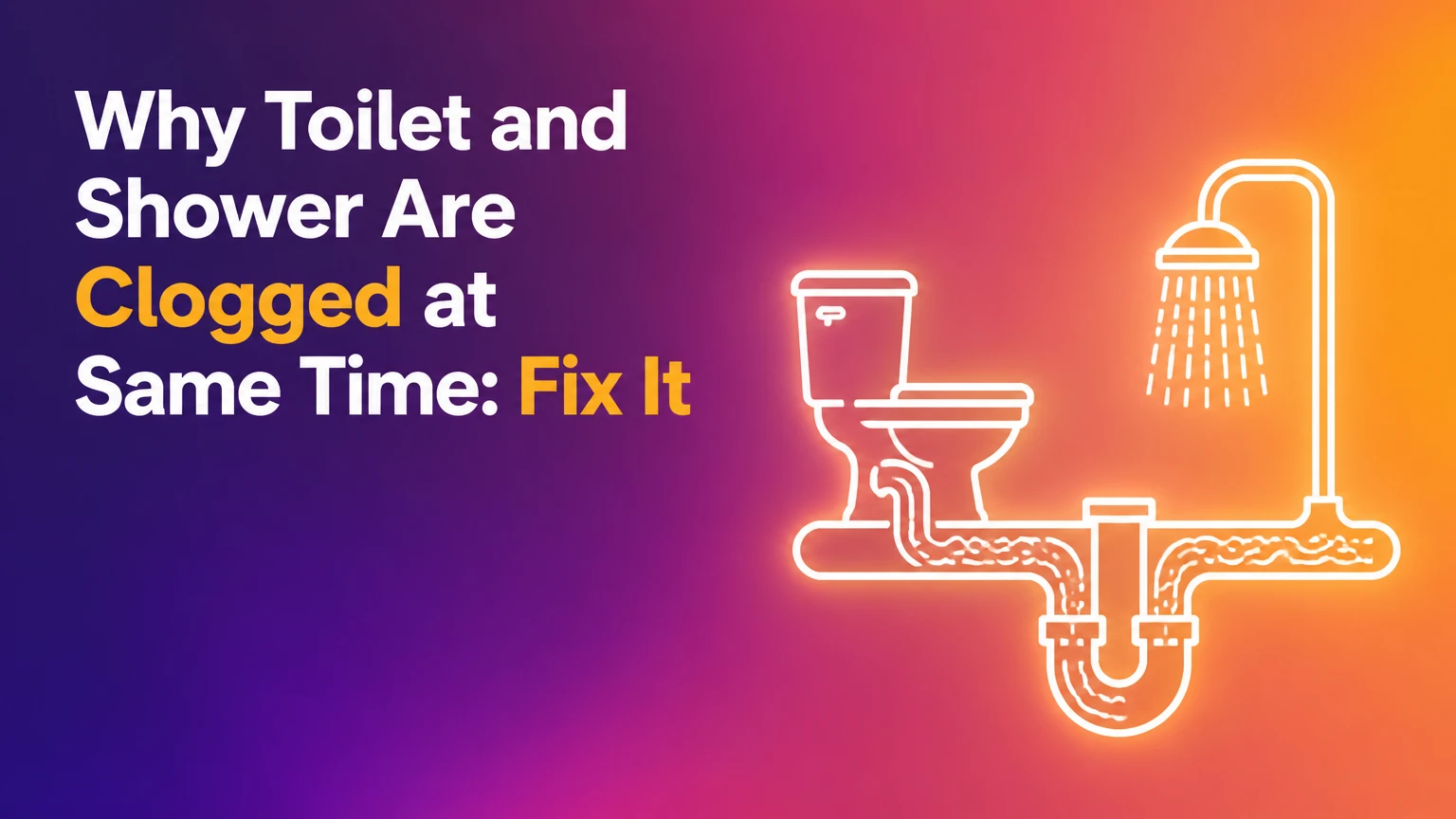
When a toilet and shower are clogged at the same time, the blockage is usually in a shared branch drain or the main sewer line, not inside either fixture alone. A downstream obstruction prevents wastewater from leaving the bathroom, so flushing the toilet can force contaminated water toward the lower shower or bathtub drain.
Key Facts at a Glance
Simultaneous toilet and shower backups usually indicate a downstream drainage blockage.
A shower drain often overflows before a toilet because the shower pan sits lower.
Running a washing machine or flushing repeatedly can turn a partial blockage into a sewage spill.
Chemical drain cleaners rarely reach a buried sewer obstruction and create a burn hazard for plumbers.
A sewer camera identifies roots, pipe collapse, scale, offsets, and recurring structural defects.
Typical U.S. planning costs range from $150-$400 for snaking and $350-$900 for hydro jetting.
What Does This Symptom Usually Mean?
A clogged toilet and shower at the same time usually mean wastewater cannot pass the point where their drains join. The obstruction may be in the bathroom branch line, the building drain, the sewer lateral leading to the street, or, in some homes, the septic outlet line.
A single toilet clog normally leaves the shower and sink working normally. A shower-hair clog normally affects only the shower. When two fixtures react together, the shared pipe becomes the more likely fault location because both fixtures discharge into the same downstream pathway.
The symptom does not prove that the public sewer is blocked. A blockage can be much closer to the bathroom, particularly in a home with a short branch connection or a horizontal drain that has accumulated paper and scale.
Which signs make a sewer blockage more likely?
The strongest indicators are wastewater rising in the shower when the toilet flushes, bubbling from the shower drain, several slow fixtures, repeated toilet clogs, or dirty water appearing during a washing-machine drain cycle. Sewage odor and brown or gray water increase the urgency because the backup may contain pathogens.
| Observation | Most likely location | Recommended response |
|---|---|---|
| Toilet fails, shower drains normally | Toilet trap or toilet branch | Use a flange plunger, then a closet auger |
| Shower alone drains slowly | Shower strainer, hair, or shower trap | Remove hair and clean the local trap |
| Toilet and shower react together | Shared branch or building drain | Stop water use and arrange drain diagnosis |
| All fixtures back up | Main sewer lateral, septic outlet, or public sewer | Treat as an urgent whole-house backup |
| Backup occurs only during storms | Public sewer surcharge or stormwater infiltration | Contact the utility and inspect the lateral |
How Does the Shared Drain System Work?
The toilet and shower connect through separate fixture drains that merge into a branch drain, then flow through the building drain and sewer lateral toward a municipal sewer or septic tank. A blockage after the merger affects both fixtures, while a blockage before the merger usually affects only one fixture.
Each fixture has a trap. The toilet contains an integrated trapway, while a shower commonly uses a P-trap below the floor. These traps block sewer gases but do not isolate fixtures from a downstream obstruction.
A simplified path looks like this:
Toilet trapway ─┐
                ├─ Bathroom branch drain ─ Building drain ─ Sewer lateral ─ City sewer or septic
Shower P-trap ──┘                 ▲
                                  Blockage
A plumbing vent is also part of the drainage system. Vents admit air so water can flow without creating excessive negative pressure. A blocked vent can cause gurgling, slow drainage, or a toilet that struggles to siphon, but a vent problem alone usually does not create a large volume of sewage in the shower. Standing wastewater points more strongly to a drain obstruction.
Why does wastewater appear in the shower first?
The shower drain is usually the lowest open fixture connected to the blocked section, so backed-up water reaches the shower pan before it rises over the toilet bowl rim. Gravity determines the visible overflow point, although pipe geometry, partial blockages, and fixture elevations can change the sequence.
The toilet may still appear to flush briefly because its bowl has more height and its trapway can hold water. That apparent capacity is temporary. Each flush adds roughly 1.28 gallons for many WaterSense-labeled toilets, while federal plumbing standards permit high-efficiency residential toilets to use no more than 1.6 gallons per flush.
The shower does not cause the toilet failure. The shower exposes the failure because it provides a low opening into the same restricted drainage network.
What Should You Do Before Testing Anything?
Stop flushing, bathing, washing dishes, and running water-using appliances immediately. The safest first action is to prevent additional wastewater from entering the blocked pipe, because a washing machine discharge can release several gallons rapidly and push contaminated water onto the bathroom floor.
Take photographs before cleanup if you rent, share a building, or plan to make an insurance claim. Keep children and pets away from sewage, wear waterproof gloves and eye protection, and ventilate the room without splashing or using a household fan that could spread droplets.
A safe first-response sequence
- Stop water use. Close the toilet supply valve if the bowl is still filling. Do not turn the handle again.
- Check other fixtures without running them. Note whether sinks, tubs, floor drains, or another toilet are also affected.
- Identify the property drainage type. Determine whether the home uses a municipal sewer, private septic tank, or shared building system.
- Locate the cleanout. Look for a capped pipe in the basement, crawlspace, yard, or near the property line.
- Call the responsible party. Tenants should contact the landlord or manager. Homeowners should call a plumber experienced in sewer-line diagnosis.
- Disclose chemicals. Tell the plumber if drain opener has been added, including the product name and approximate quantity.
Do not open a cleanout casually when sewage may be under pressure. Loosen the cap slowly with a wrench while standing to the side, or allow a trained technician to perform the inspection.
How Can You Locate the Blockage?
A cleanout and controlled fixture observations can show whether the obstruction is inside the home or farther downstream, but only a camera inspection can reliably identify structural damage and the exact defect. The cleanout test is directional, not definitive.
If the cleanout contains standing sewage, the blockage is generally downstream of that access point. If the cleanout is empty while indoor fixtures back up, the restriction may be between the fixtures and the cleanout, although cleanout placement and pipe slope can produce exceptions.
| Diagnostic finding | Likely interpretation | Limitation |
|---|---|---|
| Toilet flush causes shower bubbles | Shared downstream restriction | Does not distinguish branch from main line |
| Bathroom sink causes toilet ripples | Sink and toilet share restricted drainage | Air movement can mimic a mild blockage |
| Washer discharge fills shower | High-volume flow meets obstruction | Do not perform this test if backup is active |
| Indoor cleanout holds sewage | Blockage beyond that cleanout | Cap may be inaccessible or damaged |
| Yard cleanout is dry, bathroom backs up | Restriction may be upstream | A second blockage can exist elsewhere |
| Camera shows roots or collapse | Structural or recurring cause | Requires professional equipment and access |
A professional may use a drain camera with a sonde, which allows the operator to estimate the defect’s position from above ground. The camera can reveal root intrusion, grease coating, pipe scale, a belly, separated joints, crushed sections, and objects that a cable merely punctured.
Could a blocked vent cause both symptoms?
A blocked vent can cause gurgling and poor drainage, but a vent blockage is less likely than a sewer obstruction when water physically rises in the shower. A roof vent may contain leaves, a bird nest, ice, or debris, yet roof access introduces fall and electrical hazards.
A plumber should consider venting when fixtures gurgle without standing water, traps lose their water seal, or drainage improves and worsens unpredictably. Vent diagnosis should not replace sewer diagnosis when wastewater is backing up.
Can a Plunger or Hand Auger Solve It?
A flange plunger can solve a toilet-only obstruction, but it is unlikely to clear a clog that makes both a toilet and shower back up. A hand-crank auger is similarly limited because typical residential models reach only a short distance and cannot inspect a buried sewer lateral.
If the shower remains empty and the toilet alone is blocked, use a flange plunger with enough water to cover the cup, maintain a seal, and make controlled strokes. Stop if the shower begins to rise. Continued plunging can move contaminated water between connected fixtures without removing the downstream obstruction.
Do not use a flat sink plunger as the primary toilet tool. Do not insert a rigid object through the shower grate, because it can damage the trap or push debris deeper.
What should you never pour into the drain?
Avoid caustic drain cleaners containing sodium hydroxide, sulfuric acid, or similar reactive chemicals when wastewater is standing. The product may remain in the pipe, fail to reach the obstruction, damage vulnerable materials, and expose the next person opening the line to chemical burns.
Baking soda, vinegar, boiling water, and detergent do not dissolve tree roots, collapsed pipe, dense paper, or a sewer-line blockage. Boiling water can also soften some plastics or damage fixtures when poured aggressively. Mechanical diagnosis is the appropriate response to a shared backup.
Which Sewer-Clearing Method Fits the Blockage?
Motorized snaking is usually the first restoration method for a soft blockage, while hydro jetting is better for heavy grease and certain root or scale deposits in a structurally sound pipe. A camera inspection should guide the choice when the clog recurs, the property has older pipe, or the technician suspects collapse.
| Method | Typical U.S. cost | Typical duration | Best use | Main limitation |
|---|---|---|---|---|
| Toilet flange plunger | $10-$30 | 10-20 minutes | Toilet-only clog | Poor reach into sewer lateral |
| Closet auger | $25-$100 | 15-30 minutes | Object near toilet trapway | Cannot treat a main-line defect |
| Motorized sewer snake | $150-$400 | 1-2 hours | Paper, soft debris, moderate roots | May make only a narrow passage |
| Camera inspection | $100-$350 | About 1 hour | Locating defects and confirming cause | Does not clear the obstruction |
| Hydro jetting | $350-$900 | 2-4 hours | Grease, sludge, scale, roots | Unsafe for severely damaged pipe |
| Spot repair | $1,500-$4,000 or more | 1-2 days | Isolated broken section | Excavation may still be necessary |
| Trenchless lining or bursting | $4,000-$15,000 or more | 1-3 days | Long structural deterioration | Requires suitable pipe geometry |
Prices vary by region, access, emergency timing, depth, and whether the quoted service includes locating, cleanup, and camera documentation. These are typical planning ranges, not a guaranteed invoice.
When is sewer snaking the better choice?
Sewer snaking is the better initial choice when the line has a soft obstruction, the pipe condition is unknown, or immediate drainage restoration matters more than complete wall cleaning. A cutting head can open a passage through paper, fibrous material, moderate roots, or compacted debris.
Snaking is not a permanent repair for a collapsed line, severe offset, sagging pipe, or dense root intrusion. A cable may create a temporary channel, allowing the home to function for days or months while the underlying defect remains.
A practitioner rule is simple: if the same line blocks twice within a year, ask for a camera inspection rather than repeating blind snaking.
When is hydro jetting appropriate?
Hydro jetting is appropriate when a camera confirms that the pipe is open enough and structurally sound for high-pressure cleaning. A professional jetter may operate at pressures up to approximately 4,000 psi, using nozzle angle and flow to scour grease, sludge, scale, and root remnants from the pipe wall.
Hydro jetting is not a universal upgrade. High pressure can worsen a cracked clay pipe, weak Orangeburg pipe, badly corroded cast iron, or a collapsed section. Jetting also cannot restore a pipe that has lost its grade or has separated at a joint.
When is trenchless repair justified?
Trenchless lining or pipe bursting is justified when inspection confirms structural failure and the existing route provides suitable access. Cured-in-place pipe installs a resin liner inside the host pipe, while pipe bursting fractures the old pipe and pulls a new pipe through the alignment.
These methods reduce yard and driveway excavation, but they require more planning and higher capital cost than clearing. A plumber should provide camera footage, defect measurements, access assumptions, and a written explanation of why lining, bursting, spot excavation, or conventional replacement fits the site.
What Causes Simultaneous Toilet and Shower Backups?
The most common causes are a blocked shared drain, invasive roots, non-dispersible waste, grease, pipe deformation, or a downstream sewer and septic restriction. The correct repair depends on whether the obstruction is removable debris or evidence of a damaged pipe.
| Cause | Typical location | Diagnostic clue | Durable response |
|---|---|---|---|
| Toilet paper and waste | Bathroom branch or building drain | Sudden backup after heavy use | Mechanical clearing |
| Wet wipes and paper towels | Branch or main lateral | Recurring blockage despite flushing | Remove blockage and change disposal habits |
| Tree roots | Clay, cast iron, or jointed lateral | Seasonal or repeated backups | Cutting, root treatment, repair, or replacement |
| Grease and sludge | Shared drain or sewer lateral | Slow drainage across several fixtures | Mechanical cleaning or hydro jetting |
| Pipe belly | Low section underground | Returns after clearing; sediment buildup | Excavation or engineered replacement |
| Collapsed or offset pipe | Old lateral or shifted joint | Cable stops; camera shows deformation | Spot repair or full replacement |
| Septic outlet restriction | Tank, filter, or outlet line | High tank level or saturated drainfield | Septic service and system diagnosis |
| Public sewer surcharge | Municipal connection or street sewer | Neighbors affected, often after rain | Utility report and backflow evaluation |
Tree roots do not usually “seek out” a toilet. Roots enter through joints or cracks where moisture is available, then catch paper and solids. Root cutting restores flow temporarily unless the joint or pipe is repaired.
Flushable wipes deserve special caution. The label describes a marketing and disposal claim, not proof that a particular municipal sewer, septic system, or pipe diameter can transport them without accumulation. Toilet paper is designed to disperse rapidly; wipes often retain their structure longer.
What Changes in an Apartment or Rental?
A tenant should stop using water, document the backup, and contact the landlord or property manager immediately. In a multi-unit building, a shared stack, building drain, ejector pump, or municipal connection can affect several apartments at once, so a tenant should not open a cleanout or hire excavation without authorization.
Responsibility depends on the lease, local law, the location of the defect, and evidence of misuse. A tenant may be charged when a documented foreign object caused the obstruction, but ordinary deterioration in a building sewer is commonly treated as a property-maintenance issue.
Record the time, fixtures affected, photos, odors, and any prior complaints. Ask management whether other units are affected and whether a licensed plumber has identified the blockage location.
What Changes in a Septic-System Home?
A septic-system home can experience simultaneous toilet and shower backups when the septic tank is full, the outlet filter is blocked, the outlet pipe is restricted, or the drainfield cannot accept effluent. A full tank often produces broader, slower drainage problems rather than a single bathroom symptom.
Do not open a septic tank or enter a tank. Toxic gases and unstable surfaces can kill, and tank servicing requires appropriate equipment. Call a licensed septic professional if the tank has not been pumped according to the system’s maintenance schedule, the alarm is active, or multiple fixtures are affected.
A plumber can clear the house-side building drain, but that action will not correct a full tank or failed drainfield. Septic diagnosis and sewer-line diagnosis overlap at the fixtures but diverge at the property’s waste-treatment system.
What If the City Sewer Is Responsible?
Contact the sewer utility when the property cleanout is full, neighbors report backups, or the problem began after intense rain and affects multiple homes. The utility generally controls the public main, while the property owner commonly controls the private lateral, although boundaries vary by municipality.
Ask where the ownership point lies, whether the utility inspected the public main, and whether the utility will document a surcharge or blockage. A municipal crew clearing its main does not automatically prove that the private lateral is sound.
A backwater valve can reduce the risk of municipal surcharge entering a home, but it cannot fix a private sewer obstruction. The valve also requires maintenance and must remain accessible.
How Can You Prevent Another Backup?
Preventive steps reduce avoidable debris and reveal deterioration early, but they cannot prevent every root intrusion, pipe collapse, or municipal surcharge. The most effective program matches maintenance to the pipe’s known cause.
- Flush human waste and toilet paper only.
- Keep wipes, paper towels, diapers, floss, and hygiene products out of the toilet.
- Collect cooking grease in a container and place it in household waste according to local rules.
- Install strainers on shower drains and remove hair weekly.
- Ask for a camera inspection after a recurring sewer blockage.
- Consider a root-inhibitor treatment only after a professional confirms root intrusion and product compatibility.
- Keep cleanouts accessible and mark their locations before landscaping.
- Arrange septic pumping and filter service according to the tank and system requirements, not a one-size-fits-all calendar.
Annual camera inspections are not necessary for every home. They make more sense for older clay or cast-iron laterals, homes with mature trees over the sewer route, and properties with repeated backups.
What Does Diagnosis and Repair Typically Cost?
A typical U.S. emergency visit may cost $150-$400 for motorized sewer snaking, $100-$350 for a camera inspection, or $350-$900 for hydro jetting. Structural repair can begin around $1,500 for a localized excavation and exceed $15,000 for difficult or extensive trenchless or conventional replacement.
| Service situation | Typical cost range | Typical time | Cost drivers |
|---|---|---|---|
| Toilet-only service call | $100-$300 | 30-90 minutes | Access, after-hours labor, fixture removal |
| Shared branch clearing | $150-$450 | 1-2 hours | Distance, cable size, cleanout access |
| Main-line clearing plus camera | $250-$700 | 2-3 hours | Inspection inclusion and access |
| Hydro jetting with inspection | $450-$1,200 | 2-4 hours | Flow, pressure, roots, grease load |
| Localized sewer repair | $1,500-$4,000 or more | 1-2 days | Depth, surface restoration, permits |
| Extensive lateral replacement | $4,000-$15,000 or more | 1-5 days | Length, excavation, road or driveway work |
Request an itemized estimate that separates diagnosis, clearing, camera inspection, disposal, access work, permits, and restoration. A low initial clearing price can become expensive if the plumber later discovers that the line was structurally damaged and no inspection was performed.
Which Common Fixes Fail?
The most expensive mistake is treating a recurring sewer obstruction as a series of unrelated toilet clogs. Each emergency clearing restores flow without addressing roots, pipe collapse, or a belly that continues collecting solids.
Chemical cleaner is another failure mode. The product may sit in stagnant wastewater and create a hazardous mixture, while the plumber still needs mechanical access to the same line.
Homeowners also misread an empty cleanout. A dry cap means only that wastewater is not standing at that specific access point at that moment; it does not prove that the entire line between the bathroom and street is open.
One further limitation matters: hydro jetting is a cleaning method, not a structural repair. It can remove the material that reveals a crack, but it cannot rebuild missing pipe wall or correct a pipe installed with inadequate slope.
Frequently Asked Questions
Can I shower if my toilet is clogged?
Do not shower when the toilet is clogged and the shower drain is connected to the same drainage system. Shower water adds volume to a restricted pipe and may force sewage into the shower pan, floor drain, or another fixture. Use no water until the blockage has been cleared or professionally localized.
Why does my toilet gurgle when the shower drains?
A toilet may gurgle when the shower drains because air is being displaced around a partial blockage in their shared branch or building drain. A blocked vent can also produce gurgling, but standing water, sewage odor, or a rising shower level makes a drain obstruction more likely.
Can a toilet and shower back up because of a full septic tank?
Yes. A full septic tank, blocked outlet filter, restricted outlet pipe, or failed drainfield can prevent household wastewater from leaving the building. If several fixtures drain slowly or the septic alarm is active, stop water use and contact a licensed septic professional rather than repeatedly plunging the toilet.
Will toilet plunging push the clog into the sewer?
Toilet plunging can move a small obstruction through the toilet trapway, but it rarely removes a blockage in a shared branch or main sewer lateral. Excessive plunging during a shower backup can transfer contaminated water between connected fixtures and increase spill risk without reaching the actual obstruction.
Does homeowners insurance cover a sewer backup?
Homeowners insurance coverage depends on the policy, cause, endorsements, and whether the damaged section is inside the dwelling or on the private lateral. Sewer-backup endorsements may cover resulting interior damage, while ordinary policies may exclude the backup source itself. Photograph damage and ask the insurer before discarding affected materials.
How quickly should I call a plumber?
Call promptly when the toilet and shower fail together, especially if sewage is visible, multiple fixtures are affected, or the problem returns after plunging. Stop water use first. A same-day visit is appropriate for active backup, while a recurring but currently drained line still merits scheduled camera diagnosis.
The Bottom Line
The reason a toilet and shower are clogged at the same time is usually a blockage after their drain connections merge, most often in a shared branch, building drain, or sewer lateral. Stop using water, avoid chemical cleaners, document the backup, and arrange a professional diagnosis. Snaking may restore flow, but a camera inspection determines whether roots, grease, a belly, or pipe collapse will make the problem return.